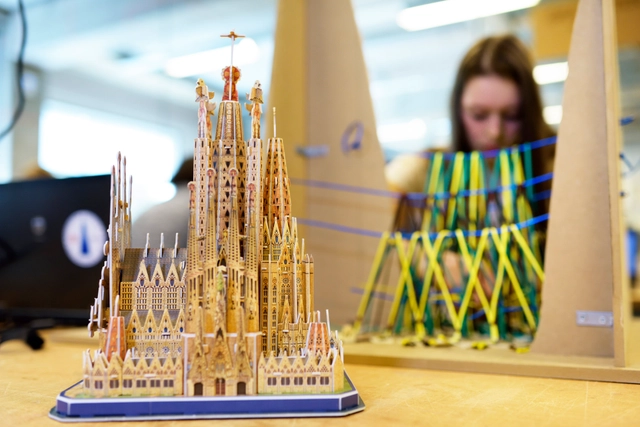
A team of students from Eindhoven University are set to build a forty metre high model of Antoni Gaudí’sSagrada Familia out of 'ice'. The project, which follows their completion of the world’s biggest ice dome last year, will be constructed from pykrete and reinforced with wood fibres. The fifty-strong team will head to Finland on the 28th December 2014 to begin construction of the impressive 1:5 scale model, which will be built in only four weeks in order to officially open in the last week of January 2015.
Read about their unique construction method and see photos of the preparatory work after the break.
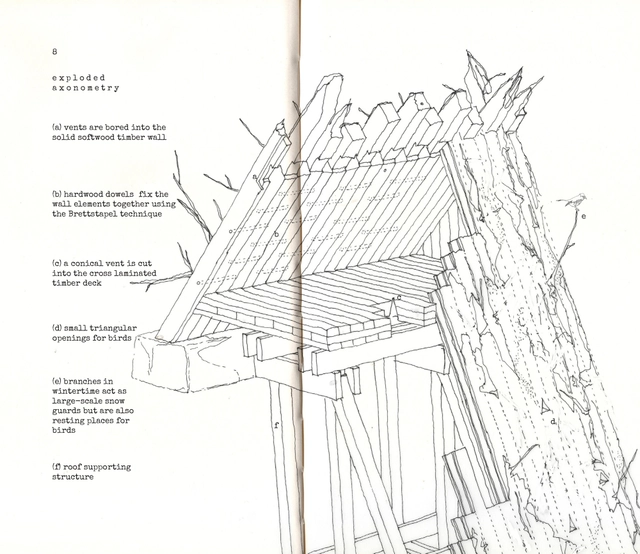
Retreat/Shelter/Nest by András Dankházi. Image Courtesy of Combo Competitions
Hello Nature, the most recent ideas-based challenge organised by Combo Competitions, asked participants to design a structure that celebrates nature on an expansive site in northern Sweden at the foot of Omneberget mountain. Located in an area known as the High Coast (Höga Kusten), the site sits within an UNESCO World Heritage Site. Designers were asked to "highlight the relationship between humanity and the rest of the planet" in putting forward proposals which "reconnect to nature." As a twist, entrants had to include both educational and recreational elements to their submissions. The entries, which range from a mountain of 'conservation drones' (with a control tower and charging station at its peak) to a collection of four extruded concrete plinths, all seek to explore our relationship with the wild when 50% of the world's population live in urban centres.
See the winning proposals and read the jury's comments after the break.
The Royal Institute of British Architects (RIBA) have announced that they will open a chapter in India in 2015 in order to offer "enhanced membership support, networking opportunities and a forum for local activities and CPD." It will also allow the RIBA to work "collaboratively with the Indian Institute for Architects (IIA) for the enhancement of the profession." The launch of this branch of the institute follows the opening of chapters in the USA, Hong Kong and the Gulf in recent years. According to Chloe Sadler, RIBA Head of International Chapters, the RIBA currently has "just under 100 members in India who are working tirelessly to uphold the principles of the [institute] and share the importance of good design." "This new Chapter will cement the RIBA’s commitment to support our members in India through knowledge exchange and the celebration of architecture."
The Royal Institute of British Architects (RIBA)’s Future Trends Survey for November showed that confidence in workload among UK architects fell back slightly with the workload index returning back to +29. This is compared to +37 in October, which was the second highest ever balance figure. The highest balance figures were in Northern Ireland (+50) and the North of England (+46), areas with the RIBA state "were initially the slowest to indicate a return to growth." In addition, the percentage of respondents reporting that they had personally been under-employed remained at 12% for the second month running – the lowest figure since the survey began in January 2009. Practices report that they are currently employing 6% more year-out and post Part II students than they were twelve months ago.
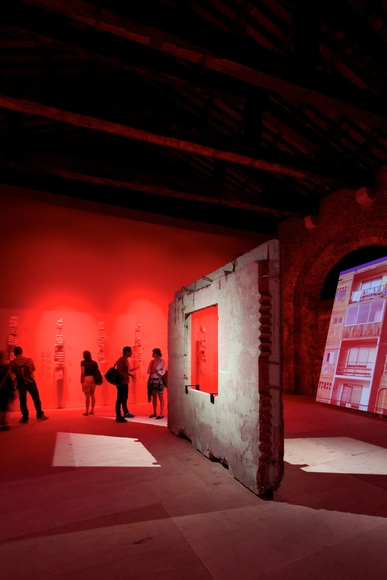
In 1970 the BBC followed architects Alison and Peter Smithson through the construction of their seminal housing project, Robin Hood Gardens (London). The impact of their architecture continues to resonate well into the 21st century, most recently in the British Pavilion at the 2014 Venice Biennale. Robin Hood Gardenswas demolished in 2013, bringing an end to the Smithson's utopian vision. Listen to Alison Smithson explain the European Housing Condition (as the vision stood in 1970), the state of British infrastructure as it was, and hear Peter Smithson discuss the impetus for their most famous collective housing project.
In an article for The Guardian, Oliver Wainwright steps "inside Beijing's apocalypse": the poisonous, polluted atmosphere that often clings to the Chinese capital. He explores ways in which those who live in this metropolis have started to redefine the spaces they frequent and the ways in which they live. Schools, he notes, are now building inflatable domes over play areas in order to "simulate a normal environment." The dangers were made clear when "this year’s Beijing marathon [...] saw many drop out when their face-mask filters turned a shade of grey after just a few kilometres." Now, in an attempt to improve the living conditions in the city, ecologists and environmental scientists are proposing new methods to filter the air en masse. Read about some of the methods here.
In an article for The Guardian, Maryam Omidi explores Moscow's Door19, a place where "Damien Hirst and David LaChapelle artworks adorn the raw concrete walls," "flair bartenders serve up gem-coloured cocktails," and "a rotation of Michelin-starred chefs flown in from around the world curate new menus each week." It is indicative, she argues, of what Kuba Snopek (a lecturer at the Strelka Institute) describes as "hipster Stalinism" - a surge of redevelopment in certain parts of Moscow that cater to the 'oligarchs', wealthy creatives and Muscovite 'hipsters'. At Door19, for example, apartments sell for between $15,000 and $20,000 per square metre.
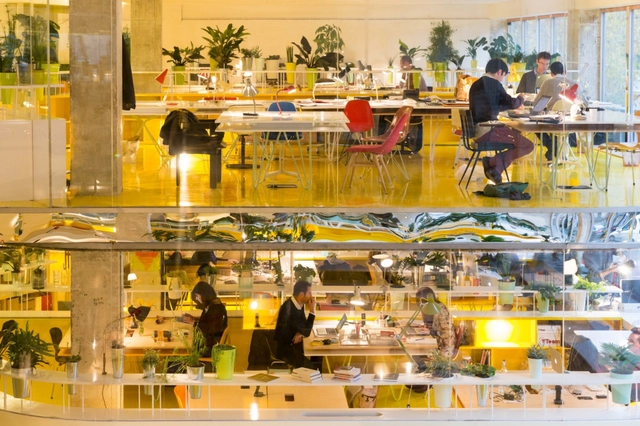
In an article for The Observer Rowan Moore examines 'Second Home', a newly opened "creative hub" in London designed by Spanish practice SelgasCano, who were recently announced as the designers of the 2015 Serpentine Pavilion. For Moore the project, which is the practice's first building in the UK, offers a "lightness and grace as well as invention, and an awareness of when to stop." The building is designed to be fluid, allowing start-up creative businesses to move in and move out as and when their business model dictates. Heavy tables can emerge from the floor, and 'roaming zones' facilitate creative thought. According to Moore's review, there "are no water-coolers, no kitchenettes, [and] no microwaves."
The Royal Institute of British Architects (RIBA) have today announced a call for entries to the 2015 RIBA Awards programme. The prestigious awards are designed to celebrate the best architecture projects that have been opened within the past two years. Projects of all sizes and budgets from across the UK (excluding those in Scotland) are eligible to be entered to the RIBA Regional Awards. Scottish projects can be entered into the RIAS Awards. Those that are successful in the regional rounds are made eligible to be considered for the RIBA Stirling Prize, one of the most coveted awards in the architectural world.
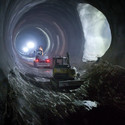
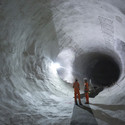
Crossrail, “the largest infrastructure project in Europe (costing more than the 2012 London Olympics) has been slowly winding it’s way beneath London's streets for years. Now, as the tunneling efforts begin to draw to a close, Crossrail have released a series of photographs demonstrating just how large and complex this latest London subterranean labyrinth really is. There are currently more than 10,000 people working directly on Crossrail at around forty separate construction sites, who have now completed 90% of the total tunneling. This brings the entire project to two thirds complete.
See the complete set of photographs after the break.
Stephen Hodder, the current President of the Royal Institute of British Architects (RIBA), has spoken out about a "U-turn" following the proposal of March 19th (passed under past President Angela Brady) condemning the Israeli Association of United Architects (IAUA) for its failure to "resist projects on illegally-occupied land" in the West Bank and Gaza. According to BDOnline, the RIBA has "been forced to abandon its policy [...] after an internal report said it should never have been put to a vote in the first place."
Winner of the RIBA Silver Medal: Nick Elias of the Bartlett School of Architecture. Image Courtesy of RIBA
The Royal Institute of British Architects (RIBA) have announced the President’s Medals Student Awards at a special event today in London. The awards, recognised as the world’s most prestigious set of awards in architectural education, were inaugurated in 1836 (making them the institutes oldest award, including the RIBA Gold Medal). Three medals in particular – the Bronze for a Part I student, the Silver for a Part II student, and the Dissertation Medal – are awarded to “promote excellence in the study of architecture [and] to reward talent and to encourage architectural debate worldwide.” In addition to these, the winners of the Serjeant Award for Excellence in Drawing and the SOM Foundation Fellowships are also announced.
Speaking to The Guardian, David Chipperfield has stated that he regards the hold of private investment over new architecture in London as an "absolutely terrible" means of building a city. He argues that Berlin - where he spends considerable amounts of time and runs a large office - "is a much more reflective society than ours" because the UK has sunk into "a success-based culture."
Eugène Viollet-le-Duc, the French architect most famous for the 'restoration' of Notre-Dame de Paris, is a person we unequivocally associate with 19th century Gothic Revival. Although there is no doubt that his interpretive restorations of medieval French monuments were some of his greatest achievements, a new exhibition at Paris' Cité de l'architecture et du patrimoine seeks to uncover a "well-connected character who pursued an uninterrupted career drawing, building, teaching, restoring, and many other things."
In a review for Domus, Léa-Catherine Szacka examines this first major retrospective dedicated to the designer, theorist and artist since 1980 in celebration of the bicentennial of his birth. According to Szacka curator Jean-Michel Leniaud has, in this exhibition, shifted focus to Viollet-le-Duc's artistic output, thereby presenting "the less known and the more unexpected aspect" of his career.
If buildings could talk, what would they say about us? Cathedrals of Culture, a six part collection of films recently premiered at this year's Berlin International Film Festival, "offers six startling responses to this question". The project, filmed entirely in 3D, allows "six iconic and very different buildings to speak for themselves, examining human life from the unblinking perspective of a manmade structure".
At a time when everyone is constantly interacting with the digital social universe, it's becoming increasingly easier to gather informal data on how well received, recommended, liked (or disliked) an event or exhibition is. Compiled as a series of diagrams for Domus, Maria Novozhilova examines the 'social ranking' of the 2014 Venice Biennale by dissecting the three core exhibitions (Fundamentals, Monditalia and Absorbing Modernity) and revealing the apparent 'winners and losers' as far as social engagement is concerned. Noting that "it is only by starting from the end and working backwards, like a salmon swimming against the current, that we can see more exhaustively how things went,", Novozhilova's visualisations reveal a number of fascinating results. See all the diagrams here.