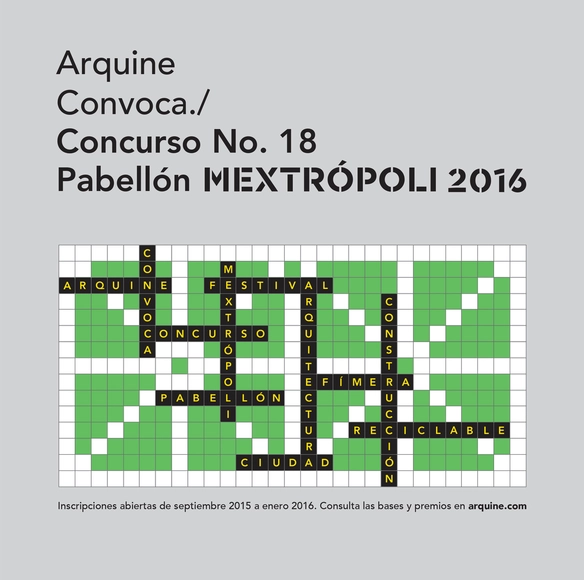
Held annually since 1998, Arquine’s International Architecture Competition seeks to explore issues of importance and relevance to society, creating a space for dialogue between both national and international architects.
For the 18th edition of its international competition, Arquine has launched an open competition to design a Pavilion for MEXTRÓPOLI, an annual International Architecture and Latin American City festival. The installation will be located in Mexico City’s historic center, and should be a public space where key themes relating to the city can be discussed. The pavilion should also have a flexible design, as it ultimately will be repurposed as an information center for a part of the city that needs it.
More information about the competition after the break.
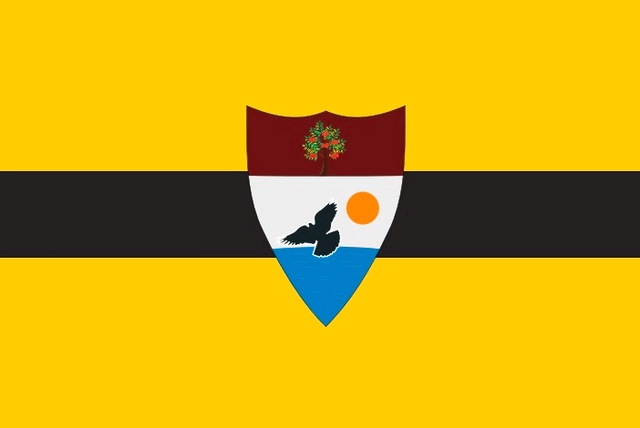
In April, the world's "third smallest sovereign state" was established: Liberland. Established on a small patch of unclaimed land created by the border dispute between Croatia and Serbia, the new country founded on the principles of libertarianism is currently battling for international recognition - although as reported by The New York Times Magazine in August, this remains a steep uphill struggle. In spite of these challenges, the European micronation is seeking ideas through a global design competition on how to masterplan its seven-square-kilometer territory. Zaha Hadid Architects' Patrik Schumacher is one of the many experts that have been summoned to judge the proposals, of which aim to establish a "multi-stage" plan that will reflect Liberland's Libertarian and Anarcho-Capitalist values.
"Rather than purely fantastical or artistic schemes, Liberland seeks radically creative, yet mature proposals for a fertile, high-density city-nation of the 21st century, responsive to its advanced contemporary network society," says the competition brief.
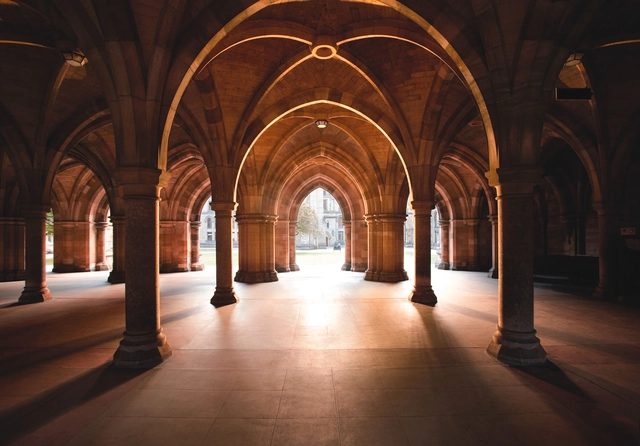
Cloisters at University of Glasgow (courtesy of People Make Glasgow)
At its 2017 Annual International Conference in Glasgow, Scotland, SAH will offer a total of 36 paper sessions. The Society invites its members, including graduate students and independent scholars, representatives of SAH chapters, and partner organizations, to chair a session at the conference. As SAH membership is required to chair or present research at the Annual International Conference, non-members who wish to chair a session will be required to join SAH at the time of submitting a session proposal.
International Architectural Design Competition for the New Nanoscience and Nanotechnology Center at Tel Aviv University (Israel)
Strelka KB, the leading Russian company in strategic consulting in the spheres of architecture, urban planning, cultural and spatial programming, is organising an international architectural competition for the best concept, design and realization of the new Nanoscience and Nanotechnology Center in Tel Aviv University campus.
Poster: 'Flower of Life' International Student Competition for Garden Design
Imagine future cities full of gardens with flower carpets, full of playing children, humming bees and fluttering butterflies. Gardens that help to create a healthy environment, cool cities, collect rainwater and are adapted to the local climate.
Architecture students and designers are called to define the home of the future under the theme ‘Living Tomorrow’. This is an idea-based challenge and seeks for conceptually sound proposals. The site can be of any size or form but limited to the Zimbabwean future context.
The Urban Development Institute of Australia NSW office wants to create more affordable, connected and livable cities and it wants your help. The CityLife Project competition presents the opportunity for three organisations or research teams to partner with the UDIA NSW on research projects in exchange for cash and promotional opportunities worth up to $145,000 AUD each. As part of the CityLife Project competition, we want one research partner to work with us on liveable cities, encouraging better health and well-being.
A consortium of innovative companies in the built environment – Aquicore, Building Robotics, Enlighted, and View – announced a call for entries for the inaugural 2015 BOLD Awards, recognizing Building Optimizers, Leaders and Disruptors who are pushing boundaries and facilitating the adoption of new technologies in the green building industry.
The Center for Architecture is currently accepting applications for the Stewardson Keefe LeBrun Travel Grant! Award: Single or multiple awards totaling $15,000.
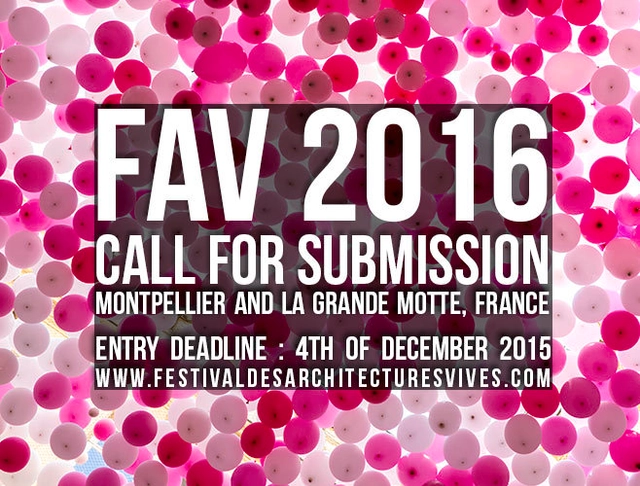
In 2015 the Festival was visited by not less than 15,000 visitors and was committed to raising awareness in schools and in 2015 it was 31 kindergarten and primary classes that took part in this new program. For its 11th edition the Festival des Architectures Vives will take place in Montpellier from June 15th to 19th 2016, the FAV La Grande Motte will take place from June the 18th to 26th 2016. Innovate is the key word for this edition. Still, the FAV will continue its work to raise the general public's awareness to architecture, to highlight the young architects generation and to make discover unexpected places of urban heritage.
The Institute for Advanced Architecture of Catalonia and the FabLab Barcelona are pleased to announce the 6th Advanced Architecture Contest, on the theme of PRODUCTIVE CITY.
FuturArc Prize seeks forward-thinking, innovative design ideas for Asia. The Competition offers a platform to professionals and students who are passionate about the environment. Through the force of their imagination it aspires to capture visions of a sustainable future.
The Association for the Promotion and Exhibition of the Arts in Lebanon (APEAL) is planning to open a museum of modern and contemporary art in Beirut by 2020.
After the record breaking success of Fairy Tales 2015, with over 1,200 participants from 65 different countries, Blank Space is excited to announce that the third edition of the competition is now open for registration.
The winning designs from the inaugural winter stations competition in Toronto
Winter Stations is once again calling on the international design community to submit their visions for Toronto's winter waterfront as registration opens for the 2016 competition. Submissions are due on November 12, 2015 with winners announced in early January 2016.
International manufacturer of wood wool panels, Troldtekt, has announced the opening of its Wood Wool Award 2015, celebrating the 80th anniversary of the company. Open to entries from September 14 to October 16, 2015, the competition will recognize two projects that best implement visible wood wool acoustic solutions: one that uses wood wool panels not manufactured by Troldtekt, and one project featuring Troldtekt cement-bonded wood wool panels.
The jury features Mikkel Frost (CEBRA), David Gianotten (OMA) and ArchDaily’s own, David Basulto. The two selected projects will receive an award of €5,000, and interested architects and designers can submit their projects via ArchDaily.