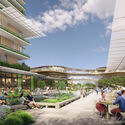
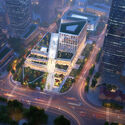
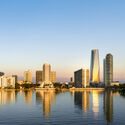
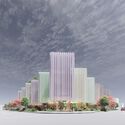
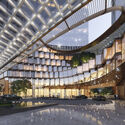
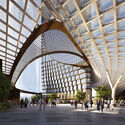
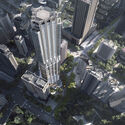
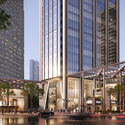
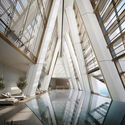
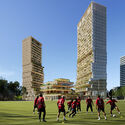
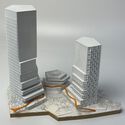
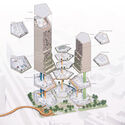
Pelli Clarke & Partners has just completed the Mori JP Tower, now standing as Japan’s tallest building. Situated in the recently revitalized Azabudai Hills district, the tower emerges at the center of this development. Establishing a new focal point for Tokyo’s skyline, the building soars 330 meters at the heart of this dynamic new mixed-use district in the city center.
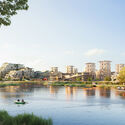
Foster + Partners has just unveiled the designs for the Xicen Science & Technology Center at the heart of the Yangtze River Delta Region in Shanghai,China. The project is strategically located along the Shanghai – Huzhou development axis, ensuring connectivity to the city center through high-speed rail links. Drawing inspiration from the timeless allure of the surrounding water towns, the center blends new and existing waterways to create a community featuring residential, commercial, and recreational spaces.
Oman has just announced plans for a $2.4 billion mixed-use project, the new Omani Mountain Destination on Jabal al Akhdar. Masterplanned by AtkinsRéalis, the scheme aims to attract sustainable development opportunities, hoping to "operate as Net Zero Carbon and striving to use 100% renewable energy." The project is in alignment with Oman Vision 2040, seeking a developed, diversified, and sustainable economy;, featuring residences, hotels, and a health village.
Domino Sugar Refinery / PAU - Practice for Architecture and Urbanism
In the same way that societies transform, times change, and cities evolve, industrial architecture modernizes and technifies, sometimes reaching a state of abandonment or ruin. Understanding its value as a built legacy and being vestiges of technological, social, and cultural changes, the renovation and/or conversion of numerous factories and industrial warehouses can lead to the revitalization, recovery, or growth of various areas in large cities, incorporating new uses and spaces for the enjoyment of their citizens.
Japanese design firm Nikken Sekkei has just completed a new building in Dubai’s central financial district, encompassing the “World’s Longest Cantilever,” which floats 100m above ground. Compromising two towers connected by an enclosed horizontal bridge, “One Za’abeel” acts as a new point of entry into the city. Designed to be a symbol of Dubai’s growth and expansion, the project offers easy access to the downtown region. The scheme features restaurants, retail spaces, workspaces, and urban hotel accommodations.
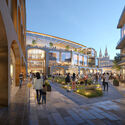
Goettsch Partners has recently won a design competition for an expansive urban renewal initiative in Jinan, China. Spanning three parcels, encompassing a total area of 111,500 sqm, the scheme is situated alongside the infamous Honglou Plaza. Positioned at the city’s center, Honglou Plaza holds historical significance as home to one of the region’s oldest cathedrals. The competition aimed to introduce concepts that would re-energize the regional core, through a design centered on pedestrian engagement.
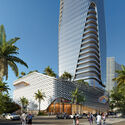
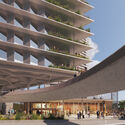
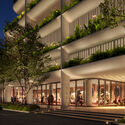
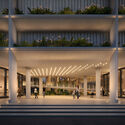
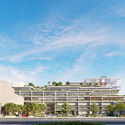
KPF’s “Tower 36,” has received unanimous approval in Miami, Florida. The building features an office space, set to become the tallest in the region at 193 meters. Emphasizing occupant well-being, the tower is designed by integrating the surrounding landscape and increasing access to outdoor areas.
The tower serves as the northern entryway to Miami’s high-rise zone, at the intersection of Biscayne Boulevard and 36th Street. Acting as a gateway to the neighborhood, the scheme connects Miami Beach with the mainland of Miami. To complement the office floors, the building’s podium boasts ground-floor retail, bicycle, car parking, and a restaurant on the landscaped roof.
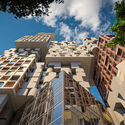
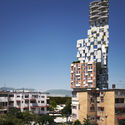
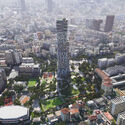
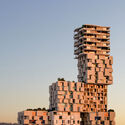
OODA has released images of Hora Vertikale, a new project planned for the Albanian capital city incorporating residential units arranged vertically surrounded by a new park and featuring a diverse range of amenities. The design stacks seven types of cubes, each measuring seven stories in height and defined by a distinct visual identity inspired by both urban and rural elements. The project, developed in collaboration with local architects Artech, has received planning permission, and construction is expected to begin in early spring.
Urban environments are constantly evolving, with cities becoming the hubs of cultural diversity and economic life. In fact, the globe is speeding towards a future in which 70% of people will live in cities by 2050. Architects are at the core of this revolutionary movement, rethinking the nature of a city due to this urban surge. In response to this immense focus on newer and more diverse cities, architects and designers are leaning towards multifunctional and mixed-use projects. Attracting diverse crowds of people, mixed-use architecture explores the maximum potential of what a structure can serve.
Highlighting architecture firms such as Atelier 333, MOR Architects, BXB studio Bogusław Barnaś, Beek Architects, Frey Architekten, and Kalbod Design Studio, among others, the forthcoming exploration unveils a collection of unbuilt architectural projects submitted to ArchDaily that champion multi-function in their design. From the innovative Plata.forma in Laqlouq to the maritime haven of The Ark and the Swiss House's harmonious alpine blend, these projects redefine urban living.
RSHP has just won the Jean Moulin competition held in La Défense, Paris, to design a low-carbon mixed-use development. The competition is a part of the Paris business district initiative to become the world's first post-carbon business neighborhood, launching “Empreintes,” aiming to revolutionize five urban sites at the district’s periphery. Through collaboration with neighboring city centers, the scheme hopes to create various sustainable mixed-use properties.
Kengo Kuma and Associates has just unveiled the designs of a new mixed-use project in Miami, Florida. Standing as the first mixed-use initiative by the architect in the United States, the scheme is set to become a popular attraction in the city. “MIRAI Design District” is comprised of retail spaces, office spaces, and commercial units.
Foster + Partners has unveiled the plans for a new multi-purpose design in the heart of Miami Beach. “The Aalton” is a six-story building encompassing ground-level retail, offices, and residential spaces. Positioned at the intersection of Aalton Road and Lincoln Road, the renowned pedestrian shopping street, the building embraces Florida’s architectural heritage.
Cities are the bedrock of civilization. For millennia, they have attracted people with the promise of superior standards of living — from better economic and educational opportunities to easier access to quality public infrastructure such as housing, healthcare, and public transport. Today, however, many cities around the world are finding it challenging to live up to this promise. With urban migration accelerating at a dizzying rate – the United Nations projects that over two-thirds of the world's population will live in cities or urban centers by 2050 – existing resources and services in cities are coming under increasing pressure, rendering them dysfunctional and leading to glaring inequities.
There is no singular way to define or assess liveability; every city has a unique set of characteristics, from its history, culture, geography, and demographics, to how it is governed and what urban issues plague it. Therefore, improving liveability requires concerted efforts from multiple stakeholders including people, governments, and experts, to identify critical problem areas and opportunities, and devise contextual solutions. The TV show Tale of Two Cities, where Indian architect and urbanist Dikshu C. Kukreja sits down with global leaders, brings out great insights into what some major cities in the world are doing to create more liveable environments for their inhabitants. Here we present five examples: from Bogotá, Kolkata, Hannover, Tirana, and Washington, D.C.
On a site that also hosts the Olympic Sports Centre, the 2023 Asian Games complex, UNStudio has unveiled the design of the new Hiwell Amber Centre, a complex of four high-rise towers planned to add a mix of offices, apartments, hotels, art spaces and retail to the city center of Hangzhou, China. Responding to the area’s rapid economic and cultural growth, the new development aims to provide a wide range of services to residents and visitors alike. To open up towards the city, the smooth glass curtain wall of the towers peels apart to reveal a tapestry-like facade that envelops the main plazas and civic spaces, creating an ‘urban living room.’
Foster + Partners has just revealed their first project in Qingdao, a major seaport and financial hub in the Shandong Province of China. 1 Nanjing Road is a mixed-use development in the city’s southern district. From office space to luxury apartments, the studio’s mixed-use design integrates into the existing urban fabric.
UNStudio has been selected as the winner of the international competition for the design of a mixed-use development in Düsseldorf, Germany, surpassing other internationally recognized participant offices, including 3XN, BIG, David Chipperfield Architect, and finalists Hadi Teherani Architects, HPP Architekten, and Ingenhoven. UNStudio’s proposal features two mixed-use towers measuring up to 120 meters, surrounded by a low-rise community pavilion. In addition to the office and residential spaces, the scheme also includes multifunctional uses and services such as sports, fitness, medical facilities, gastronomy spaces, a mobility hub, a daycare center, and opportunities for cultural events.
Skyscrapers are iconic symbols of modern urbanization and technological advancements all over North America. In fact, these structures are a sign of economic prosperity, urban density, and the capabilities of humanity’s ambition. In major cities across the continent, they shape the skyline and give identity to these metropolises. Cities like New York City, Toronto, and Florida utilize these cutting-edge designs to showcase power beyond their physical stature.
In general, skyscrapers are characterized by their remarkable height and pioneering engineering capabilities. They use advanced materials such as steel, glass, and concrete and serve as multifunctional spaces, ranging from housing to hotels and offices. Architects all around the world continually push the boundaries of architectural creativity, design, sustainability, and functionality while crafting these buildings. The structures allow architects to maximize land use in new ways, tackling densely populated urban areas.