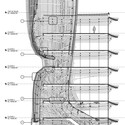
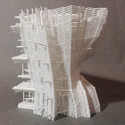
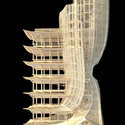
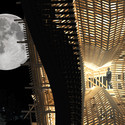
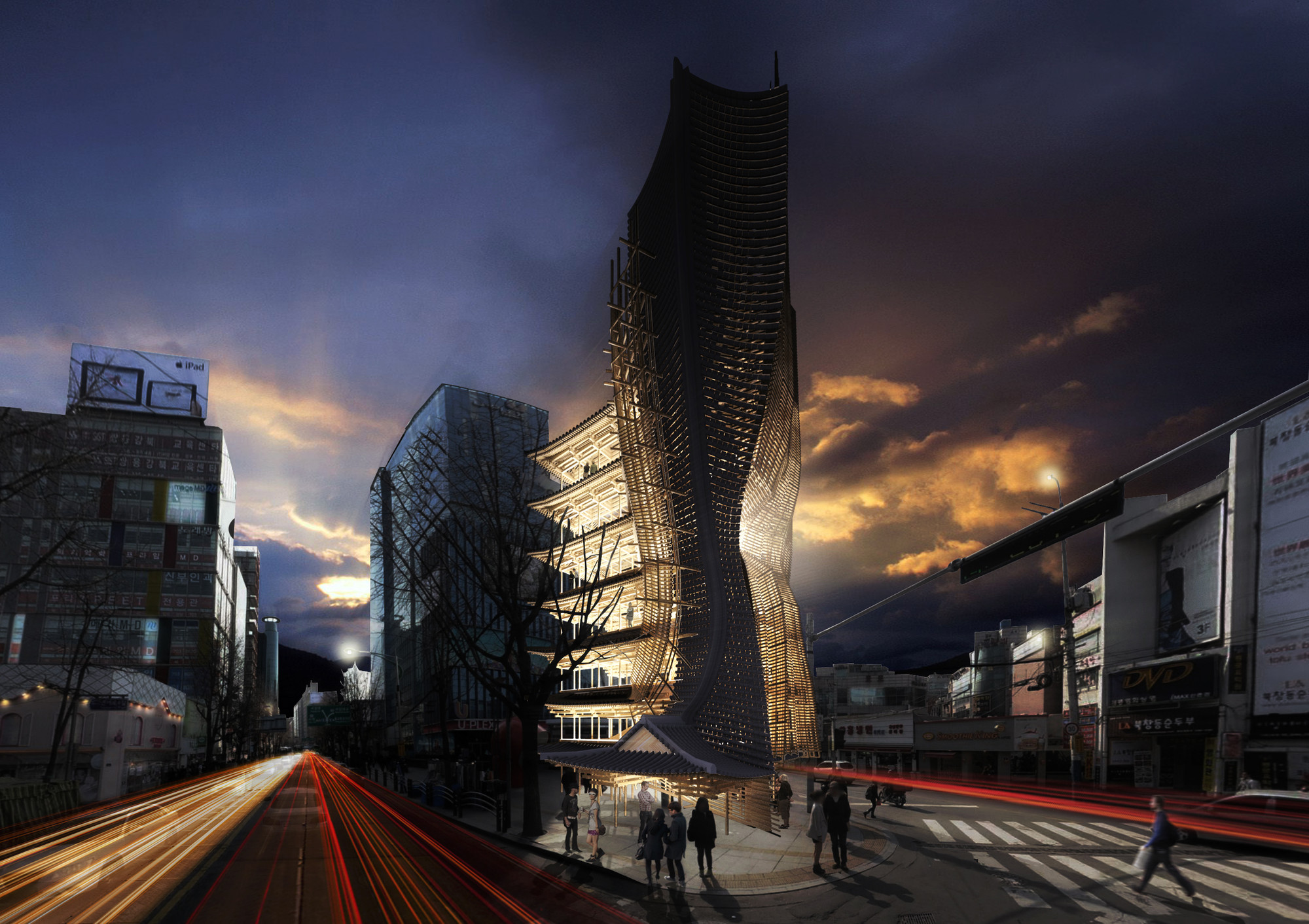
Vernacular Versatility, recently awarded first place in the 2014 eVolo Skyscraper Competition, seeks to adapt traditional Korean architecture into a contemporary mixed-use high-rise. The vernacular design of the Hanok, the "antonym of a western house" and epitome of the Korean style, has disappeared from every town. Extensive urban development in the 1970s led to a boom in modern apartment dwellings and, consequently, a loss of established Korean vernacular architecture. Yong Ju Lee's proposal aims to reimagine the Hanok in one of the country's busiest districts, drawing people's attention to and stimulating their interest in traditional architecture with the intention that "it will eventually be absorbed into people’s everyday lives"
The winning entry of the Northern Shore Lake Zwenkau competition, which challenged select firms to introduce "holiday villages" and recreational activities to a small lake twenty minutes outside of Leipzig, Germany, was proposed by Labor4plus. Dubbed "Yearning Spaces," the proposal envisions a Western harbor village that concentrates recreational activity along the northern coast of Lake Zenkau and connects to eastwardly located "hermit huts" via hiking trails paralleling the shore.
Placing fifth in the international competition to design the Austrian Pavilion for the 2015 Milan Expo, Paolo Venturella’s concept is designed as an extruded version of the Austrian mountain house that connects two major programs: an exhibition space and “big green-house.” To the north, the elevated exhibition space is shielded by a fabric sheathing which diminishes as it moves towards the greenhouse, south, where visitors are presented with a fresh vegetable garden, bar and restaurant that serves traditional cuisine.
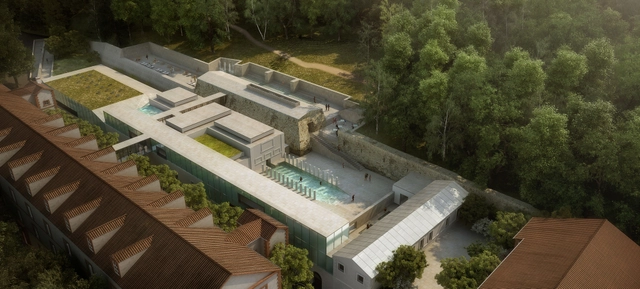
The Hague government officials have named KAAN Architecten’s design for the Facilicom Consortium PPS B30 as winner of the PPP contract for the Bezuidenhoutseweg 30 project. Originally built in 1917 for the Department of Agriculture, Nature Management and Fisheries, KAAN is expected to transform the existing National Heritage Site facilities into a vibrant and open “modern day think tank” for the Dutch government.
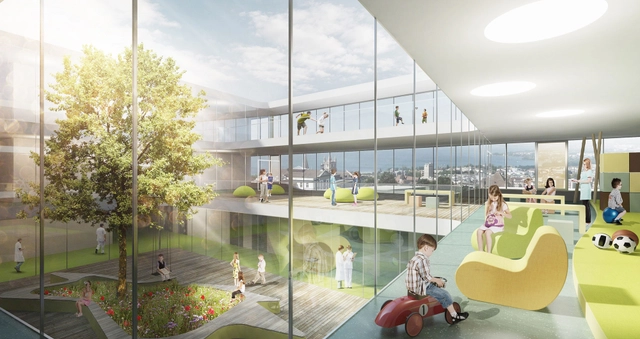
Architects von Gerkan, Marg and Partners (gmp), with partners JB Ferrari, have won first prize in an international competition to design a new children’s emergency unit at the Lausanne University Hospital in Switzerland. The 85-bed hospital will feature a terraced inner courtyard with conservatory, which will serve as a protected outside play area, that offers ample natural light and space for plant-life.
Courtesy of Silvio d’Ascia Architecture and Omar Kobité
Silvio d’Ascia Architecture, Omar Kobité Architecture and Eric Giudice Architects have been announced as winner of an international competition to design the new TGV high-speed railway station in Kénitra. The winning design aims to unite the northern and southern parts of the city by providing two entryways joined by one geometrical volume whose triangular framework recalls traditional shapes found in vernacular Moroccan architecture.
Danish architectsElkiær + Ebbeskov (E+E) andLeth & Gori have won an invited competition to design a large multifunctional sports building in Langvang, Denmark. Competing against teams led by Dorte Mandrup Arkitekter, CEBRA, COBE and Kontur, their winning proposal features a combined sports hall and community centre consisting of a series of multifunctional arenas for activities and events. The scheme also includes a masterplan of the surrounding area centeredaround sports and recreation.
Tsinghua University, alongside New York-based Studio Link-Arc, has been announced as winners of a competition to design the Chinese Pavilion at the 2015 Milan Expo. Expanding on the Expo’s overarching theme, “Feeding the Planet - Energy for Life,” the pavilion’s “Land of Hope” is centered on the idea that “hope can be realized when nature and the city exist in harmony.”
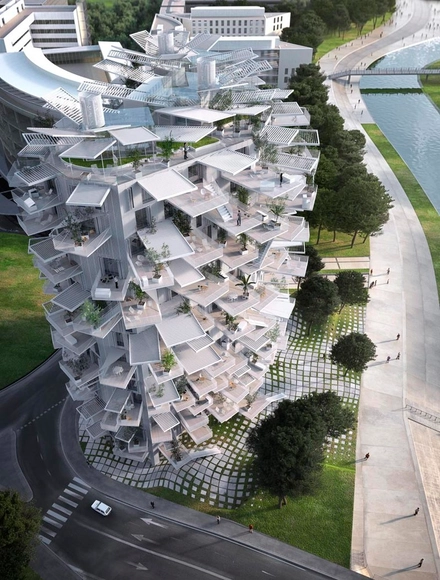
The City of Montpellier has chosen Sou Fujimoto Architects, Nicolas Laisné Associés and Manal Rachdi Oxo architects’ “White Tree (L’Arbre Blanc)” as winner of the "Architectural Folie of the 21st Century" competition. Inspired by the city’s tradition of outdoor living, and the efficient properties of a tree, the mixed-use residential tower will feed off locally available natural resources as it rises 17-stories and connects the new and old districts of Montpellier.
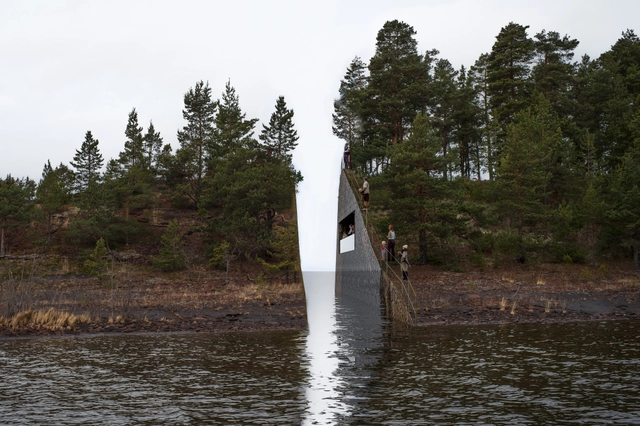
Envisioned as a three-and-a-half-meter wide “wound” within the landscape, Swedish artist Jonas Dahlberg’s powerful monument to those lost in the 2011 Utøya terror attacks has won Oslo’s July 22 Memorial competition.
“My concept for the Memorial Sørbråten proposes a wound or a cut within nature itself. It reproduces the physical experience of taking away, reflecting the abrupt and permanent loss of those who died,” described Dahlberg.
Berlin'sBarkow Leibinger has won an invited competition to design a new hotel tower and conference centre as part of Berlin's largest hotel complex, the Estrel. Establishing a new gateway to the center of Berlin from Schönefeld International Airport, the tower will stand at 175 meters (578 feet) making it the tallest high-rise in Berlin to date. Located on the Sonnenalle at the intersection of the Ship Canal, S-Bahn and Autobahn, the site acts as a threshold between the heterogeneous industrial and residential periphery of the city and the historical neighborhoods of Neukölln.
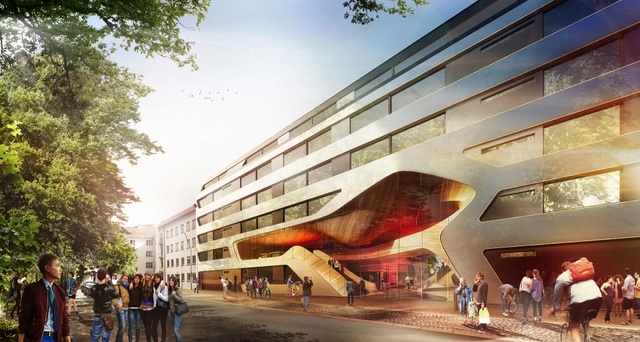
GRAFT Architects have won an invited competition to restore and extend one of Germany's oldest youth hostels in central Munich, Germany. Their proposal, which was judged alongside designs by haascookzemmrich (Stuttgart), Snøhetta (Oslo), and YES Architecture (Munich), centers around the idea of "experiencing community." Their proposal enables exchange and communication whilst also alluding to the "established traditions of simple traveling, youthful curiosity and the thirst for encounter." Connecting the historic quality of the building with the challenges of modern habits and traveling practices, their design "builds a bridge between origins and departure."
After a nine-month long competition, LAN Architecture has been commissioned to restructure and extend the historic Grand Palais in Paris. With the intent to “restore the building’s original coherence and sense of transparency,” LAN plans to revamp the 1900 World’s Fair building by resorting its unity and circulation, as well as the volume of its galleries around the Grand Nave and the addition of a new entrance court.
Review the plan in more detail, after the break...
ArchiPlanhas won first prize in an international competition for a contemporary art museum designed solely for the work of Korean painter Kim Tschang-Yeul. Planned for the volcanic Jeju Island, a province in South Korea, the single-story museum is designed to be the physical manifestation of Kim’s philosophy regarding the water drop.
“We spent a long time understanding [Kim] - understanding his life, intention and his philosophy,” described the architects. “It is necessary to transform his philosophy into a constructed architectural space.”
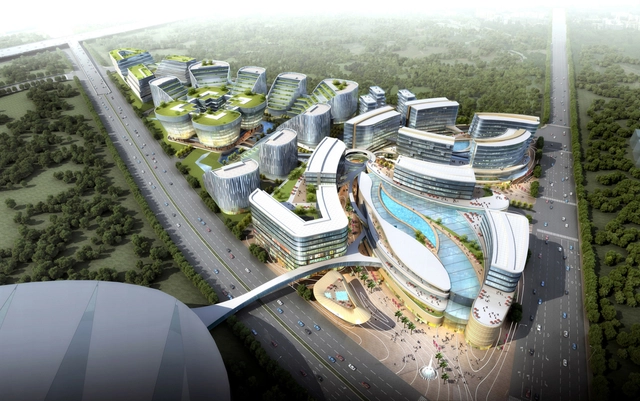
Urban Architecture (UA Studio 7) and Aedas' winning proposal for the Hongqiao Central Business District has broke ground at Shanghai’s domestic Hongqiao Airport, mainland China's fourth busiest airport. The 18.4 hectare office and retail center, masterplanned by UA, has been divided into two parts: UA Studio 7 will design the office district, “a flower with eight leaves,” while Aedas designs the shopping, hotel, and conference center along a "bow curve" of pedestrian flow.
According to UA, the winning scheme's success was "due to a highly energy-efficient architecture proposal combined with an urban plan that allows for pedestrian-friendly spaces."
Arctic Harvester was the first prize winning entry in the “Innovation and Architecture for the Sea” category of the Jacques Rougerie Foundation International Architecture Competition, 2013. It proposes an itinerant soil-less agricultural infrastructure designed to drift the circulating ocean currents between Greenland and Canada, exploiting the nutrient-rich fresh water released by melting icebergs as the basis for a large-scale hydroponic-farming system. The floating facility is equipped to house a community of 800 people, inspired in its compact urban form by vertically oriented, bayside Greenlandic villages and their social, cultural and economic relationship to the sea.
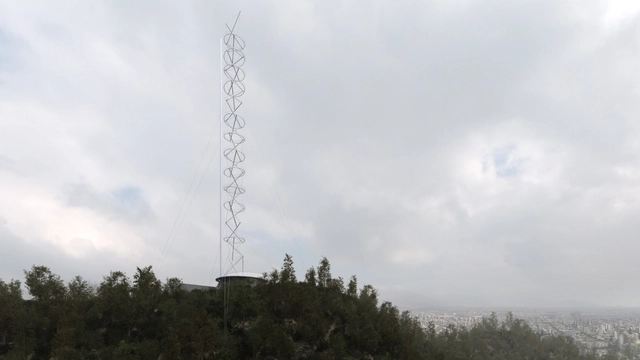
The 'Santiago Antenna Tower,' a unique telecommunications tower with panoramic views, should be completed in 2017, in time for the centenary of the Metropolitan Park of Santiago.
Further detail and the architect's description of the project, after the break.