The students of the MA Architecture + Urbanism invite contributors to participate in their forthcoming symposium FRONTIERS OF RESPONSIVE ARCHITECTURE to be held in summer 2016. If you feel that your Research / Practice responds to the mission statement outlined in previous posts in English / Italian / French / Chinese / Turkish / Arabic we would love to hear about it from you.
What does the word ‘basic’ mean? Fundamental, critical, essential, necessary - all these synonyms illustrate the significance of its meaning. Architecturally, we often associate the term with the primitive, the vernacular, even the banal. However, we sometimes forget to take into consideration the relative and temporal nature of the term. What was considered ‘basic’ in the 1900s was a radically different paradigm from what we consider as ‘basic’ today.
Socrates Sculpture Park and The Architectural League invite designers and architects to help shape the physical setting in which the park fulfills its mission as an environment for art, creative expression, social programming, and education. Socrates, located in Long Island City, Queens, is distinctive for its combination of waterfront setting, accessibility, and community-driven programs.
In previous years the Folly program investigated the intersection between sculpture and architecture with temporary structures that intentionally served no utilitarian purpose. This year, marking the program’s 5th and the park’s 30th anniversaries, the competition instead asks entrants to fuse form with utility, creating designs that explore the intersection of art and architecture while durably addressing and improving the conditions of the park.
Update: The deadline has been extended to January 4, 2016.
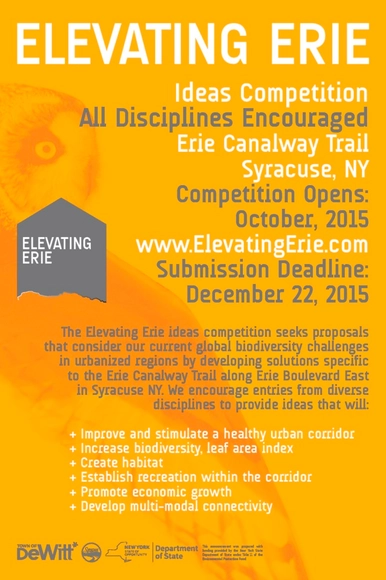
The creation of the Erie Canal was a paradigm shift for American progress in the 19th century, leveraging hundreds of miles of canal networks capable of generating cities out of swamps and ushering in a new era of exchange. Over a century later, what was the Erie Canal through Central New York has been capped over with urban development and sprawl. We are now presented with the opportunity to reposition Erie as the vehicle for a globally relevant, ecologically turbocharged urban corridor. The Elevating Erie ideas competition seeks proposals that consider our current global biodiversity challenges in urbanized regions by developing solutions specific to the Erie Canalway Trail along Erie Boulevard East connecting DeWitt to Syracuse.
Design Challenge: This design competition is an exploration into the relationship between a physical architectural design, the virtual world, and a tangible site. Investigate the influence of the virtual world blending with physical architecture. A virtual world, built on the framework of the internet, computers, and mobile technology, exchanges information globally. This creates new ways of interacting with the built world. As the virtual and physical worlds become increasingly interconnected, how does this relationship influence physical architecture and its context?
Presented by StorefrontMB and The Forks, Cool Gardens is an exhibit of contemporary garden and art installations that offers a shift of sensation for the summer—cooling—as a general theme for public projects in Winnipeg and Brandon. The 2016 Competition seeks creative proposals from designers, architects, landscape architects, and / or artists who are interested in challenging and celebrating the interface between urbanism, landscape, and design. Engage the urban design culture of Winnipeg or Brandon! Register today!
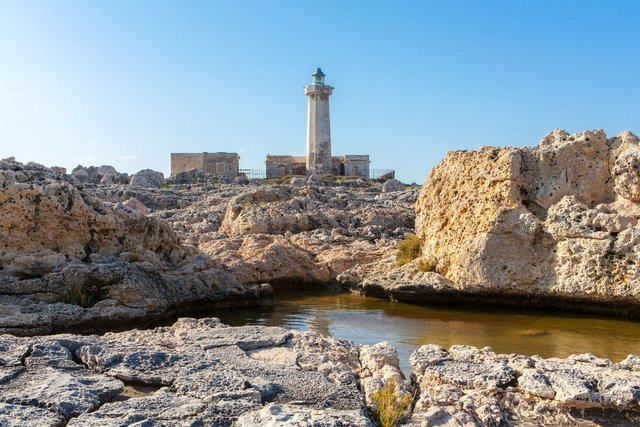
Young Architects Competitions (YAC) has launched their latest competition, asking international designers to imagine a new future for an abandoned Italian lighthouse by transforming it into a tourism facility. There is 15.000€ cash prizes for the winning proposals, and awarded proposals will be published on architectural magazines /websites / will be internationally exhibited.
https://www.archdaily.com/777661/open-call-transform-abandoned-lighthouses-into-tourist-accommodationsSponsored Post
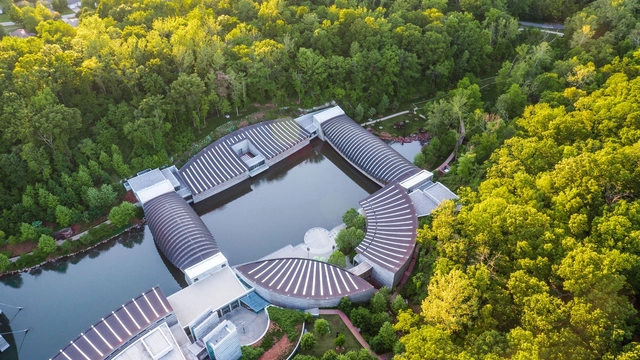
Aerial view of Crystal Bridges; photography by Adair Creative. Courtesy of Crystal Bridges Museum of American Art, Bentonville, Arkansas.
Crystal Bridges Museum of American Art invites applications for the 2016-2017 Tyson Scholars of American Art Program. The residential program supports full-time scholarship in the history of American art, visual and material culture from the colonial period to the present. To support their research, Tyson Scholars have access to the art and library collections of Crystal Bridges as well as the library at the University of Arkansas in nearby Fayetteville. Housing is provided at the Crystal Bridges Farmhouse, within easy walking distance from the Museum via wooded trails and approximately 1.5 miles from downtown Bentonville. It features comfortable indoor and outdoor common spaces including an expansive yard, patio and swimming pool; scholars have private bed and bath rooms.
CANactions School, the first school for urban studies in Ukraine, has launched an international call for applicants for STUDIO #2: “Tackling the Future of Ukrainian (Post)industrial Cities." The seminar will take place from February to May 2016.
The Superscape 2016 title Future Urban Living – Functional Reduction with Maximum Space Gain opens a field for visionary design suggestions and space concepts which focus on building the urban residential space of the future. Innovative solutions are sought, combining high-quality residences with great space efficiency and the greatest functional flexibility possible. In this context, the changing needs and requirements of urban dwellers for their residences during the next 50 years shall be taken into consideration. The goal is to formulate forward-thinking concepts, to question familiar residential patterns and to risk experiments in design, but also to consider their feasibility, and to check the possibility of realising them within existing building substance and existing urban structures. Furthermore, the subject is highly relevant with regard to increasing mobility and urban traffic flow within the context of urban planning.
Contemporary education is changing rapidly and is evolving in response to the changing demands of society and technology development. The classical model where a professor stands at a lecturing desk and students sit in the auditorium has lost its relevance. New educational technologies are calling for a new approach to classroom setup and modern architecture has to come up with an adequate response.
Confindustria Ceramica (the Italian Association of Ceramics) and the Italian Trade Commission are proud to announce the 2016 Ceramics of Italy Tile Competition Call for Entries. Now in its 23rd year, the contest is open to North American architects and designers who use Italian ceramic tiles in their institutional, residential and commercial/hospitality spaces. From corporate headquarters with ventilated porcelain facades and hospitals utilizing antibacterial ceramic floors to summer homes using decorative ceramics, Ceramics of Italy is looking for all types of inspiring projects featuring Italian ceramics.
In 2016 PUBLIC ideas go into action with FORM’s PUBLIC Platform taking creativity for the common good out into the streets and laneways. PUBLIC Platform invites you – the diverse creative minds from all parts of our community – to create installations and activation prototypes to enliven Claremont town centre during PUBLIC’s annual takeover on 2 & 3 April. Prototypes for citizens and by citizens will reimagine our public spaces and activities, and engage the public to participate, explore and play in their own city. Your big idea could bring our streets to life. Entries are due by January 25, so sign up now by emailing platform@form.net.au for more information or to attend a briefing.
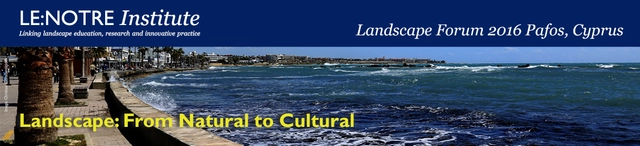
2016 LE:NOTRE Landscape Forum in Paphos (photo Christos Constantinides)
Individuals or groups of people are invited to submit a poster to be presented at the 2016 LE:NOTRE Landscape Forum in Paphos, Cyprus 16th - 20th of March 2016, hosted by Neapolis University. The call is addressed to Forum participants. The project presented on your poster may relate to Practice, Research or Education. Contributions from a variety of disciplines are welcome as well as student projects.
International Sustainable Waterfront Design Competition (ISWDC 2016)
We are pleased to announce InternationalSustainableWaterfront Design Competition (ISWDC 2016). The competition is a partnership and cooperation between universities and design firms. The program is intended to engage students or experienced designers, working individually or in teams to paying more attentions on our waterfront environment with sustainable methods, using renewable resources, offering appropriate technology and construction, improving healthy life styles and working environments. This competition aims to promote the design ability of international students of architecture, landscape or urban planning, and stimulate their enthusiasm and competition sense. We would also like to encourage and train outstanding architects with innovative ideas. By focusing on “Sustainable Waterfront”, this competition is open to architects, engineers, planners and designers who want to contribute to progress in making the world more habitable by developing a proposal capable of responding to emerging challenges. Winning participants or students will receive cash prizes totaling $32,500 plus a certificate. We welcome everyone who is interested in this competition to attend it.
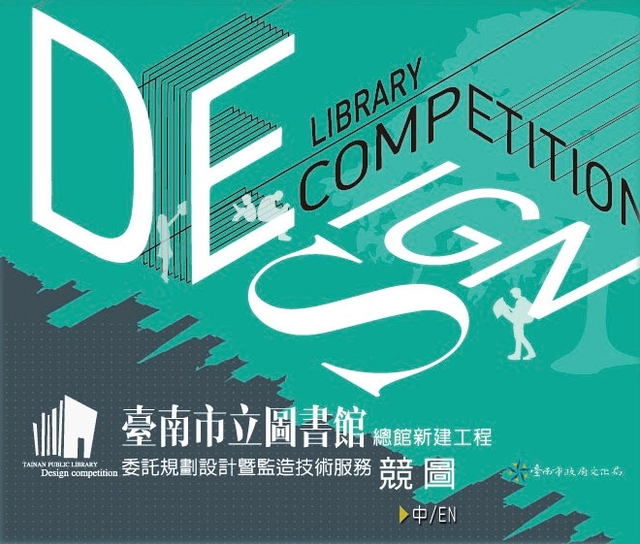
The Tainan City Government in Taiwan has launched an international design competition for its Tainan Public Library Project, a key factor in the cultural development of Tainan.
ZGF is a nationally recognized architecture, planning, and interior design firm with a long commitment to the critical collaboration of architectural education and professional practice. In place since 2004, this scholarship is intended to recognize and foster students who have demonstrated a talent and passion for architecture.
What does it mean to build? Traditionally, building has been defined as the assembly of parts or materials toward the creation of a whole. While to build is often perceived as an Apollonian pursuit, to destroy appears to be its Dionysian counterpart. Understanding that our built environment is the product of many forces, it can dialectically be reduced to the tensions between creation and destruction, addition and subtraction, and erection and demolition.