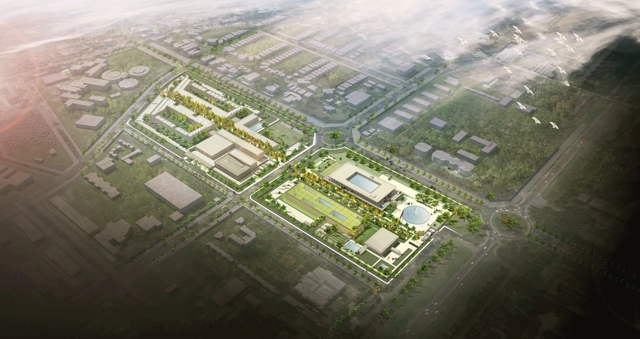
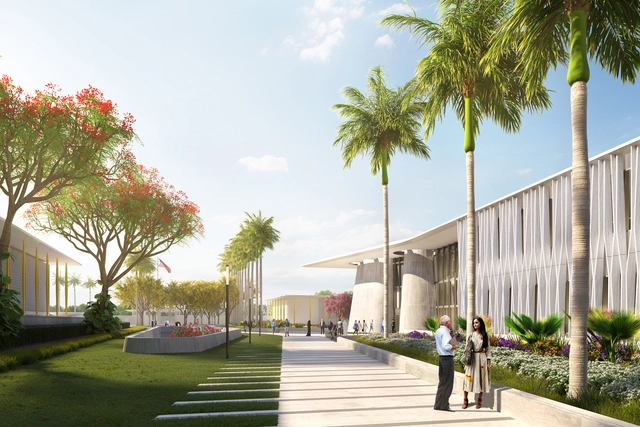
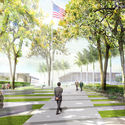
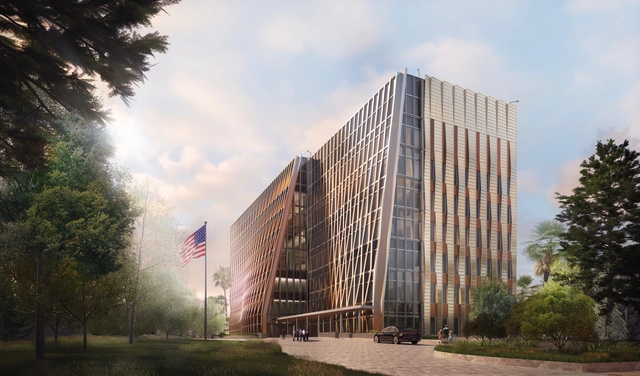
Multidisciplinary design practice Weiss/Manfredi has broken ground on the reimagined U.S. Embassy campus in New Delhi, India. Designed for the U.S. Department of State with the Bureau of Overseas Buildings Operations, the project aims to support the U.S.-India Comprehensive Global Strategic Partnership with a new chancery building for the embassy. The project includes restoring Edward Durell Stone’s early modernist Chancery Building and remaking the 28-acre compound into a resilient campus.
The architecture of diplomacy balances security and openness. As symbols of protection and representation, embassies are built for utility in both urban and rural contexts alike. At their core, they are also made to communicate the values and ideals of nations as welcoming structures and sustainable civic spaces. Today, modern embassy projects are made to meet rigorous security standards while embracing local culture and conditions.
Weiss/Manfredi has unveiled their design for the re-envisioned U.S. Embassy campus in New Delhi, India. The first phase of a long-term masterplan, the scheme features a New Office Building, a support annex, and connected landscape offering a secure campus for America’s mission in India. Included in the design is the restoration of the early modernist Chancery Building by Edward Durell Stone.
As the Durell Stone-designed embassy reaches its sixtieth anniversary, the scheme offers a sustainable vision for the Embassy’s future that builds on the legacy of the historic campus to create a new foundation for American diplomacy in India.
https://www.archdaily.com/912252/weiss-manfredi-designs-us-embassy-in-new-delhi-indiaNiall Patrick Walsh
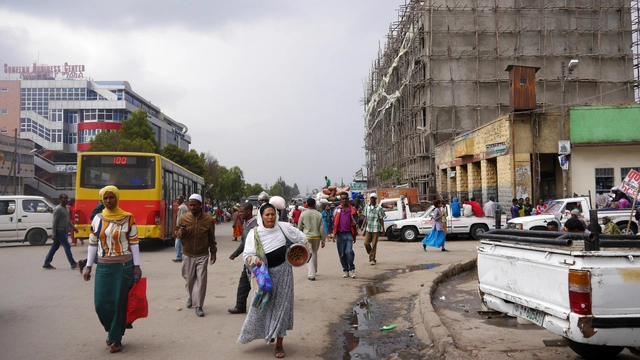
ADDIS ABABA, ETHIOPIA, November 2013: Street scene in Addis Ababa. rvdw images / Shutterstock.com
If you're a student looking for an opportunity to make your mark and display your vision and direction for your career, this recently launched competition is definitely worth looking into. The Czech Republic's Ministry of Foreign Affairs has offered an exceptional invitation to create a proposal for a new embassy in the capital of Ethiopia, Addis Ababa. The embassy is going to be built according to the student's proposal. As the organization committee sees this as one of the largest opportunities to support talented students in the creation of such a prestigious project, the competition has been opened up to students from all universities around the world.
Tegucigalpa New Embassy Compound. Image Courtesy of SHoP Architects
SHoP Architects have revealed new renderings of their design for a New Embassy Compound (NEC) in Tegucigalpa, Honduras. In 2013, SHoP was among the firms selected by the U.S. Department of State’s Office of Overseas Building Operations (OBO) to realize facilities that will meet its operational needs while embodying and communicating the spirit and highest values of the United States.
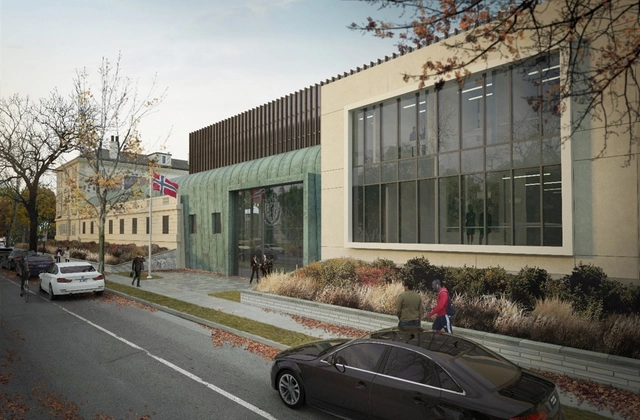
Fentress Architects has revealed their design for the expansion of the Norwegian Chancery in Washington D.C. A prominent new addition to the embassy’s Washington D.C. campus. The scheme expands the architectural language of the existing embassy buildings, embracing contemporary design techniques within the context of traditional bureaucratic architecture.
Fentress’ design integrates materials of Norwegian cultural significance as prominent features of the façade. The use of Norwegian spruce timber, Oppdal stone, and patinated copper pay homage to the country’s traditions in shipbuilding and woodworking, as well as their abundance of natural resources.
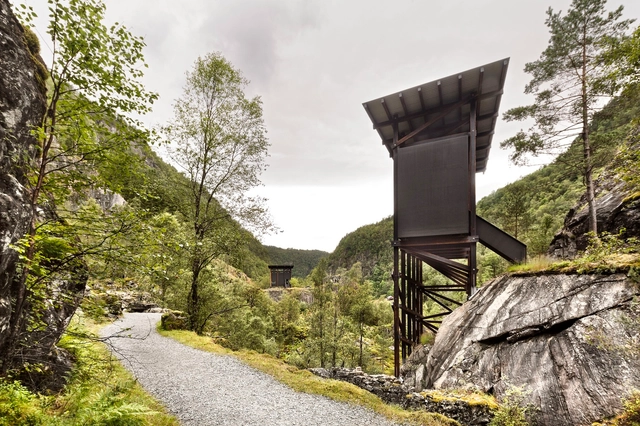
Architecture and Landscape in Norway, a photography exhibition by Ken Schluchtmann, will open this fall in the Felleshus of the Nordic Embassies in Berlin. Featuring architecture, landscapes and roads in northern light, the exhibition situates Ken Schluchtmann in a long tradition of landscape representation in Norway. Opening on October 5, 2018, the show is part of the "European Month of Photography." The exhibition will displays images taken along the National Tourist Routes in Norway.
The U.S. Department of State’s Bureau of Overseas Building Operations (OBO) has selected the 16 architecture/engineering firms that will provide comprehensive design services for new construction and modernization projects at U.S. diplomatic facilities across the globe.
Chosen from a shortlist of 26 architectural practices (itself chosen from 136 total submissions), the chosen firms were selected by OBO as “the most highly qualified technical teams [who have] demonstrated exemplary past performance, strong management and project delivery experience, a well-defined approach to public architecture, and a commitment to sustainability and integrated design.”
The U.S. State Department is moving forward with plans for a new Embassy in Beirut, Lebanon. After awarding the commission to California architects Morphosis in 2013, the government has now granted the construction contract to to B.L. Harbert of Birmingham, Alabama, willing allow the project to get underway.
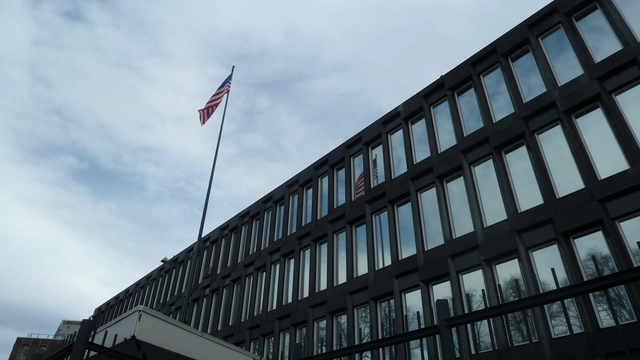
The Eero Saarinen-designed US Embassy in Oslo is set to be placed under historic preservation orders following the building’s sale by the US government.
The US embassy to Norway since 1959, the building will change hands once staff are moved into the new US embassy building at Huseby, which is expected to complete in early 2017.
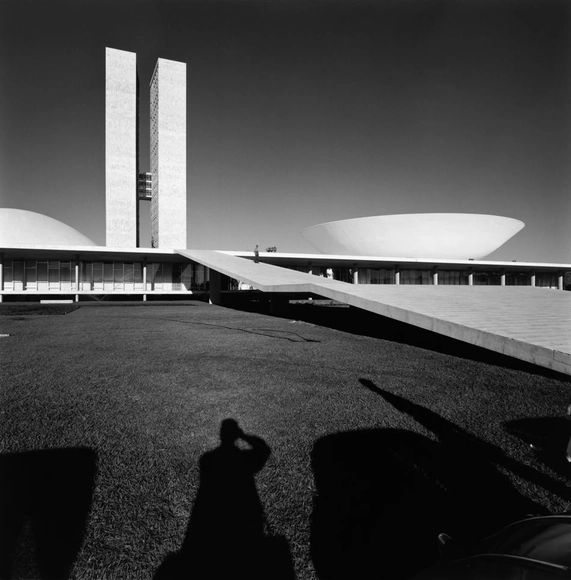
Studio Gang Architects has been chosen by the Department of State to design the new US Embassy compound in BrasíliaBrazil's federal capital. Selected from a shortlist of six, the Jeanne Gang-led practice won the commission with their "strong and cohesive team approach with more than 20 years of collaborative experience executing projects with complex constraints at challenging sites," says the report.
The United States Department of State has commissioned WEISS/MANFREDI to re-envision the Edward Durell Stone-designed embassy compound in New Delhi, India. Fifty years after its opening, the masterplan hopes to "restore the early modernist Chancery Building and recast the Embassy Compound as a multi-functional 28-acre campus setting." The masterplan's first phase will see the addition of a new office annex and restore the complex's landscape.
The United States Department of State (DOS) has released a request for information (RFI) in search of architects interested in designing a New Embassy Compound (NEC) in Brasília, the federal capital of Brazil. The (up to) $350 million, design-bid-build project will be located on a 4.86 hectares (12 acres) site near the seat of the Brazilian Government within the city's planned "Diplomatic Sector." All proposals must take in considering the site's conditions, the city planning context and the architectural significance of Brasilia as a 1956 urban planned city and now UNESCO World Heritage Site. More details after the break.
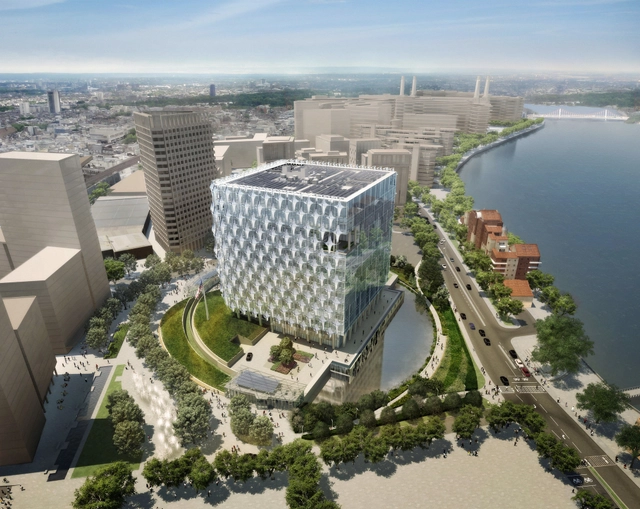
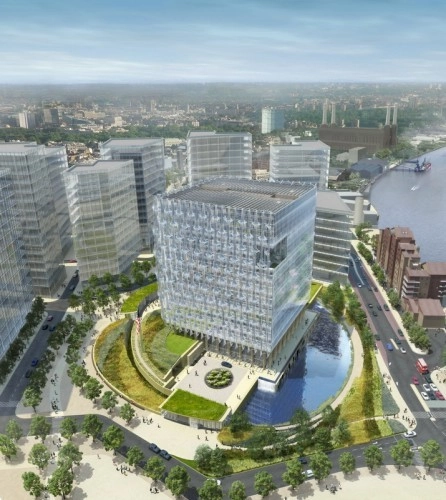
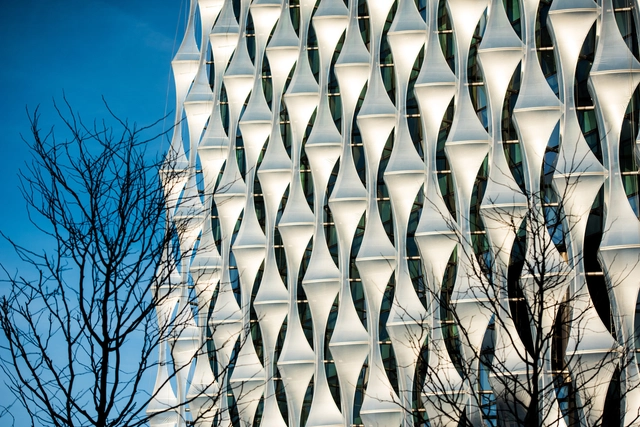
The new US Embassy in London – designed by Philadelphia’s KieranTimberlake. Image via US Department of State.
“Embassies and consulates serve as the front door for US diplomacy. The safety and security they provide to our personnel are the first priority, but they must also reflect our national values of openness and ingenuity. Embassies and consulates must exemplify the best of American architecture, environmental stewardship, and innovation.” - Secretary of State John Kerry on the US Department of State’s Design Excellence program, November 2013
As the meeting point for diplomacy, embassies serve as the face of America abroad. Embassy location and architectural design have the potential to promote inclusion and openness, but when tucked behind tall fences and bunker-style architecture they can convey exclusion and hostility.
While protecting diplomatic personnel is critical, conveying core American values such as transparency, openness and equality is also key. But how do you balance security and openness? Does a focus on design put safety at risk?
These questions are currently at the center of debate, as the State Department’s embassy Design Excellence program is facing criticism for being too costly and jeopardizing security.
The Department of State’s Overseas Buildings Operations (OBO) has shortlisted six design teams for the new U.S. Embassy in Beirut, Lebanon. The project is part of OBO’s Excellence in Diplomatic Facilities initiative in which seeks to provide safe and functional facilities that represent the best in American architecture.
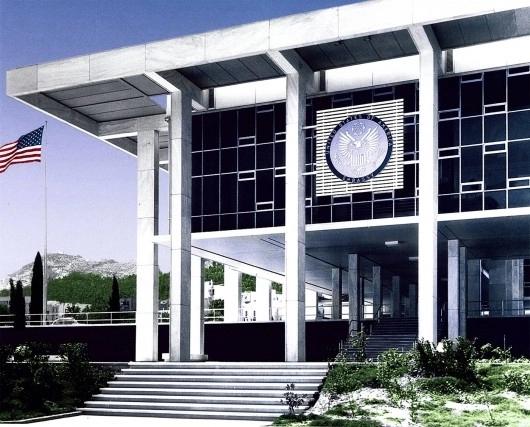
Embassy of the United States in Athens, Greece; Courtesy of the U.S. Department of State Bureau of Overseas Buildings Operations
The Department of State’s Bureau of Overseas Buildings Operations (OBO) has shortlisted four design firms for the major rehabilitation of the Athens Chancery project. Protected as an architectural landmark, the mid-century modern building was originally designed by the famed Bauhaus architect Walter Gropius with the consulting architect Pericles A. Sakellarios.
The Department of State’s Bureau of Overseas Buildings Operations (OBO) has selected five design teams in a worldwide Architecture/Engineering Design Services solicitation to rehabilitate/renovate facilities that "represent American values and the best in American architecture, engineering, technology, sustainability, maintainability, art, culture, and construction execution."
US Embassy in London / KieranTimberlake Architects
"The works of our artists, architects, and preservationists provide us with another language of diplomacy. A transcendent language that allows us to convey values that are at once uniquely American yet speak to all of humanity. Increasingly in this world, art and architecture help us maintain our sense of openness and liberation." -- Former Secretary of State Hillary Rodham Clinton, April 12, 2010
An embassy is much more than a building or a work of architecture; it functions as a symbolic representation of countries' relationships to one another. It represents the universal language of diplomacy - "communicating values and ideals, extending well beyond any moment in time". An embassy has the difficult task of representing two diametrically opposed concepts: security and openness. The former typically overpowers the latter in importance, which is most probably why when we think of foreign embassies, it conjures up images of stately monolithic buildings surrounded by tall fences and menacing guards or "bunkers, bland cubes, lifeless compounds", according to Tanya Ballard Brown of NPR's All Things Considered.





.jpg?1551218987&format=webp&width=640&height=580)





.jpg?1485285860&format=webp&width=640&height=580)
.jpg?1457466632&format=webp&width=640&height=580)