In this post originally published on Metropolis, former ArchDaily Managing Editor Vanessa Quirk explores a client's expectations, and how Nicholas Grimshaw treated them--in both built and book form.
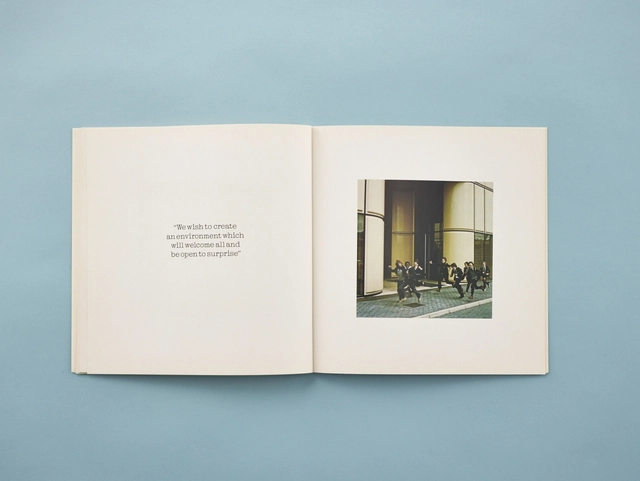
It is not often a client states that their aim is “to build the indeterminate building.” But so Max De Pree, the son of Herman Miller founder D.J. De Pree, expressed his hope for his company’s new manufacturing facility in 1975. Following the ideas of designers such as Charles and Ray Eames and Alexander Girard, De Pree compiled a long list of philosophical guidelines for the project, which he summed up under the laconic heading, “A Statement of Expectations.”
The young architect Nicholas Grimshaw, who had been hand-picked by De Pree for the project, was immensely inspired by the Statement, particularly its emphasis on the longevity and flexibility of the facility, its integration into context (the city of Bath, England), and the necessity for the building to empower its workers. In Grimshaw’s response to the brief, he noted: “Many of the views expressed about the well-being of the users, flexibility, and non-monumentality agree very closely with the approach we have built up since the founding of our practice ten years ago. We feel particularly that any new building should not impose itself on the occupiers, but that it should be a tool in their hands.”
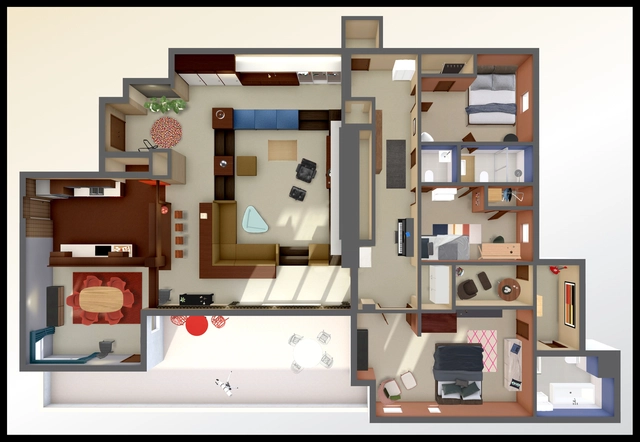
In the 5th season of Mad Men, it’s June 1966, and Draper moves into his love nest with his young wife, Megan. The set was designed by Claudette Didul and the Mad Men team, and it’s a psychogram of a man who is about to fall apart at the seams.
Everything about the space is designed to be perfectly of its time. It has a white carpeted conversation pit for a living room, and a modernist kitchen with clashing colours. The masculine elements include a leather armchair, and a drum-shaped ice bucket. The design is inspired by the 1965 book “Decoration USA,” by Jose Wilson and Arthur Leaman, and the bestselling books of Betty Pepis. This is pop design, no high modernist masterpiece, it’s about pretending you are happy, rather than about civilization. A small indicator of depravity: the living room is over twice the size of the dining room. Who cares about table manners when your wife is half your age?
https://www.archdaily.com/784720/a-virtual-look-into-don-drapers-mad-men-apartmentMadlaina Kalunder and Monika Kedrova, Archilogic
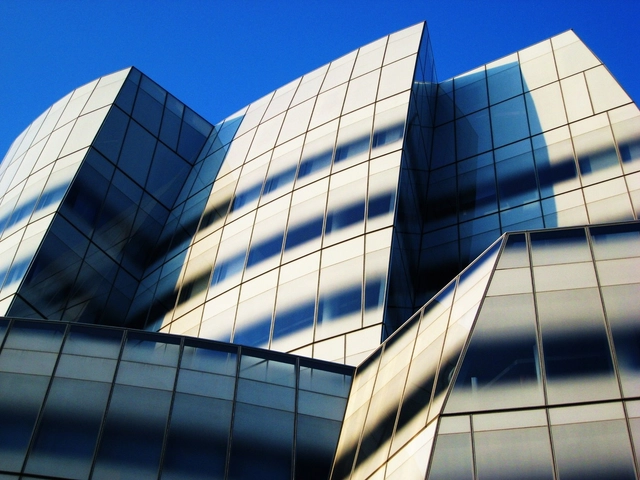
Discovered by archaeologists in civilizations as old as ancient Egypt and Mesopotamia, fritted glass is hardly a new technology. Yet thanks to its energy-saving abilities and the smooth, gradient aesthetic it produces, fritted glass has seen a rebirth in contemporary architecture.
Frit itself is a ceramic component that can be laid out into an assortment of patterns, most typically consisting of dots or lines. These patterns can then be silk-screened onto annealed glass using frit paint. Then, the glass is fired in a tempering furnace, which strengthens and improves the safety of the glass under thermal stress. The resulting product is glass of determined transparency that, when used in building facades, can reduce solar heat gain and even make buildings more visible and less deadly for birds.
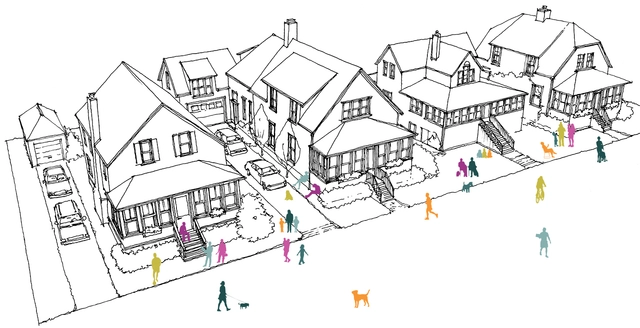
For a project in Maine, the author lived in the neighborhood and held charettes, presentations, and workshops in his cottage. Illustration: Adapted by Stoltze Design from a drawing by Russell Preston. Image
Too often community engagement can be seen as an afterthought, carried out in a dull and unengaging way. But does it always have to be this way? In this article from ArchitectureBoston’s Spring 2016 Issue, originally titled “Bring on the joy: Civic engagement strategies in the age of Twitter,” Russell Preston makes a case for more dynamic public engagement, citing several examples where “engagement is actually the process” rather than just a “required step to a planning process.
In New England, changing zoning is more difficult than sending someone to the moon. In the spring of 2015, Dan Bacon, planning director for Scarborough, Maine, asked for help implementing a better zoning code for Higgins Beach, a picturesque community of largely seasonal residents. Outdated regulations were putting its historic character in jeopardy. Different tactics were needed to successfully change the zoning before the next season of construction.
The hard task was helping the residents understand that they controlled future development with their own regulations. Change like this takes trust, and my team did not have months to build that trust. The best tactic? Become locals. We decided to live in the neighborhood, and in June of 2015, we rented a cottage with a large living room to host a multiday planning charette. Every meeting, presentation, and workshop was held in that cottage.
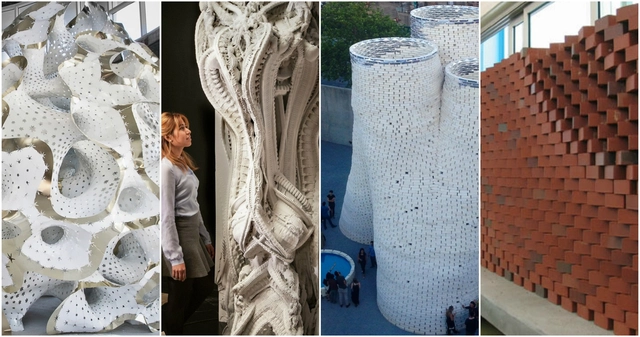
Swept up in an age of digitization and computing, architecture has been deeply affected in the past decade by what some critics are calling “The Third Industrial Revolution.” With questions of craft and ethics being heavily present in the current architectural discourse, projects taking advantage of these new technologies are often criticized for their frivolous or indulgent nature. On the other hand, there has been an emergence of work that exemplifies the most optimistic of this “Third Industrial Revolution” – an architecture that appropriates new technology and computation for the collective good of our cities and people.
We’ve collected 7 of these projects, ranging from exemplars of engineering to craft and artistry; projects that 80 years after Le Corbusier’s modernist handbook hint at a further horizon – towards a newer architecture.
Most residential projects must include parking spaces, but only few cases are notably innovative. Your vehicle's resting place can be more than just a required space; it may even become the backbone of the design itself.
The integration of parking, interior spaces and facades can deliver extremely intriguing and unique results.
Here we present 8 cases in which the humble parking space has assumed a main role in the design, while integrating new functions such as exhibition spaces, or structural features and versatile technology.
The Technium is the sphere of visible technology and intangible organizations that form what we think of as modern culture. —Kevin Kelly, What Technology Wants
The Technium is ubiquitous; like air it could be invisible. Fortunately, raging torrents that affect every person on earth are hard to ignore. Let’s look into one of the hearts of the Technium, that organ we call architecture.
You Are in the Technium Now
An ecosystem is a system of inter-dependent organisms and conditions. Ecosystems evolve. The current system can only exist because of past systems, each a stepping stone for new levels of action, each creating new sets of conditions, niches for life in its many forms.
But of course that’s what architecture does: it creates new conditions for life and culture, as does science, education, art and technology. Our culture and technology is evolving, enabled and built upon current and past developments. Kevin Kelly uses the word Technium to describe this complex stratum of evolving interdependencies and capacities. The Technium is evolving and growing fast. Our buildings must also evolve if they are to nurture our current and future cultures.
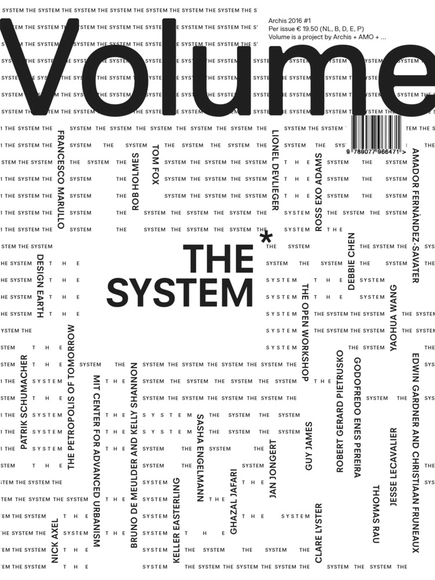
Volume is an "agenda-setting" quarterly magazine, published by the Archis Foundation (The Netherlands). Founded in 2005 as a research mechanism by Ole Bouman (Archis), Rem Koolhaas (OMA*AMO), and Mark Wigley (Columbia University Laboratory for Architecture/C-Lab), the project "reaches out for global views on designing environments, advocates broader attitudes to social structures, and reclaims the cultural and political significance of architecture."
Over the next six weeks Volume will share a curated selection of essays from The System* on ArchDaily. This represents the start of a new partnership between two platforms with global agendas: in the case of ArchDaily to provide inspiration, knowledge and tools to architects across the world and, in the case of Volume, "to voice architecture any way, anywhere, anytime [by] represent[ing] the expansion of architectural territories and the new mandate for design."
https://www.archdaily.com/784350/introducing-volume-number-47-the-system-starAD Editorial Team
The Curry Stone Foundation has announced The Society for the Promotion of Area Resource Centers (SPARC) as the winner of the 2016 Curry Stone Design Prize Vision Award. For over 30 years, SPARC has supported, represented and implemented improvements for Indian citizens living in slum communities throughout the country. Through its alliance with the National Slum Dwellers Federation (NSDF) and Mahila Milan (Women Together), SPARC is now active in over 70 cities throughout India, lobbying for physical, social and legal advancement, as well as facilitating the construction of housing for more than 8,500 families and community toilets for over 500,000 seats in slums with no existing facilities.
“SPARC with the National Slum Dwellers Federation and Mahila Milan are driving change by using the knowledge and capacity of the urban poor,” said Emiliano Gandolfi, the Director of the Curry Stone Design Prize. “With their work they designed the social framework that enables underrepresented populations to have a voice in the decision processes that determine their quality of life.”
We’re almost three full months into 2016. I don’t know about you but that optimistic rush from from the New Year is starting to peter out. I always begin the year with fire in my belly to get big things done. I’ve got a to-do list as long as my arm. I want to launch a bunch of new courses. I want to write a book. I want to design great projects for great clients.
The problem is that the real world has a way of interfering with those goals. There are deadlines to finish and bills to pay. All that time I thought I’d have is taken up with things I didn’t anticipate like snow days, sick kids, and unexpected out-of-town trips. How about you? Feeling the same way?
It’s that time of the year when you need to look at how you’re working and make adjustments so you can crush those goals. With that in mind, here are 5 ways you can pull yourself out of the winter doldrums and work smarter this year.
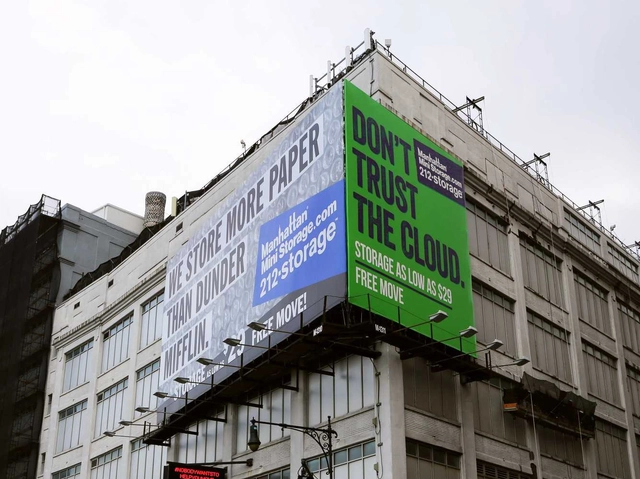
A billboard advertisement for Manhattan Mini-Storage. The green background and mention of “the cloud” is a direct reference to MakeSpace. Image via Business Insider, MakeSpace
Volume Magazine in advance of their 47th issue, The System*.
Two recent trends have recently emerged from the United States’ real estate market that pick up on societal transformations in the way architecture and the city is inhabited. If synchronized, they stand to alter the principles under-riding contemporary logics of urban development. They do so by embodying an alternative system of values, framing its spatial articulation as a critical design project. The purpose of this short text is to present the two trends next to one another, evaluate the prospects of their synchronization, and speculate toward the future they potentiate in unison.
https://www.archdaily.com/784163/cloud-urbanism-towards-a-redistribution-of-spatial-valueNick Axel
The impacts of architecture on the quality of human life are often debated, and in the 21st century, projects are under greater scrutiny than ever for the experiences they provide for people. Buildings all over the world must address a specific context, responding to the cultural framework of their users.
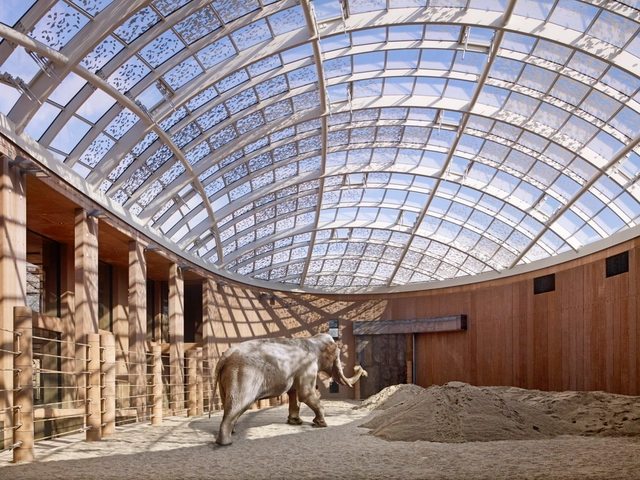
In light of this, we’ve gathered 8 projects that have a different sort of user -- projects designed not just for people, but also for animals. Ranging from zoo buildings to aquariums, stables and shelters, these projects have the unique challenge of balancing a human and animal experience. See them all after the break.
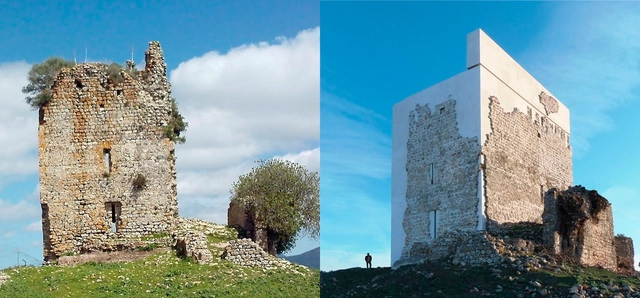
When we began these bi-weekly round-ups of readers' comments back in October, we did so with one key aim: to encourage open, democratic debate with a very low barrier for entry - the type of internet-enabled debate that many architecture critics and publications have given up on. This week, we got a taste of just that kind of rational, professional debate as our readers picked apart the popular opinion in the wider media that the renovation of Cádiz Castle was "a perfect example of how not to restore an old castle." Alongside debates on whether architecture is a form of art and what the AIA should be doing about sustainability, read on to see what our readers had to say after the break.
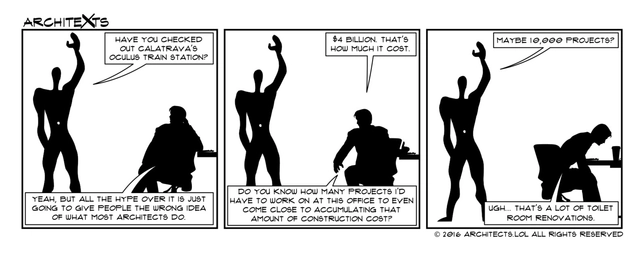
We're happy to announce a new partnership with Architexts! In this first edition of their bi-monthly contributions, they let us know a little more about themselves.
Architexts is a webcomic about a fictitious architectural firm called Franklin + Newbury Architects, Inc. Our comics are largely based on real-life experiences, giving a tongue-in-cheek chronicle of what it’s really like to be an architect.
I had the pleasure of speaking alongside IA's Guy Messick, AIA, director of design intelligence; and Kelly Funk, IIDA, senior workplace strategist. While 2015 was a big year for early adopters, VR has rapidly left the "beta" phase with firms like IA equipping all their offices with VR headsets and integrated work flows with InsiteVR, which lets them easily present their Revit models at human scale with the click of a button.
A core focus of our panel was describing direct experiences that IA has had with clients using VR. In a video shown to the audience, a confidential client was challenged to comprehend various design options and a specific ceiling solution. When the client put the VR headset on, one could see an immediate reaction revealing his sudden understanding.
https://www.archdaily.com/784008/virtual-reality-for-architecture-predicts-patterns-drives-business-decisionsAngel Say
The most revolutionary material in architecture may be one we’re already quite familiar with: glue. In a recent article for New Scientist’s New Urbanist column, futurist Geoff Manaugh of BLDG BLOG argues that the typical building’s structural system may soon see an overhaul. Instead of steel held together with bolts and welds, petroleum-based composite materials and carbon fiber panels fixed in place with glue could serve as both a building’s structure and skin.
Ask some people, and they'll tell you that pop-up architecture is a quintessentially 21st century form of architecture, but in fact the idea goes back over 2000 years. In this article originally published on Curbed as "The Rise and Rise of Pop-Up Architecture," Marni Epstein-Mervis traces the development of pop-up architecture right from its origins in ancient Rome, analyzing how the phenomenon has transformed into what we recognize today.
For five weeks in August and September 2015, street artist Banksy opened a dystopian theme park with Disney-esque castles and theme rides in the seaside town of Weston-super-Mare in southwest England. Attractions included a police van mired in the muck and goo of a forgotten cityscape, and an overturned pumpkin coach and horses with Cinderella tossed half outside of it. These installations, one a commentary on our police state and the other a commentary on celebrity and the tragic death of Princess Diana, were just two of the many pieces at last summer’s temporary "bemusement" park, which Banksy called Dismaland. After its run, the timber and fixtures were sent to a refugee camp—home to over 3,000 people, mostly from Sudan, Eritrea, and Afghanistan—near Calais in France.
Pop-ups like Dismaland are everywhere. The impermanent, unexpected, and even slightly irreverent have become community staples. We can visit pop-up amusement parks, shop at pop-up stores, eat at pop-up restaurants, and stay at pop-up hotels. "Architecture has transitioned into an experience. An experience where, purposefully, it is difficult to tell the difference between the design and the art installation," says Melanie Ryan, Design Principal at the Los Angeles-based experiential and mobile design house Open For Humans.