1. ArchDaily
  2. Architecture News

Architecture News

New Details Released of Norman Foster and Fernando Romero's Designs for Mexico City's New Airport

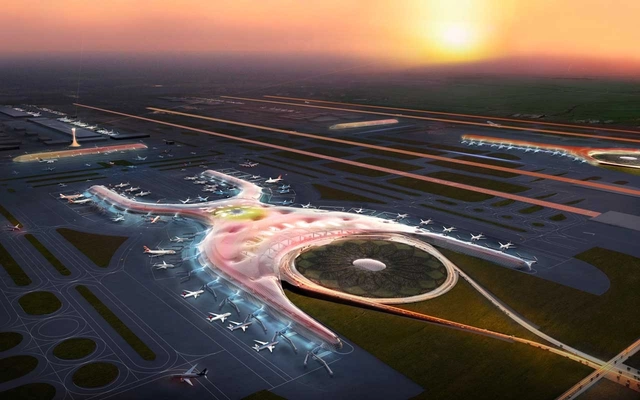
Yesterday, a consortium led by Foster + Partners and Fernando Romero of FR-EE were announced as the winners of the competition for the design of Mexico City's new international airport. Designed in conjunction with a masterplan developed by Arup, the airport will initially include three runways, but is designed to expand to up to six runways by 2062, all served by the single terminal building.

One of the world's largest airport terminals at 555,000 square meters, the building is enclosed by a single, continuous lightweight gridshell, the largest of this type of structure ever built with spans reaching up to 170 meters. By utilizing a single airport terminal, passengers will not need to travel on internal train services or underground tunnels, and the design of the building ensures shorter walking distances and few changes of level, all making for a more relaxing experience for users.

The building is designed to be the world's most sustainable airport, with the single lightweight shell using far less material than a cluster of buildings, and cooling and ventilation strategies that require little to no mechanical assistance for most of the year.

More details of the design after the break
Frank Gehry’s Design for Ground Zero Arts Center Shelved

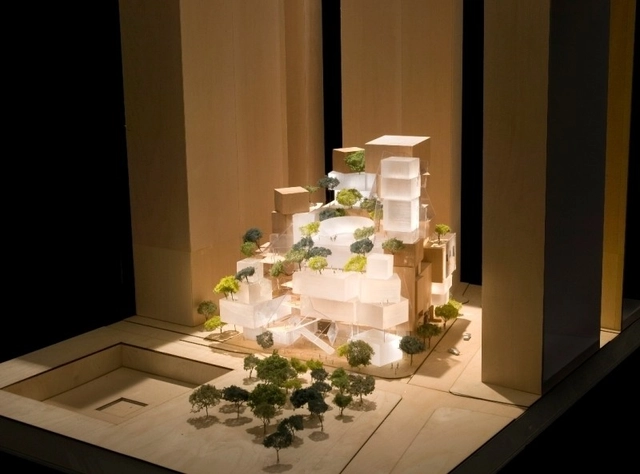
Frank Gehry’s design for the performing arts center at ground zero in New York has been shelved and the planning board will instead select a design from three other finalist architects, the New York Times has reported. This follows on reports from February that Frank Gehry’s original design was being revised and his plans for an initial 1,000 seat center were being abandoned. “We’re in the process of selecting a new architect,” said John E. Zuccotti, the real estate developer who is the chairman of the arts center’s board. “Three architectural firms are being considered.” Gehry, however, has said that he’s heard “zero at ground zero” and hasn’t been informed of the board’s decision. To learn more about the plans for the performing arts center see the full article from the New York Times.

New Details Released of Norman Foster and Fernando Romero's Designs for Mexico City's New Airport

Yesterday, a consortium led by Foster + Partners and Fernando Romero of FR-EE were announced as the winners of the competition for the design of Mexico City's new international airport. Designed in conjunction with a masterplan developed by Arup, the airport will initially include three runways, but is designed to expand to up to six runways by 2062, all served by the single terminal building.

One of the world's largest airport terminals at 555,000 square meters, the building is enclosed by a single, continuous lightweight gridshell, the largest of this type of structure ever built with spans reaching up to 170 meters.

By utilizing a single airport terminal, passengers will not need to travel on internal train services or underground tunnels, and the design of the building ensures shorter walking distances and few changes of level, all making for a more relaxing experience for users.

The building is designed to be the world's most sustainable airport, with the single lightweight shell using far less material than a cluster of buildings, and cooling and ventilation strategies that require little to no mechanical assistance for most of the year.

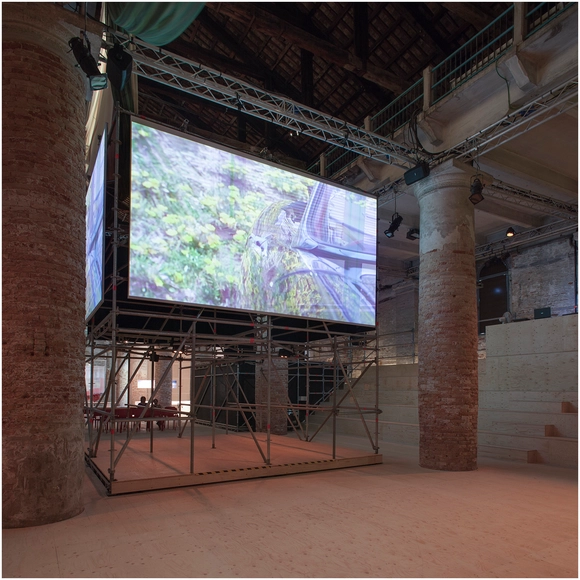
OMA Creates 360-Degree Cinema at the Venice Biennale

OMA has recently transformed the F stage of the Corderie at the Venice Biennale to become a four screen, 360-degree cinema hall. Complementing the exhibitions at the Biennale, full movies will be screened in the space on weekends from now until November.

More on the movie screenings after the break

Álvaro Siza, Carlos Castanheira and Wang Shu Design Museum for Hangzhou Art Academy

After inaugurating his first building in China – “The Building on the Water” – Álvaro Siza has just announced his second project in the country, again in collaboration with Portuguese architect Carlos Castanheira. This time the two architects will develop a museum for Hangzhou Art Academy.

The new museum - which will have approximately 15,000 sqm, a total area similar to that of Serralves Foundation building – will host an important collection of pieces from the famous German school of arts and design, Bauhaus, founded by Walter Gropius in 1919.

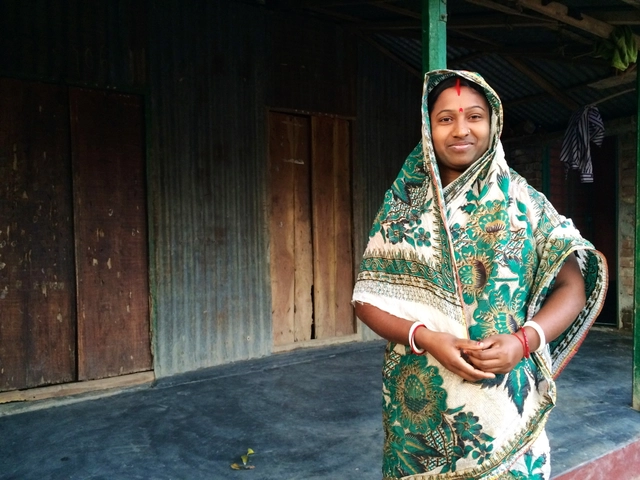
ARCHIVE Global Sets Out to Build Healthier Homes in Bangladesh

Each year 6.5 million children around the world die from diseases directly related to substandard housing conditions. Dirt floors in particular are carriers of parasites, bacteria, and viruses contributing to many fatal diseases. In response to this and with the aim of dramatically reducing child mortality rates, New York-based non-profit Architecture for Health in Vulnerable Environments (ARCHIVE), has launched a new initiative to replace dirt flooring with concrete in Bangladesh.

Learn more about the initiative after the break. 

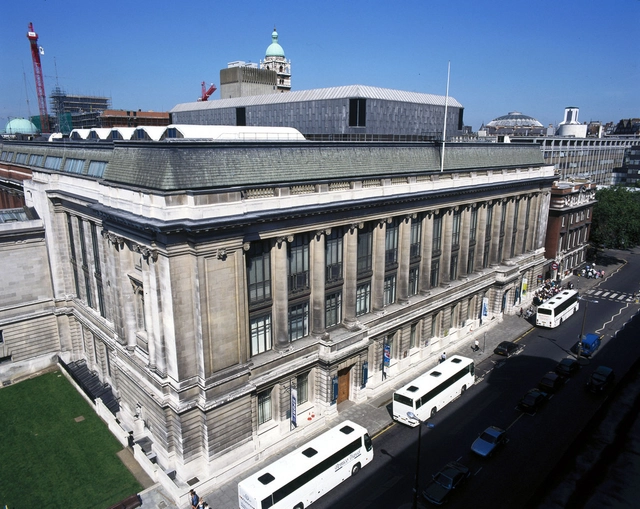
London Science Museum Selects Muf Architecture/Art to Design Interactive Gallery

London’s Science Museum has selected muf architecture/art to design a new permanent interactive gallery. Set to open in 2016, the new gallery will be an expansion of the current Launchpad children’s gallery, creating a larger area to engage visitors in interactive math and science exhibits and live events.

“Muf architecture/art impressed us with their collaborative approach, strong design and bold vision for the new gallery. Above all, their scheme shows a keen awareness of the prime purpose of the gallery – fostering exploration and curiosity in science through intelligent and exciting design,” Karen Livingstone, Director of Masterplan at the Science Museum said.

RIBA Future Trends Survey Reveals Decrease in Workload & Staffing Levels

The results of the Royal Institute of British Architects (RIBA) Future Trends Survey for July 2014 show that the Workload Index among practices fell back to +28 (from +34 in June) with confidence levels among RIBA practices about the level of future workloads remaining "very strong in practices of all sizes across the whole of the ." Whereas last month’s survey saw Scotland top the index with a balance figure of +50, London showed the greatest strength in July with a balance figure of +38. Practices located in Wales and the West were the most cautious about prospects for future workloads, returning a balance figure of just +12. The survey shows that actual workloads have been growing for four consecutive quarters and the overall value of work in progress last month was 10% higher than this time last year.

Maarten Hajer Appointed as Chief Curator of 2016 Rotterdam Biennale

The International Architecture Biennale Rotterdam (IABR) has announced Maarte Hajer as the Chief Curator of IABR-2016-. Hajer, a professor of Public Policy at the University of Amsterdam and Director General of the PBL Netherlands Environmental Assessment Agency, was selected for his proposed theme, "The Next Economy." More on Hajer's appointment after the break.

ARTISTECT: Famous Paintings With An Architectural Twist

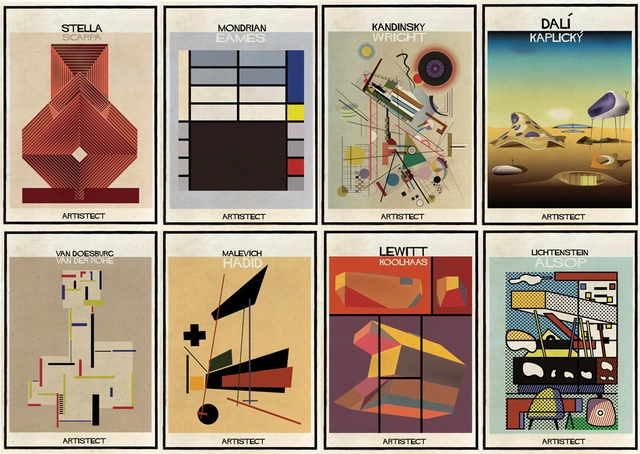
Our friend Federico Babina's latest illustrations blur the lines of art and architecture in this series: ARTISTECT. These 25 images, he explains, represent "possible and impossible encounters between artists and architects," emphasizing the "probable and improbable connections between forms of expression and aesthetic languages sometimes distant and sometimes very close."

In this exercise of overlapping styles, it is perhaps easier at first glance to identify the artist. But careful inspection of these stunning drawings reveals the idiosyncratic and stylistic tendencies of some of our most beloved architects. 

Babina writes, "The project’s main idea is to reinterpret famous paintings using a brush soaked in architectural tints…These images are a metaphor for an imagined and imaginary dialogue between creative minds: Le Corbusier talks with Picasso and Kandinsky discusses with Wright... The wires that connect and intertwine this relations can be thin and transparent or robust and full-bodied."

Take a look at the entire ARTISTECT series after the break. And don't miss Federico Babina's other (very popular) illustration sets: ARCHISET, ARCHIMACHINE, ARCHIPORTRAIT, ARCHIST, ARCHIBET and ARCHICINE.

Complexity Via Simplicity: Urbana's Parking Structure Facade

Asked to design an interactive facade for an existing parking structure at the new Eskenazi Hospital in Indianapolis, Urbana principle Rob Ley had a conundrum to deal with: "With Indianapolis’ really extreme weather patterns, we gave a lot of thought to: how can we make something that’s interactive but won’t be broken in a year?” he told the Architect's Newspaper. “Unfortunately, the history of kinetic facades teaches us that that they can become a maintenance nightmare."

His solution came from turning the question on its head - how could they design and fabricate a static facade that appears to change when the viewer moves? The resulting design appears highly complex, while in fact using aluminum fins bent at just three different angles. Find out more about the challenges of fabricating this facade, and inserting it into an existing structure, through the video above or at the Architect's Newspaper Fabrikator blog.

Complexity Via Simplicity: Urbana's Parking Structure Facade - Image 1 of 4

Foster + Romero Alliance Wins Competition to Design the Mexico City Airport Expansion

A duo comprised of British architect and Pritzker Prize winner Norman Foster of Foster + Partners and Mexican architect Fernando Romero of FR-EE has won the competition to expand the Mexico City airport, Reuters has reported.

The new airport not only plans to solve overcrowding at the current terminal, but also to “develop economically and socially one of the most densely populated and marginalized regions” of Mexico.  The project is set to be finished by the end of 2018. 

Learn more about the airport and the winning design team after the break…

Interview: Behind the Scenes of the University of Toronto's Mental Health Report

In a TED Talk from 2009, writer Elizabeth Gilbert muses about how uncomfortable she is with the assumption that “creativity and suffering are somehow inherently linked.” The majority of Gilbert's thoughtful and humorous monologue is about finding sanity amidst both success and failure, or in other words, about finding a way to break this link. Earlier this year, the University of Toronto Graduate Architecture Landscape and Design Student Union’s (GALDSU) set out to do just that – break the link between creativity and suffering at their school – and start a productive dialogue about mental health. GALDSU began by gathering the facts through a mental health study of their peers, the results of which we discussed several months ago.

To learn more about what's happened at their school (and beyond) since it was published, we sat down with Joel Leon, the man who spearheaded the effort and the newly elected president of the student union, as well as Elise Hunchuck, the vice-president of the student union.

Giveaway: Introducing the Moleskine Tool Belt

Giveaway: Introducing the Moleskine Tool Belt - Image 7 of 4
Courtesy of Moleskine

Moleskine notebooks go as hand-in-hand with architects and designers as the color black. Over the years, these creative individuals have hacked and personalized the simple design of the Moleskine notebook, turning it into wallets, key chains, pen holders, and more. In response to this culture, Moleskine recently came out with their own hack called the Moleskine Tool Belt.

The Tool Belt is an add-on that attaches to the cover of their notebooks. It contains several compartments for storing pens, smart phones, business cards, eye glasses, and more. We also have two Moleskine Tool Belts to give away - check out the article after the break for your chance to win!

Al Jazeera’s Rebel Architecture: Episode 3, “The Architecture of Violence”

The third episode of Al Jazeera’s “Rebel Architecture” series takes us on a journey through the settlements and roads of the West Bank with London-based, Israeli architect, academic and writer, Eyal Weizman. In the 25-minute episode, Weizman shows the key role of architecture in the Israeli occupation of Palestine, and talks about his latest project, Forensic Architecture, which uses damage to buildings as evidence for war crimes.

Watch the full episode above and read on after the break for a full episode synopsis and a preview of upcoming episodes…

Chinese Company Showcases Ten 3D-Printed Houses

Chinese company WinSun Decoration Design Engineering has constructed a set of ten single story, 3D-printed homes which it produced in under 24 hours. The homes, printed in prefabricated panels which fit together on site, were created using WinSun's custom-built 3D printer which measures 10 meters by 6.6 meters, and took the company twelve years to develop.

Formed with a cement-based mixture containing construction waste and glass fiber, each of the houses cost just $5,000 to build. Read on after the break for more on the development.

World Architecture Festival to Kick-Off in One Month

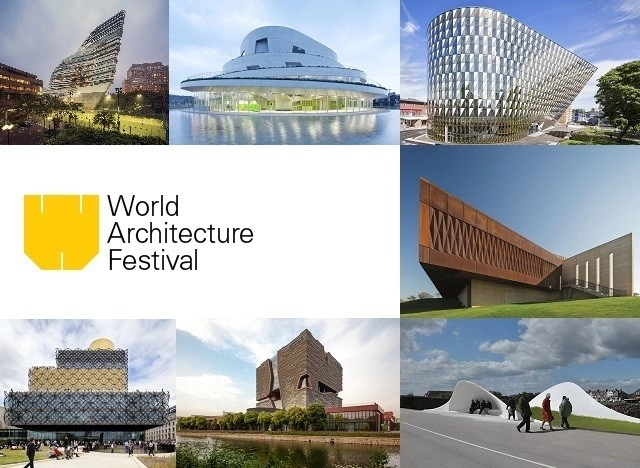
With only one month to go before the 2014 World Architecture Festival (WAF) begins in Singapore, WAF has unveiled new additions to the Festival Program, including a keynote speech by Ole Scheeren of Buro Ole Scheeren. With “Architects and the City” as WAF’s overarching theme this year, Scheeren’s talk will be on the relationship between architects, architecture and urbanism.

Other keynote speakers include Rocco Yim of Rocco Design Associates who will speak on his involvement in the West Kowloon Cultural District, the largest arts and cultural project in Hong Kong to date, and Richard Rogers who will speak candidly about his life as one of the most influential global figures in architecture and his future agenda. Moshe Safdie will close the Festival, looking back over his extensive career to talk exclusively about the defining moments that shaped its path.

Read on after the break for more information on WAF’s three days of fascinating talks, networking opportunities and its annual awards.

UK Airports Commission Rules Out Thames Estuary Airport Plans

UK Airports Commission Rules Out Thames Estuary Airport Plans - Featured Image
© Foster + Partners

The Airports Commission, the independent group charged with planning the future of the London's airport infrastructure, has finally ruled out an ambitious plan for a major airport in the Thames Estuary designed by Foster + Partners and supported by London Mayor Boris Johnson. Chairman of the Airports Commission Sir Howard Davies said the proposal had been ruled out because "the economic disruption would be huge and there are environmental hurdles which it may prove impossible, or very time-consuming to surmount."

Instead, the Airports Commission will select between three options to expand one of London's existing airports at either Heathrow or Gatwick. Read on after the break for the reactions to the decision.

Oops! We don't have this page.

But you can browse the last one: 556

In alliance with Architonic
Check the latest Architecture NewsCheck the latest Architecture NewsCheck the latest Architecture News

Check the latest Architecture News