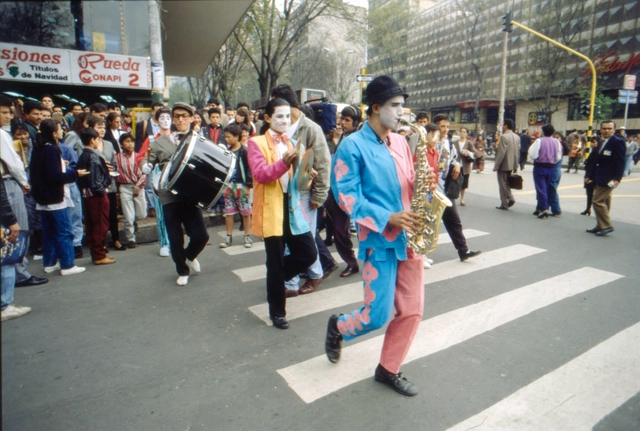
Mimes ridiculing bad-behaviour on the roads in Bogotá
In a recent article for The New York TimesAntanas Mockus, the former Mayor of Bogotá who served two terms in office between 1995 and 2003, discusses what he learnt to be "the art of changing a city." Mockus, a professor of philosophy by vocation, was at times pressured to wear a bullet-proof vest — which he wore with a heart-shaped hole cut over his chest as a "symbol of confidence, or defiance, for nine months." His article discusses how his government tackled Bogotá's "chaotic and dangerous" traffic through a thumbs-up, thumbs-down card system performed by mimes, how they dealt with water shortages, and how they persuaded 63,000 households to voluntarily pay 10% more tax.
Images of Souto Moura Arquitectos' first US project has emerged. Aimed to replace a former gas station at 2715 Pennsylvanian Avenue NW in Washington DC, the five-story red brick and concrete building will feature a ground floor restaurant and eight 2,000-square-foot apartment units with balconies, a gym and penthouse terrace.
As BizJournals reports, the proposal is being pitched by EastBanc Inc. as the new "entrance to Georgetown." The Portuguese architect chose red brick "because it seems to be the most appropriate for this part of the city."
Alongside the release of the American Institute of Architects' (AIA)annual Compensation Report comes a new (free!) Salary Calculator Tool that allows you to compare your income with 17 architectural staff positions - from CEO to Intern 1. You can use the tool to see the overall mean and median salaries throughout the US or by region, and even by firm size (organized by annual firm revenue). Compare your salary here.
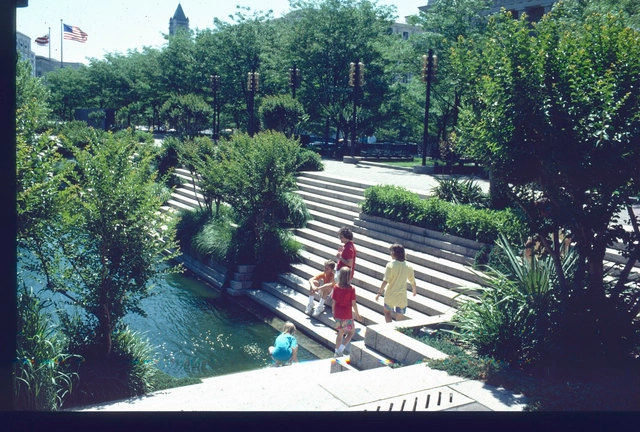
The competition, hosted by the United States Federation for the Commemoration of the World Wars and sponsored by the World War I Centennial Commission, received over 350 entries. While these entries did generally follow the guidelines they were given, most of the designs incorporated the complete demolition of the park.
Now, because the park is one of the most significant works of Modernist landscape architect M. Paul Friedberg, with planting plan designs by Oehme, van Sweden & Associates, landscape architecture organizations like The Cultural Landscape Foundation are speaking up against the possibility of demolition.
In a recent article for The Observer, Rowan Moore discusses what he describes as the "quiet revolution in British housing." In compiling a list of practices and collectives from the recent past and present, he has created a compendium of people and organisations who he believes are creating exemplary dwellings in the UK. Noting that the British housing stock is not necessarily in the best shape (a symptom of the 1970s), Moore ultimately offers an optimistic message tinged with words of caution.
View has raised $150 million to fund their specialized Dynamic Glass tints. The new technology automatically responds to outdoor conditions or from a mobile phone, resulting in a reactive tint that reduces heat and glare. This, as the company said in a press release, allows for "greater occupant comfort and energy savings without ever compromising the view." The tinted windows have been installed in more than 100 locations across North America. The funds will be used to accelerate product development.
Taipei 101, once the world's tallest building before losing the title to the Burj Khalifa, has set a new record. As Popular Mechanics reports, the 1,667-foot-tall skyscraper's internal "tuned mass damper" swayed more than it ever has before in last week's Typhoon Soudelor. Also known as a "harmonic absorber," the massive damper moved a full meter from its central position at the tower's top in an effort to keep Taipei 101 upright during the early morning storm's 100 to 145 mph winds.
The weighted ball, measuring 18-feet in diameter and weighing 728 tons, sits on hydraulic cylinders suspended between the 87th and 92nd floors. It was engineered for winds up to 135 mph. Watch the damper (and building) sway in the video below.
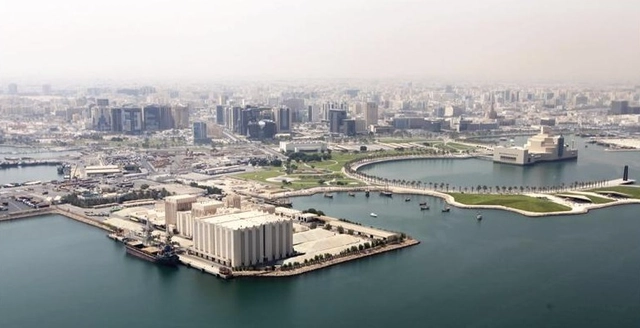
Renzo Piano, David Chipperfield, Sou Fujimoto, Miralles Tagliabue EMBT and ELEMENTAL are among 26 celebrated architects that have been longlisted in an international competition that seeks to transform the Qatar Flour Mills in Doha's Arabian Gulf into a massive "Art Mill." Moving on to the competition's second stage, the remaining architects will now develop site strategies that focus on the mill's connection to the city. The complete longlist includes:
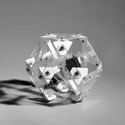
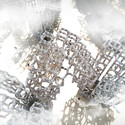
Architecture is a swarm, and a self aware one at that. That's the vision presented by noMad: a built environment made of Buckminster Fuller-like geometric structures that compile themselves entirely autonomously, according to data gathered and processed by the units. Developed by Architectural Association students Dmytro Aranchii, Paul Bart, Yuqiu Jiang, and Flavia Santos, on a basic level noMad's concept is fairly simple - a small unit of motors that is attached to several magnetic faces, which can be reoriented into different shapes. Put multiple units together, however, and noMad's vision becomes an entirely new form of architecture: non-finite, mobile and infinitely adaptable.
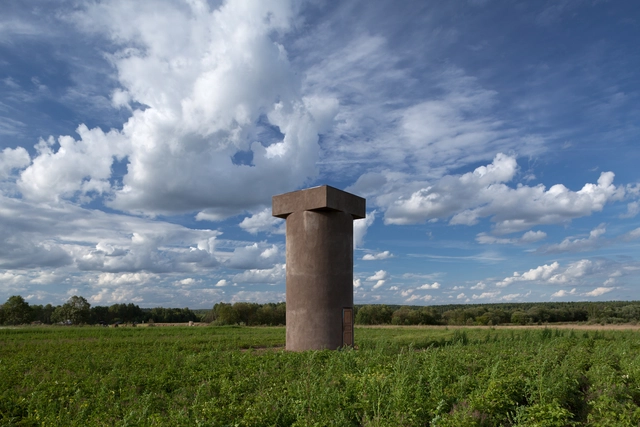
Standing tall in the expansive landscape of Western Russia, the monolithic Museum for Rural Labor is an architectural beacon for the Kaluga Oblast region. Built of local straw and clay, the eight meter tower is comprised of one round sunlit room adorned with the instruments of manual labor. Jarring, unexpected and mysterious, the museum was conceived by Russian architects Sergei Tchoban and Agniya Sterligova to pay homage to the region's deep agricultural history. Defined by a stark and unorthodox form, the tower disrupts the Russian landscape while simultaneously serving as a wayfinding device for residents from the nearby village of Zvizzhi.
Enter the rudimentary world of the Museum for Rural Labour after the break.
After spending five-figure sums on their education, you might think that architectural students would, at the very least, continue in the architectural profession. However, as investigated in a new BBC Business article, many students of architecture “are using their newly-learned digital animation and design skills to break into the world of film.” With a growing demand for both architectural and all other kinds of animations, the number of film careers built from architectural foundations seems to be burgeoning. Architects-turned-filmmakers now work on a wide variety of projects, from special effects in Beyoncé videos to Oscar-winning films, to visualization films of future architectural projects.
Learn more about how digital animation has created a “two-way street” between architecture and film, here.
A 40-strong list of international studios has named the official participants of the first-ever Chicago Architecture Biennial - the “largest international survey of contemporary architecture in North America.” Chosen by Biennial Co-Artistic Directors Joseph Grima and Sarah Herda - who are supported by an advisory council comprising David Adjaye, Elizabeth Diller, Jeanne Gang, Frank Gehry, Sylvia Lavin, Hans Ulrich Obrist, Peter Palumbo, and Stanley Tigerman - each participating practice will convene in Chicago to discuss "The State of the Art of Architecture" and showcase their work from October 3 to January 3, 2016.
“The city of Chicago has left an indelible mark on the field of architecture, from the world’s first modern skyscraper to revolutionary urban designs,” said Mayor Rahm Emanuel. “That’s why there’s no better host city than Chicago for this rare global event. The Chicago Architecture Biennial offers an unprecedented chance to celebrate the architectural, cultural, and design advancements that have collectively shaped our world.”
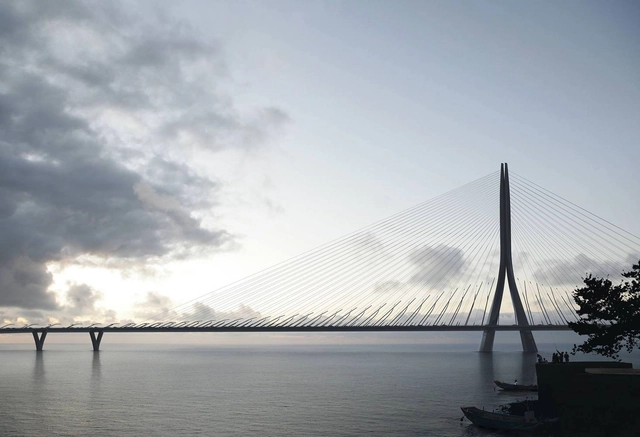
Zaha Hadid Architects has been announced as winner of the Danjiang Bridge International Competition in Taiwan. The new bridge was designed to "make a conspicuous landmark against the backdrop of Tamsui's famous sunset," says ZHA director Patrik Schumacher. It will be comprised of a cable-stayed bridge design that will minimize its "visual impact" by needing only one concrete structural mass to support its 920-meter-long span.
"The Danjiang Bridge will be the world’s longest single-tower, asymmetric cable-stayed bridge," said ZHA in a press release. Read on to see how the bridge will be constructed.
In recent years, DIY approaches to building houses have become increasingly popular, as increasing cost and decreasing availability have caused some prospective house-buyers to embrace simple methods of fabrication and the sweat of their own brow, as discussed in this recent article. However, this trend has much earlier precedents: in 1979, self-build pioneer Walter Segal had already embraced these progressive concepts in a development known as "Walter's Way," an enclave of self-built social housing in southeast London. According to Dave Dayes, a Walter's Way resident and an original builder on the project, Segal believed that "anybody can build a house. All you need to do is cut a straight line and drill a straight hole." The houses were built entirely of standard wood units assembled onsite in Lewisham.
In this video, London based non-profit The Architecture Foundation steps into the utopia of Walter's Way, a micro-neighborhood founded on principals of communal living for people of all backgrounds. The film has been released in connection with Doughnut: The Outer London Festivaltaking place September 5th, which will bring together writers, historians, architects and economists for "an adventurous celebration of all things Outer London and a critical reflection on the rapid transformation that the city's periphery is currently experiencing." The Architecture Foundation aims to introduce central Londoners (and the world) to the radically functional housing concepts in practice at Walter's way.
How do you compare cities? It's difficult to collapse millions of individual subjective experiences into a single method of comparison, but one popular technique used in recent years has been to judge a city's "livability." But what does this word actually mean? In their 2015 ranking of the world's most livable cities, Metropolis Magazine has gathered together a group of experts on city planning, urban life, tourism and architecture to break down "livability" into the categories they think matter and draw upon Metropolis' considerable urban coverage to produce one of the most thorough attempts to rank world series yet attempted. Find out the results after the break.
For the latest edition of The Urbanist, Monocle 24's weekly "guide to making better cities," the team travel to Moscow, Portugal and Hong Kong to examine how "architecture has always been the unfortunate sidekick of any dictatorial regime." In the process they ask what these buildings actually stand for, and explore the legacy of the architecture of Fascist, Imperial and Brutalist regimes from around the world today. From the Seven Sisters in Moscow to António de Oliveira Salazar's Ministry of Internal Affairs in Lisbon, this episode asks how colonial, dictatorial and power-obsessed architecture has shaped our cities.
You may remember seeing LYCS Architecture's clever CATable when if first was released in 2013. The solid wood cavernous table was intend to provide a beautiful work space that both you and your cat could enjoy. Now, LYCS has released CATable 2.0. Likening it to LEGO, the cubic wooden module consists of four stackable components that can be rearranged into an unconventional table, stools, or even a bookshelf - all while providing your cat with an ever-changing vertical playscape.
See how the cats respond in a video, after the break.
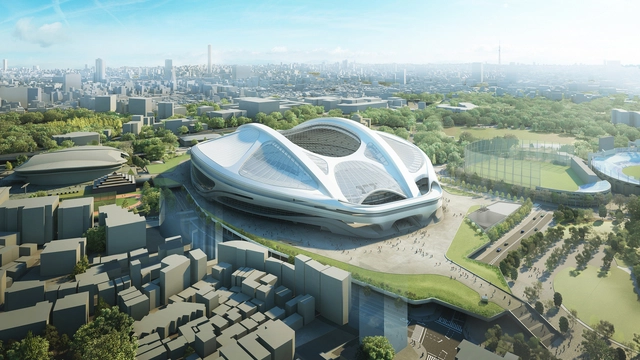
Now, British architect Richard Rogers, who served on the jury that selected ZHA's stadium design, has joined the conversation claiming Japan has "lost their nerve" and warning that their decision to "start over from zero" will harm Japan's "reputation as a promoter of world-class architectural design."
Populous has unveiled plans for a new Chargers football stadium that is meant to capture the "essence of San Diego," California. The 68,000-seat stadium, planned to be built on the Qualcomm Stadium site in Mission Valley, will feature a "kinetic skin" that will mimic the sound of the ocean as it sways in the wind.
"We wanted to make sure as a team that we were making this a really authentic place and people who see it will say, 'That represents our city - that represents where the Chargers should be. They've been here over 50 years and they should stay here.' This stadium represents that. This is an expression of San Diego," Populous senior principal Scott Radecic told the San Diego Union Tribune.
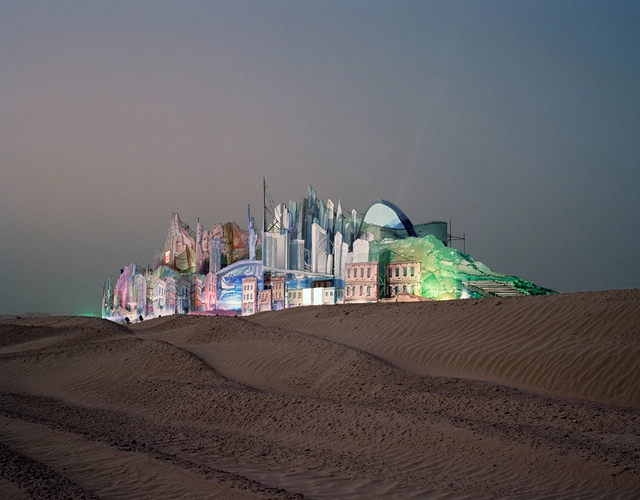
Florian Joy, Bawadi, 2006. Image Courtesy of the MoCP
The Graham Foundation has announced the recipients of its 2015 Grants—49 innovative architectural projects from a global range of “major museum retrospectives, multi-media installations, site-specific commissions, and documentary films to placemaking initiatives, e-publications, and academic journals.”
All of these newly funded project designs, chosen from over 200 submissions, show great promise in respect to impact on the greater architectural field. Overall, the Graham Foundation has awarded the projects $496,500 in an effort to help chart new territory in the future of architecture.
Out of the 49 projects, 12 are “public programs and exhibitions that will coincide with the inaugural Chicago Biennial, opening this fall.”
Learn about a few of the winning projects with descriptions via the Graham Foundation after the break.
Just over six months have passed since we announced the winners of our 2015 Building of the Year (BOTY) Awards, in which 31,000 of our readers helped us to narrow down over 3,000 projects to just 14 winners. Over six editions of our BOTY Awards, we've given awards to 83 buildings - some of these have gone to established names in the field, from OMA to Álvaro Siza; however over the years our peer-voted awards have also brought attention to emerging architects like Tiago do Vale Arquitectos and given international exposure to architects that were previously only known locally such as sporaarchitects.
Of course, with six months since BOTY 2015 we're also around six months from the award's next installment, making now the perfect time to start looking ahead to 2016. Find out how to ensure your firm has a chance to join the prestigious list of ArchDaily's BOTY winners after the break.
https://www.archdaily.com/771730/submit-your-project-for-inclusion-in-archdailys-2016-building-of-the-year-awardsAD Editorial Team
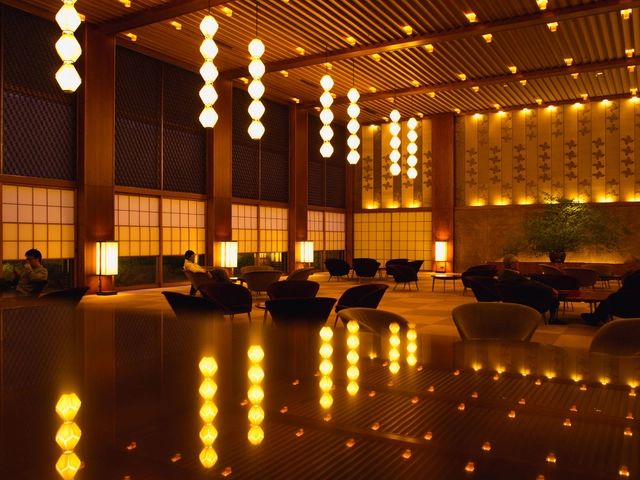
About a year ago, it was announced that Hotel Okura, one of Tokyo’s best-known modernist landmarks, was headed for demolition. With the impending demolition date of the hotel, deemed a “beautiful orphan child,” set for this September, an article from T: The New York Times Style Magazine’s upcoming Women’s Fashion issue looks at Japan's "ambivalent — and unsentimental — relationship with its Modernist architecture."
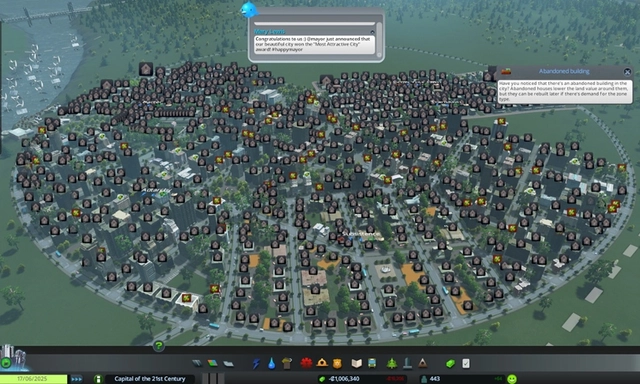
As part of an ongoing series of articles for Guardian Cities, architect Finn Williams uses the Cities: Skyline Simulator to ask whether "the game’s growth-driven model proves incompatible with a post-growth strategy" — ultimately narrating its response to this challenge in the form of a "resounding no." The game, which is designed to "realise the thrill and hardships of creating and maintaining a real city," allows for players to deal with infrastructure issues, housing problems, and budgetary matters on a large urban scale.




_Nick_Kane_6.jpg?1439884712&format=webp&width=640&height=580)