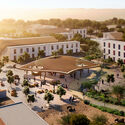
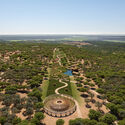
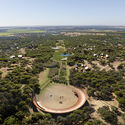
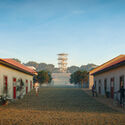
In collaboration with MassLab, OODA has been awarded first place in the Barrosinha Agricultural Company competition, aimed at creating a 2,000-hectare development seamlessly integrated into the agro-forestry heritage of Alcácer do Sal, Portugal. The master plan, covering a variety of functions for tourism, housing, commerce, and leisure, is designed in harmony with the United Nations Sustainable Development Goals, striving to transform Herdade da Barrosinha into a model of sustainable renewal.
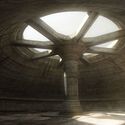
Imagine a world thousands of years into the future, one where humanity has conquered planets from galaxies away, only to default to a neofeudalistic social order in a constant power struggle, all built upon an intricate tapestry of cultures and religions and set in a harsh yet vivid landscape that becomes a character in and of itself. This was the challenge faced by director Denis Villeneuve and production designer Patrice Vermette in creating the cinematic adaptation of Frank Herbert's 1965 novel. The two Dune movies, released in 2021 and 2024, were conceived as a whole and therefore share a coherent style and cinematic expression. Beyond aesthetics, the environment and architecture of Dune present a lived-in, believable world, one that anchors the action and characters, silently offering invaluable insights into the values and mythology of each civilization.
Luxe Lakes Arts Center, Chengdu, China. . Image Courtesy of Wide Horizons Development
Internationally recognized architect, writer, and professor Antoine Predock passed away in Albuquerque, New Mexico, on March 2, 2024, at the age of 87. Throughout his career, Predock developed a unique style, working outside of urban centers and seeking to find a connection between the landscapes and the human experience of space. In addition to serving as a long-term faculty member at the University of New Mexico, he is also the architect behind some well-known projects, including the Nelson Fine Arts Center, the Tang Teaching Museum and Art Gallery at Skidmore College, and the Canadian Museum for Human Rights in Winnipeg, Manitoba.
Henning Larsen and Ramboll have won the competition to design the new campus for the prestigious scientific research center,CERN. Designed to integrate science and nature, the B777 building uses biogenic materials and low-carbon methods to reimagine traditional laboratory settings. Situated on the border of France and Switzerland, in CERN’s Prévessin Campus, the scheme aims to foster a sense of community, collaboration, and well-being.
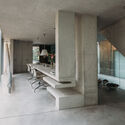
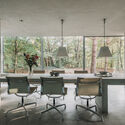
For the Fall/Winter Prada 2024 menswear show, AMO has designed a space that draws inspiration from two contrasting elements of modern life: office interiors and the natural landscape. Transforming yet again the space of the Deposito Hall at Foundation Prada in Milano, the designers have chosen to create a contrasting image of seemingly opposite elements: rows of office chairs illuminated by the white glow of LED lights, standing over a pastoral landscape with meandering creaks and ample foliage. The design aims to highlight this separation between natural instincts and the typical environment of modern life.
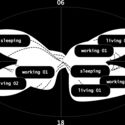
In 1993 a young professional couple from Amsterdam set out to build a private house unlike any other. They wanted to create something that “would be recognized as a reference in terms of renewal of the architectural language.” They reached out to several architects, including Rem Koolhaas, but finally decided to entrust the commission to Dutch architect Ben van Berkel after he studied the site and came up with a vision for the project, relating it to the couple’s lifestyle.
Located in Het Gooi, its design took over 5 years, going through several iterations, but always coming back to its core inspiration: the Möbius loop. The shape, defined as a single-sided surface with no boundaries, was the key to a new architectural language that aimed to weave together all the individual activities of each family member, allowing the functional program to be integrated within the dynamic structure. By 1998, when the house was completed, it became widely published and internationally recognized. It also became a sort of manifesto for its architect, as it uses an organizational principle to inform the final image.
Courtesy of Danish Landscape Award | H.C. Andersen Garden
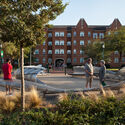
The Danish Landscape Award 2023 has been awarded to the H.C. Andersen Garden, designed by MASU Planning. The award focuses on honoring landscape architectural works with character, serving as “inspiration” for the industry. Situated in Odense in Denmark, this year’s winner was praised for reviving urban renewal in the city center by creating an escape that blends with the existing context.
BIG has just unveiled “Gelephu,” an envisioned master plan that draws from Bhutanese culture, Gross National Happiness principles, and spiritual heritage. During the 116th National Day of Bhutan, His Majesty King Jigme Khesar Namgyel Wangchuck introduced the plans for the prospective economic center in the country. Designed in collaboration with Arup and Cistri, the master plan is adhering to the sustainable standards of the world’s first official carbon-negative country, Bhutan.
In 1993 a young professional couple with two toddlers and a large suburban lot in Naarden, a town less than half an hour's drive southeast of Amsterdam, approached Ben van Berkel to design an unusual house. They envisioned it as progressive and innovative in every way possible. More than that, they wanted a kind of building that “would be recognized as a reference in terms of renewal of the architectural language.” Before settling on the architect, they spoke to several candidates, including Rem Koolhaas. They chose van Berkel who five years earlier, together with his then-wife Caroline Bos co-founded their eponymous practice, because as he told me, “I went to the site and studied it carefully and already had ideas about what I called the four quadrants of the landscape. I knew what kind of house it would be. I could see clearly where different rooms would go, how they would be shaped, and how they would relate to each other.” The couple couldn’t resist. Yet, there would be no rush on the project which took five years to complete, most time was invested in its design, going through many iterations and refinements, all based on the Möbius loop.
The Second Studio (formerly The Midnight Charette) is an explicit podcast about design, architecture, and the everyday. Hosted by Architects David Lee and Marina Bourderonnet, it features different creative professionals in unscripted conversations that allow for thoughtful takes and personal discussions.
A variety of subjects are covered with honesty and humor: some episodes are interviews, while others are tips for fellow designers, reviews of buildings and other projects, or casual explorations of everyday life and design. The Second Studio is also available on iTunes, Spotify, and YouTube.
This week David and Marina of FAME Architecture & Design discuss the local architecture, adobe buildings, and natural landscapes of the southwest region of the United States. The two cover the role nature has in cities, designing experiences, how architecture can co-exist with the natural landscape, craftsmanship, and more. Destinations included the Taos Pueblo in New Mexico, Monument Valley, Antelope Canyon, Frank Lloyd Wright’s Taliesin West, and Paolo Soleri’s Arcosanti.
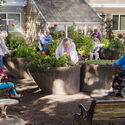
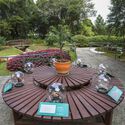
The convergence of neuroscience, architecture, and landscaping has ignited a creative revolution in the design of our built environments. Neuroarchitecture, an emerging discipline that blends principles of neuroscience with architectural design, sheds light on the significant impact of physical spaces on our emotions, behaviors, and overall well-being. Amidst this, sensory gardens emerge as intriguing therapeutic spaces, investigating the distinct interplay between the human brain and nature.
Minghu Park / Turenscape. Photo Courtesy of Turenscape
A type of wetland that provides an incredible carbon-storing capacity. This could be an excellent way to describe a peatland. Found in practically every climate zone in the world, this type of ecosystem is much more than this short description, as it plays an important role in mitigating the climate crisis. But what is it, and how can we use it responsibly?
As has become customary in recent years, on the first Monday of October, we celebrate both World Architecture Day and World Habitat Day, serving as a reminder to the global community of its collective responsibility for the well-being of the built environment. This edition, like its predecessors, sheds light on the realm of architecture and the challenges faced by our cities, introducing new themes, contemplating the state of our urban areas, and proposing constructive strategies.
Since urban economies have encountered significant difficulties this year, the UN's World Habitat Day focuses on "Resilient Urban Economies: cities as drivers of growth and recovery." Launching Urban October, this event seeks to bring together diverse urban stakeholders to deliberate on policies to help cities recover after the dual economic impacts caused by the COVID-19 pandemic and conflicts worldwide. Aligned with this concept, World Architecture Day, created by the UIA in 1985, has chosen to concentrate on "Architecture for Resilient Communities," emphasizing the role and duty of architecture in fostering thriving community existence while initiating a global dialogue regarding the interconnectedness of urban and rural regions within every nation.
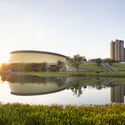
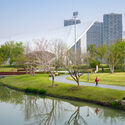
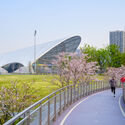
In 2018, Archi-Tectonics NYC and !Melk were announced as the winners of a competition to develop a masterplan transformation for the Hangzhou Asian Games Park 2022. Spanning 116 Acres, the now-completed project includes an expansive Eco Park and seven buildings. Although its initial purpose was to serve as a venue for the Hangzhou Asian Games 2022, the team extended its vision far beyond this event, charting a new path for the city’s environmental future.
The photographic archive of landscape photographer and architect Alan Ward has been recently gifted to the Cultural Landscape Foundation (TCLF). The collection features 110 Portfolios composed of approximately 2,500 images of parks, estates, memorials, gardens, university campuses, cemeteries, museums, and botanical gardens, taken in 12 different countries, and captured by Alan Ward, a principal at the Boston-based firm Sasaki and a Fellow of the American Society of Landscape Architects.
Ever since the birth of our cities, we’ve made sure to protect the green spaces within them. Civilizations as far back as the Romans built expansive parks in the heart of the city with ‘Rus in Urbe’ – translating as ‘Country in the City’ – still referenced today. In order to control the urbanization boom of the mid-20th century, meanwhile, greenbelt policies across many European cities literally ring-fenced the natural environments surrounding them, making air quality and easier access to nature a part of city life.
The post-pandemic city, however, is a new breed of conurbation, and these city parks and greenbelts are no longer enough. As we migrate away in search of greener, healthier climes, the cities we’re leaving are evolving, proving they can be green too by exchanging lesser-used black surfaces of roads and structures for natural grass- and parkland. These four projects from across Europe transform unused city spaces back into the natural and regenerative green environments they once were.
After years of dominance, orthogonal lines and right angles are giving way to organic designs and rounded shapes within interior design projects. This profound shift in formal language has led to the infiltration of gentle curves and amorphous volumes into design pieces, furniture, and decorative elements, a transformation that's becoming increasingly evident. Some argue that this change may be indirectly linked to the growing interest in sustainability and the pursuit of strategies that reconnect people with nature, as seen in the consistent presence of biophilia across projects of various scales. The period of social isolation during the COVID-19 pandemic further heightened this inclination, prompting individuals to devise ways to incorporate nature into their living spaces, thereby enhancing well-being in day-to-day life.