Vilhelmsro Skole / BIG

Courtesy of

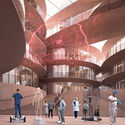
Danish architects BIG shared with us their 7,000 sqm school project for the city of Asminderød in . More images and architect’s description after the break.

How Architects Work in the Current Times

DesignJet -

“What defines the Internet is its social architecture. It’s the living environment that counts, the live interaction, not just the storage and retrieval procedure.” -Geert Lovink, 2005

Last week we were invited to the HP Designjet Launch and BIG’s House 8 Presentation. The experience was really striking, because being there with some other architects and bloggers, made us think about how work systems are changing so fast, that some times is difficult to even notice them until you find yourself inside that system, working and sharing information without any limitations.

That made us re-think about what social networks and web 2.0 are doing in the field of architectural production. All the new tools we’re discovering every day, make the practice more collaborative and open. Some months ago, we wrote in a guest post for Ymag:

Now communication is more dynamic and also it may be a little bit confusing because of that. With blogs actualized every single day and using social networks as facebook and twitter, architects may have a personal contact in between them, with the users of their buildings and also with researchers that are working on new materials and constructive solutions.

Update: House 8 / BIG

© Julien Lanoo

Belgian photographer Julien Lanoo share with us his photoset of House 8, the latests project by danish architects BIG, featured last week here on ArchDaily.

More photographs after the break.

8 House / BIG

© Jens Lindhe
© Jens Lindhe

Celebrating its third project with the same development team in the maturing neighborhood of Orestad, the construction of the 61,000 sqm 8 House has come to an end, allowing people to bike all the way from the street up to its 10th level penthouses alongside terraced gardens where the first residents have already moved in.  Follow the break and you can find images of 8 House at night, interiors, gardens, and diagrams along with a more detailed project description and quotes from the architects.

You can also check our previous feature on the construction of this amazing project.

Architect: BIG – Bjarke Ingels Group
Location: , Denmark
Collaboration: Hopfner Partners, MOE & Brodsgaard, KLAR
Partner-In-Charge: , Thomas Christoffersen
Project Leader: Ole Elkjaer-Larsen, Henrick Poulsen
Project Manager: Finn Norkjaer, Henrik Lund
Project Team: Dennis Rasmussen, Rune Hansen, Agustin Perez Torres, Annette Jensen, Carolien Schippers, Caroline Vogelius Wiener, Claus Tversted, David Duffus, Hans Larsen, Jan Magasanik, Anders Nissen, Christian Alvarez Gomez, Hjalti Gestsson, Johan Cool, James Duggan Schrader, Jakob Lange, Kirstine Ragnhild, Jakob Monefeldt, Jeppe Marling Kiib, Joost Van Nes, Kasia Brzusnian, Kasper Broendum Larsen, Louise Heboell, Maria Sole Bravo, Ole Nannberg, Pablo Labra, Pernille Uglvig Jessen, Peter Rieff, Peter Voigt Albertsen, Peter Larsson, Rasmus Kragh Bjerregaard, Richard Howis, Soeren Lambertsen, Eduardo Perez, Ondrej Tichy, Sara Sosio, Karsten Hammer Hansen, Christer Nesvik, Soeren Peter Kristensen, Lacin Karaoz, Marcello Cova, Luis Felipe González Delgado, Janghee Yoo, SunMing Lee
Client:
St. Frederikslund Holding
Project Area: 61,000 sqm, 476 residences
Project Year: 2010
Photographs: Dragor Luft, Jens Lindhe, Ty Stange

BIG’s proposal for the Audi Urban Future Award

“(Driver)less is more”, BIG’s proposal for the Audi Urban Future Award was one of the five finalists of the competition won by J. Mayer H. More images and architect’s description after the break.

LOOP City / BIG

We’re so happy to share this video BIG passed along to us highlighting their contribution to the 2010 Venice Biennale.  Entitled the LOOP City, the exhibition focuses on a new Metro loop that become the catalyst for development for the cross border region as different programs grow around the new stations.  The loop will connect areas around the Øresund Strait in a sustainable spine of public transport, energy exchange and electric car infrastructure.   The design introduces a new “vein of true urbanity” that will weave it was through the suburbs.  This new loop will create a new realm by uniting specific points, yet activating each interstitial segment.

More about the project after the break.

8 House: BIG win for BIG

Photo Courtesy of

BIG has proven in the past to be a source of innovating projects. Their idea is far beyond the superficial: it´s about improving the city, as you can see on this presentation by Bjarke Ingels for 8 House.

For this project -which will open in October-, BIG has been honored by the Scandinavian Green Roof Association as the Best Green Roof in the Scandinavia for its 1.700 m2 sloping green roof at an award ceremony held at 8 House in Oerestad, .

More information about this award after the break.

Ingels + Nakazawa on Rio

Bjarke Ingles

In the August-July 2010 edition of The Economist, Bjarke Ingels and Paul Nakazawa examined ’s potential to undergo a “new urban revolution” with the 2014 World Cup and 2016 Olympics Games. With these two major events being hosted by the same country, Brazil will need to implement long term strategies for properly equipping the areas. Yet, the real solution lies in the country’s “improvements for the large local population rather than merely servicing the temporary needs of the global tourists and the world press.”

More about the article after the break.

Ride the Danish pavilion in Shanghai

We have seen the Danish pavilion on its conceptual stage, during construction, completed and finally opened to the public.

And now we got the chance to “ride” it with from BIG, and get a closer look at the experience that the giant loop of the pavilion offers to the visitors, to have a little taste of the danish way of life.

YES IS MORE Exhibition: An Archicomic on Architectural Evolution

As part of arc en rêve’s long-term ambition, this event aims to call attention to a young European agency that considers architectural projects in an incisive, innovative way that does not exclude a sense of humour. With projects such as the Copenhagen Harbour Baths (2003), the Ørestad residences (2008) built on a gigantic sloping slab resembling an urban mountain, and a bike track spiralling through the Danish pavilion at Expo Shanghai (2010), BIG’s completed projects offer profound architectural experiences at a far remove from minimalism, political correctness and digital formalism.

Set up in arc en rêve’s main gallery, the exhibition takes the form of a huge, 130-metre-long comic strip occupying the entire 450 square metres of the space and complete with 30 models – one of them an astonishing LEGO construction – and 19 animated films. As a manifesto project accompanied by a book, Yes is More is an invitation to update our vision of architecture and the city in a return to modernity and its utopias. This is ’s first solo exhibition in France which was inaugurated earlier this year at the Danish Architecture Center. The exhibition will take place tomorrow, June 17, 6pm at Arc en Rêve, Entrepôt 7 Rue Ferrêre, 33000 Bordeaux, France.

Denmark Pavilion / Shanghai 2010

Take a look at this video on the Danish Pavilion (thanks again, Seppe!) and be sure to view yesterday’s on the UK Pavilion.  The Shanghai 2010 Expo is in full swing and several of the pavilions are living up to their expectations.  Which pavilion is your favorite?

In Progress: 8 House / BIG

Last year, BIG completed Mountain Dwellings (winner of the Building of the Year 2009 Award under the Housing category), showing us new approaches to a complex typology.

© Dragor Lufthavn

Along this line of innovation in housing, we now present you a sneak peek of the soon to be completed 8 House a 62,000sqm project located in Copenhagen with an interesting approach to mixed use. Over 540 units for different configurations (single or family, young and elders, growing or shrinking families) are placed around a bow in the shape of an 8, mixed with commerce and community facilities, which explain on the above video with a simplicity that has become BIG’s signature when it comes to project presentation.

More photos of the construction process after the break:

Denmark Pavilion, Shanghai Expo 2010 / BIG

© Iwan Baan

The Shanghai Expo 2010 has opened its doors, and we start to see how the pavilions evolved from the previews we saw during design/construction phases at ArchDaily, to become a showcase of the current status of architecture from around the world.

The Denmark was one of the first ones we presented you, almost a year ago. The project, designed by BIG with ARUP and 2+1, was interesting not only from an architectural and structural point of view, but also for the danish spirit it represents.

Basically, the pavilion is a big loop on which visitors ride around on one of the 1,500 bikes available at the entrance, a chance to experience the Danish urban way. At the center of the pavilion there’s a big pool with fresh water from Copenhagen’s harbor (one of the most clean in the world), on which visitors can even swim.

© Iwan Baan

At the center of the pool you will find The Little Mermaid, a statue that has become a symbol for Denmark. And this time, it will be moved temporarily to . In Bjarke Ingels words “it is considerably more resource efficient moving The Little Mermaid to , than moving 1.3 billion Chinese to Copenhagen”.

After the break, more images of the completed pavilion by arch photographer Iwan Baan, including Bjarke Ingels himself riding a bike on the circular loop:

Musée National des Beaux Arts du Québec proposal / BIG + Fugère Architectes

We have been featuring different proposals for the competition including  Saucier + Perrotte‘s proposal and the winning proposal by OMA.   BIG, who teamed with Fugere Architectes, just shared their proposal for the expansion with us.  The design includes a grand green roof that, although it seems to slope at quite a precarious angle, is accessible for people to walk on.  The sweeping form surrounds two large facades that reveal the changing exhibitions inside the museum.   These massive windows also flood the interior with daylight.   As the two facades rise opposite each other, the roof lines connect to the ground and continue the existing park onto the actual building.

Building of the Year 2009, Housing: Mountain Dwellings / BIG with JDS

Architects: BIG Architects
Location: , Denmark
Partner in Charge: Bjarke Ingles for , Julien De Smedt for JDS
Project Architect: Jakob Lange
Project Leader: Finn Nørkjær
Project Manager: Jan Borgstrøm
Construction Manager: Henrick Poulsen
Contributors: Annette Jensen, Dariusz Bojarski, Dennis Rasmussen, Eva Hviid-Nielsen, Joao Vieira Costa, Jørn Jensen, Karsten V. Vestergaard, Karsten Hammer Hansen, Leon Rost, Louise Steffensen, Malte Rosenquist, Mia Frederiksen, Ole Elkjær-Larsen, Ole Nannberg, Roberto Rosales Salazar, Rong Bin, Sophus Søbye, Søren Lambertsen, Wataru Tanaka
Collaborators: JDS/JULIEN DE SMEDT ARCHITECTS, Moe & Brødsgaard, Freddy Madsen Rådgivende Ingeniører ApS
Client: Høpfner A/S
Engineering: Moe & Brodsgaard
Construction: DS Elcobyg A/S /PH Montage
Project year: 2008
Constructed Area: 33,000 sqm
Photographs: Dragor Luft, Jacob Boserup, Jens Lindhe, Ulrik Jantzen

Go to project page

P.S.1 2010 entry: P.S. 1 out of 7295 by BIG

Pool lounge ©

To close our coverage of this years P.S.1 YAP competition we present you BIG‘s proposal.

BIG’s invitation to the P.S.1 is not only rare for not being based in NY or in the US (they are based in ), as it has been the common denominator over the years, but also because they have built several small-medium-large scale projects.

But personally, this was the proposal I wanted to see the most: BIG’s P.S.1 out of 7295 is a “cloudscape” formed by
translucent recycled PVC “bubbles”, with a cradle to cradle life-cycle design on which 7,295 bags will be made out of the ballons after the installation, completing the cycle that started as recycled truck bed covers and bags.

Check our P.S.1 coverage (2008 until 2010!) here.

More on BIG’s proposal after the break:

Faroe Islands Education Centre / BIG

© BIG
©

Danish firm BIG, in collaboration with Fuglark, Lemming & Eriksson, Sámal Johannesen, Martin E. Leo and KJ Elrad, was awarded with 1st prize on a competition for a new Education Centre in Torshavn, at the Faroe Islands.

The Faroe Islands are an autonomous province of , and this is the largest educational project in the country’s history, and will house the Faroe Islands Gymnasium, the Torshavns Technical
College and the Business College of Faroe Islands.

The schools are stacked and twisted, generating a central patio which will be the main gathering space of the center. Each of this programatic stripes is then open to the landscape, getting the most out of its location on a hillside with views over the sea, mountains and the harbor. A very simple scheme, which I like a lot as it doesn´t fragment the public space.

But apart from being a whole when seen from the common areas, each school escapes on its own, through the cantilevered volumes that generate a wide array of different views, giving character to each one of the programatic units. I find this reunite/desegregate scheme very good to get a sense of individuality at the center, and have an intense social life at the same time.

More information after the break, and take a special look at the structural diagram.

World Village of Women Sports / BIG

WVWS_Image By BIG_01
©

BIG, in collaboration with AKT, Tyréns and Transsolar, just won the competition for the World Village of Women Sports in Malmo, , a 100.000sqm complex for research, education and training of women’s sports.

Rather than a program organized around a sports arena disconnected from the city, the project becomes a town inside a town, offering rich public spaces as you can see on the renderings.

WVWS_Image By BIG_02
© BIG

The central space of the village offers a large area for public gathering, which can host professional football matches, concerts, conferences, exhibitions and flea markets. Around this space we find a series of sloped buildings, which reduce the visual impact of the complex to the adjacent neighborhood.

Between these buildings we find a pedestrian network around the main sports hall which plugs into the surrounding street networks as well as the interior galleries of Kronprinsen, turning it into a complete ecosystem of urban life.

More images and drawings after the break.

BIG seeks Russian-speaking Project Leader for Kazakhstan Presidential Library

Astana

BIG is looking for a Project Leader to head up the team responsible for developing the new Presidential Library in Astana, , which we previoulsy featured in ArchDaily and got many comments from our readers.

The new library, named after the first President of the Republic of Kazakhstan, encompasses an estimated 33.000m2. Being one of the future cornerstones of Kazakh nation-building, and a leading institution that will represent the Kazakh national identity, the library goes beyond a mere architectural challenge.

The new Presidential Library in Astana, Kazakhstan’s new capital since 1997, shall not only accumulate history but also provide a foundation for new futures. It will serve as an intellectual, multifunctional and cultural center with the primary goal to reflect the establishment and development of Kazakhstan, its political history, and the Head of the State’s activities and roles in the development of the country.

Requirements after the break.

Bjarke Ingels at TED

Quick video friday, at TED talks. You can download an iPhone/iPod friendly version here.

Shenzhen International Energy Mansion / BIG

Exterior render
Exterior render

The skylines of the world´s most important cities (except for Dubai I guess) are shaped by the typical office tower. The reason is simple: it provides a flexible floor plan, with an economical structural system. “Bang for the buck” if you want to call it. To address lighting and cooling issues that these tower traditionally have, electric lighting and air conditioning were the solution.

But in times when energy is a issue, we can no longer design buildings that depend on high consumption to provide a comfortable working environment, specially in tropical weathers. And this is what BIG had as a design principle for the International Energy Mansion competition they just won, proposing a tower based on an efficient and well-proven floor plan, enclosed in a skin specifically modified and optimized for the local climate.

Exterior render
Exterior render

We propose to enhance the sustainable performance of the building drastically by only focusing on its envelope, the façade.

We propose to make the Shenzhen Energy Mansion the first specimen of a new species of office buildings that exploit the buildings interface with the external elements – sun, daylight, air humidity, wind – as a source to create a maximum comfort and quality inside.

The Shenzhen Energy Mansion will appear as a subtle mutation of the classic skyscraper – a natural evolution rather than a desperate revolution.

More details on how this facade works, along with more information after the break: