Can Architecture Make Us More Creative? Part II: Work Environments

Jane Jacobs revered the West Village. It was a bustling neighborhood enlivened by its social, spatial, and functional diversity. It had different building types and functions, which meant that people were always in places for different purposes; it had short blocks, which have the greatest variety of foot traffic. It had plenty of old buildings with low rent which “permit individualized and creative uses;” and, most importantly, it had all different kinds of people. As a result, West Villagers could establish casual and informal relationships with people that they might not have had the opportunity to otherwise.
Without these necessary characteristics, Jacobs felt “there is no public acquaintanceship, no foundation of public trust, no cross-connections with the necessary people – and no practice or ease in applying the most ordinary techniques of city public life at lowly levels.”
By simply changing a few words, it’s not hard to imagine Jacobs’ writing describing offices instead of cities. Buildings are different internal spaces, like individual offices or gathering spaces; desks are homes; sidewalks are hallways or circulation space; etc.
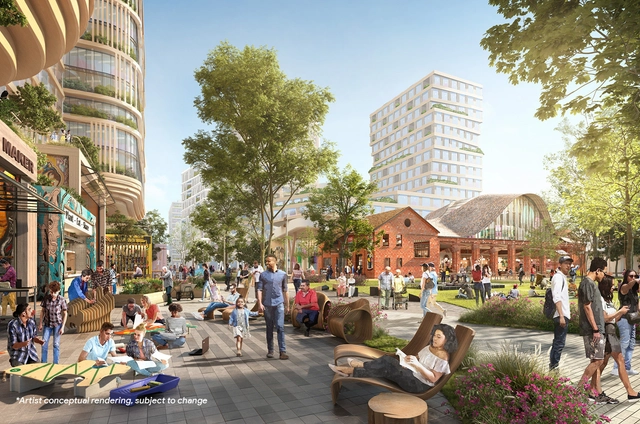
If the office is a small microcosmic city, then suburbia is the cubicle-strewn office, and Google might be the West Village. And ‘people analytics,’ the statistical and spatial analysis of interpersonal interaction, is the office’s urban planning.
To find out what creative work environments can learn from the composition of cities, keep reading after the break…
ArchDaily partners with Google for Google Nose BETA

Just to be clear.. this was after all our April Fools ;)
We know a good idea when we see it. That’s why as soon as we heard about Google Nose we decided to call our friends at Google and work something out between us. Google has the power to bring you the scent of food, animals, and all sort of things. But what about buildings? That’s where we come in.
You won’t have to travel to Sydney to smell the Opera House. Or fly thousands of miles to Pisa to catch the smell of “leaning”. Starting today, you will be able to smell every building in the world from your computer. So far, we’ve been trying Google Nose with the following:
- High Line Park on a rainy day (smells like wetness)
- Any of our AD Classics (smell old)
- Kumutoto Toilets (smells like crustaceans… what were you thinking?)
- Burj Khalifa (smells like gold)
- Barbie Shanghai Store (smells like cotton candy)
We only have one problem. There are probably dozens… or even hundreds of buildings worldwide! So we do need your help. Prepare your noses and get out there. Smell those buildings and share your scents with us in the comments. We will do our best to replicate the smells and share them with the world.

Google Collaborates with NBBJ to Expand California Headquarters

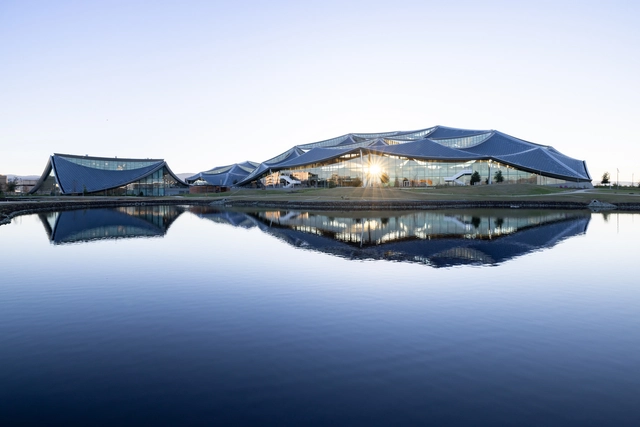
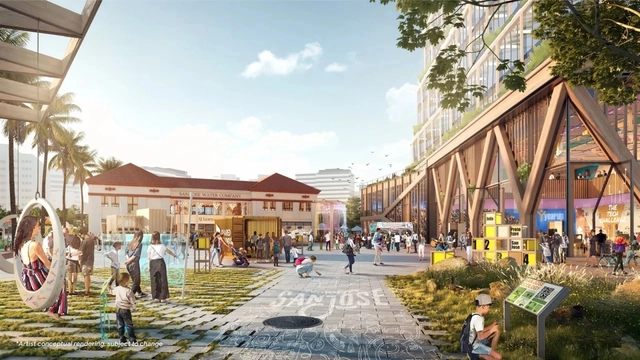
One thing Google has become known for is their spectacular work environments. From playful employee lounges to environmentally sensitive design, the multifaceted internet giant has successfully transformed hundreds of existing spaces from around the globe into casual work environments that spawn innovation, optimizes efficiency, and boasts employee satisfaction. Much like many other California-based corporations, Google has been toying with the idea of building their own office space from scratch. Well, this dream will soon be realized, as the company has teamed up with Seattle-based NBBJ to expand their current, 65-building “Googleplex” in Mountain View, California. By 2015, Google plans to construct a 1.1-million-square-foot complex known as “Bay View” on a neighboring 42-acre site.
More on Bay View after the break…
Google Glass and Architecture
Last year, Google founder Sergey Brin demoed Google Glass a new technology from the big G that puts an augmented reality display in front of your eye. The device is scheduled for early release to developers and creatives (in order to get feedback before the $1,500 product finds its way to the general public) in just a few weeks, but it has already been highly acclaimed by the media (including Best Inventions of the Year 2012 by Time).
On this video released by Google you can understand what all the hype is about. The 0.5″ display supported by a thin aluminium frame is placed in front of your right eye and thanks to its camera it serves as a two way interface with the Internet. As you can see on the video, natural language instructions (“Glass, take photo”, “Glass, record video”, “Glass, How long is the Brooklyn bridge?”) let you easily control the device and not only check emails or send messages, but also to display maps, definitions, and to share photos and videos in real time. In this aspect, the device opens a big door for architecture.
In our field, the experience is very important, and it is a dimension that hasn’t been able to be reproduced in its entirety through traditional media (plans, 2D or even 3D photos). Attempts to make immersive panoramas or the efforts of architecture photographers to embrace videos have extended the representation, but not in a significative way. And this is why travel is an important thing for the architect.
Imagine a tour broadcasted by the architects of the project, with the possibility of instant reader feedback to discuss a particular moment inside the building. Imagine finally experiencing the approach to the Parthenon like Le Corbusier did almost a century ago.
In this aspect, Google Glass will change the way we understand architecture media.
USGBC Announces Grant from Google to Accelerate the Advancement of Green Materials
Greenbuild, the world’s largest conference and expo dedicated to green building has commenced in San Francisco with an interesting announcement from the main stage. Google has granted $3 million to the U.S. Green Building Council (USGBC) in an effort to transform the building materials industry and accelerate the creation of healthier indoor environments.
“Healthy, non-toxic building materials are a critical component in green building,” said Rick Fedrizzi, President, CEO & Founding Chair, U.S. Green Building Council. “Fostering awareness of the materials we put into our buildings is of paramount importance, since many materials can link to a host of environmental and health issues. Working with Google enables us to broaden our efforts in the materials industry as we prepare for the next version of the LEED green building program, LEED v4. This updated rating system will paint a more complete picture of materials and products, enabling project teams to make more informed decisions.”
More after the break…
Google Releases Software Framework for Building Interactive Experiences in Physical Spaces

Google recently released a new, intriguing type of software, which allows programmers to make a room come alive with interactive spaces. The new software framework, which is called ‘Interactive Spaces’, works by providing a high-level architecture for building activities that respond to events in a room through ‘blob tracking’. As seen in the image above, an Interactive Spaces installation was used where ceiling-mounted cameras tracked the position of individuals in a room so that the software could display colored lights on the floor where they are standing. The source code, which will open the door for creative and design oriented minds everywhere, is distributed under the permissive Apache license and is available for download from a Mercurial repository hosted on Google Code here.
WMF partners with Google to Preserve World Heritage Sites

From the archeological areas of Stonehenge to the Hiroshima Peace Memorial, Google’s World Wonders Project is dedicated to digitally preserving and virtually sharing the World’s Heritage Sites. Users can explore some of the world’s greatest places through panoramic images, 3D laser scanned models, videos and informative text. Although Google World Wonders is a new and ongoing project, they already have more than 130 sites in 18 countries featured. The project is also an educational resource, allowing students and scholars to use the materials to discover some of the most famous sites on earth. A selection of free educational packages are available to download for classroom use.
Google World Wonders is made possible through the partnership of Google, UNESCO, the World Monuments Fund and Cyark, with a shared mission to preserve world heritage sites for future generations.
New York City Positioned to be the US’s Next Tech City

A report released by the Center for an Urban Future has positioned New York City as the fastest growing tech sector in the country, outpacing Boston to become the U.S.’s #2 Tech Hub (only behind Silicon Valley).
Its rapid growth – a 28.7% increase of tech-related jobs in five years and a 32% increase in venture capital deals (compare that to the national average of -11%) – has been attributed to the diversification of its startup tech companies, focused not on creating new technologies, but on providing technological solutions to existing industries.
However (as we noted earlier this week in “The Next Silicon Valley(s)“) there is another “key” factor to the city’s burgeoning innovation and entrepreneur scene – the city itself.
Read More on how New York City’s Urban lay-out is encouraging its technological boom, after the break.
The Next Silicon Valley(s)

HP, Apple, Google – they all found their success amongst the peach groves and Suburban houses of California. But why? What is it about Silicon Valley that makes it the site of technological innovation the world over?
It’s tempting to assume that the Valley’s success must be, at least in part, due to its design. But how does innovation prosper? What kind of environment does it require? In a recent interview with The Atlantic Cities, Jonah Lehrer, author of Imagine: How Creativity Works, suggests that creativity is sparked from casual exchanges, the mingling of diversity, the constant interaction with the strange and new. In short, and as a recent study corroborates, innovation flourishes in dense metropolises.
Seemingly then, Silicon Valley, a sprawl of highways and office parks, has become a hotspot of creativity in spite of its design. But let’s not write off design just yet.
As technology makes location more and more irrelevant, many are looking to distill the magic of Silicon Valley and transplant it elsewhere. The key will be to design environments that can recreate the Valley’s culture of collaboration. The future Valleys of the world will be microsystems of creativity that imitate and utilize the structure of the city.
The Motherships Are Landing: What Google’s New Headquarters Reveal About Apple 2
When Apple revealed the plans for their new campus in Cupertino, the responses to the “spaceship” were….varied, to say the least:
“Spectacular would be an understatement” ; “So disappointing…” ; a “…panopti-lawn…” ; and – my personal favorite – “Sphincter?” [1]
The announcement instigated a flurry of analyses and criticisms over the meaning of the design for the world – the Zen-like significance of the circle, the role of architecture in this technologically-driven age, the legacy and hubris of Jobs – but produced very little discussion over its meaning for the company itself.
Meanwhile, months before news of the “spaceship” landed, another internet giant was searching the California landscape for its own space to call home. Still very much under-wraps, the new Googleplex will be the first time Google builds a workplace completely from scratch. [2]
These projects will be the Magnum Opuses, the ultimate physical representations, of the two most influential Tech companies in the world, and the two share striking similarities. So let’s clash the plans of these two titans and take another look at Apple 2 – but this time in the light of Google – and see what they can tell us about these companies’ futures.
Caring for Your Office Introvert

“this open, ‘collaborative’ environment, where worker drones so nicely sit in poise out in the open while click-clacking on their computers, creates an atmosphere where people become desensitized to being on display. [...] Sitting and thinking is actually frowned upon as being a waste of productivity. Why are you just sitting there? Why are you not talking, or typing, or writing, or drawing, or multitasking?”
– Mark Genest, comment on “In Defense of Introverts” [1]
Consider the contemporary office. White floors, minimalist style, no pesky walls getting in the way – just pure, unadulterated openness.
From our assembly-line past has emerged an increasingly consumer-oriented world, in which collaboration and gregariousness are valuable commodities. As a result, offices that resemble art galleries – with the employees on display – have become the norm, and while this sociable environment is energizing for the extrovert, for the introvert, it’s crippling.
In my last article, “In Defense of Introverts,” I posited that learning modalities, which better incorporate our introverted brethren, could revolutionize classroom design. In this one, I expand the concept to that of working modalities: an answer for office design that would engender an office culture sensitive to introverted rhythms and – at last – expand the way we conceive of creativity and innovation as a purely extroverted enterprise.
“Memories for the Future” by Google

The devastating earthquake and tsunami that ravaged northeastern Japan in early March caused unimaginable damage and heartbreak to many. In response, Google has created a website named “Mirai e no kioku”, meaning “Memories for the Future”. The website allows the people of Japan to share photos and videos of their cities in an effort to preserve the memories collected over generations that may have been lost during the disaster. Google has also provided thousands of miles of Street View imagery that includes “Before” and “After” comparisons of the hardest hit areas.

Google to build sustainable Headquarters in Mountain View with Ingenhoven Architects

The award winning sustainable German architecture firm, Ingenhoven Architects, has been hired by Google Inc to design their new headquarters in Mountain View, California. Expected to begin construction in 2012, Ingenhoven approached the design with the idea that ‘the architecture should be an expression of the corporate culture and at the same time a model for sustainable architecture in the broadest sense surpassing the LEED-Platinum-Standards with its holistic concept’. Jordan Newman, a Google spokesman shared about Ingenhoven, “we’ve asked them to build the most green, sustainable building possible.”
Google’s offices in Milan, previously featured on ArchDaily can be viewed here. More about this exciting news from the architects following the break.
ArchDaily on Google Chrome
Our favorite browser is now Google Chrome. It works on every platform here at the office (Mac, Windows, Linux), it’s fast, secure, easy to use, helps you search the web and makes our life easier.
We also developed an extension for Google Chrome so you can see the latest projects featured at ArchDaily straight on your browser just as you can see on the image above. To install the extension just go to the Google Chrome Extensions link, click the Install button and follow the instructions.
If you want to further customize your Google Chrome, you can try the Michael Graves or Karim Rashid themes designed especially for the browser.
Happy browsing.
Google EMEA Engineering Hub / Camezind Evolution
Architects: Camenzind Evolution
Location: Zürich, Switzerland
Project Team: Stefan Camenzind, Tanya Ruegg
Client: Google Inc.
Site Managment: Quadras Baumanagement Ltd.
Building Engineering: Amstein + Walthert Ltd.
Office Furniture Consultant: Büronauten Ltd.
Catering Consultant: Planbar Ltd.
Project Area: 12,000 sqm
Project year: 2007
Construction year: 2007-2008
Photographs: Camenzind Evolution
Design It: Shelter Competition Winners announced
Over the course of the summer, Design It: Shelter Competition received submissions from people in 68 countries for a total of nearly 600 entries that met competition requirements. On the occasion of the Guggenheim Museum‘s 50th Anniversary, they are pleased to announce the two winning entries.
David Mares’s CBS – Cork Block Shelter, won the People’s Prize after receiving 64,875 votes out of more than 100,000 votes submitted online by voters around the world; and David Eltang’s SeaShelter, which was selected by a jury of architecture and design experts for the Juried Prize. Prizes include airfare and two nights accommodation for two in New York City, behind-the-scenes tours of the Guggenheim Museum and Google offices, and Google SketchUp Pro licenses.
Images of the two winners and videos from the competition after the break.
Google World Builder
The recent release of Google Sketchup 7.1 gave us powerful tools to easily create accurate models of urban contexts, with the integration of Street View for textures and better geo location of models.
And yersterday, Google released World Builder, a web based tool that enables users to easily model the buildings of 50 cities.
As you can see on the video it is very simple: you choose a regular volume to start with, and you adjust the width and height in views of the terrain from different angles, and voilá! you just modeled a part of the city, available for everyone at Google Earth and 3D Warehouse.
You can see the latest buildings modeled by users at 3D Warehouse… and if you refresh the page you will see how fast this is being populated.
Thank you Google :)
Google SketchUp 7.1 now available
This morning Google announced Google SketchUp 7.1. This new version will be a free upgrade for existing Pro users, and has emphasis on three important aspects of this easy-to-use (yet powerful and extensible) software: performance, an improved version of LayOut (2.1) and collaboration.
As for performance, the engine has been improved and you will notice that orbiting, zooming and drawing can be quicker and smoother in 7.1, for both PC and Mac editions.
LayOut 2.1, the SU componente that enables you to create presentation boards and design documents straight from your model, has now the ability to apply dimensions to scaled SU models and vector graphics. Based on my personal experience, LayOut is very good to deliver quick construction documents and has helped me a lot working with furniture manufacturers. The new dimension tool is something I was waiting for.
LayOut 2.1 also includes snap to the model, an improveed Freehand tool, lists (bullet or numbered, very useful) in the text area, improved grids and improved copy/paste, making it easier to work with other design softwares. You can see more on the video and images below.
Design It: Shelter Competition, remembering the Frank Lloyd Wright spirit
This year we not only celebrate the 142nd birthday of Frank Lloyd Wright, but also the 50 years of the Guggenheim, one of his master pieces (completed the year he passed away). These dates are not only commemorated with Lego Kits and exhibitions, but also with a very interesting competition held by the Guggenheim Museum and Google Sketchup.
The interesting part of the Design It: Shelter Competition is that it invites people from around the world to do pretty much what Wright made his apprentices at Taliesin: If you wanted to study to be an architect with Wright, you had to design and build a shelter in the desert outside of Phoenix, Arizona. Then you had to live and study in it, as it have been for the past 7 decades (you can see more of this at the Learn by Doing exhibition).
So, the competition invites people to design a small structure where someone might sleep and work. Your shelter should be created for a specific site anywhere in the world and geo-located in Google Earth. It also should conform to size constraints and must not include running water, gas or electricity. Then it must be submitted to Google 3D Warehouse, as described on the video (more details on how to enter here).
You can submit your shelter until August 23. After that, Taliesin students will pick 10 shelters for the People´s Choice Prize, and a jury will pick a shelter for the Juried Prize. You can read more about the prize and the jury here.
I like that this competition is not aimed to architects only, but to anyone who has a good idea for a shelter. As Frank Lloyd Wright, you don´t need formal architectural training, just a good idea and a pen. Or in this case, a 3d modeling tool easy and powerful as a pen.
Bonus: Architecture for Humanity decided to “hack” the competition, by adding a social component to it: The Purpose Prize. Instead of designing your shelter anywhere, do it for a specific community that can use your design to improve their living standard. So after submitting your entry to Google 3D Warehouse, submit it to the Open Architecture Network following these guidelines and you will be running for the Purpose Prize (US$500 + 10th Anniversary AFH Moleskine Folio). But the most important, you will be helping a community with your design skills, even if you don´t get awarded.
Buy Google Sketchup Pro 7, get $100 off

While walking around the booths at the AIA 2009 Convention, I stopped by Google, who are not only presenting Sketchup 7 but also showing architects how to market their firms using AdWords and YouTube.
Also, they have a very good discount for those of you who want to buy Google Sketchup Pro 7: a $100 off (retails at $495).
So, if you were looking to buy the latest version of one of the most easy (yet powerful) modeling tools just head to their store and use promo code SUAIA9, valid until May 15, 2009 on single-user licenses only.
You can also download the basic version for free.