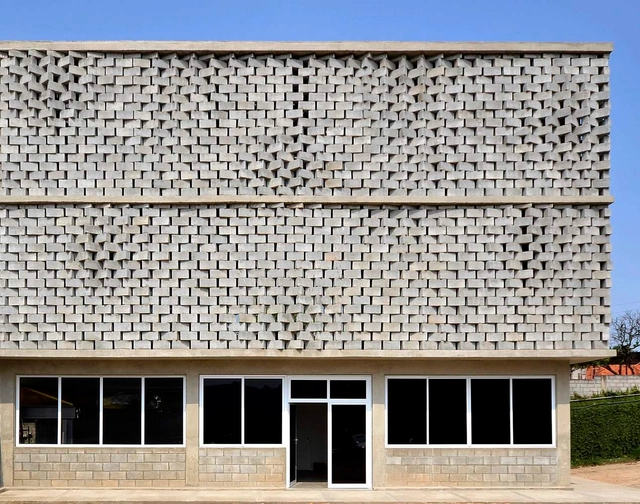
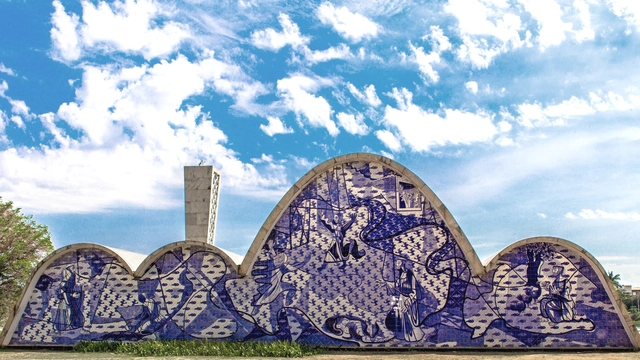
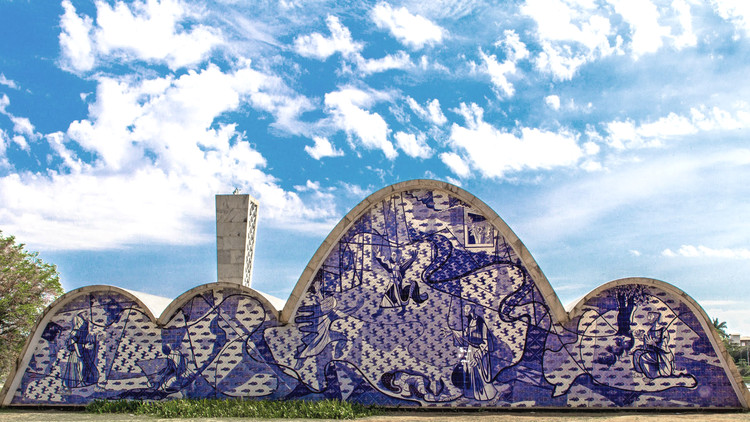
"I felt like I was Nino Rota and Oscar Niemeyer was Fellini, it was like I was creating an important piece of music in that work of art." Renowned visual artist Athos Bulcão uses this comparison between the Italian composer and the film director to refer to the relationship between his work with ceramic tiles and architecture. This fusion between art and architecture marked an important period in the history of Brazil, shedding light on issues such as national identity, the massification of art, and architectural techniques aimed at the tropical climate.
As the prefix already indicates, postmodernism is a turning point in history, thereby proving the willingness of scholars to define this new era based on the rejection of the previous movement. Postmodernism first emerged in the 1960s as a departure from modernism. As a reaction against the austerity, formality, and lack of variety of modern architecture, particularly in the international style advocated by Le Corbusier and Mies van der Rohe, postmodernism defends an architecture full of signs and symbols that can communicate cultural values. Postmodernism is a reaction to homogeneity and tediousness by praising difference and striving to produce buildings that are sensitive to the context within which they are built.
Charles (June 17, 1907 – August 21, 1978) and Ray Eames (December 15, 1912 – August 21, 1988) are best known for their personal and artistic collaboration and their innovative designs that shaped the course of modernism. Their firm worked on a diverse array of projects, with designs for exhibitions, furniture, houses, monuments, and toys. Together they developed manufacturing processes to take advantage of new materials and technology, aiming to produce high-quality everyday objects at a reasonable cost. Many of their furniture designs are considered contemporary classics, particularly the Eames Lounge & Shell Chairs, while the Eames House is a seminal work of architectural modernism.
https://www.archdaily.com/642966/spotlight-charles-and-ray-eamesArchDaily Team
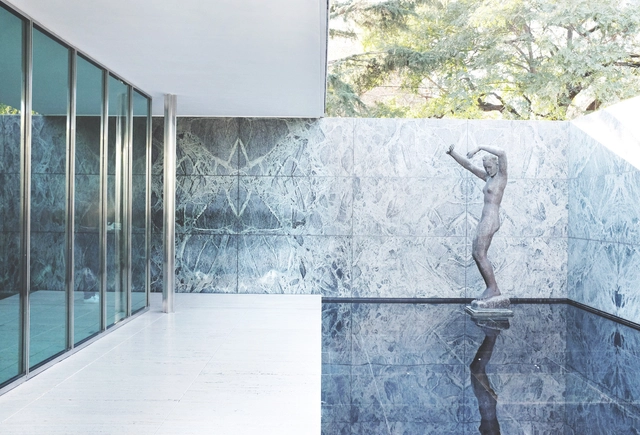
Ludwig Mies van der Rohe (27 March 1886 – 17 August 1969) is one of the most influential architects of the 20th century, known for his role in the development of the most enduring architectural style of the era: modernism. Born in Aachen, Germany, Mies' career began in the influential studio of Peter Behrens, where Mies worked alongside two other titans of modernism, Walter Gropius and Le Corbusier. For almost a century, Mies' minimalist style has proved very popular; his famous aphorism "less is more" is still widely used, even by those who are unaware of its origins.
Architect John S. Chase with his sons Anthony (left) and John, Jr. (right). The trio stand in front of the Chase Residence, built in 1959. Image Courtesy of John and Drucie Chase Collection, African American Library at the Gregory School, Houston Public Library
The following text is excerpted fromJohn S. Chase — The Chase Residence(Tower Books, 2020) by architect and University of Texas professor David Heymann and historian and Rice University lecturer Stephen Fox. Richly illustrated with archival materials and new drawings, the book is the first devoted to Chase, who was the first Black licensed architect in Texas. The study is divided into two parts, with Heymann examining the personal, social, and architectural significance of Chase’s own Houston house and Fox describing Chase’s architectural career.
This excerpt draws on Heymann’s analysis and highlights the first incarnation of the Chase Residence (Chase substantially altered its architecture in 1968). It places great emphasis on the house’s remarkable courtyard, a modernist innovation, and a singular statement about domestic living at the time. New section, elevation, and perspective drawings prepared for the book help illustrate the ingenuity of the house’s configuration. Finally, the excerpt was selected in part to honor Drucie (Rucker) Chase, who passed away in January of 2021.
Liminal spaces are everywhere, both literally, and as a popular topic of intrigue on Reddit and other image-sharing platforms. Posting photographs of empty dilapidated spaces followed by collective reminiscing of childhood experiences is proving to be a popular activity these days. At one time or another, the spaces depicted in these eerie photos seemed like a good idea, a useful solution to the problem of providing shelter for crowds in the act of movement or commerce. Architecture had specific terms for these spaces too and defined them through theories that explained their role in our culture. In this video, architectural professor Stewart Hicks presents how architects think about liminal spaces, what goes into them, why they exist, and why some architects and artists still work to produce their effect.
The Architectural realm has always been torn between artistic and rational cosmos. During our architectural studies, we are rarely given one specific methodology with which we can approach a project, resulting in diverse outcomes and methods of designing. However, in order for us to discover our personal stand, we must look back at the logic and philosophy of the great pioneers who influenced architecture before us.
Le Corbusier, Mies van der Rohe, Frank Lloyd Wright, and Louis Kahn are four of the most notable architects to date. Read on to find out more about the creative process of these four leaders of the modern era, and why their projects and practices are still influential to our modern times.
Grupo BANGA. Em sentido horário: Yolana Lemos, Kátia Mendes, Gilson Mendes, Mamona Duca e Elsimar de Freitas. Image Cortesia de Grupo BANGA
Investing in virtual projects has probably never been more timely, after all, we have been partially deprived of contact with the concrete world. Exploring the singularities of the present moment and the power of online engagement, a group of architects from Angola started an ambitious work: pursuing a new identity for Angolan architecture.
Formed by Yolana Lemos, Kátia Mendes, Mamona Duca, Elsimar de Freitas, and Gilson Menses, Grupo BANGA is responsible for the project Cabana de Arte (Art Hut), which combines the efforts of young architects and artists from Angola in virtual works that seek to bring visibility to emerging professionals and bring architecture closer to people's daily lives.
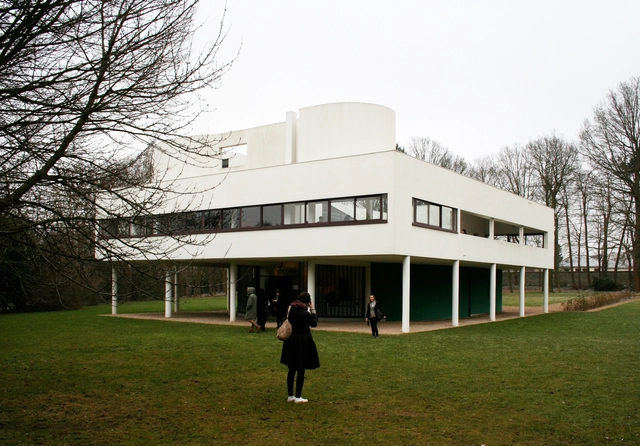
In 1926, Le Corbusier developed the five points that would become the foundations for modern architecture. Once materialized in 1929 in the iconic Villa Savoye project, Le Corbusier's principles - pilotis, free design of the ground plan, free design of the facade, horizontal window, and roof garden - have been extensively explored in modern architecture and continue to influence the most diverse contemporary architectural projects to this day.
The five points became a kind of guideline for the New Architecture, as Corbusier used to call it. Even after decades, new technologies, materials, and demands of society have continued to update those architectural solutions, announced almost a century ago as the basis for a new architecture.
How did modern architecture happen? How did we evolve so quickly from architecture that had ornament and detail, to buildings that were often blank and devoid of detail? Why did the look and feel of buildings shift so dramatically in the early 20th century? History holds that modernism was the idealistic impulse that emerged out of the physical, moral and spiritual wreckage of the First World War. While there were other factors at work as well, this explanation, though undoubtedly true, tells an incomplete picture.
A graphic shows some early microclimate-tailored strategies detailed in "Modern Architecture and Climate: Design Before Air Conditioning" by Daniel A. Barber. Image Courtesy of Princeton University Press
It’s easy to think of Modernism as inseparable from air conditioning, simply because we are surrounded by so much of it that is. A valuable reminder that this wasn’t always the case is provided in University of Pennsylvania architecture professor Daniel A. Barber’s Modern Architecture and Climate: Design Before Air Conditioning (Princeton University Press), which outlines the story of the febrile, flexible, and often-forgotten early experiments in climate control.
Design diagram for the City of Culture of Galicia, Spain. Image Courtesy of Eisenman Architects
If we define deconstructivism, it literally translates to the breaking down, or demolishing of a constructed structure, whether it being for structural reasons or just an act of rebellion. It is perhaps for this reason that many misunderstand the Deconstructivist movement.
Deconstructivism is, in fact, not a new architecture style, nor is it an avant-garde movement against architecture or society. It does not follow “rules” or acquire specific aesthetics, nor is it a rebellion against a social dilemma. It is the unleashing of infinite possibilities of playing around with forms and volumes.
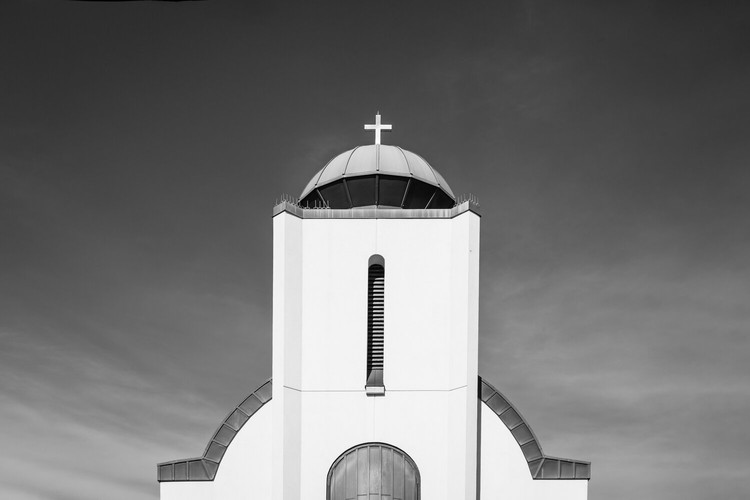
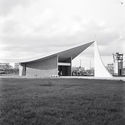
Between the late 1940s to the 1980s, Toronto, Canada, experienced a high rate of growth and development, resulting in a wealth of modernist-style buildings. Due to an increasing population, parishes were also outgrowing their spaces and found themselves in need of new facilities. Consequently, many well-designed modernist churches began to pop up throughout Toronto. This black and white photography series, titled Fifty/50 by Amanda Large, is an ode to these churches, and a celebration of their enduring importance to the city more than fifty years after their construction.
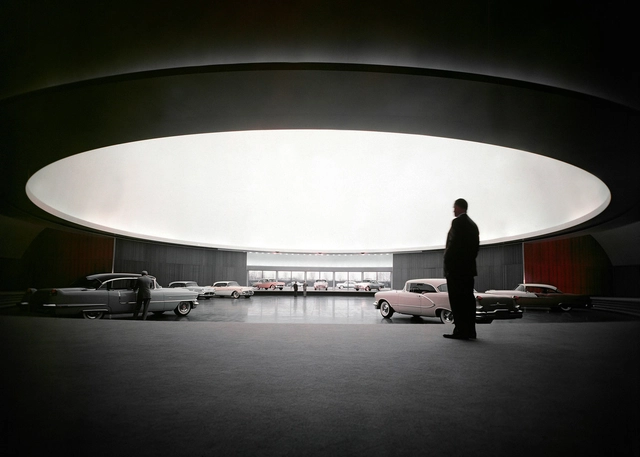
The General Motors Technical Center fascinates with architecture filled with an abundance of light. Interior offices and showrooms evoke the impression of a calm overcast sky for a human environment and beauty. The campus designed by Eero Saarinen represents an influential icon of midcentury design. Susan Skarsgard's book "Where Today Meets Tomorrow" opens intriguing perspectives to the origin of the American landmark.
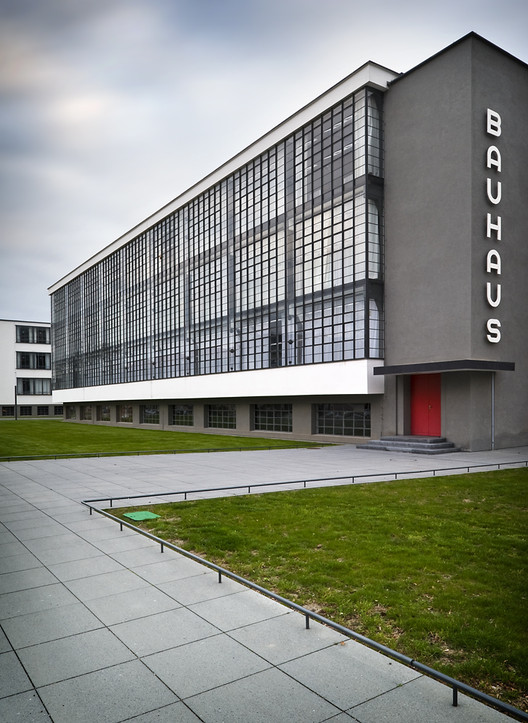
One of the most highly regarded architects of the 20th century, Walter Gropius (18 May 1883 – 5 July 1969) was one of the founding fathers of Modernism, and the founder of the Bauhaus, the German "School of Building" that embraced elements of art, architecture, graphic design, interior design, industrial design, and typography in its design, development and production.
Architects throughout the modern era have displayed their fantasies through their designs and their obsessions with how women have inhabited them. Take for example Corbusier’s infatuation with Eileen Gray and her home, E. 1027. Plagued with unconfirmed tales of how he broke into her home to paint murals on the white walls, he was also known to publicly downplay the home's design, while conversely praising it in a series of unreciprocated love letters to Gray. In the same vein, while Adolf Loos stood firmly against architectural decoration, he perhaps supported the elegance of women acting as a human ornament, an assumed notion in his envisioned home for the French Entertainer, Josephine Baker. The unbuilt proposal took on the form of a black and white striped solid which located a glass pool at the center of the space, forcing Baker to catch the male gaze of other occupants.
The relationship of sensuality and space doesn’t stop with the provocative desires of these three men, but lives on in one of the world’s most famous publications, Playboymagazine. Perhaps best known for its significance as a vanguard in the sexual revolution with its promotion of masculinity, the magazine also illustrated a showcase of swanky glass bachelor pads standing high above Beverly Hills that pushed forward a debonair lifestyle punctuated by modern design. As a generator of a glamorized lifestyle, the magazine highlighted architectural titans including Mies van der Rohe, Bucky Fuller, and Eero Saarinen, and made them palatable to a general audience.
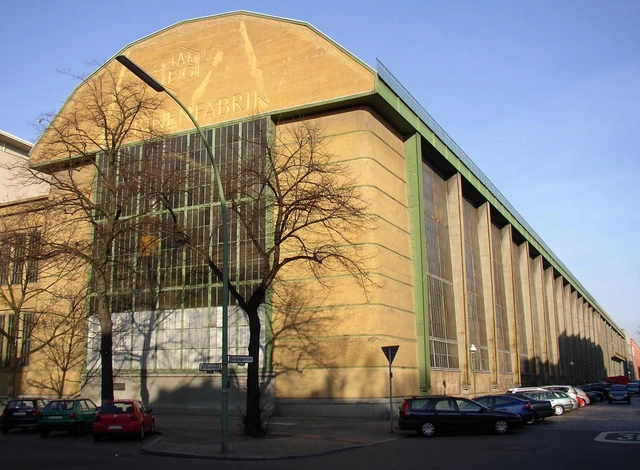
If asked to name buildings by German architect and designer Peter Behrens (14 April 1868 – 27 February 1940), few people would be able to answer with anything other than his AEG Turbine Factory in Berlin. His style was not one that lends itself easily to canonization; indeed, even the Turbine Factory itself is difficult to appreciate without an understanding of its historical context. Despite this, Behrens' achievements are not to be underestimated, and his importance to the development of architecture might best be understood by looking at three young architects who worked in his studio around 1910: Le Corbusier, Mies van der Rohe, and Walter Gropius.

.jpg?1625088987&format=webp&width=640&height=580)



.jpg?1625088987)
.jpg?1592346164&format=webp&width=640&height=580)





_-_Vista_da_Praça.jpg?1601059705 "Projeto arquitetônico virtual para a exposição \"Tchitundu-Hulu, a história resgatada\". Image Cortesia de Grupo BANGA")
_-_Planta_de_Cobertura.jpg?1601059767 "Planta do projeto para a exposição \"Mfwanana, Dialetos da Terra\". Image Cortesia de Grupo BANGA")
_Eu_sou_o_sol_-_as_marcas_perpetuadas_em_mim_(2)_-_Sala_de_Exposição.jpg?1601059792 "Projeto arquitetônico virtual para a exposição \"Eu sou o sol - as marcas perpetuadas em mim\". Image Cortesia de Grupo BANGA")









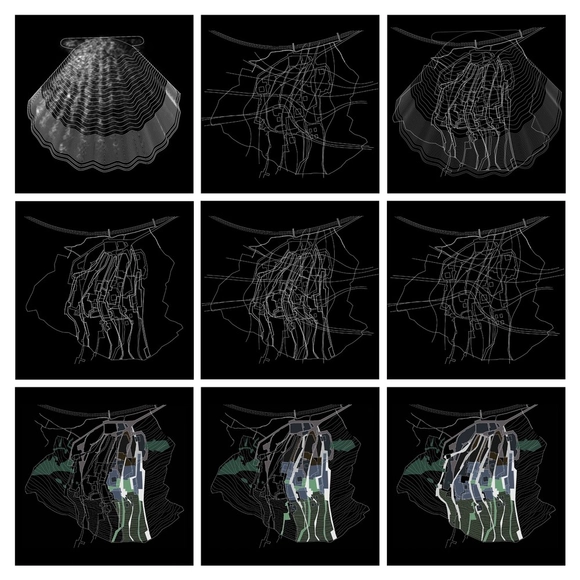
.jpg?1597099445 "Parc de la Villette / Bernard Tschumi Architects. Image © Peeradontax | Shutterstock")