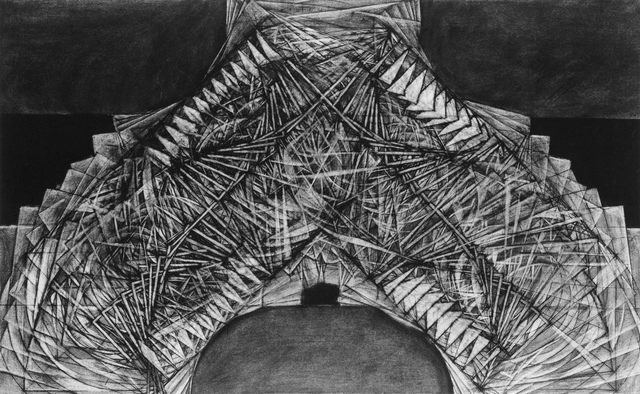
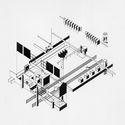
Author: Christian Dickson. Project Title: The Mark of Cain and Cain’s Mark. Course/AY: Thesis, 1991-92. Professors: John Hejduk, Roderick Knox, Sean Sculley, Regi Weile. Image Courtesy of The Irwin S. Chanin School of Architecture Archive, The Cooper Union
Drawing together the works of Elizabeth Diller,Laurie Hawkinson, Daniel Libeskind, and others, the exhibition titled “Archive and Artifact: The Virtual and the Physical” presents hand-drawn, digital, and three-dimensional works.
What comes to mind when you encounter the term “sensory design”? Chances are it is an image: a rain room, a funky eating utensil, a conspicuously textured chair. But the way things actually feel, smell, even taste, is much harder to capture. This difficulty points to how deeply ingrained the tyranny of vision is. Might the other senses be the keys to unlocking broader empirical truths? Does the ocular-centric bias of art, architecture, and design actually preclude a deeper collective experience?
It is so refreshing to hear the words: “We do everything differently. We think differently. We are still not a part of any system or any group.” In the following excerpt of my recent conversation with Liz Diller and Ric Scofidio at their busy New York studio we discussed conventions that so many architects accept and embrace, and how to tear them apart in order to reinvent architecture yet again. In New York the founding partners of Diller, Scofidio + Renfro have shown us exactly that with their popular High Line park, original redevelopment of the Lincoln Center, sculpture-like Columbia University Medical Center in Washington Heights, and The Shed with its movable “turtle shell” that’s taking shape in the Hudson Yards to address the evolving needs of artists because what art will look like in the future is an open question.
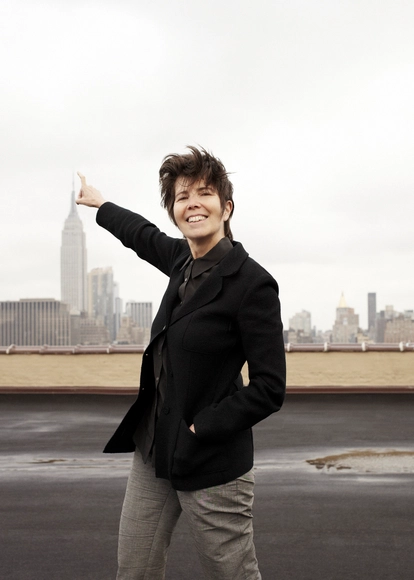
Architect Elizabeth Diller of firm Diller Scofidio + Renfro has once again been named one of TIME’s most influential people in 2018. TIME Magazine’s annual ‘Time 100’ List recognizes the achievement of artists, leaders, activists, entrepreneurs, and athletes who are exemplary in their fields. Diller has been named to the category of “Titans,” along with Roger Federer, Oprah Winfrey, Jeff Bezos, Elon Musk and Kevin Durant. This is Diller’s second time on the list but the first time being honored as a "Titan."
Other honorees this year include Shinzo Abe, Justin Trudeau, Xi Jinping and Jimmy Kimmel.
What is the role of sound and acoustics in the work of leading architecture practices? In February this year, reSITE and MAAT in collaboration with Meyer Sound hosted RESONATE: Thinking Sound and Space, a conference focused exclusively on the intersection of architecture and sound.
What is the relationship between art and architecture? What makes a great space for art? How do buildings inform what and how we see? Leading architects will be in conversation with museum directors, gallerists and artists to discuss major international projects and the role of architecture in shaping the cultural landscape.
At this morning’s press event, The Museum of Modern Art in New York (MoMA) unveiled the completed renovations to the east end of its museum campus, while also revealing for the first time the full design of their multi-year expansion project designed by Diller Scofidio + Renfro in collaboration with Gensler.
With the completion of the east wing renovation, which began in February 2016, the museum has created two spacious third-floor galleries by reconfiguring 15,000 square feet of space, allowing for better flexibility in installing the collection and temporary exhibitions.
Continuing in her firm’s tradition of blurring the lines between architecture, art and environment, Elizabeth Diller, founding partner of Diller Scofidio + Renfro, is producing an opera for the High Line. Dubbed the “Mile Long Opera,” the production will be set along New York’s new favorite attraction, which was designed by DS+R with James Corner and Piet Oudolf and opened to the public in 2009.
Blur Building. Exposition Pavilion: Swiss Expo, Yverdon-Les-Bains, 2002. Architects: Diller Scofidio + Renfro. Image Courtesy of Diller Scofidio + Renfro
Today, the MacArthur Foundation announced the 23 recipients of their 2016 MacArthur Fellowship Grants, which are awarded annually “to encourage people of outstanding talent to pursue their own creative, intellectual, and professional inclinations.” Each fellowship comes with a stipend of $625,000 for the recipients to use for individual pursuits, paid out in equal quarterly installments over a five year period. Fellows are selected based on 3 criteria: exceptional creativity, promise for important future advances based on a track record of significant accomplishment, and potential for the fellowship to facilitate subsequent creative work.
This year’s fellows include artists, playwrights, geobiologists, poets, jewelrymakers, novelists and historians, but, for the fifth straight year, no architects. In the program’s 36 year history, just 6 recipients have come from architecture-related fields.
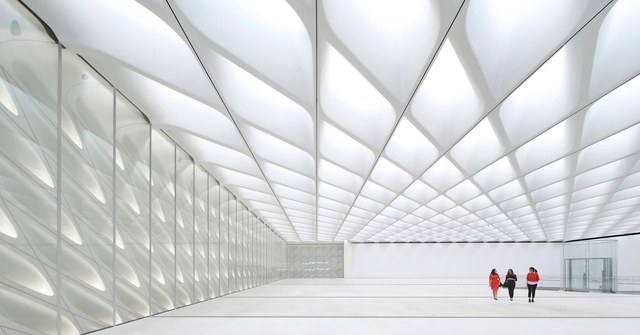
The Broad has officially opened its doors in downtown Los Angeles. Taking four years to complete, the highly anticipated, 120,000-square-foot building houses a prominent collection of postwar and international contemporary art owned by billionaire philanthropists Eli and Edythe Broad. During the press preview, VernissageTV caught up with the building's architect, Elizabeth Diller of Diller, Scofidio + Renfro, to gain a better understanding of The Broad's “veil over the vault" concept.
No matter what you think of it, these days there is no denying that a celebrity culture has a significant effect on the architecture world, with a small percentage of architects taking a large portion of the spotlight. Questioning this status quo, Vladimir Belogolovsky's new book "Conversations with Architects in the Age of Celebrity" interrogates some of these famous architects to find out what they think of the culture which has elevated them to such heights. In this excerpt from the book's foreword, Belogolovsky asks how we got into this celebrity-loving architectural culture, and what it means for the buildings produced.
The 35-year career of Elizabeth Diller, a founding partner of the New York–based architecture studio Diller Scofidio + Renfro, is a study of contrasts: conceptual and pragmatic, temporary and permanent, iconoclastic and institutional. After graduating from Cooper Union in 1979, Diller started her practice mounting temporary installations with her partner and future husband, Ricardo Scofidio, their interests leaning closer to art and theory than conventional buildings and construction. Today the duo—along with Charles Renfro, who became a partner in 2004—is responsible for some of the most important architectural projects in the country. DS+R counts Boston’s Institute of Contemporary Art (completed in 2006) and a makeover of New York’s Lincoln Center (finalized in 2012) among its highest-profile works. Especially influential, at least among architects and academics, has been the firm’s unbuilt Slow House (1991), a proposal for a residence on Long Island, New York, renowned for its examination of how we see in a media-saturated world.
One notices sharp contrasts not just in the firm’s work history but in its public reception as well. Widely lauded for repurposing a dilapidated elevated railway into New York City’s beloved High Line park (the third phase opened in September), DS+R received heavy criticism this year for its involvement in a major expansion proposal for the Museum of Modern Art. The museum’s plans included the demolition of its little-guy neighbor, the American Folk Art Museum; despite efforts to work the idiosyncratic building into the design scheme, Diller’s studio, hired to lead the expansion, ultimately acknowledged that the structure couldn’t be saved.
Surface recently met with Diller at her office in Manhattan to speak about the ensuing controversy, as well as early career experiences that have influenced her firm’s recent commissions for cultural institutions, including the current exhibition “Musings on a Glass Box” at the Cartier Foundation in Paris (through Feb. 25, 2015), a collaboration with composer David Lang and sound designer Jody Elff. Diller, 60, is pensive and surprisingly relaxed for someone whose aides are constantly interrupting her to remind her of meetings she has to attend. She speaks with an erudite inflection befitting her academic credentials and professional accolades (she is, after all, a professor at Princeton and a MacArthur “genius grant” recipient), though she smiles with the ease of an affable neighbor.
https://www.archdaily.com/569298/surface-mag-interviews-liz-diller-on-architecture-art-and-early-aha-momentsDave Kim
Videos
Rendering of the garden entrance of the new MoMA, by Diller Scofidio + Renfro. Image Courtesy of MoMA
Yesterday, Glenn Lowry, director of the Museum of Modern Art (MoMA), and Elizabeth Diller, principal of Diller Scofidio + Renfro, presented their plans for the MoMA expansion to an audience in New York City, insisting - once again - that they require the demolition of the American Folk Art Museum.
The presentation was part of a larger event, "A Conversation on the Museum of Modern Art’s Plan for Expansion," presented by The Architectural League, the Municipal Art Society, and the American Institute of Architects New York Chapter. After Lowry and Diller reiterated their case, a panel of experts - including the editor of Architectural Record, Cathleen McGuigan, and critic Nicolai Ouroussoff - gave their opinions on the subject (some panelists spousing particularly anti-MoMA sentiments). ArchDaily was there to catch the conversation; read on after the break for the highlights.