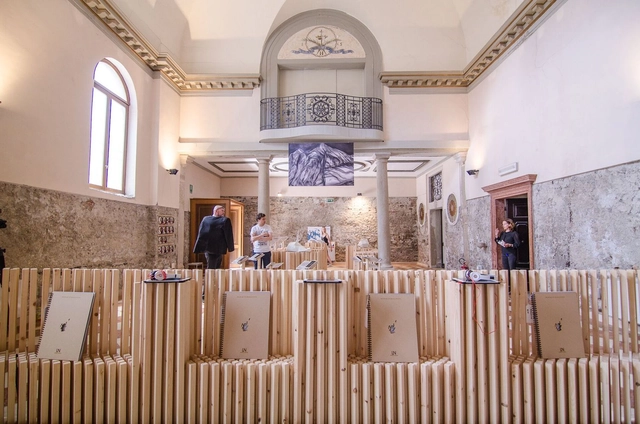
As director of the 2016 Venice Biennale, Alejandro Aravena has sought to shift the very grounds of architecture. Rather than an inward-looking interrogation of the profession's shortcomings, as Rem Koolhaas undertook in 2014, the Chilean Pritzker Prize-winner asks us to gaze in the opposite direction—to the vast swathes of the built horizon that traditionally lay beyond the profession's purview: urban slums, denatured megacities, conflict zones, environmentally compromised ports, rural villages far off the grid.
"We believe that the advancement of architecture is not a goal in itself but a way to improve people’s quality of life," states Aravena in his introduction to event. In other words, his biennale does not ask what architecture ought, yet often fails, to be, but rather what it could, yet often forgets, to do.
Stereotomic architecture is characterized by two strong themes: the continuity of the forces of gravity to the ground, into the soil; and the search for natural light, which drills through the massive, solid walls to illuminate and allow habitation by the human being. It’s from these themes that this project takes its power.
Today we present to you May’s Project of the Month, the San Bernardo Chapel, which in its search to transform ecclesiastic symbolism uses nature as a way of ritual expression. The client required a place in a remote location that accommodated religious acts and rituals, in a context in which time is reflected by the use of recycled materials—materials that have been a part of the place for more than 100 years. This established construction criteria based on ancient masonry techniques. However, the project also involved the use of new materials in the interior of the work, creating an interesting play of textures.
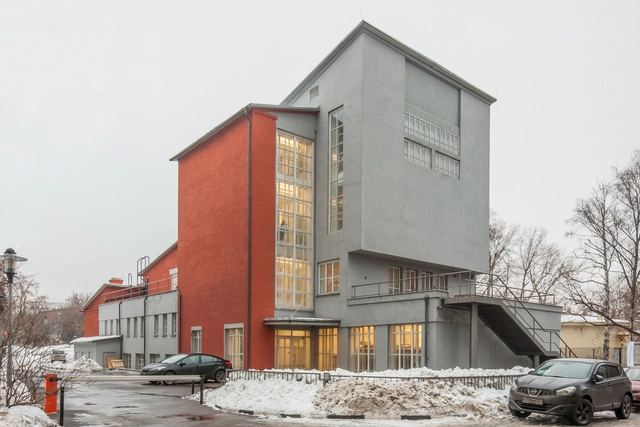
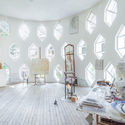
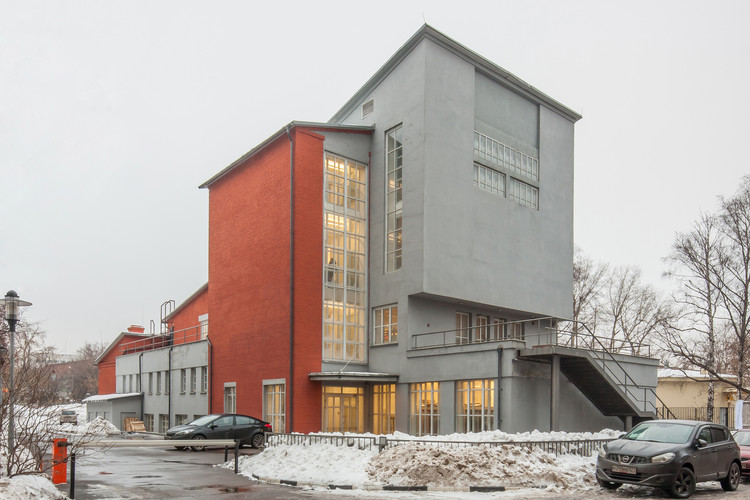
Konstantin Melnikov (August 3, 1890 – November 28, 1974) played a key role in shaping Soviet Architecture from the mid-twenties to mid-thirties, despite being independent from the Constructivists who dominated architecture at the time. Besides his well-known pavilion for the USSR at the 1925 Exposition des Arts Decoratifs in Paris, Melnikov was famous in Moscow for his workers’ club building, for his own house, and for his bus garages.
With this recent photoset, photographer Denis Esakov (who is now looking for a publisher to produce a photobook featuring the full set of almost 600 images) has created a unique opportunity to explore – both inside and out – all 12 Melnikov projects that shaped Moscow’s Architecture during the Soviet Era.
The theme for this year’s Venice Biennale is largely an invitation for architects and designers to expand and think beyond architecture’s traditional frontiers and to respond to a wider range of challenges relating to human settlement. With news of political crises continuing to fill the headlines of late, Aravena’s theme challenges architects to respond. One such response comes from Lucas Boyd and Chad Greenlee from the Yale School of Architecture. They believe that:
While [places of worship] do not provide a basic need for an individual’s biological survival, they do represent a fundamental aspect of not only an individual’s life beyond utility, but an identity within the collective, a familiar place of being—and this is something that we consider synonymous with being human—a requirement for the persistence of culture.
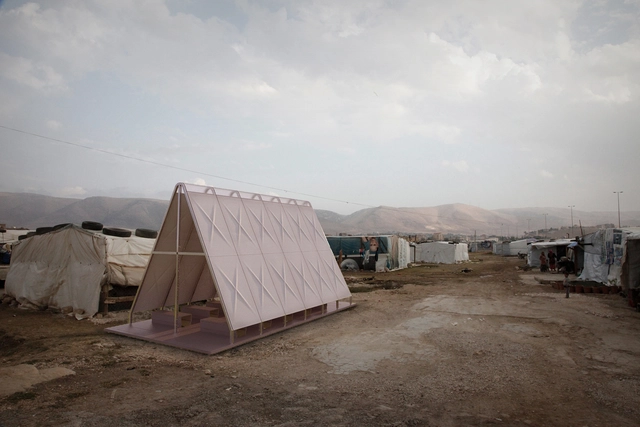
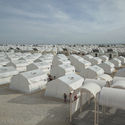
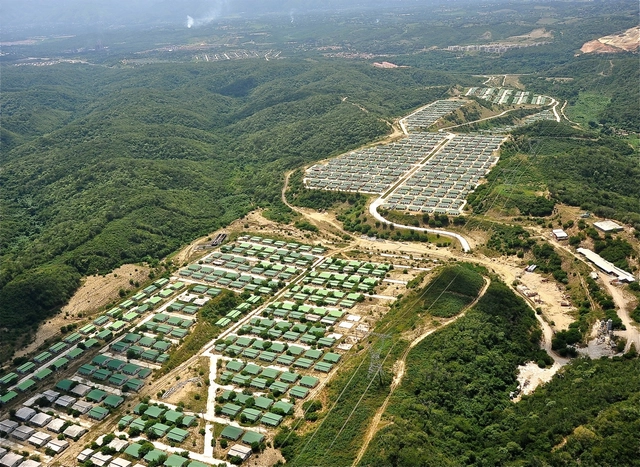
The two students came up with proposal designs on churches, synagogues and mosques that can be quickly built as “Pop-Up Places of Worship” in refugee camps. By presenting immediately-recognizable sacred spaces that are transportable and affordable, Boyd and Greenlee highlight spaces for worship as an absolute necessity in any type of human settlement. Through this process, the students also determine what, for them, is “necessary” in a religious structure.
The following interview with Adrian Lahoud was first published by Volume Magazine in their 48th issue, The Research Turn. You can read the Editorial of this issue, Research Horizons, here.
The political left has had a rough few decades; everything just seems to be going in the other direction. Instead of romanticizing what it would be like "only if," we’d better get to work on figuring out how to turn the engine of progress around. Volume spoke with Adrian Lahoud about the stakes of architectural research within the academy today and how it might contribute to moving towards the horizons of the left.
This year ArchDaily celebrates 10 years since it was first launched in Spanish as Plataforma Arquitectura. To commemorate, we sorted through the thousands of projects that have been published over the years to highlight those that represented a milestone for their time.
We also reviewed the most popular projects from each one of our sites – those that our readers highlighted through their many visits. Afterwards, we asked each one of the architects to send along additional material for their project, taking advantage of new technologies that exist and that can help our readers better understand the works.
The compilation of this material allows us to present our selection of the Top 100 Projects. These 100 projects make up a list of interesting case studies and references for millions of architects, students and specialists who are in search of the most important and inspiring projects from around the world. This section will have greater visibility on our site, exponentially increasing the global impact and opportunities that these projects can create.
https://www.archdaily.com/789165/top-100-projectsAD Editorial Team
Montréal’s CCA (Canadian Centre for Architecture), the international museum and research center which was founded by Phyllis Lambert in 1979 and is currently directed by Mirko Zardini, has launched a new iteration of its website. The organisation’s new online presence has been conceived as an active editorial project which aims for more than dissemination of information alone; rather, it will take positions and—being organised around several themes such as “The Planet is the Client,” “Origins of the Digital” and “Technology Sometimes Falls Short”—will reflect the CCA’s ongoing research interests.
This interview with Zardini has been conducted by Steffen Boddeker (currently Director of Communications at Columbia University Graduate School of Architecture, Planning and Preservation – GSAPP), who has worked with the CCA as a communications and online consultant overseeing its web presence since 2006.
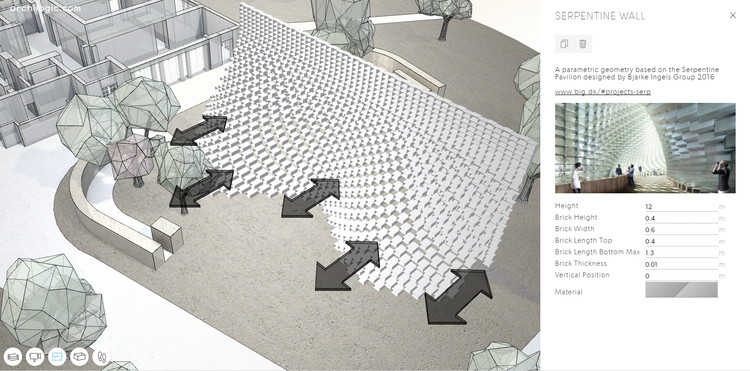
Every year the Serpentine Gallery commissions an Architect to design a pavilion which will sit on its lawn, greeting the hundreds of thousands of people who will visit over the summer months. Temporary pavilions like this are an important chance for architects to test new ideas, and to communicate to the public what architecture is and could be.
Unless you’re in London, you may not get the opportunity to visit the pavilion physically, but thanks to the web we can take you there virtually.
As part of ArchDaily's coverage of the 2016 Venice Biennale, we are presenting a series of articles written by the curators of the exhibitions and installations on show.
People wearing the huge sculptural head of a unicorn has become one of the most surreal images to be seen at this year’s 15th Venice Architectural Biennale.
Part of the Prospect North exhibition at the Scottish Pavilion, which is jointly produced by Lateral North, Dualchas Architects and Soluis, a design-visualization studio from Glasgow, the heads of the unicorn, moose and polar bear allows you to enter an immersive virtual reality world of the Highlands past, present and future.
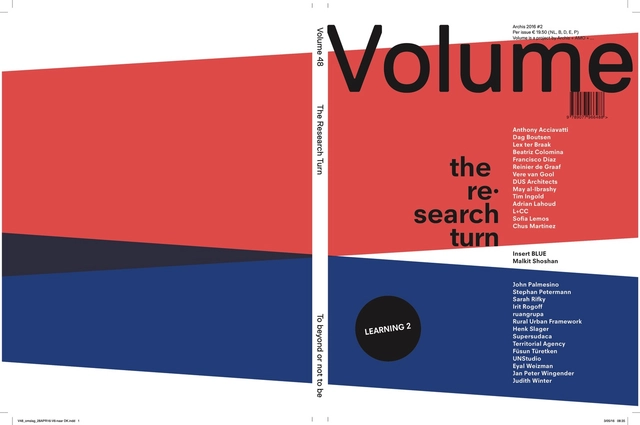
Volume #48: The Research Turn is comprised entirely of interviews and conversations. We wanted to learn from those who have been instrumental in shifting the boundaries and shaping today’s landscape of creative knowledge production. The issue also includes the catalogue for BLUE: Architecture of UN Peacekeeping Missions by Malkit Shoshan, the Dutch contribution to the 15th Venice Architecture Biennale.
Over the coming weeks Volume will share a curated selection of essays from this issue on ArchDaily. This represents the continuation of a partnership between two platforms with global agendas: in the case of ArchDaily to provide inspiration, knowledge and tools to architects across the world and, in the case of Volume, "to voice architecture any way, anywhere, anytime [by] represent[ing] the expansion of architectural territories and the new mandate for design."
https://www.archdaily.com/788861/introducing-volume-number-48-the-research-turnAD Editorial Team
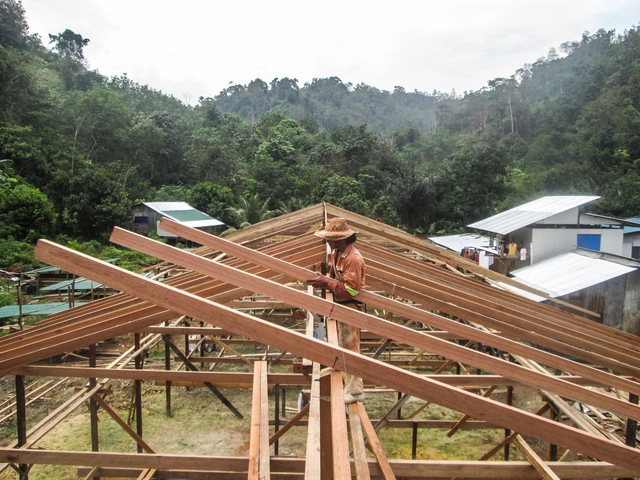
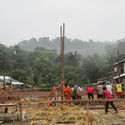
A version of this essay, originally titled "Rumah in the woods: Resurrection of the Nanga Sumpa Longhouse," reached the top 8 in this year's Berkeley Prize. It was shared with ArchDaily by the authors.
These bodies are perishable, but the dwellers in these are indestructible and impenetrable.
This verse from Bhagavad Gita (a Hindu religious scripture) speaks about the human body and soul. For me, even a piece of architecture has a soul which rests in its place. We can feel its presence even when the building is no longer there.
ArchDaily is continuing our partnership with The Architectural Review, bringing you short introductions to the themes of the magazine’s monthly editions. In this introduction to the May 2016 issue on Indian architecture, Editor Christine Murray highlights just some of the challenges facing the world's second most populous country, arguing for a more respected architecture profession that will be well-equipped to solve those problems.
When I think of Indian architecture, visions of Chandigarh dance in my head. India has long been a country in which to build out dreams. But with a legacy of outsourcing design to the West, for too long it has been subject to the long-arm imposition of utopian ideas.
From Lutyens to Le Corbusier, rarely have these idealistic foreign interventions made adequate provision for the nation’s rapid urbanization and vast numbers of urban poor.
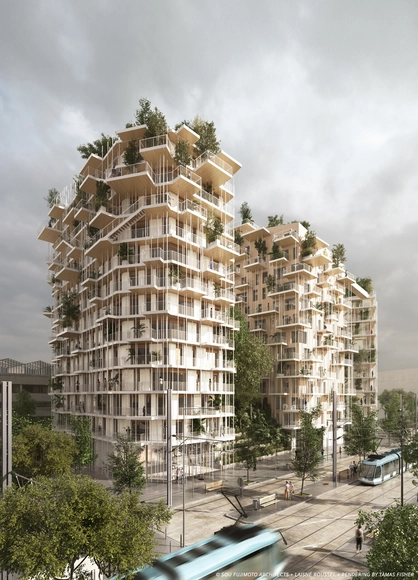
Nowadays the main building materials used in the construction industry are concrete, steel and timber. From the point of view of ecological sustainability, there are four important differences between these three materials: first, timber is the only material of the three that is renewable; second, timber needs only a small amount of energy to be extracted and recycled compared to steel and concrete (but the implementation of its potential is not as developed yet); third, timber does not produce waste by the end of its life since it can be reused many times in several products before decomposing or being used as fuel and; and fourth, timber traps huge amounts of carbon from the atmosphere – a tree can contain a ton of CO2 [1] – and the carbon absorbed remains embedded as long as the wood is in use.
Considering the fact that 36 percent of total carbon emissions in Europe during the last decade came from the building industry,[2] as well as 39 percent of total carbon emissions in the United States,[3] the materiality of construction should be a priority for governments’ regulations in the future as measurements against global warming. The amount of CO2 in the atmosphere and the level of carbon emissions of the big economies across the globe are big issues that need to be solved with urgency in order to avoid larger, more frequent climate catastrophes in the future. The current regulation in several countries of the EU, which is incentivizing the use of renewable materials in buildings, is showing the direction the building industry in many other parts of the world should follow. And if these measures are adopted across the EU and beyond – if other countries start to follow this tendency as well – there will be significantly more wood in cities.
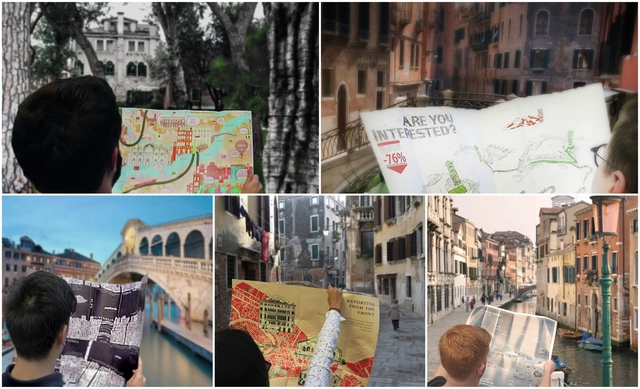
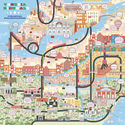
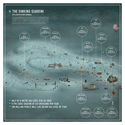
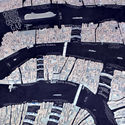
This article, by David Neustein and Grace Mortlock of Otherothers, explores a key paradox of the 2016 Venice Biennale: the disconnect between the geography of the topics on show and the geography of the Venice Biennale itself. With maps created by their students at the University of Technology, Sydney, they suggest new ways to explore the Biennale with Aravena's theme in mind.
In announcing his theme for the 2016 Venice Architecture Biennale, “Reporting From the Front,” Biennale director Alejandro Aravena declared that “architecture is about looking at reality” and that “any effort to tackle relevant issues has to overcome the increasing complexity of the world.” Aravena has envisioned a sweeping exhibition of architecture’s “frontiers” and “margins,” as if he were a general surveying the global battlefield from above.
The greatest impediment to this admirable ambition is the architecture of the Venice Biennale itself. Marooned on its tourist island, the Biennale is an idealized world-in-miniature, free of the realities, confusions and conflicts of the world-at-large. The environment is timeless, picturesque, serene: hardly representative of the world’s “increasing complexity.” Within the Biennale gardens (Giardini), former Colonial powers occupy prominent permanent pavilions while other countries, including those of present-day significance, are consigned to the periphery, relegated to temporary off-site spaces, or else absent altogether.
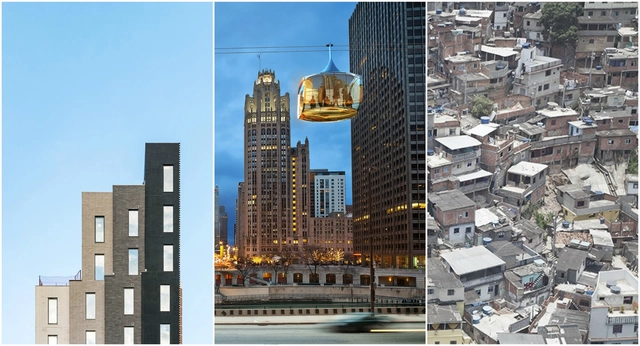
The past month has seen a variety of potential topics of discussion - but when it comes to the most thoughtful comments, it seems ArchDaily users have been preoccupied with one theme: quality of life. From a discussion about micro-apartments, to a critical take on the supposedly "romantic" portrayal of favelas, and even to a prediction that soon the design of virtual reality will take precedence over the design of actual reality, it seems our readers have been thinking a lot about living conditions in many spheres of life. Read on to find out what they had to say.
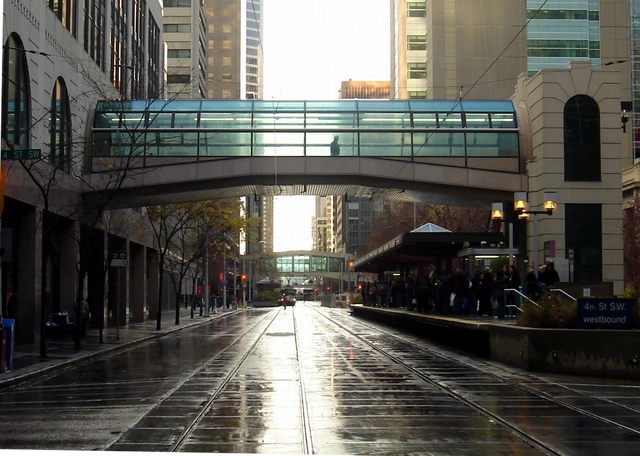
When hearing the word “skybridge” or “elevated walkway,” what often comes to mind is a narrow, glassed-in pathway perhaps crossing between two office buildings or hospital concourses; a narrow artery whose only purpose seems to be keeping people dry and away from cars as they walk from meeting to meeting. But this wasn’t always the case - in the 1960s, skyways were seen as radical urban inventions that would bring city circulation into the 3rd dimension. Championed in the United States by architect Victor Gruen, following ideals espoused by both CIAM and Team 10 in Europe, the skyway movement took hold in cities all over the world with varying degrees of success, but rarely with the fluid connections between levels originally envisioned by its designers.
Many technological advancements have changed the way we design in the past 150 years, but perhaps none has had a greater impact than the invention of the passenger elevator. Prior to Elisha Otis’ design for the elevator safety brake in 1853, buildings rarely reached 7 stories. Since then, buildings have only been growing taller and taller. In 2009, the world’s tallest building, the Burj Khalifa, maxed out at 163 floors (serviced by Otis elevators). Though a century and half separates those milestones, in that time elevator technology has actually changed relatively little - until recently.



.jpg?1465854467&format=webp&width=640&height=580)
.jpg?1465854457 "The \"Reporting From the Front\" exhibition. Image © Laurian Ghinitoiu")
.jpg?1465854487 "Gabinete de Arquitectura's contribution to the \"Reporting From the Front\" exhibition. Image © Laurian Ghinitoiu")
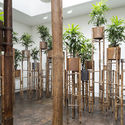
.jpg?1465854604 "The Spanish Pavilion. Image © Laurian Ghinitoiu")
.jpg?1465854467)






.gif?1465311775)