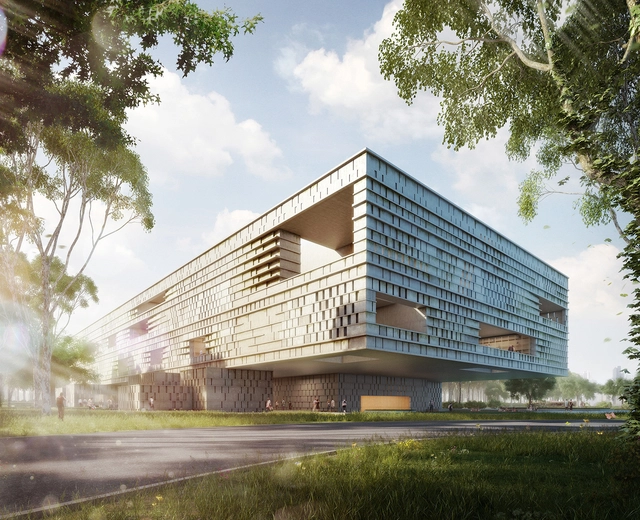
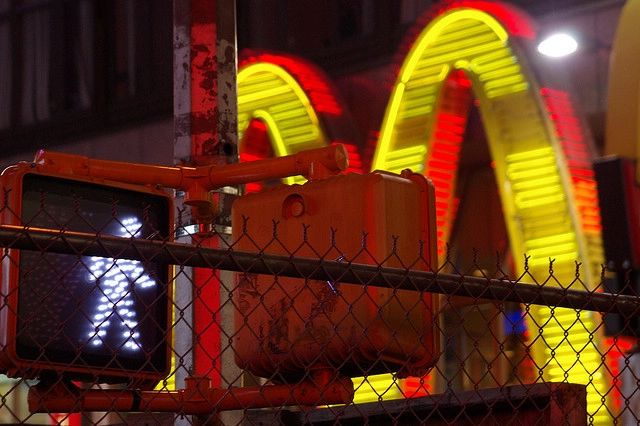
In an article for the New York Times, Michael Kimmelman gets to the bottom of an unusual local dispute: a McDonald's in Queens, New York is kicking out groups of elderly Koreans who are out-staying their 20-minute welcome (and who have no access to community spaces nearby). The story raises an important question: how can we design our cities with elder populations in mind (a generation on track to out-number all others in the next few years)? You can read this poignant tale in full here.
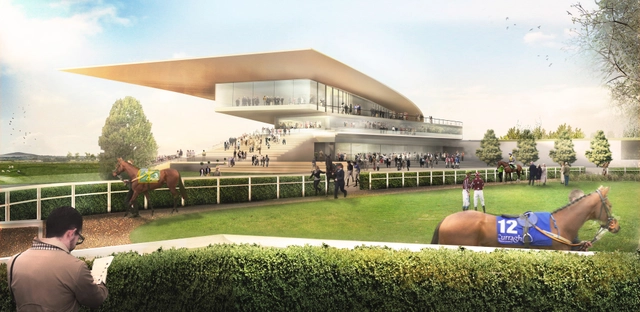
The Irish Turf Club has selected Grimshaw, alongside collaborators Newenham Mulligan & Associates (NMA), amongst 100 other leading practices to envision a concept design for the modernization of Ireland’s most prestigious thoroughbred race course.
Embedded within County Kildare’s open plains, the historic Curragh Racecourse is need of a masterplan that preserves the site, upgrades facilities and respects the surrounding landscape. Grimshaw’s winning proposal promises to satisfy these requests, in addition to constructing a new grandstand that retains the “intimate and distinctive character” of the existing grounds.
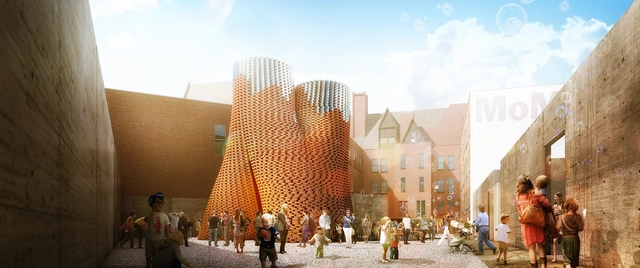
The Museum of Modern Art and MoMA PS1 has selected "Hy-Fi," a “circular tower of organic and reflective bricks” designed by The Living (David Benjamin), as the winner of the 15th annual Young Architects Program (YAP) in New York. An exemplar of the cradle-to-cradle philosophy, the temporary installation will be built entirely from organic material via a new method of bio-design.
Long Island’s downtowns have more than 4,000 acres of surface area dedicated to parking lots. That’s roughly 6.5 square miles of prime real estate, a phenomenon quite common in most American cities. When necessary, these lots are often exchanged for a standard “set of concrete shelves” that share little to no connection with their surroundings. This leads to the question, why must parking garages be so monofunctional and, well, ugly?
To help solve this nationwide issue, the Long Island Index challenged four leading architectural firms to envision a more innovative way to free up surface lot space in four Long Island communities.
When it comes to designing schools, security is always a big issue. This fact was thrown into sharp focus in December of 2012 after the Sandy Hook Tragedy in Newtown, Connecticut. Last year, we featured an article discussing how design can deal with tragedy - both in order to prevent it and how to deal with the aftermath. Now, a report by Building Design and Construction investigates the measures that could prevent dangerous incidents. While they admit "it’s impossible to stop an armed madman who is hell-bent on killing", the report has a number of simple and sensible recommendations which aid in preventing and responding to a threat. You can read the report here.
As an immigrant “who has made lasting contributions to American society through extraordinary achievements in biomedical research and the arts and humanities,” Israeli-born designer and architect Neri Oxmanhas been selected as the 2014 Vilcek Prize in Design’s recipient.
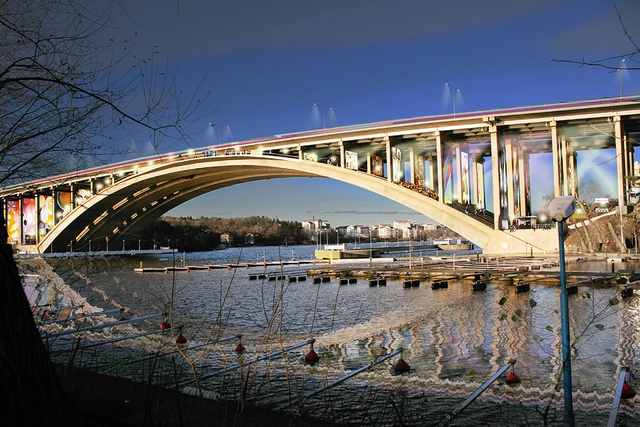
With minimal intervention, Swedish architecture firm visiondivisionclaims that the underused structure beneath Stockholm’s Tranebergsbron bridge could be transformed into a pedestrian walkway and informal cinema. If built, this proposal would not only remove pedestrians from the dismal walking space provided alongside the bridge’s bustling car lanes, but it would also dramatically shorten the walking distance between the city island of Kungsholmen and western suburb of Bromma.
The American Institute of America’s New York Chapter (AIANY) has selected six young, and “pioneering” firms as the winners of the 2014 New Practices New York portfolio competition. The award is designed “to recognize and promote” emerging practices that are less than a decade old and based within the five boroughs of New York City. As a result, each winner will be featured in an exhibition at the Center for Architecture from October 1, through January 15, 2015.
Without further ado, the 2014 New Practices New Yorkwinners are:
New York City’s notoriously space-hungry real estate market is converting the cantilever – perhaps made most famous in Frank Lloyd Wright’s floating Fallingwater residence of 1935 – from a mere move of architectural acrobatics to a profit-generating design feature. Driven by a “more is more” mantra, developers and architects are using cantilevers to extend the reach of a building, creating unique vistas and extended floor space in a market in which both are priced at sky-high premiums.
https://www.archdaily.com/472009/the-new-york-city-cantilever-if-you-can-t-go-up-go-outJose Luis Gabriel Cruz
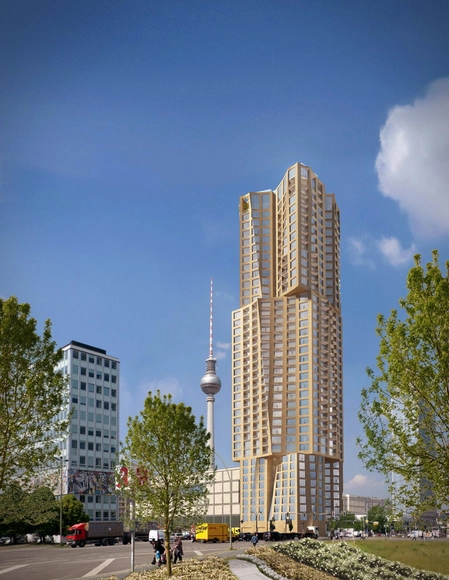
Gehry Partners has been selected over David Chipperfield, Adjaye Associates and seven other practices in an invited competition for a 300-unit residential tower in Berlin. The winning proposal, deemed “the most compelling” by jury for its rotating stacks of sculptural, stone-clad cubes that rise up to 150 meters, is expected to be Berlin’s tallest skyscraper and Germany’s tallest residential tower.
“Gehry’s design is strong in visual expression and introduces an unusually eccentric, new pattern for this location. Nevertheless, the façade radiates agreeable tranquility. In addition, the design blends well with the neighborhood and conveys all aspects of metropolitan living,” commented Regula Lüscher, Senate Building Director.
Adobe has unveiled a major update to Photoshop CC (Creative Cloud) with the hope that a "radically simplified 3D printing process" will make their software the "go-to tool for anyone who wants to print a 3D model." Their new software allows for designers to create a model from scratch or refine an existing design leading to perfect print ready 3D models. Since one of the most common problems with 3D printing is the human errors in virtual modeling, Photoshop includes automatic mesh repair and will insert a support structure if necessary to ensure that the model will print reliably and without faults.
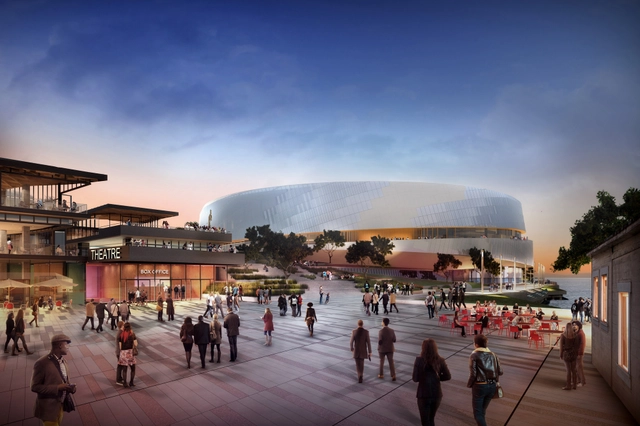
Version 3.0: Arrival onto Pier; Rendering by steelblue. Image Courtesy of Snøhetta
Snøhettahas released an updated, more "slimmed-down" version of the Golden State Warriors’ Stadium, which is scheduled to debut on a preeminent San Francisco waterfront site for the 2017-18 NBA basketball season. Located on Piers 30-32, just walking distance from the downtown Financial District and easily accessed by a variety of public transportation, the revised design has shaved off over 30,000 square feet of the venue's total square footage and increased public open space to nearly 8 acres, 60 percent of the 13 acre site.
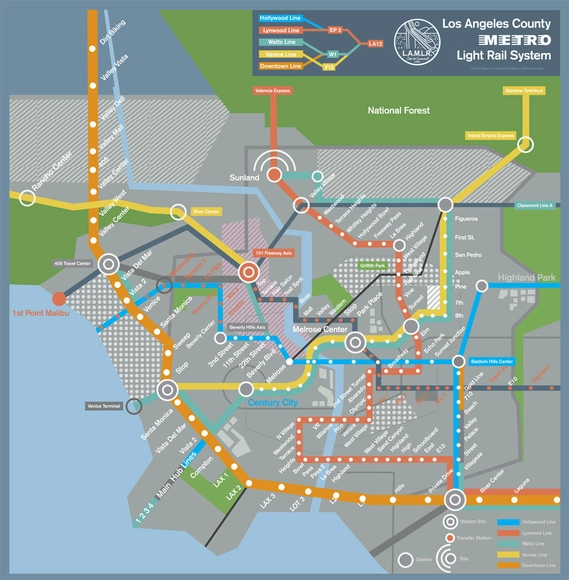
In his review of Spike Jonze's movie "Her", LA Times architecture critic Christopher Hawthorne explains a rather comforting aspect of the movie: instead of the dystopia that usually characterizes films set in the future, "Her" is set in a future version of LA which is more dense, has better public transport (with a subway map with a story all of its own) and has managed to overcome its dependence on the car. No wonder this film has touched a chord with architects and urban designers. Read the full review here.
MANIFEST, an annual independent print journal on American architecture and urbanism, is requesting text, project, and photographic proposals for its second issue entitled, “Kingdoms of God.” Edited by Anthony Acciavatti, Justin Fowler, and Dan Handel, and supported in part by the Graham Foundation for Advanced Studies in the Fine Arts, MANIFEST was founded to initiate a critical conversation about the state of American architecture, its cities, and its hinterland.
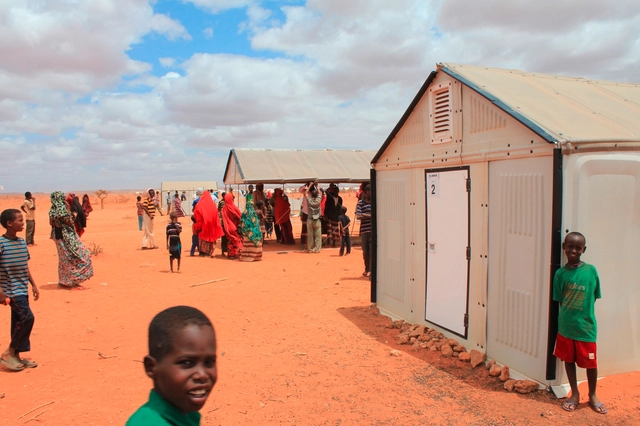
An IKEA prototype for a modular “Refugee Housing Unit” has been selected as one of three finalists for the International Council of Societies of Industrial Design’s (Icsid) World Design Impact Prize 2014. The pilot project was lauded for providing a “temporary shelter in which facilitates ‘a feeling of normality’ for families living in refugee camps.” The project will be measured against a “BioLite HomeStove” and “ABC Syringe” before an overall prize winner is announced. You can learn more about the unit here and preview the competing innovations here.
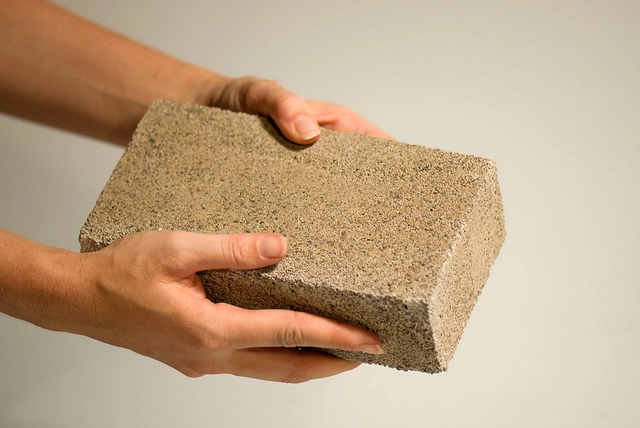
A unique biotechnology start-up company have developed a method of growing bricks from nothing more than bacteria and naturally abundant materials. Having recently won first place in the Cradle to Cradle Product Innovation Challenge, bioMason has developed a method of growing materials by employing microorganisms. Arguing that the four traditional building materials - concrete, glass, steel and wood - both contain a significant level of embodied energy and heavily rely on limited natural resources, their answer is in high strength natural biological cements (such as coral) that can be used "without negative impacts to the surrounding environment."
Milroy Perera Associates, in collaboration with Mäga Engineering, has unveiled plans for the world's tallest residential vertical garden in Rajagiriya, Sri Lanka. The Clearpoint tower will house 164 apartments spread across 46 floors within 10 kkilometers from the centre of Columbo. Overlooking the tributaries of the Diyawanna Lake in Kotte, planted viewing terraces will encircle the entire structure fed by "inbuilt self-sustaining watering systems."
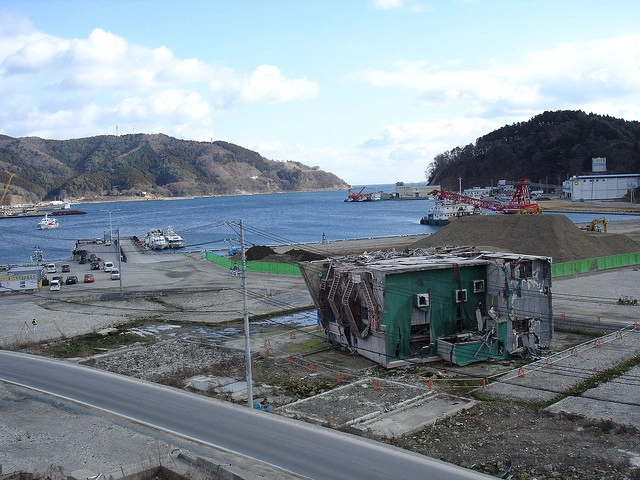
Almost 3 years after the earthquake and tsunami that devastated the North-East coastline of Japan, this article on Arcspace examines the current - unsettling - state of rebuilding in the Tōhoku region. According to former residents and architects working for Architecture for Humanity, plans neither address what the people want nor sufficiently provide protection in the event of a similar disaster. Furthermore, with Japan now preparing for the 2020 Olympics, it seems the Tōhoku region is being neglected. Read more on the story here.
A proposal by gmp Arquitectos, L35 Arquitectos andRibas & Ribas has been announced as winner of an international competition to revamp Real Madrid’s Santiago Bernabéu Stadium in Spain. Selected over an impressive shortlist of candidates including Foster & Partners, Herzog & de Meuron and Populous, the winning gmp-led team is expected to “transform the Santiago Bernabéu into the most advanced and developed stadium of the 21st century,” as described gmp owner Volkwin Marg.
“This building is undoubtedly the most important project of our careers.," Marg added.
Chicago-based Harboe Architects has been chosen by the Frank Lloyd Wright Foundation to construct a preservation master plan for Taliesin West, which will guide future restoration and conservation efforts for the prized National Historic Landmark. Built in Scottsdale, Arizona, by the hands of the architect himself, alongside his apprentices between 1937 and 1959, the desert landmark served as the winter home, studio and school of Frank Lloyd Wright. Read and relive the story of Taliesin West here on ArchDaily.
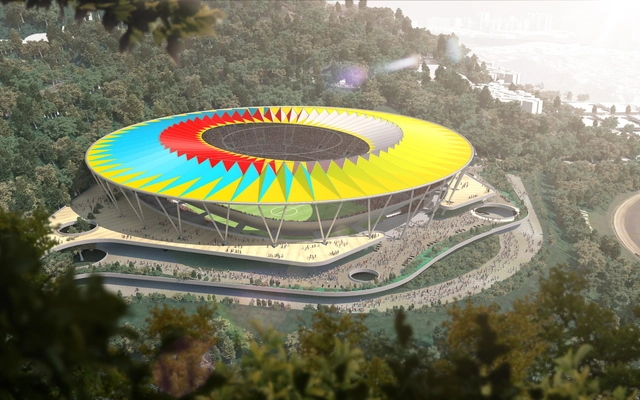
Following our recent news that confirmed Rogers Stirk Harbour + Partners (RSHP) will oversee the design and construction of two new stadiums within Caracas' Hugo Chavez Park, details have emerged regarding the Estadio Nacional de Fútbol de Venezuela. Designed by RSHP, in collaboration with Arup and Schlaich Bergermann und Partners, the project will be the practice’s first ever football stadium.
Architects and LEGO® Bricks. For many, it was love at first sight.However, playing with LEGO at the office - fun as it may be - is not exactly something you can justify doing (at least not everyday).
Well, no more. For your procrastination pleasure, Google Chrome and LEGO® have paired up and created "Build With Chrome," a game that lets you play with LEGO online. Good-bye productivity.
We are happy to present the winners of the 2014 ArchDaily Building of the Year Awards, a peer-based, crowdsourced, architecture award where the collective intelligence of 60,000 architects filter and recognize the best architecture featured on ArchDaily during the past year.
City Approach. Image Courtesy of Harry Gugger Studio and over,under
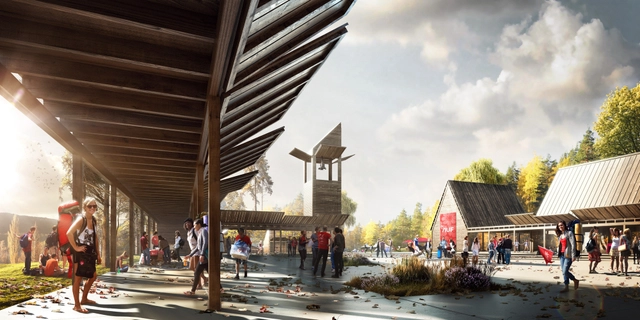
Basel-based Harry Gugger Studio and Boston’s over,under have collaborated to design the Museo Maya de América, Central America’s largest museum of Maya artifacts and culture. Planned for a prominent site at the Northern edge of L’Aurora Park in Guatemala City, the $60 million project will be the “capstone” to a “cultural nexus”, which will eventually include the Children’s Museum and the Museum of Contemporary Art within the city's largest recreational open space.









.jpg?1391095745&format=webp&width=640&height=580)