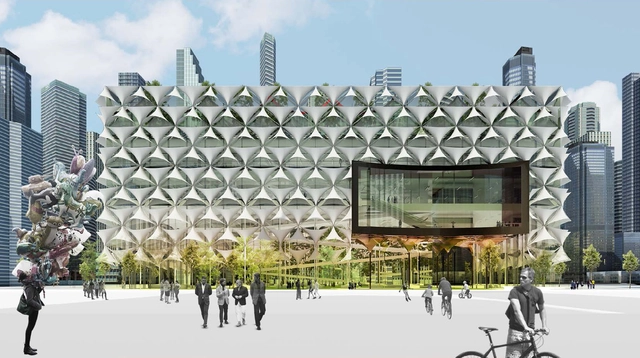
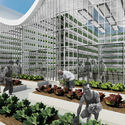
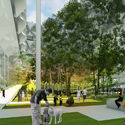
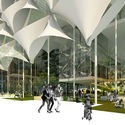
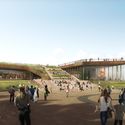
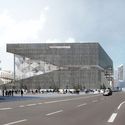
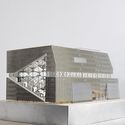
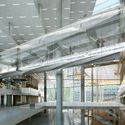
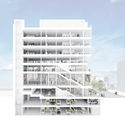
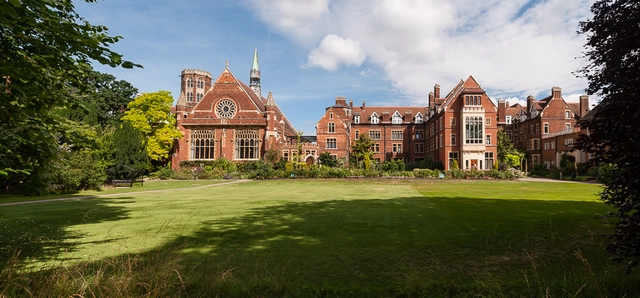
Homerton College, a constituent college of the University of Cambridge, announced today the five firms shortlisted in the competition to design a emblematic £7 million ($8.5 million USD) centrepiece building to house a 300-person dining hall for the school. The finalists were selected from an original pool of 155 architects, from which 24 were selected for the longlist.
The competition, organized by Malcolm Reading Consultants, is a part of the College’s wider plan to improve and expand school facilities. Homerton boasts one of the largest student communities at Cambridge, and is one of a few of the University’s colleges capable of housing all undergraduate students in on-site facilities for all four years. To be located on an attractive wooded site, the commission has the potential to determine the character of the school for years to come.
At the ground breaking ceremony this week, officials including His Highness Sheikh Mohammed bin Rashid Al Maktoum, UAE Vice President and Prime Minister and Ruler of Dubai, His Excellency Mohammad Al Gergawi, Chairman of Dubai Holding, and Mohamed Alabbar, Chairman of Emaar Properties, and Micael Calatrava, CEO of Calatrava International announced that upon its completion in 2020, the landmark observation tower will measure in at a height slightly taller than Dubai’s own Burj Khalifa, making it the tallest tower in the world.
“The design and architectural features of The Tower demand unique engineering approaches that are currently being implemented on site. Extensive studies were undertaken in preparation for the groundbreaking, and the learning that we have gained from the experience will add to the knowledge base of mankind,” said Santiago Calatrava.
In the spirit of open access to information, professor Jochen Gros and designer Friedrich Sulzer headed up a research project at the C...Lab of the Hochschule für Gestaltung Offenbach in Germany, where they have developed 50 different wood joinery techniques capable of being fabricated digitally, using tools such as a CNC mill or lasercutter.
Now these files have been made accessible to the public via downloadable files in various data formats (including several Autocad capable formats). They have also provided each joint with a PDF guide to assembly, to make piecing together the wood elements a snap.
https://www.archdaily.com/797107/50-downloadable-digital-joints-for-woodworkingAD Editorial Team
The latest chapter in the saga of London's Garden Bridge, which has seen counter proposals and reactionary follies alike, has revealed major concerns relating to its funding mechanisms. As reported by the Architects' Journal, new findings from the United Kingdom's National Audit Office (NAO), which has studied the decision taken by the Department for Transport's decision to grant £30 million ($37 million) of funding to the Garden Bridge Trust, has discovered that the "sum [£30 million] was provided following a commitment from [the] then Chancellor George Osborne, and despite the DfT’s conclusion that there was ‘a significant risk that the Bridge could represent poor value for money’."
https://www.archdaily.com/797111/uk-nao-presents-report-thomas-heatherwicks-garden-bridge-londonAD Editorial Team
Courtesy of Maksim Atayants & Maksim Atayants Workshop
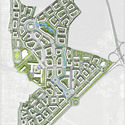
Maksim Atayants and Maksim Atayants Workshop have announced the construction of Laikovo, a new, large, classically-designed city in the Moscow Region that will be built from scratch – which, according to the architects, will be the first classical city to be built from the ground up in Russia in over 100 years.
Intended to embody the best practices of Russian and global urban planning, the city will be designed in the modern classic style in five districts, and will become Moscow’s nearest satellite city, located near Rublyovka, with easy access to the paid expressway, the M-1 double.
50 percent of the 116-hectare city will be dedicated to public space, including a two-hectare park and lake at city center, as well as a main waterway that will become the Moscow Region’s longest artificial channel.
The British Council for Offices (BCO) has announced the winners of the 2016 National Awards. The BCO Awards program was established to recognize “ top quality office design and functionality and sets the standard for excellence across the office sector in the UK,” providing a benchmark for excellence in design and functionality. This year’s ‘Best of the Best’ winner was The Enterprise Center at the University of East Anglia by Architype.
“This year we have once again seen a fantastic range of diverse and innovative workplaces, highlighting Britain’s position at the forefront of the global office sector. The Enterprise Centre stands tall as both a dynamic and collaborative work and event space, and as a benchmark in sustainable design," said Emma Crawford, Managing Director of Central London Leasing at CBRE and BCO National Awards Chair.
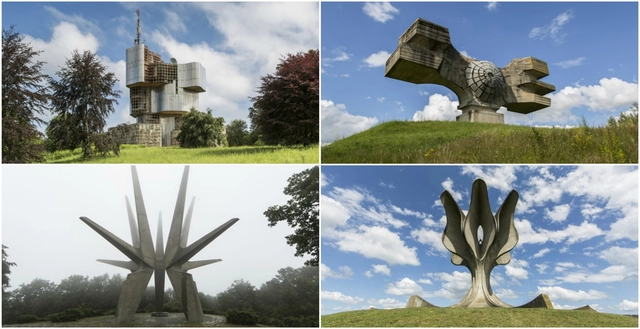
French photographer Jonk drove over 5,000 kilometers through southeast Europe. His subject matter? Yugoslavian monuments, or “spomenik” in Serbian.
Built in the 1960s and 70s under former president Josep Broz Tito, these monuments commemorate the communist resistance during the German occupation. While their sculptors and architects vary (Vojin Bakic, Jordan and Iskra Grabul among others), all of the monuments memorialize WWII battle sites or former concentration camps. Although the monuments attracted a high rate of visitors in the 1980s, many of them have been abandoned or poorly preserved after Yugoslavia’s split. Jonk’s photographs illuminate both the decay and beauty of these sculptures.
In this edition of Section D, Monocle 24's weekly review of design, architecture and craft, the show explores how wood is being used creatively at every scale by designers and architects today. From the "timber terrazzo" of London-based designer Conor Taylor, to the four protected (yet threatened) wooden escalators at Sydney's Wynyard Railway Station, the episode questions how innovative designers are, or need to be, with this age-old tried and tested material. Finally, the show visits Folkhem in Sweden – a construction company who believe wood "to be superior to conventional alternatives in almost every respect, from construction time to acoustic properties."
https://www.archdaily.com/797040/monocle-24-explores-creative-uses-of-wood-in-contemporary-architecture-and-designAD Editorial Team
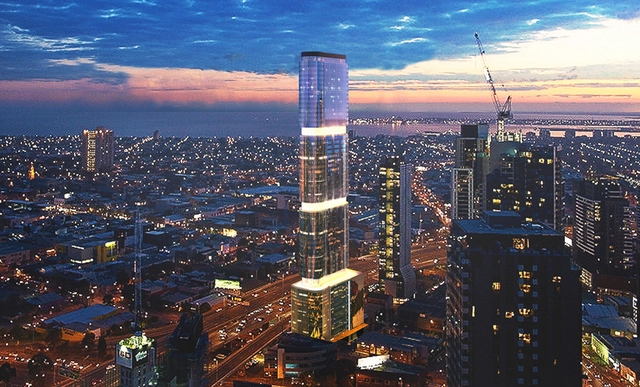
Peddle Thorp Architects have submitted their proposal for the Moray Street Residential Tower in Melbourne for approval. At 1173.5 square meters, Sol Invictus is wrapped entirely in solar panels, attaining 10 times more solar surface area than a traditional roof covering. The facade can achieve up to 5000 square meters of solar panel array and is connected to a battery storage system.
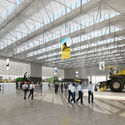
The team of tvsdesign and Shanghai Hecheng (上海合城) Architectural Design Ltd.(Cospace) has won the competition for the design of the Zhumadian International EXPO Center, located in Zhumadian, a city known for its agricultural industry, in the Henan Province of China. The competition sought out convention center designs that could not only serve as a location to hold agricultural conventions and trade fairs but could also connect back to the city’s historic roots in order to expand the area as a rendezvous of agriculture.
Drawing from the fact that Zhumadian is specifically known for supplying China with sesame seeds, the proposal utilizes the imagery of the seed in its shape—with rounded triangular forms—as well as in its overarching concept: “as an epicenter of activity in the agricultural industry, the convention center represents origins, life, growth, and health for the region and the people who visit the building" described the architects.
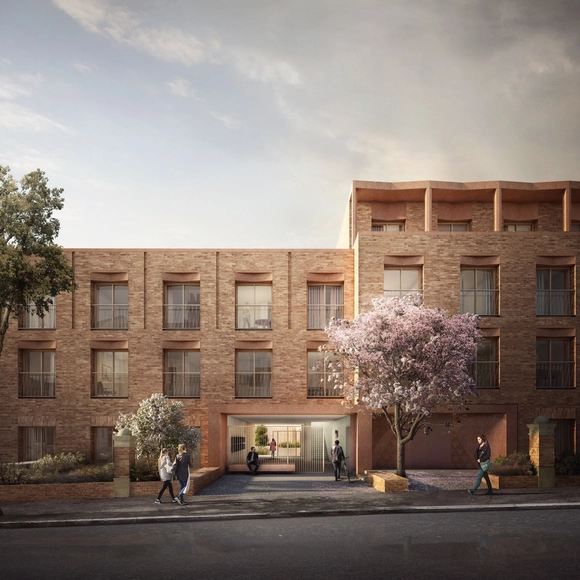
Gort Scott, in collaboration with developer Pocket Living, has secured planning permission to build 45 affordable “Pocket” apartments on the site of an unused office building in Walthamstow, England. In an effort to produce highly-sought-after living space in the heart of the city, the design features three- and four-story elements that complete the terrace in the rear of the existing building, filling the gap between neighboring developments.
Inspired by the legacy of the William Morris School that previously occupied the site, as well as by the Warner Houses typical to the city, the exterior of the project will be characterized by a decorative fletton type red brick and precast concrete.
Manila Architecture Workshop (MAAW) was just awarded one of six outstanding entries to the recently completed Metrobank Art and Design Excellence (MADE) programs for Architecture and Interior Design. In partnership with the United Architects of the Philippines and BluPrint Magazine, MADE encourages architects to design inventive buildings that address public, economic, and environmental issues.
French studio Lacaton & Vassaland Chilean studio UMWELT have been revealed as the recipients of the 2016 Lisbon Architecture Triennale's Lifetime Achievement Award and Début Award, respectively. An award ceremony will take place on the 15th November 2016 at the Centro Cultural de Belém (CCB), followed by a conference convened by Anne Lacaton and Jean-Philippe Vassal.
Berkeley-based TLS Landscape Architecture has won the Lion Mountain Park Design competition in Suzhou, China, corresponding to the Chinese government's new Urban Work Guidelines. The guidelines prioritize ecological and urban development, as well as rejuvenation of local character in public spaces. Lion Mountain Park will be the first large-scale public project to be constructed according to these values, envisioned as the core of a new urban ecosystem complex.
181 Fremont—which will become the third tallest structure in San Francisco and the most resilient tall building on the West Coast of the U.S.—has been awarded the REDi™ Gold Rating, a new earthquake resilience rating. The building was designed by San Francisco-based Heller Manus Architects.
The 56-story mixed-use tower, built above five basement levels, is being constructed in compliance with a new set of holistic design and planning guidelines—the Resilience-based Earthquake Design Initiative (REDi Rating System)—that allow it to withstand the impact of a 475-year seismic event (roughly a M7.5-M8.0 earthquake on the San Andreas Fault) with minimal disruption.
Developed by Arup with contributions from external collaborators, the REDi™ system outlines design and planning criteria within a resilience-based framework, creating a system that not only considers occupant safety but also takes into account the future of the building after an earthquake.
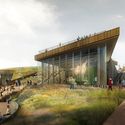
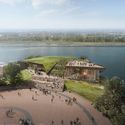
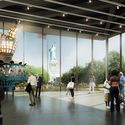
FXFOWLE has unveiled their design for a new Statue of Liberty Museum on Liberty Island in the New York Harbor. Set into a new landscape and lighting plan, the 26,000 square foot (2,415 square meter) museum will feature an exhibition experience by ESI Design, giving the island’s 4.3 million yearly visitors an opportunity “to learn about and honor the Statue’s history, influence, and legacy in the world.”
For centuries before the invention of screws and fasteners, Japanese craftsmen used complex, interlocking joints to connect pieces of wood for structures and beams, helping to create a uniquely Japanese wood aesthetic that can still be seen in the works of modern masters like Shigeru Ban.
Up until recent times, however, these techniques were often the carefully guarded secrets of family carpentry guilds and unavailable for public knowledge. Even as the joints began to be documented in books and magazines, their 2-dimensional depictions remained difficult to visualize and not found in any one comprehensive source.
That is, until a few years ago, when a young Japanese man working in automobile marketing began compiling all the wood joinery books he could get his hands on and using them to creating his own 3-dimensional, animated illustrations of their contents.
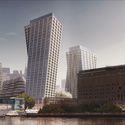
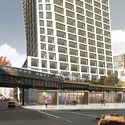
BIG’s planned residential complex along the High Line in New York has gone through multiple iterations since its unveiling last November. Now, in its latest form of two twisting towers rising from a split podium, the project is receiving a new name and key program piece.
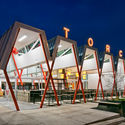
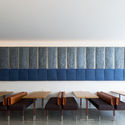
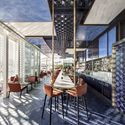
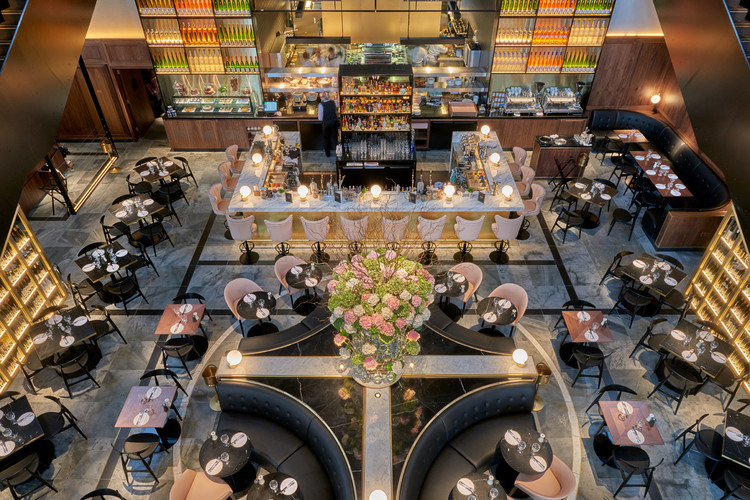
The winners of the 2016 Restaurant & Bar Design Awards have been announced. Now in its eighth year, the global competition seeks the best of food and beverage spaces, and “covers every imaginable space, from ships to airports, museums to burger vans, and from revered Michelin-starred establishments to the fleeting dynamism of pop-ups.”
This edition of the annual Awards attracted 1,000 entries from the UK and 70 other countries, and was judged by a panel of influential design personalities.
The winners of the 2016 Restaurant & Bar Design Awards are:
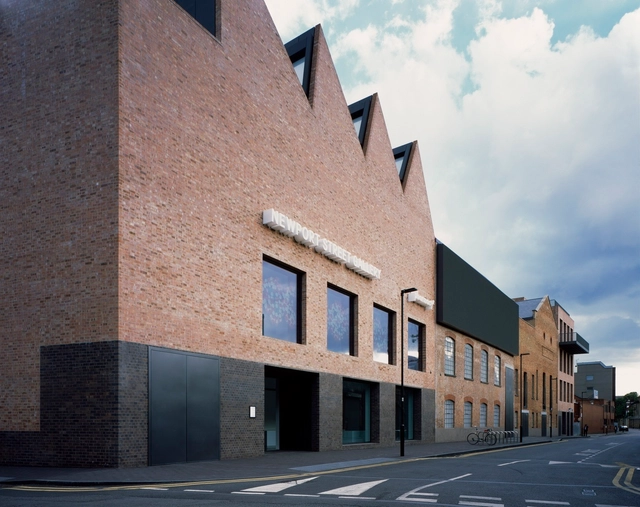
Designed as a free public gallery to house artist Damien Hirst’s private art collection, Caruso St John’s scheme sandwiches three restored Victorian-era industrial buildings between two new structures, one of which features a distinct saw-tooth roof.
"This highly accomplished and expertly detailed art gallery is a bold and confident contribution to the best of UK architecture. Caruso St John’s approach to conservation is irreverent yet sensitive and achieves a clever solution that expresses a poetic juxtaposition of old and new," said the jury in their citation.
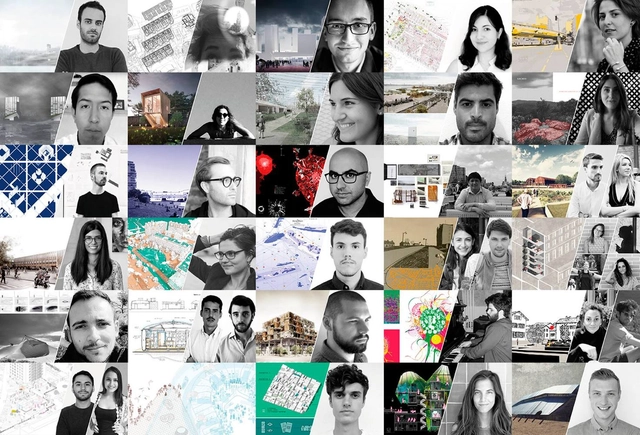
The Fundació Mies van der Rohe has announced a list of 30 projects that will compete for the inaugural Young Talent Architecture Award (YTAA) 2016. The award was established this year to “support the talent of recently graduated Architects, Urban Planners and Landscape Architects who will be responsible for transforming our environment in the future,” and joins the Foundation's European Union Prize for Contemporary Architecture – Mies van der Rohe Award “in promoting high quality work amongst emerging and established architects through the acknowledgement of the value of good buildings.”
More than 200 projects were submitted from over 100 European architecture schools, which were narrowed down to a shortlist of 30 projects by an esteemed jury of architects and curators. Three winners will be selected at the Teatro Piccolo Arsenale in Venice on October 28th 2016 as part of the 2016 Venice Biennale.
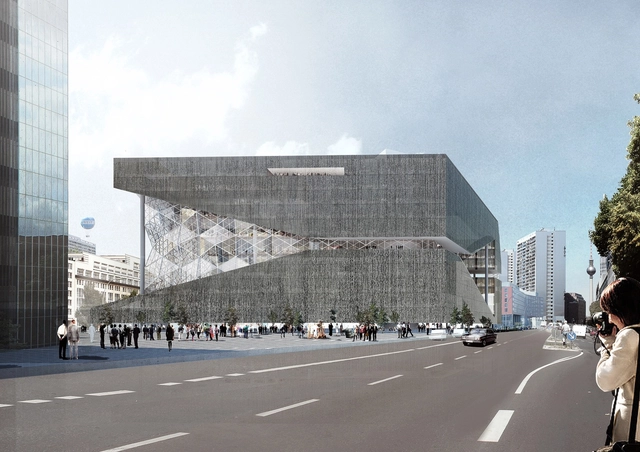
OMA has released new images of their design for Axel Springer’s business and digital division, in Berlin, Germany. One of the largest digital publishing houses in Europe, Axel Springer officially launched the project to celebrate the 50th anniversary of the company’s publishing building.
OMA’s proposal was selected in a 2014 international design competition, beating out finalist entries from BIG and Büro Ole Scheeren. The brief called for a new modern work environment to house Axel Springer’s growing business and digital divisions.
JCJ Architecture and Leong Leong have unveiled their design for the Center for Community and Entrepreneurship, a new mixed-use community building for the non-profit organization, Asian Americans for Equality (AAFE), which will be located in Flushing, Queens, New York. Upon completion, the building will span 90,000 square feet over seven stories at the corner of College Point Boulevard and 39th Avenue.
Inspired by AAFE’s mission to enrich the lives of Asian Americans and others in need throughout New York City, the design is modeled using a progressive building form following the concept of holding hands in interweaving fingers.
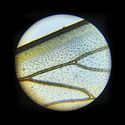
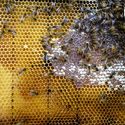
Designer and architect Neri Oxman and the Mediated Matter group have announced their latest design project: the Synthetic Apiary. Aimed at combating the massive bee colony losses that have occurred in recent years, the Synthetic Apiary explores the possibility of constructing controlled, indoor environments that would allow honeybee populations to thrive year-round.
On Friday, September 30, 2016, the US Fish and Wildlife Service added seven species of bees to the Federal Endangered Species list, after a UN-sponsored report released in February found that nearly 40 percent of invertebrate pollinator species (which includes bees and butterflies) are now facing extinction. Bees play a vital role in the reproductive cycle of many plants, including those used for human food production, and according Mediated Matter, losses continuing at these rates could have dire impacts for both human and environmental well-being.


_Credit_Santiago_Calatrava.jpg?1476205643)


.jpg?1475701455)
.jpg?1475701388 "Courtesy of Maksim Atayants & Maksim Atayants Workshop")
.jpg?1475701334 "Courtesy of Maksim Atayants & Maksim Atayants Workshop")
.jpg?1475701484 "Courtesy of Maksim Atayants & Maksim Atayants Workshop")
.jpg?1475701455)

.jpg?1475695920 "© Jonk")

.jpg?1475695949 "© Jonk")