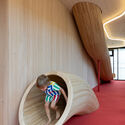
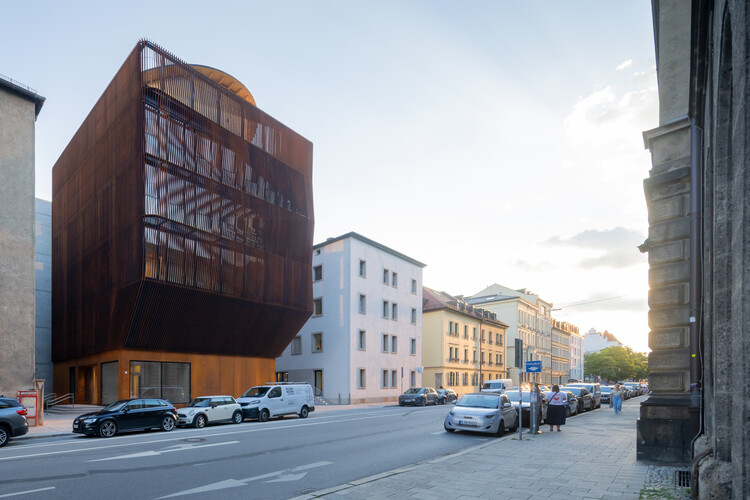
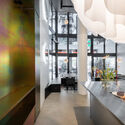
Lenbachhaus Museum / Foster + Partners

© Nigel Young /

Architects: Foster + Partners
Location: Munich,
Design Team: Norman Foster, David Nelson, Stefan Behling, Christian Hallmann, Ulrich Hamann, Klaus Heldwein, Florian Boxberg, Leonhard Weil, Judith Kernt, Henriette Hahnloser, Eike Danz, Diana Krumbein, Simon Weismaier, Christopher Von Der Howen, Inge Tummers, Jörg Grabfelder, Katrin Hass, Tillmann Lenz
Area: 12,328 sqm
Year: 2013
Photographs: Nigel Young / Foster + Partners

House with Music Room / Beer Architektur Städtebau

© Daniel Mosch

Architects: Beer Architektur Städtebau
Location: Munich,
Structural Engineering: Gordian Kley
Area: 440 sqm
Year: 2010
Photographs: Daniel Mosch

The Jewish Center in Munich / Wandel Hoefer Lorch + Hirsch

© Roland Halbe

Architects: Wandel Hoefer Lorch + Hirsch
Location: Reichenbachstraße 27, Munich,
Structural Planer : Sailer Stepan und Partner GmbH
Area: 11,890 sqm
Year: 2007
Photographs: Roland Halbe

Salvartor Car Park / Peter Haimerel Architektur

© Gero Wortmann

Architects: Peter Haimerel Architektur
Location: ,
Area: 7,500 sqm
Photographs: Gero Wortmann, Florian Holzherr

Harbour me, Celia! / Peter Haimerl Architektur

© Edward Beierle

Architects: Peter Haimerl Architektur
Location: , Bayern, Germany
Year: 2008
Photographs: Edward Beierle

IVG Media Bridge / steidle architects

Courtesy of

Architects: steidle architects
Location: Rosenheimerstraße, Munich,
Design Team: Johannes Ernst, Martin Klein, Team: Stefan Kissling, Manfred Erich, Duc Hua
Area: 7,500 sqm
Photographs: Courtesy of steidle architects

Illumination: Business Area, Olympic Hall / pfarré lighting design

© Andreas J. Focke / architekturfoto.org
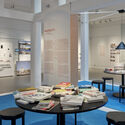
Serving as a backstage area for artists who perform at the Olympic Hall in , the business area can be booked for conferences, meetings, seminars and other events. In order to meet established requirements calling for variable use of the business area, pfarré lighting design created a system which is as effective when the area has no partitions as when it is subdivided into separate areas. More images and their description after the break.

Mittlerer Ring / Léon Wohlhage Wernik Architekten

© Christian Richters

Architects: Léon Wohlhage Wernik Architekten
Location: , Germany
Project Year: 2009
Project Area: 12,250 sqm
Photographs: Christian Richters

Illumination: Small Olympic Hall / pfarré lighting design

© Andreas J. Focke / architekturfoto.org

With a capacity of 3600 places, and an alternative to its ‘grand sister’, the small olympic hall, is embedded carefully in the protected Olympic Park ensemble as it almost disappears. With pfarré lighting design working closely with the architects, the attic has been detailed to house a linear, dimmable lighting system. The huge notch, cut into the hill, which covers the building, was underlined with light on both sides. More images and their description after the break.

Bavarian Parlament / Léon Wohlhage Wernik Architekten

© Christian Richters

Architects: Léon Wohlhage Wernik Architekten
Location: Munich,
Project Year: 2012
Project Area: 4,350 sqm
Photographs: Christian Richters

Illumination: Central Bus Terminal / pfarré lighting design

© Andreas J. Focke / architekturfoto.org

The lighting for the Central Bus Terminal in by pfarré lighting design aims at giving the appearance of a building floating on a cushion of cold white light. As a result, warm light is used in the upper floors and in the exterior space while a softly shimmering façade evokes a powerfully glowing orange. More images and their description after the break.

Video: Goetz Gallery building by Herzog & de Meuron

The Sammlung Goetz, an internationally renowned collection of contemporary art in  housed in a purpose-built Herzog & de Meuron building, is home to private collector Ingvild Goetz’s eclectic acquired works of paintings and video projections.

‘Schaustelle’ Temporary Pavilion / J. Mayer H. Architects

Courtesy of

Designed by J. MAYER H., the ‘Schaustelle’ or ‘show site’ will be a temporary pavilion and platform for the four collections housed at the Pinakothek der Moderne in Munich, . The temporary closure has been seen as an opportunity that will give rise to a makeshift exhibition building – the Schaustelle. Set up to hold exhibitions, workshops, talks, performances, film screenings and video installations, and much more, the scheme has been initiated by the Pinakothek der Moderne Foundation. More images and architects’ description after the break.

VIP Wing / Erich Gassmann Architekten – Tina Assmann

© Florian Holzherr

Architects: Erich Gassmann Architekten - Erich Gassmann, Tina Assmann
Location: , Germany
Cooperation: Philipp Hutzler, Andreas Obermüller, Sebastian Filutowski
Client: Flughafen München GmbH
Photographs: Florian Holzherr


House 11 x 11 / Titus Bernhard Architekten

©

Architects: Titus Bernhard Architekten - Titus Bernhard, Ulrich Himmel
Location: , Germany
Built Area: 182 sqm
Site Area: 1,300 sqm
Completion: August 2011
Photographer: Titus Bernhard Architekten


Schrannenhalle Munich / Oliv Architekten Ingenieure

© Edzard Probst

Interior designers: Oliv Architeckten Ingenieure
Location: , Germany
Project Area: 1,000 sqm
Completion: 2011
Photographs: Edzard Probst

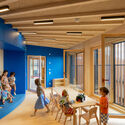
Day Care Center / LÜPS

© ATELIER LÜPS

Architects: ATELIER LÜPS – Mauritz + W-E. Lüps
Location: ,
Collaborators: Claudia Peter, Martina Machova
Construction Management: Silke Neugebauer, CLMap GmbH
Structure: Planungsgesellschaft Dittrich MBH
HVACR: GFI mbH
Elecrical engineering: IBM-TGA GmbH
Contractor: Mickan mbH&Co.KG
Photographs: ATELIER LÜPS


Sammlung Goetz Munich / Herzog & de Meuron

We’ve been following the progress of Herzog and de Meuron’s recent projects, such as the construction stages of the Elbe Philharmonic and the design of the Museum der Kulturen Basel. Yet, every so often, it is interesting to view some of the firm’s older projects to see the common line of thought running throughout their portfolio and examine how their design process has evolved throughout the years to respond to newer technologies, materials and environmental concerns.  Although the Sammlung Goetz Museum in was designed and constructed nearly two decades ago, the project illustrates the firm’s obsession with the building’s outer  treatment.  Material selection and facade design is an important facet of the firm’s identity, but we noticed another common thread between this project and their future works – the fascination with the floating volume.

More about the museum, including more photos, after the break.

Todd Saunders Lecture at the Academy of Fine Arts in Munich

Courtesy of Saunders Architecture

of Saunders Architecture will be giving a lecture at the Academy of Fine Arts in on January 25th at 7:30pm. Led by a strong contemporary design sensibility, Saunders has worked on cultural and residential projects right across Norway, as well as England, Denmark, Italy, Sweden and Canada. The studio believes that architecture must play an important role in creating place, using form, materials and texture to help evoke and shape memory and human interaction.

Siemens Headquarters / Henning Larsen Architects

rendering

Henning Larsen Architects was recently awarded the international competition for Siemens’ new headquarters. The design by is an urban, recognizable composition of plazas, courtyards and alleys that will unfold a new, vibrant urban space in central . Siemens and are integrated into a harmonious whole by merging two archetypal entities – mass (Siemens) and void () – into a complementing formation. The city opens up the mass, which in response opens up to the city.

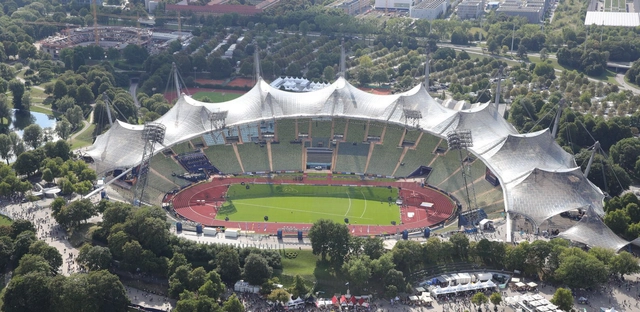
AD Classics: Munich Olympic Stadium / Frei Otto & Gunther Behnisch

Courtesy of Wikimedia Commons

Often mentioned as a pioneer in lightweight tensile and membrane construction, yet overshadowed in the discipline of architecture, along with Gunther Behnisch collaborated to design the 1972 Munich Olympic Stadium in Munich, .  With the Olympics having already been held in Berlin in 1936, Otto and Behnisch took the second Olympics games in as an opportunity and a second chance to show in a new light.  Their goal was to design a structure that would emulate the games motto: “The Happy Games” as more of a whimsical architectural response that would overshadow the heavy, authoritarian stadium in Berlin.

More of the 1972 Olympic Stadium in Munich after the break.