In Progress: Serpentine Gallery Pavilion / Sou Fujimoto

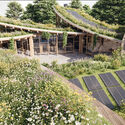
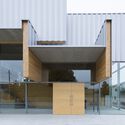
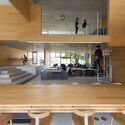
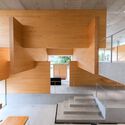
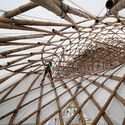
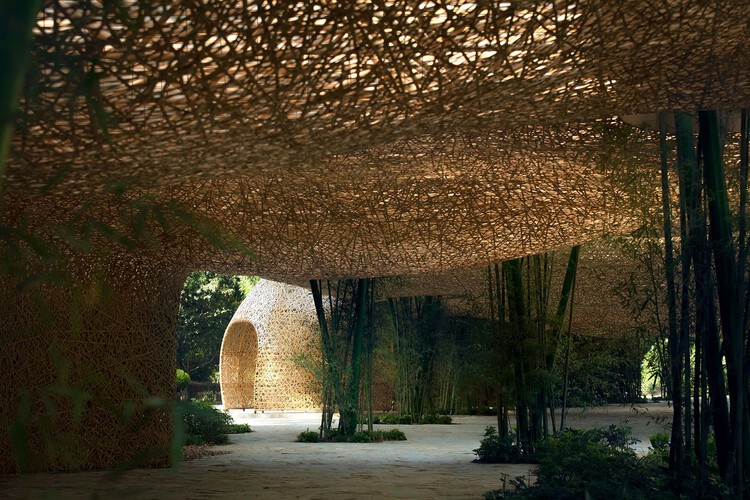
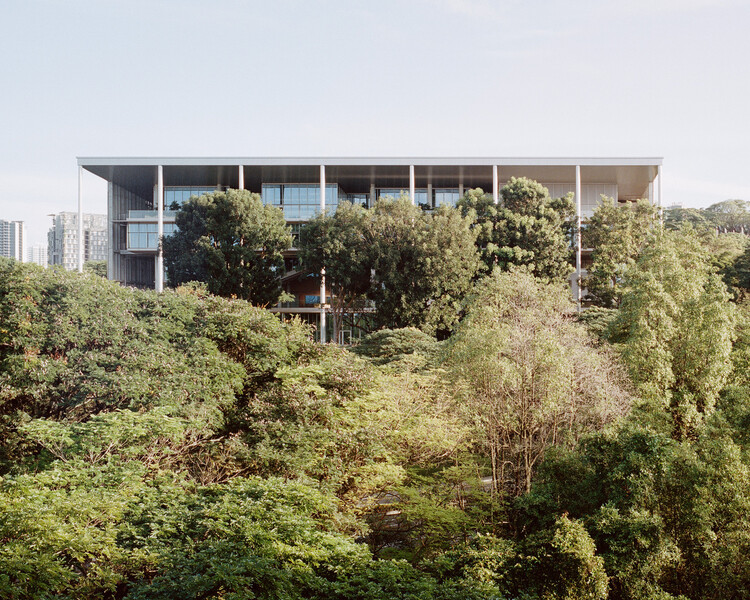
Sou Fujimoto’s contribution for the 13th edition of the Serpentine Gallery Pavilion is beginning to take shape, as the “geometric, cloud-like form” has slowly made its way towards the height of the trees in the rustic landscape of London’s Kensington Gardens. Upon its completion in June, the 350 square-meter latticed structure will fuse together the man-made and natural world, creating a lush, semi-transparent terrain that will host a series of flexible social spaces and a vibrant collection of plant life.
More images by London photographer Laurence Mackman after the break.
Help Rebuild Moore

Recovery efforts are underway in the Oklahoma City suburb of Moore after a deadly, 1.3-mile-wide tornado carved a 20-mile-long swath of destruction through neighborhoods and schools on Monday afternoon. With winds up to 210 miles per hour and a death count that currently stands at 24, President Obama has declared this tornado to be “one of the most destructive in history,” ranking it at a Category 5.
In an effort to help, Architecture for Humanity and the American Institute of Architects (AIA) have mobilized their teams to provide instant assistance and aid in long term reconstruction efforts. Although professional design and construction volunteers from both organizations are already on the ground, the community needs your help. Find out how you can help the residents of Moore after the break.
Why Skaters Need the Southbank Centre

Among the extensive discussion of Feilden Clegg Bradley‘s scheme to redesign the Southbank Centre in London, one issue which has sometimes been ignored by the architectural media has been the proposal to relocate the skate park in the under-croft of the Queen Elizabeth Hall to a space beneath the nearby Hungerford bridge.
Unsurprisingly, this decision has sparked a petition, which has collected nearly 40,000 signatures to save one of the UK’s most famous skating hotspots. We’ve talked about how skaters can teach architects about understanding space before; however, in this instance I would like to examine how skaters as a (sub)cultural entity interact with the city, and how the city can cater to their needs. Though many architects are already in favor of accepting skaters, I hope to explore why the wider community tends to see skating as a problem to be solved, and what this can reveal about the proposal at the Southbank Centre.
Read on to find out more about the peculiar way skaters experience cities…
Why LEED Doesn’t Work in Rural Africa and What Will

Originally published on Intercon, Ohioan and Africa-based architect Charles Newman, LEED AP discusses the pitfalls of LEED in rural Africa. Newman, who is currently working for the International Rescue Committee in Bukavu, Democratic Republic of Congo, is dedicated to the integration of sustainability in communities worldwide. Learn more about his work and travels on his blog Afritekt.
While in a small southern town of the Democratic Republic of Congo in mid-2012, a colleague of mine approached me for some guidance on a large health proposal he was putting together. A portion of the grant would be earmarked for the construction of hundreds of clinics across the DR Congo, and he mentioned that the donor would be very interested in “green” building standards. Knowing that I was a LEED Accredited Professional, he began asking how we might be able to incorporate such building standards into the designs for the pending projects. I rattled off some general guidelines such as using local materials – recycled ones if available, incorporating existing infrastructure, natural ventilation, etc. He jotted down a few notes, then began to pry a little deeper. “What about the LEED point system? Could we incorporate that into our strategy?”
My response was frank: “No, not really. LEED doesn’t work here in rural Africa.” (more…)
UCSD: A Built History of Modernism

At just a little over 50 years old, the University of California San Diego is one of the younger college campuses in the United States, but despite this it is one of the most architecturally fascinating universities around. In the official UCSD campus guide, Dirk Sutro emphasizes that “UCSD does not have a single example of the historical-revival styles prevalent at other University of California campuses… and at San Diego’s two other major universities”. The history of UCSD architecture is one of ambition, which has made the campus a display case of modernism in all of its forms from the last half a century.
Thanks to photographer Darren Bradley, we can now share this history and a selection of the exciting structures it has produced.
Find out more about the UCSD campus after the break
Can Architecture Make Us More Creative? Part III: Academic Environments

August Kekulé discovered the structure of the benzene ring after having a daydream of the Ouroboros, a famous mythological snake depicted as biting its own tail. Francis Crick figured out the complimentary replication system of DNA when he remembered the process of replicating a sculpture by making an impression of it in plaster, and using it as a mold to make copies. Johannes Keppler attributes his laws of planetary motion to an inspiration from religion: the sun, the stars, and the dark space around them represent the Father, Son, and Holy Ghost respectively.
What’s the point? According to Arthur Koestler, “all decisive events in the history of scientific thought can be described in terms of mental cross-fertilization between different disciplines.” Great discoveries arise not from the isolated hermit working without interference, but from tireless work enlightened by unintentional collisions with an unfamiliar subject. For Kekulé, it was ancient mythology, for Crick, sculpture, and for Keppler, religion.
Creativity and innovation, then, thrive where disciplines collide. And this is true not only for science, but for all subjects. We all have something to learn from one another, and what better place to encourage this cross-fertilization than school?
Keep reading to find out more about how interdisciplinary architecture can foster creativity and collaboration in schools…
Zaha Hadid Architects Selected to Design the King Abdullah Financial District Metro Station in Saudi Arabia

In order to serve its rapidly expanding population of more than five million, the ArRiyadh Development Authority has commissioned Zaha Hadid Architects to construct the new King Abdullah Financial District (KAFD) Metro Station in its capital city of Riyadh, Saudi Arabia.
With six platforms over four public floors and two levels of underground car parking, the KAFD Metro Station will be integrated within the urban context of the financial district, while responding to the functional requirements for a multimodal transport centre and the district’s future vision. The project extends beyond the simple station typology to emphasize the building’s importance as a dynamic, multi-functional public space; not only an intermediate place perceived through quick transitions, but also a dramatic public space for the city.
AD Interviews: Jarmund / Vigsnæs Architects
Jarmund / Vigsnæs Architects was the first Nordic practice we featured on ArchDaily after seeing their impressive Svalvard Center, a sharp copper-cladded volume that slowly ages and blends into the landscape.
Since then we have seen many more strong projects of different scales from the Norwegian firm. The firm was established in 1996 by Einar Jarmund and Håkon Vigsnæs, with Alessandra Kosberg who joined as a partner in 2004.
JVA’s projects range from small cabins in the woods and interiors, to large scale hospitality projects and urban plans. The firm has developed expertise in designing for the Nordic weather as well as creating connections between the buildings and the distinctive Nordic landscape. With the above as their focus, the practice constantly explores how to innovate through the use and experimentation of materials.
Their work has been featured in recent exhibits, and in their recent monograph.
JVA projects at ArchDaily:
The Constructivist Project / Natalia Melikova

In Russia, hundreds upon hundreds of buildings are endangered. The work of making sure they don’t become extinct? That’s in the hands of a tireless few.
One of these crusaders is Natalia Melikova, the author of The Constructivist Project, an on-line web site that seeks to preserve the memory – and hopefully inspire the protection of – Russia’s avant-garde architecture. Although it began as her thesis project, it’s steadily become one of her life passions. In Melikova’s words, “By sharing photographs (my own and others), articles, events, exhibitions, and other resources on the topic of the avant-garde, The Constructivist Project unites common interest and appreciation of Russian art and history and makes it accessible to an international English-speaking audience. This is a way to initiate discussion not only of the perilous situation of Russian avant-garde architecture but also of cultural preservation and urban development in general.”
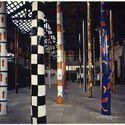
See 10 of Melikova’s images, snapshots into a part of Russian history quickly being forgotten, with her descriptions, after the break.
Charles Correa: India’s Greatest Architect

The Royal Institute of British Architects (RIBA) presents the first major UK exhibition showcasing the work of renowned Indian architect Charles Correa (born in 1930). Rooted both in modernism and the rich traditions of people, place and climate, Correa has played a pivotal role in the creation of an architecture and urbanism for post-war India. He has designed some of the most outstanding buildings in India and has received many of the world’s most important architecture awards including the RIBA Royal Gold Medal (1984), Aga Khan Award for Architecture (1988) and Japan’s Praemium Imperiale (1994), and is still working today.
Can Glowing Trees One Day Replace Electric Streetlights?

“We don’t live in nature any more – we put boxes around it. But now we can actually engineer nature to sustain our needs. All we have to do is design the code and it will self-create. Our visions today – if we can encapsulate them in a seed – [will] grow to actually fulfill that vision.” - Andrew Hessel in a recent ArchDaily interview
“Engineering nature to sustain our needs” is exactly what the Glowing Plant Project aims to do. Synthetic biologist Omri Amirav-Drory, plant scientist Kyle Taylor and project leader Antony Evans are working together to engineer “a glow-in-the-dark plant using synthetic biology techniques that could possibly replace traditional lighting” – and perhaps even create glow-in-the-dark trees that would supplant (pun intended) the common street light.
How is this possible? Read on to find out.
Ochoalcubo: Japan + Chile

In Chile, a very special project is being developed.
Eduardo Godoy, a design impresario who started his business in Chile in the 80′s, has always been an advocate for design and architecture in the country. In Chile, more than 40 schools of architecture have flooded the market, but the ever growing number of professionals has had a relatively small impact on Chilean cities. Seeing the almost infinite landscape of cookie cutter housing in the suburbs, Godoy asked himself: why not break this model into smaller pieces, each designed by a particular architect, each an opportunity for a young professional? With this in mind, and to foster the appreciation for architects, Eduardo and his team at Interdesign started a project called “Ochoalcubo” (Eight-Cubed). His original idea was to make 8 projects, with 8 buildings designed each by 8 architects, to create developments where the singularity of each piece was key, in order to demonstrate how the individuality of the architect could result in good architecture.

BIG Unveils Design for Miami Beach Convention Center

BIG has collaborated with West 8, Fentress, JPA and developers Portman CMC to challenge an OMA- and South Beach ACE-lead team in the 52-acre Miami Beach Convention Center overhaul. With a mission to “bring Miami Beach back to the Convention Center,” BIG’s newly unveiled proposal aims to transform the “dead black hole of asphalt in the heart of one of the most beautiful and lively cities in America” into an archipelago of urban oases made up of paths, plazas, parks and gardens, which will all lead to the heart of the plan: the Miami Beach Square. This tropical centerpiece will become the front door to the convention center and the convention hotel, as well as the front lawn to a revitalized Jackie Gleason Theatre, a town square for the city hall, an outdoor arena for the Latin American Cultural Museum, and the red carpet for the big botanical ball room.

More images and the teams description after the break…
The Moscow Affair

Russia has madly, passionately (and not a little blindly) fallen in love. And, as with any love affair worth its salt, this one will have its fair share of consequences when the honeymoon ends.
The object of Russia’s affection? The good, old-fashioned automobile.
It started fast and has only gotten faster. In 2005, Russia’s auto industry grew 14%; in 2006, 36%; and, in 2007, a whopping 67% – an exponential growth that attracted foreign investors, particularly after 2009, when the country welcomed companies like GM & Ford with open arms. Today, the ninth largest economy in the world is the seventh-largest car market, positioned to surpass Germany as the largest in Europe by 2014.
Nowhere is this love affair more evident, more woven into the city itself, than in Moscow. The city has a reputation (perhaps rivaled only by Beijing’s) for traffic, pollution, and downright hostility to pedestrians. And, ironically, because of its epic congestion, the city continues to expand its highways and parking spaces.
We’ve heard that story before, and we know how it ends – for that matter, so does Moscow. But passion, by nature, is blind – and stopping a love affair in its tracks is far from easy.
Smithsonian Cooper-Hewitt Announces 2013 National Design Awards Winners

Now in its 14th year, the Smithsonian Cooper-Hewitt National Design Awards is continuing its legacy to recognize outstanding achievement across a variety of disciplines in the design community. The awards were established to “promote design as a vital humanistic tool in shaping the world”. This year the recipients will be honored at a gala in October during National Design Week in New York City. The goal of recognizing this achievements is to reinforce the idea that “everything around us is designed” and the potential for innovation and creation is present across all types of development. The winners of this year’s design awards were selected based on excellence, innovation and public impact.
Join us after the break for a look at the 2013 Winners. (more…)
Can Architecture Make Us More Creative? Part II: Work Environments

Jane Jacobs revered the West Village. It was a bustling neighborhood enlivened by its social, spatial, and functional diversity. It had different building types and functions, which meant that people were always in places for different purposes; it had short blocks, which have the greatest variety of foot traffic. It had plenty of old buildings with low rent which “permit individualized and creative uses;” and, most importantly, it had all different kinds of people. As a result, West Villagers could establish casual and informal relationships with people that they might not have had the opportunity to otherwise.
Without these necessary characteristics, Jacobs felt “there is no public acquaintanceship, no foundation of public trust, no cross-connections with the necessary people – and no practice or ease in applying the most ordinary techniques of city public life at lowly levels.”
By simply changing a few words, it’s not hard to imagine Jacobs’ writing describing offices instead of cities. Buildings are different internal spaces, like individual offices or gathering spaces; desks are homes; sidewalks are hallways or circulation space; etc.
If the office is a small microcosmic city, then suburbia is the cubicle-strewn office, and Google might be the West Village. And ‘people analytics,’ the statistical and spatial analysis of interpersonal interaction, is the office’s urban planning.
To find out what creative work environments can learn from the composition of cities, keep reading after the break…
MoMA Selects Diller Scofidio + Renfro as Architect of the Folk Art Museum

The Museum of Modern Art has commissioned Diller Scofidio + Renfro (DS+R) to design its controversial expansion that will overtake the former American Folk Art Museum in New York. This news comes after an intense backlash from prominent architects, preservationists and critics worldwide pressured MoMA to reconsider its decision to raze the iconic, Tod Williams and Billie Tsien-design museum in order to make way for its new expansion.
In response, DS+R has requested that MoMA gives them the “time and latitude to carefully consider the entirety of the site, including the former American Folk Art Museum building, in devising an architectural solution to the inherent challenges of the project,” as stated by Glenn D. Lowry, MoMA’s director, in a memo sent on Thursday to his trustees and staff. He added, “We readily agreed to consider a range of options, and look forward to seeing their results.”
More on the DS+R’s commission and the fate of the Folk Museum after the break…
Architecture City Guide: Beirut

Following a brutal 15-year civil war that tore the city apart, Beirut has recovered remarkably; it was voted the number one destination to visit by the New York Times in 2009, and, more recently, received a similar title by Frommer’s. The city is in the second phase of one of the biggest urban reconstruction projects in the world, run by Solidere, which has brought architects like Steven Holl, Herzog & DeMeuron, Zaha Hadid, Vincent James, and Rafael Moneo to the local scene. In less internationalized parts of the city sit the landmarks of the 1960s and 1970s, Beirut’s pre-war glory days, including buildings by names such as Alvar Aalto, Victor Gruen, and the Swiss Addor & Julliard. With a city growing as fast as Beirut it is impossible to have a final city guide, so we look forward to hearing your suggestions and building on this over the years.
Photos and a map of Beirut’s most exciting buildings after the break…
Madla-Revheim Masterplan Proposal / MVRDV + Space Group

MVRDV and Space Group are one of three teams who have been asked to submit a masterplan proposal for the Norwegian town of Madla-Revheim, the main development area outside of Stavanger. The aim of this commission is to develop a model of sustainable growth that treats development principles, transportation systems and built structures as parts of a whole. In this proposal, MVRDV and Space Group propose to concentrate 4,000 housing units on the edge of the 780 acre site, preserving the heart of the development for open, green space, public programs and sports facilities.
Adrian Smith and Gordon Gill Architecture Unveils Proposal for Mumbai’s Tallest Tower

Adrian Smith and Gordon Gill Architecture has unveiled a competition-winning prototype in which they hope will become Mumbai’s tallest skyscraper. Standing 400-meters about the crowded city streets, the 116-story Imperial Tower’s curvilinear form is aerodynamically shaped to “confuse the wind.” Its 132 “spacious and luxurious” residential units are punctuated by north- and south-facing sky gardens, which break up wind currents around the tower and provide unprecedented access to natural light and views of the Arabian sea.
Update: Golden State Warriors Stadium / Snøhetta + AECOM

Snøhetta and AECOM have released updated renderings of the Golden State Warriors’ Stadium, which is scheduled to debut on a preeminent San Francisco waterfront site for the 2017-18 NBA basketball season. Located on Piers 30-32, just walking distance from the downtown Financial District and easily accessed by a variety of public transportation, the 728,000 square foot arena will please the masses with its expansive open space, Bay Bridge views, and amenities. Not only will the 125-foot, disk-shaped stadium cater to Warriors’ needs, but it will also provide 90,000 square feet of retail space, ferry and cruise ship access, along with a waterside fire station. In addition, the 18,000-seat venue will also accommodate for music concerts, conventions and other cultural events. (more…)