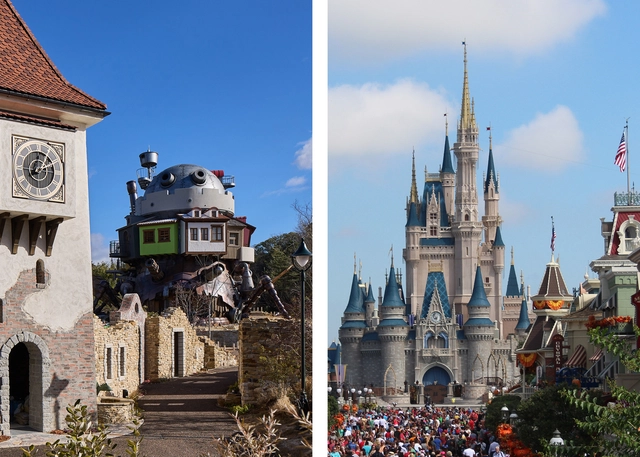
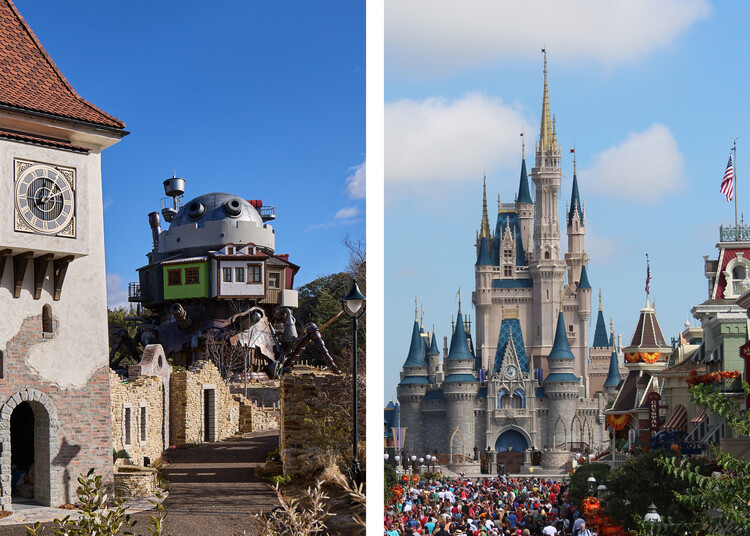
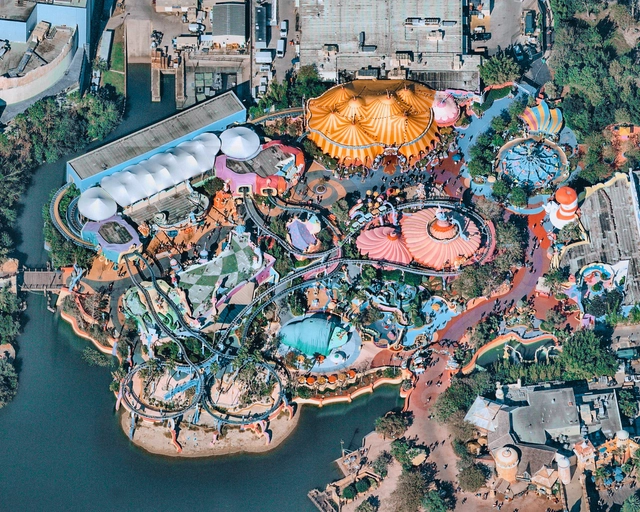
Ghibli and Disneyworld comparison. Image via J-LIGHTS / Koichiro Itamura and Theme Park Tourist on wikipedia with license CC BY 2.0
When it comes to designing for a child's imagination, the architectural landscape presents two different philosophies. Disneyland and Studio Ghibli, both masters of imaginative storytelling, represent this core division. Their approaches, far from being accidental, reflect different views on how children experience and engage with space. One provides a spectacle of constructed fantasy, while the other offers a landscape for potential magic. These two models present architects with a fundamental choice for tackling these sorts of projects: to design spaces that cater to children's innate need for sensory and personal discovery, or to create a fantasy that appeals to their growing ability to understand narratives and more complex spaces.
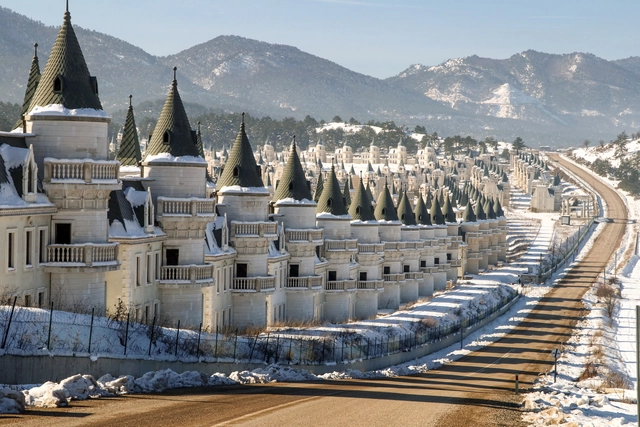
Most of us have probably imagined living in a castle at some point, whether during childhood, enchanted by fairy tales, or as adults studying European monarchies. Considering this fascination, what would you think if you had the chance to buy your castle? In mid-2014, you could make that dream a reality in Turkey for just $370,000. Each luxurious 325-square-meter castle came complete with blue turrets and spiral staircases. The only catch? Your castle would be one of 731 identical ones. But who cares about exclusivity when you have the chance to live in a Disney fairy tale?
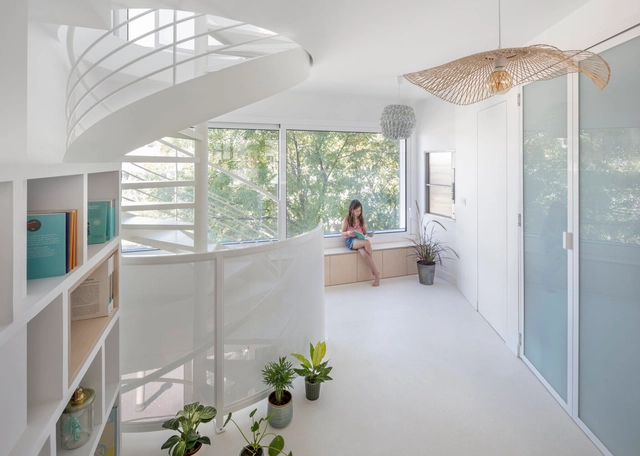
Whether rising to the highest room of the tallest tower in a Disney-esque castle, giving an admirer the chance to confess their love on an apartment buildingfire escape, or connecting a basement or attic room with a decorative period feature, there’s something unavoidably romantic about spiral staircases. But there’s more function behind these coiling forms than just their good looks.
One common-held theory is that spiral staircases were first installed in historic castles as vertical baffles, tiring out enemy infiltrators before they could make it to the top. This is why – it is said – many are set to turn clockwise on the ascent, so attackers have a smaller arc for swinging weapons (mostly held in right hands) than defenders making their descent.
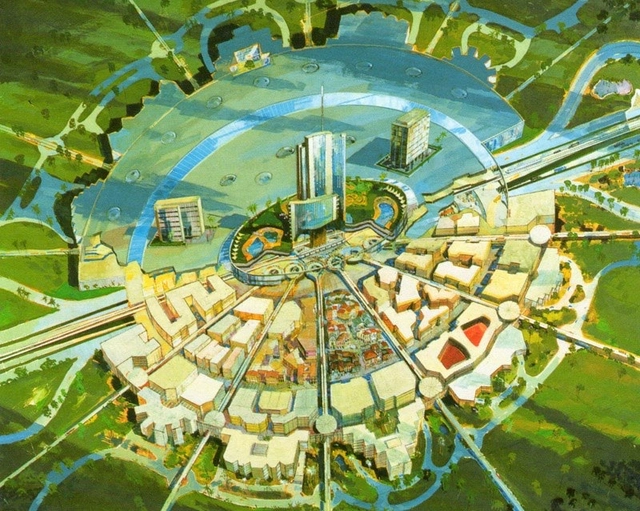
Community development proposals in Disney World come from back days. One of Walt Disney's last visionary projects was the Experimental Prototype Community of Tomorrow (EPCOT), a center for American enterprise and urban living. Disney advocated that the problems of cities were the most critical issues facing society and planned a city that could develop in a controlled manner, contrary to the urban expansion in the USA during the first half of the last century. After Disney died in 1966, the "EPCOT" concept was abandoned as the company was uncertain about the feasibility of operating a city. Fifty- five years later, after a thorough search, Walt Disney World chose The Michaels Organization for its experience in building and managing attainable housing communities.
Beneath the Spaceship Earth geodesic sphere and the display of world cultures that symbolize Disney World’s EPCOT lies the buried vision for a utopian city. The original EPCOT - a community built around innovation - was one of Walt Disney’s last visionary projects. Bothered by haphazard urban sprawl, Disney had bold ideas for an urban fabric that would drive progress in the USA. The “Experimental Prototype Community of Tomorrow” was Walt Disney’s antidote to the decay of American cities.
Throughout history, humans have always craved a sense of thrill and an affinity for different forms of entertainment and attraction at all different scales and sizes. Theme parks have continuously evolved, as society redefines what it means to be entertained, and have transformed from evening strolls into physics-defying twists and turns on state-of-the-art rollercoasters.
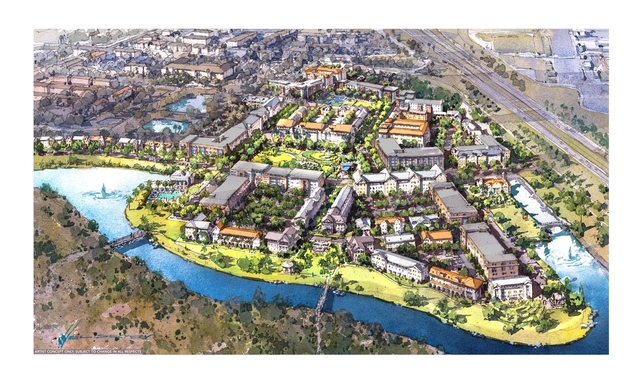
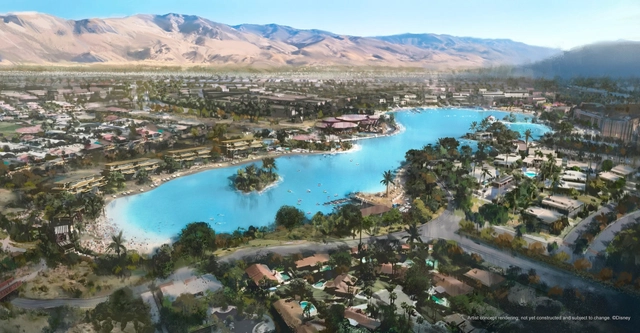
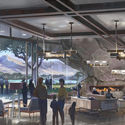
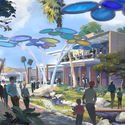
Disney, the multinational entertainment and media conglomerate announced its new addition to its Signature Experiences Program. Titled "Cotino", part of its new Storyliving by Disneyventure, the master plan is Disney's first master-planned community project, and will feature distinctly-designed housing units and neighborhoods, along with commercial and civic amenities and man-made beaches in the heart of Rancho Mirage, California's Coachella Valley.
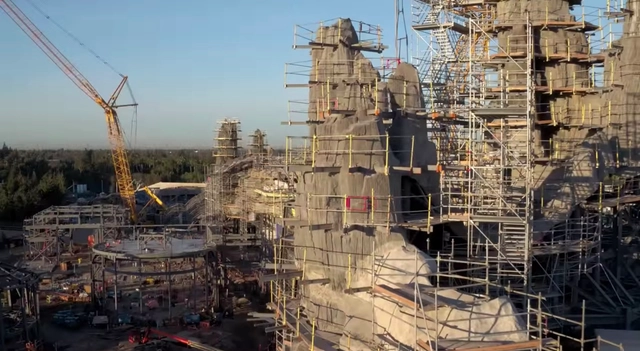
Construction is well underway on Disney’s much anticipated Star Wars: Galaxy’s Edge theme parks planned for both Disney World in Florida and Disneyland, California.
A new drone video released by Disney Parks shows that many of the California park’s landscape and architectural elements – including mountains spires, towers and domes – are already in place. Inspired by the real-world land- and cityscapes of Istanbul and Morocco, the park will evoke the Outer Rim planet of Batuu, a remote trade outpost located along old sub-lightspeed trade routes.
At the D23 Expo this past weekend, Disney announced plans for a new Star Wars hotel and resort at the Walt Disney World in Orlando, Florida, and revealed an animation of the upcoming Star Wars: Galaxy’s Edge theme park that will bring the beloved galaxy into the present and not-so-far-away.
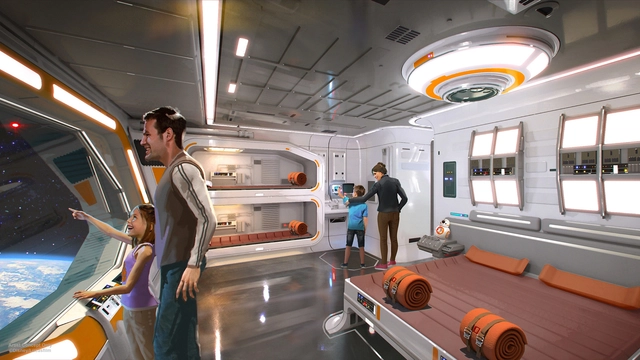
The revolutionary hotel has been envisioned as a completely “immersive” experience – visitors will each be given their own “story line” complete with “secret missions,” interacting with a full in-costume and in-character hotel staff. Early concepts for the resort show starship-themed spaces throughout, from the lobby to hotel rooms each featuring “a view into space.”