Whether rising to the highest room of the tallest tower in a Disney-esque castle, giving an admirer the chance to confess their love on an apartment buildingfire escape, or connecting a basement or attic room with a decorative period feature, there’s something unavoidably romantic about spiral staircases. But there’s more function behind these coiling forms than just their good looks.
One common-held theory is that spiral staircases were first installed in historic castles as vertical baffles, tiring out enemy infiltrators before they could make it to the top. This is why – it is said – many are set to turn clockwise on the ascent, so attackers have a smaller arc for swinging weapons (mostly held in right hands) than defenders making their descent.
Ever since the Industrial Revolution and the introduction of mass production, the ownership and use of simple products and services like flush toilets with running water, electricity, heating, and cooling are seen as human rights in many areas of the world. With the majority of homes and residential projects being individually designed and built to order – therefore without the speed and cost advantages of mass production – an underperforming housing construction sector means many people – even in the world’s richest countries – are being denied one of the most basic human rights, having somewhere to call home.
The UNHCR (UN Refugee Agency) states that there were over 100 million forcibly displaced people worldwide in 2023 – a figure that has tripled over the last 10 years. For host countries, finding safe, sustainable housing solutions for those in need, both in the short- and the long-term, is an ongoing and dramatically worsening challenge.
We are on the brink of concluding the hottest year in the past 125,000 years. Recently, elevated temperatures have adversely impacted the daily routines of a significant portion of the population, particularly those who spend most of their day outdoors without access to air-conditioned environments. Excessive heat stems from various sources, both natural and human-induced. Given the grim outlook on this matter, it becomes imperative to explore structural measures to address and mitigate the potential deterioration of public health caused by escalating temperatures.
Social responsibility and the desire to improve society has long been influenced by the built environment. Looking at city centers, architecture has contributed to the improvement of the urban fabric, whether it being through planning and zoning strategies, integration of public spaces, or small interventions. In some cases however, these interventions are in fact used as tools to keep the homeless off the streets, disguised as art or conceptual designs. Several public urban policies have all implicitly prohibited the homeless and other marginalized social groups from city centers, claiming that their presence and “irregular” use of public space could compromise the reputation, security, and desirability of the city.
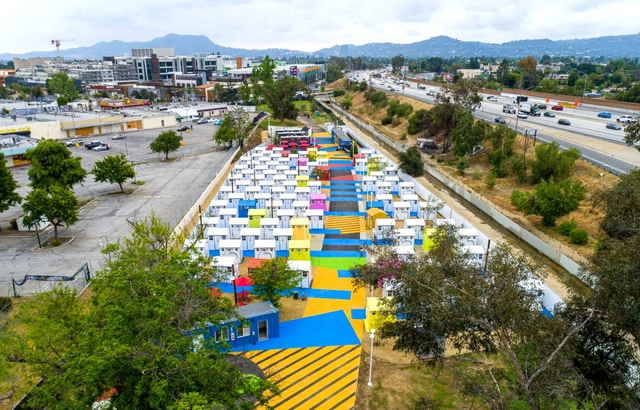
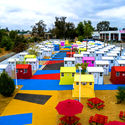
Alexandria Park Tiny Home Village. Image Courtesy of Lehrer Architects
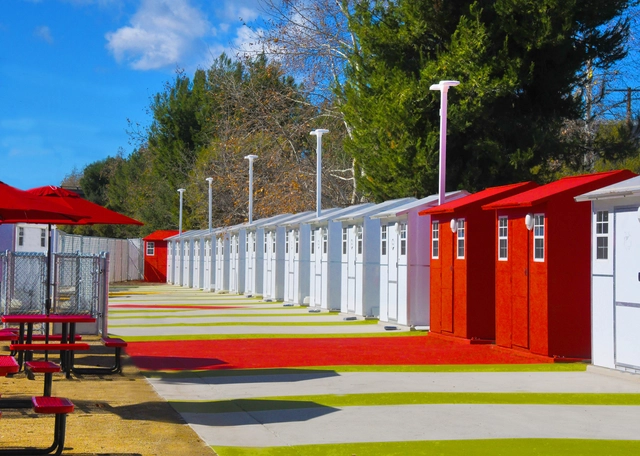
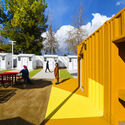
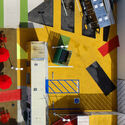
Lehrer Architects converts several leftover plots in Los Angeles into micro-homes developments, unfolding an experimental template for tackling homelessness. Together with the Bureau of Engineering for the City of Los Angeles, the architecture firm creates an efficient yet functional design using prefabricated pallet shelters and brings character to the project through vibrant colours to shape a new sense of community and restore dignity through design.
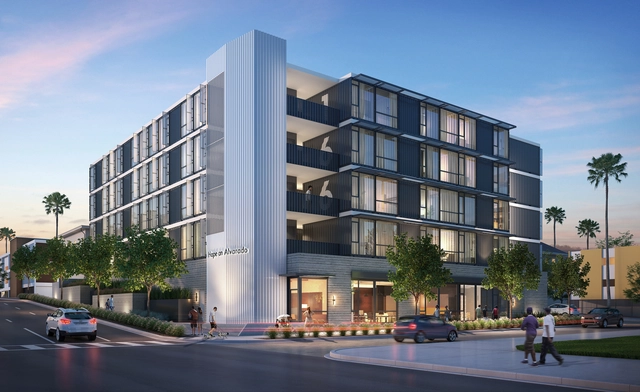
Hope on Alvarado, designed by KTGY Architecture + Planning, is the first modular housing project in the series of Hope On developments, aiming to find sheltering solutions for the chronically homeless, in Los Angeles.
Exterior Rendered View. Image Courtesy of James Furzer
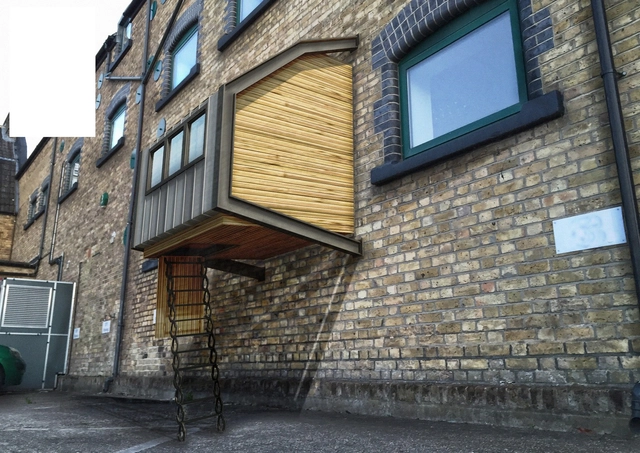
The 6th annual “Space for New Visions” competition has announced its winner: a project entitled “Homes for the Homeless,” by James Furzer of Spatial Design Architects. Hosted by FAKRO, a global manufacturer of roof windows and loft ladders, and A10 Magazine for European Architecture, the competition sought proposals that incorporated FAKRO products. With entries from around the world, projects were judged based on user comfort, environmental impact, functionality and natural light, among other things. Read about the winning entry after the break.