1. ArchDaily
  2. Steel

Steel: The Latest Architecture and News

Call for entries MEDS Workshop 2018 - DiverCity

Update: The deadlines for this opportunity have been extended 

  • Call For tutors : Extended till January 28
  • Call for participants : Ends on February 28

MEDS workshop “Meetings of Design Students” is an international workshop that takes part each summer in a different country, focusing on various issues, themes, topics and settings that will help any designer expand their expertise. It is a chance to get in touch with diverse approaches to design, different building techniques, traditions and skills. MEDS workshop is both practical and educational because it focuses not only on creative theoretical designs, but actually compels participants to execute these designs during the 2-week span of the workshop. You can apply to MEDS as a tutor or as a participant.
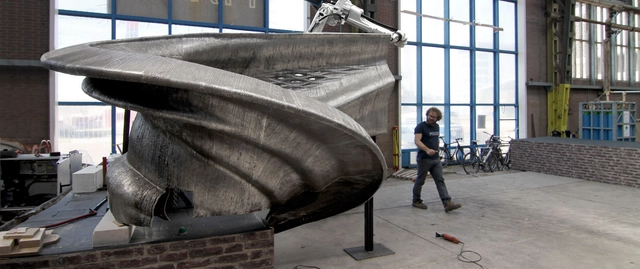
Work is Underway on The World's First 3D-Printed Metal Bridge

Dutch 3D-printing start-up MX3D has revealed new details about their plans to install the world’s first 3D-printed metal bridge over a historic canal in Amsterdam.

Originally slated to be built in place, further research concluded that the design would have placed too much stress of the canal walls. So it was back to the drawing board, and the studio, where the updated design is now under construction. Featuring complex curves and a 12-meter-span, the bridge is now being constructed by MX3D’s sophisticated 3D-printed robot. And with about one-third of the structure already completed, it is back on schedule for a late 2018 installation on Amsterdam’s Oudezijds Achterburgwal canal.

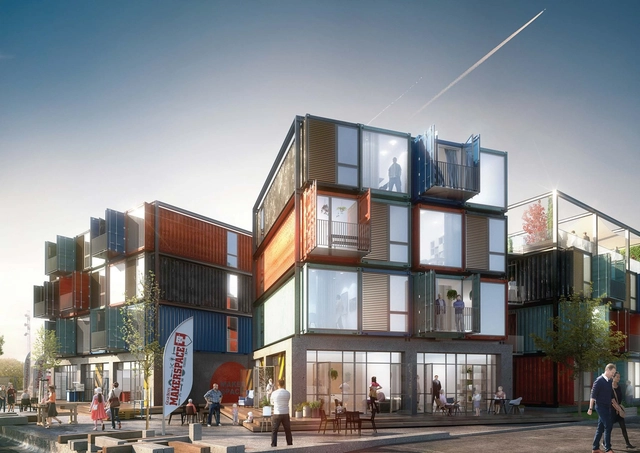
Arkitema Architects Designs 30 Shipping Container Apartments in Roskilde, Denmark

Beat Box: 30 apartments in 48 containers to transform the Danish neighborhood of Musicon, adjacent to the famous Roskilde Festival area. Designed by Arkitema Architects and constructed by Container Living, Beat Box is an integral part of Roskilde’s goal to revamp Musicon over the next 15 years by adding 1,000 jobs and 1,000 homes.

Arup Develops Affordable 3D-Printing Sand Casts for Complex Steel Structural Elements

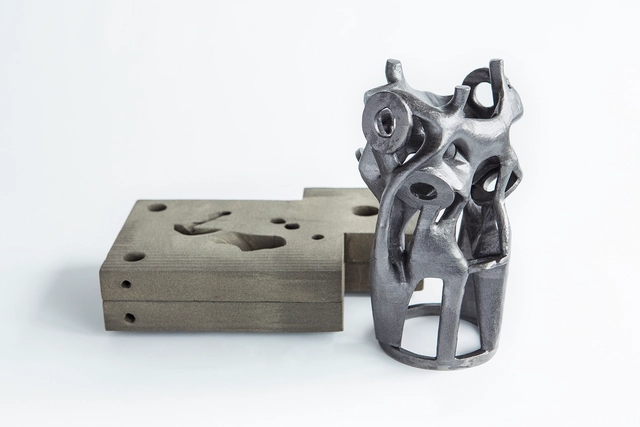
Arup's’ research into alternative production techniques and materials has focused on the potential of 3D printing metal in the construction sector. Complex and individually designed steel structural elements can be efficiently produced “resulting in endless possibilities in mass customisation, weight reduction, product integration and more.”

Working with the Anglo-Dutch company 3Dealise, their 3D-printed sand molds are used in the traditional casting process to create sophisticated, unique structural steel nodes as a certified material. Sand printing offers a quick technique that can reuse the materials and allows costs to be kept low.

Striking Images of Exposed Steel: The Best Photos of the Week

Subscriber Access | 

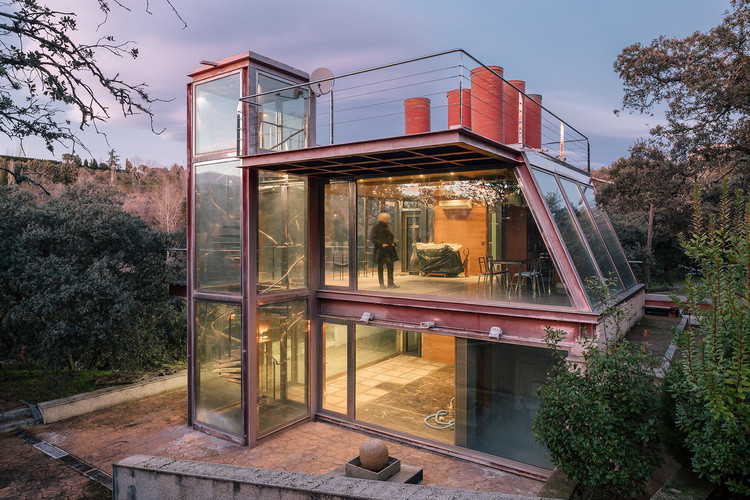
High strength, ease of transport, and simplicity of assembly are among the many major advantages of steel. But while utilitarian steel structures tend to be hidden by architects, working with exposed steel can lead to attractive results. Steel not only brings lightness to a design, but can also offer different expressions of color and texture, depending on the treatment of the material. Below we present a selection of 14 photos of steel architecture from well-known photographers such as Adrien Williams, Imagen Subliminal, and Sergio Pirrone.

Striking Images of Exposed Steel: The Best Photos of the Week - Image 1 of 4Striking Images of Exposed Steel: The Best Photos of the Week - Image 2 of 4Striking Images of Exposed Steel: The Best Photos of the Week - Image 3 of 4Striking Images of Exposed Steel: The Best Photos of the Week - Image 4 of 4Striking Images of Exposed Steel: The Best Photos of the Week - More Images+ 11

This Low-Cost System Creates Sleek Shelving from Simple Plasterboard Profiles

Subscriber Access | 

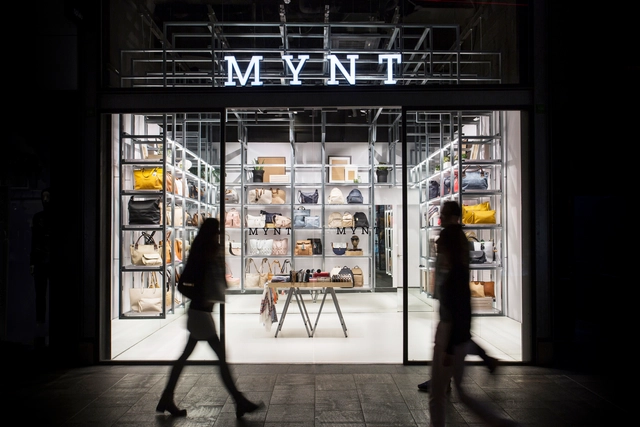
The premise for this design was to create an iconic space, with a concept adaptable to any property and versatile when exposing the product. It should also be a design that could be quickly built and at a moderate cost.

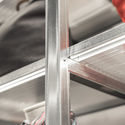
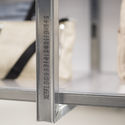
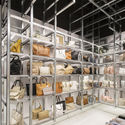
To reach this goal, DearDesign has designed an open store with a structure that, despite its rigid and orthogonal look, solves flexibility in terms of product display. The design of the store is based on a three-dimensional grid inspired by the Fibonacci sequence, which creates a variable rhythm in a permeable volume, ordering the space by generating niches to exhibit the product along its perimeter.

This Low-Cost System Creates Sleek Shelving from Simple Plasterboard Profiles - Image 1 of 4This Low-Cost System Creates Sleek Shelving from Simple Plasterboard Profiles - Image 2 of 4This Low-Cost System Creates Sleek Shelving from Simple Plasterboard Profiles - Image 3 of 4This Low-Cost System Creates Sleek Shelving from Simple Plasterboard Profiles - Image 4 of 4This Low-Cost System Creates Sleek Shelving from Simple Plasterboard Profiles - More Images+ 24

Oskar Zieta Inflates Steel Arches With Air to Create This Lightweight Pavillion

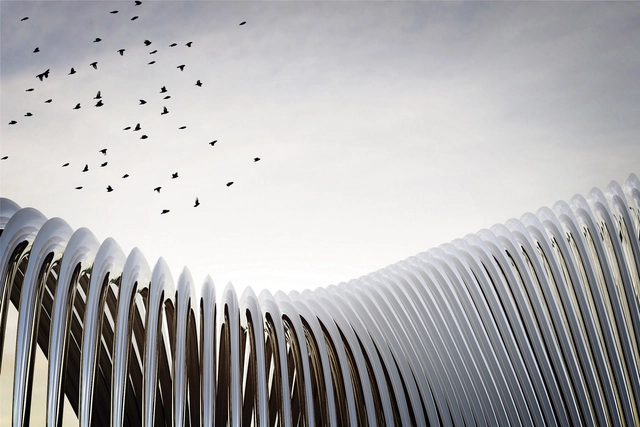
Polish architect, designer, and sculptor Oskar Zieta has unveiled his latest project: the arched NAWA pavilion on an island in Wroclaw, Poland. The pavilion forms part of the European Capital of Culture celebrations following the theme of “Metamorphoses of Culture” and was unveiled in June. The lightweight steel elements that make up the parametrically designed sculpture are made in a unique method called FiDU, a metal-inflating process created by Zieta during his PhD studies in ETH Zurich. Though Zieta has used FiDU successfully for various products (many exhibited in the Salone del Mobile in Milan), the NAWA Pavillion is the first project of this size to use the technology entirely, and is thus coined as “a manifesto of FiDU."

Oskar Zieta Inflates Steel Arches With Air to Create This Lightweight Pavillion - Image 1 of 4Oskar Zieta Inflates Steel Arches With Air to Create This Lightweight Pavillion - Image 2 of 4Oskar Zieta Inflates Steel Arches With Air to Create This Lightweight Pavillion - Image 3 of 4Oskar Zieta Inflates Steel Arches With Air to Create This Lightweight Pavillion - Image 4 of 4Oskar Zieta Inflates Steel Arches With Air to Create This Lightweight Pavillion - More Images+ 45

Public Pools or Private Houses - How Should Stockholm Use its Cliffs?

Public Pools or Private Houses - How Should Stockholm Use its Cliffs? - Image 5 of 4
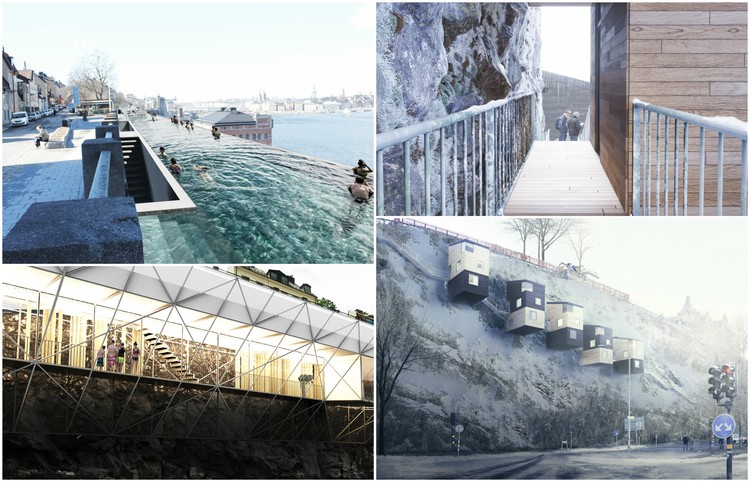
Courtesy of UMA / Manofactory. Image Infinity Pool vs Nestinbox

One of architecture’s most delightful anomalies is the diversity of solutions generated by any given site. From hypothetical university projects by architecture students to professional international design competition entries, the differing perspectives, stances, and experiences brought to rest on one site by several design teams can wield a bounty of contrasting ideas.

Recently, we reported on Nestinbox, a proposal by Swedish architecture firm Manofactory to attach a series of simple, functional houses to a cliff face in Stockholm, addressing the demands of increased populations and land prices in cities across the world. Now, the cliffs of Stockholm have been the subject of an entirely different, though just as evocative concept by Swedish firm UMA. Rather than private housing, UMA proposes the Stockholm Infinity Pool, a public pool 1km along the Sodermalm cliffs of Sweden’s capital.

Public Pools or Private Houses - How Should Stockholm Use its Cliffs? - Image 1 of 4Public Pools or Private Houses - How Should Stockholm Use its Cliffs? - Image 2 of 4Public Pools or Private Houses - How Should Stockholm Use its Cliffs? - Image 3 of 4Public Pools or Private Houses - How Should Stockholm Use its Cliffs? - Image 4 of 4Public Pools or Private Houses - How Should Stockholm Use its Cliffs? - More Images+ 8

New Book Calls for an End to Our Fetish for Conditioned Skyscrapers

Professor Alan Short of the University of Cambridge has published a book advocating for the revival of 19th-century architectural ideas to address the crippling energy use of modern skyscrapers. The Recovery of Natural Environments in Architecture proposes an end to the architectural fetish for glass, steel, and air conditioning, instead drawing inspiration from forgotten techniques in naturally ventilated buildings of the 1800s. The book is a culmination of 30 years’ research and design by Prof. Short and his colleagues at the University of Cambridge.

New Book Calls for an End to Our Fetish for Conditioned Skyscrapers - SustainabilityNew Book Calls for an End to Our Fetish for Conditioned Skyscrapers - SustainabilityNew Book Calls for an End to Our Fetish for Conditioned Skyscrapers - SustainabilityNew Book Calls for an End to Our Fetish for Conditioned Skyscrapers - SustainabilityNew Book Calls for an End to Our Fetish for Conditioned Skyscrapers - More Images

Manufacturing Utopia - How Assemble is Creating a Model Factory at A/D/O

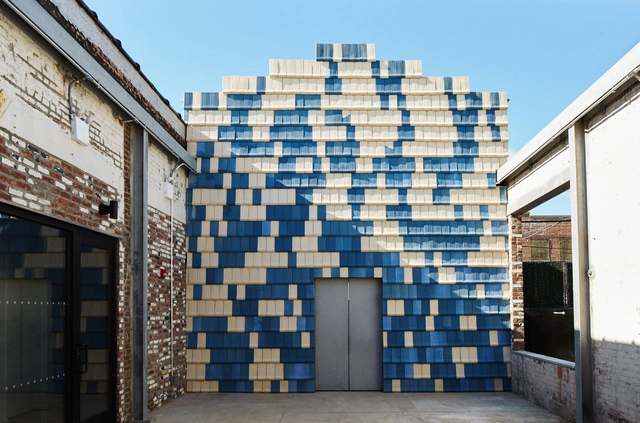
London-based architecture collective Assemble is set to transform an outdoor courtyard at A/D/O in Brooklyn into a ‘model factory’ to explore utopian ideals of work. The Turner Prize-winning architects will use their first site-specific installation in the U.S. entitled ‘A Factory As It Might Be’ to depict a vision of how society should build and function using abundant, malleable materials.

Manufacturing Utopia - How Assemble is Creating a Model Factory at A/D/O - Image 1 of 4Manufacturing Utopia - How Assemble is Creating a Model Factory at A/D/O - Image 2 of 4Manufacturing Utopia - How Assemble is Creating a Model Factory at A/D/O - Image 3 of 4Manufacturing Utopia - How Assemble is Creating a Model Factory at A/D/O - Image 4 of 4Manufacturing Utopia - How Assemble is Creating a Model Factory at A/D/O - More Images+ 10

Competition Winning Stadium Design Promotes Inclusivity in Dunkirk, France

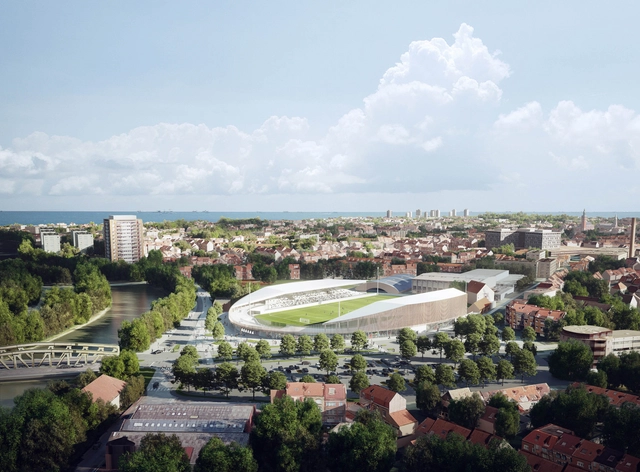
The SOCKEEL + OLGGA consortium have won a competition to design the new Tribut Stadium in Dunkirk, France. The historic stadium, in a prominent location on a canal bank in central Dunkirk, will be transformed into a 5,000 seat stadium seeking to maximize inclusiveness and accessibility.

Competition Winning Stadium Design Promotes Inclusivity in Dunkirk, France - Image 1 of 4Competition Winning Stadium Design Promotes Inclusivity in Dunkirk, France - ChairCompetition Winning Stadium Design Promotes Inclusivity in Dunkirk, France - Image 3 of 4Competition Winning Stadium Design Promotes Inclusivity in Dunkirk, France - FacadeCompetition Winning Stadium Design Promotes Inclusivity in Dunkirk, France - More Images+ 6

AA Summer DLAB Program Applies Computational Design to Concrete

Update: We've added a video of the process to the article!

This year's Architectural Association (AA) Summer DLAB program culminated in Weave.X, the final working prototype of three-dimensionally interwoven concrete structures. Designed and fabricated by 21 participants from 11 countries in July and August, the prototype explores computational design, geometry rationalization, material behavior, and robotic fabrication as applied to concrete and robotic rod-bending techniques. The result is a network of self-supporting concrete branches that envelop an amorphous enclosure.

AA Summer DLAB Program Applies Computational Design to Concrete - Image 1 of 4AA Summer DLAB Program Applies Computational Design to Concrete - Image 2 of 4AA Summer DLAB Program Applies Computational Design to Concrete - Image 3 of 4AA Summer DLAB Program Applies Computational Design to Concrete - Image 4 of 4AA Summer DLAB Program Applies Computational Design to Concrete - More Images+ 7

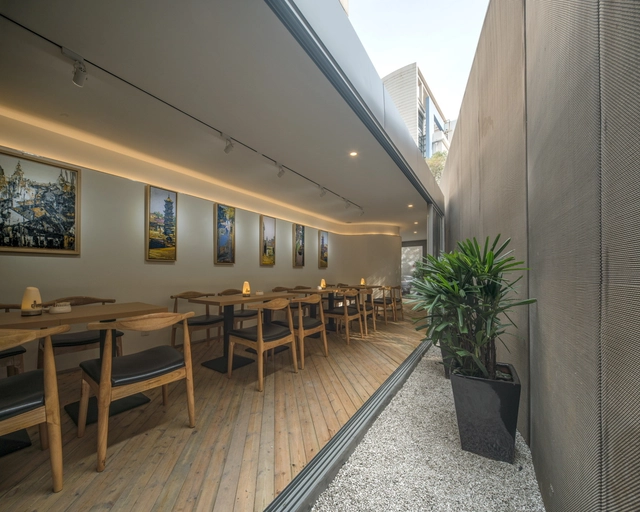
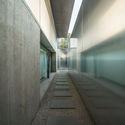
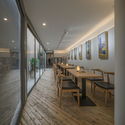
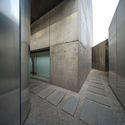
Chimney Café / GOA

Chimney Café / GOA - Coffee ShopChimney Café / GOA - Coffee Shop, Facade, Door, Table, ChairChimney Café / GOA - Coffee Shop, Garden, Facade, Stairs, Handrail, DoorChimney Café / GOA - Coffee Shop, FacadeChimney Café / GOA - More Images+ 8

Shanghai, China
  • Architects: goa
    : GOA
  • Area Area of this architecture project Area:  60
  • Year Completion year of this architecture project Year:  2015

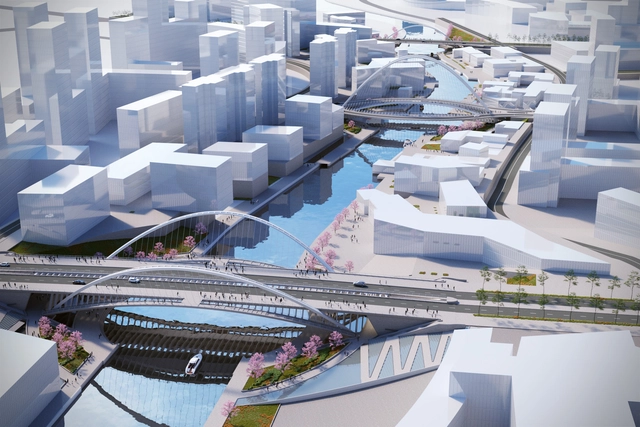
Santiago Calatrava Designs 3 New Bridges for Huashan

Santiago Calatrava has been commissioned to design a trio of bridges in the Chinese city of Huashan, east of Wuhan. The three steel bridges - Xihu, Xianbi and Lincong - will span 1.5 kilometers of the city's new Yangtze River canal, providing access to pedestrians, cyclists and vehicles.

“Architecture is one of the art forms best able to improve and revitalize cities both artistically and functionally,” said Calatrava. “The Huashan project is a clear example of how an urban element, key to the successful growth of the city, can at the same time improve the quality of life for its citizens, thanks to an integration of all three bridges and the creation of boulevards on the banks of the canal.”

The Apple and the Leaf: On How in Architecture There Are No Indisputable Truths

Subscriber Access | 

For many centuries, the demands of gravity appeared to give architecture one requirement that was largely unquestionable: that structures must rise vertically. However, with the advent of steel it was revealed that this limit had not been provided by gravity but by our own limited technologies. In this text, originally published by Domus Magazine in Italian and shared with ArchDaily by the author, Alberto Campo Baeza reflects on the architectural freedom offered by steel structures and the arbitrariness they bring to architectural space.

Isaac Newton was resting under an apple-tree in his garden when an apple fell on his head. Being endowed with such a privileged head and thoughts faster than lightning, he rose forthwith from his afternoon nap and set about calculating the acceleration of gravity.

Had Sir Isaac Newton had a little more patience and had he taken his time in getting to his feet, he might have noticed how, following the apple, a few leaves also fell from that same apple-tree, and while they fell, they did so in quite a different manner to the apple.

The Apple and the Leaf: On How in Architecture There Are No Indisputable Truths - Image 1 of 4The Apple and the Leaf: On How in Architecture There Are No Indisputable Truths - Image 2 of 4The Apple and the Leaf: On How in Architecture There Are No Indisputable Truths - Image 3 of 4The Apple and the Leaf: On How in Architecture There Are No Indisputable Truths - Image 4 of 4The Apple and the Leaf: On How in Architecture There Are No Indisputable Truths - More Images+ 1

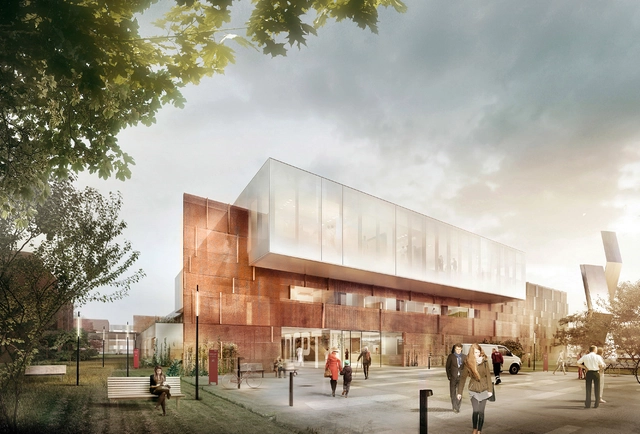
aarhus arkitekterne Designs Revolutionary Proton Therapy Center for Denmark

Danish practice aarhus arkitekterne has won a competition to design the new Proton Therapy Centre for advanced cancer treatment in Aarhus, Denmark. As “the most advanced radiation center to date and the only one of its kind in Denmark,” as well as one of only a few in the world, the Centre will undoubtedly become a pioneer in cancer treatment.

Designed from the inside out, the building’s façades are meant to convey the function of the interior, “and tell the story of precision, which is they key component of proton therapy as a form of treatment,” according to the architects. Thus, the atrium of the building becomes central to its orientation, providing not only an axis, but also a source of natural lighting.

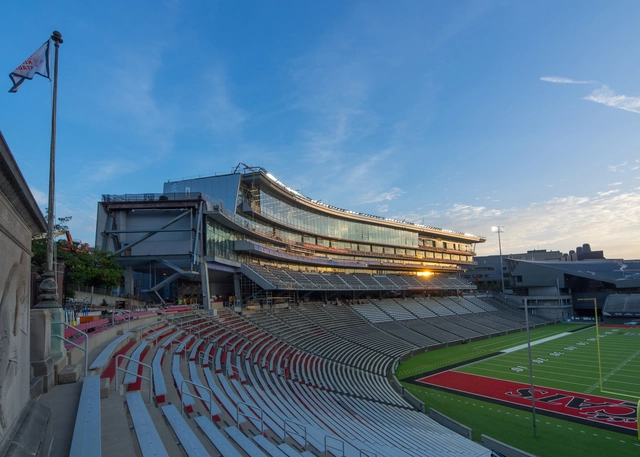
ARO and Heery Design Nippert Stadium Expansion for University of Cincinnati

Architecture Research Office (ARO) and Heery International have designed the West Pavilion, a 115,000 square-foot extension to the University of Cincinnati’s Nippert Stadium. Set at one of America’s most historic college football venues, the new expansion will stretch 450 feet in length —about half of the stadium—and “will introduce the program’s first true premium seating, club spaces, and high-end press facilities.”

In addition to being a part of university-wide expansions, the project is the centerpiece of the $86 million renovation of Nippert Stadium itself, which includes adding more restrooms and concessions, and better pedestrian circulation.

ARO and Heery Design Nippert Stadium Expansion for University of Cincinnati - Image 1 of 4ARO and Heery Design Nippert Stadium Expansion for University of Cincinnati - Image 2 of 4ARO and Heery Design Nippert Stadium Expansion for University of Cincinnati - Image 3 of 4ARO and Heery Design Nippert Stadium Expansion for University of Cincinnati - Image 4 of 4ARO and Heery Design Nippert Stadium Expansion for University of Cincinnati - More Images+ 12

Bortolotto Unveils Design for Rosalie Sharp Pavilion in Toronto

The Ontario College of Art and Design University (OCAD U) has commissioned Toronto firm Bortolotto to transform the university’s main office building into the Rosalie Sharp Pavilion. The office will be wrapped in a technologically-responsive layer, transforming it into a multi-use, student work and exhibition space and transforming the corner of Dundas and McCaul streets into an interactive gateway for the campus.