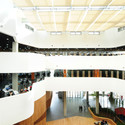
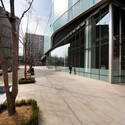
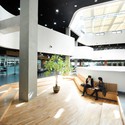
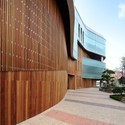
A few days ago, we introduced Junya Ishigami’s Kanagawa Institute of Technology Workshop, a lightweight studio space with an interesting interior due to 305 slender columns. Our friend, Brandon Shigeta, shared his photos with us that illustrate Ishigami’s technique of using column distribution as a space generator. Although the slender columns appear randomly distributed, the architects’ seemingly scattered order has created defined zones that subdivide the large studio workspace.
More images and more about the columns after the break.
Check out Junya Ishigami and Associates‘amazing studio + workspace where students of the Kanagawa Institute of Technology get to spend their days designing. The studio is about the closest you can get to the feeling of working outside while being indoors. The floor-to-ceiling glass makes the building appear weightless and elegant, and the open plan preserves the building’s sense of transparency as the viewer’s eye can shoot directly across the uninterrupted space. 305 columns of various sizes support the stripped roof of skylights, yet their white color keeps the focus on the space and the view, not the structure. The columns, although seemingly random, as specifically placed to create the sensation of zoned spaces, but their nonrestrictive quality provides a flexible layout to suit the changing needs of students.
A few weeks ago we introduced you one of the latest built projects by Frank Gehry, the Cleveland Clinic Lou Ruvo Center for Brain Health in Las Vegas. The center is supported by Keep Memory Alive, and it is planned to become a national resource for the most current research and scientific information for the treatment of Alzheimer’s, Parkinson’s, Huntington ‘s Diseases, and ALS (Lou Gehrig’s Disease) as well as focusing on prevention, early detection and education.
On our previous feature we got a glimpse of the project, which at first sight might look like just another Gehry project. And now, thanks to these new photos by Matthew Carbone, we can get a better look at it.
We recently published the project Railway Footbridge at Roche-sur-Yon, now our friends from HDA_Paris share with us the Turin Footbridge, that was constructed for the 2006 Winter Olympics.
About the competition, we know that the city of Turin hosted the 2006 winter Olympic games and had embarked on an extensive programme of construction of various venues and infrastructure for the games. The city took advantage of the infrastructure programme to incite urban renewal in the southern part of the city that has been affected by the economic downturn in the car industry. The Olympic village, situated in the disused Mercati Generali in the Lingotto district adjacent to the main railway lines entering the city from the south, is part of this new infrastructure and will contain housing and a logistics centre.
John Jay College of Criminal Justice, an active college in the City University of New York, currently occupies a former Public School building, Haaren Hall, on 10th Avenue between 58th and 59th Streets. With ownership of the entire Manhattan block, the college has ambitions to grow over two phases into the full Zoning capacity of the block. The charge of this project is to occupy the entire site with an integrated campus while providing a base for future growth.
The Steel Structures Education Foundation organized a competition designed for students to fuse their conceptual ideas with the reality of physical structure. With the program and scale left to the discretion of the designer, the proposal had to emphasize the “essential relationship” between the exploration of form and material, with regards to surfaces, members and connections. As an academic project, students also had to use their details to communicate with the steel fabrication industry as a way to expose ”the opportunities and restraints inherent in realizing conceptual design.” “It is important for students of architecture to grasp the fact that structural design lies not just in the realm of the engineer, but can be a means for architects of arriving at a meaningful realization of architectural ideas,” explained the SSEF. The winner, student Matt Schmid from the University of Waterloo, designed a bird sanctuary in Niagara Gorge in Niagara Falls, Ontario, Canada.
Architects:MAD Location: Erdos, Inner Mongolia Director in Charge: Ma Yansong, Yosuke Hayano, Dang Qun Design team: Shang Li, Andrew C. Bryant, Howard Jiho Kim, Matthias Helmreich , Zheng Tao, Qin Lichao, Yang Lin, Sun Jieming Yin Zhao , Du Zhijian Collaborators: China Institute of Building Standard Design and Research, The Institute of Shanxi Architectural Design and Research Site Area: 27,760 sqm Constructed Area: 41,227 sqm Status: Under Construction Client: Erdos Municipal Government Images: MAD
This contemporary modern house by Replinger Hossner Architects is up for sale in Seattle, WA. Amazing views and good interior spaces. I just got this on my mail and I thought any of our readers could be interested.
Of the things i really love about maintaining this blog is that it gathers architects from all around the world. In this case, the people from ZLG Design in Malaysia sent us their project for the BOH Visitor Center through our contact form – same as many other offices we will publish in the next days. Everyone is invited!
This great building -my personal favorite in the last month- is located in Malaysia, overlooking an amazing landscape. I think that its tectonic work really frames the natural surrounding.
Architect: ZLG Design Team: Huat Lim, Susanne Zeidler, Jimmy Wong, Mary Verhaeghe, Hong Chieh Location: Sungai Palas, Cameron Highland, Boh Visitor Centre, Malaysia Locale description: Tea plantations and factory Site area: 12,168.32 sqm Built area: 1,233.8 sqm Building start: November 2005 BUilding completion: July 2006 Budget: USD$498,652.29
Sorry for the lack of posts this last few days, but before leaving to San Francisco my computer died. Now i´m back home with a borrowed computer, and will be posting some buildings i found in SF.
This two rotated cubes are part of the adaptation of the 1907 Jessie Street Power Substation, adjacent to the Yerba Buena Park in San Francisco, into the new Jewish Contemporary Museum by Daniel Libeskind Studio and local architects WRNS Studio. The project houses 63,000 sq feet for exhibitions and programs in visual, performing and media arts, and includes 3,500 square feet of space for education.