In Progress: Railway Footbridge at Roche-sur-Yon

3919688634_7d28bf5080_b

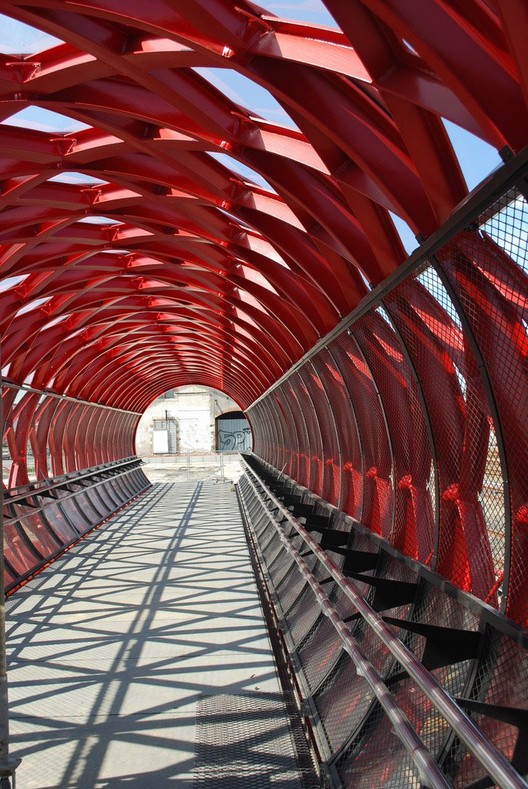
The project for a footbridge located in Roche-sur-Yon was commissioned as a collaborative work in between HDA Paris, who has a previous experience with the footbridge they did in Turin for the Olympic Village in 2006 and Bernard Tschumi, who recently finished the Acropolis Museum.

The program for the extension of the TGV network in southern France includes a passage through the town of la Roche sur Yon. The town is modernizing the train station and replacing an 1890’s footbridge over the railway tracks. The town is separated by the railway tracks into two parts: the historical central neighborhood, which contains the ‘Pentagon’ planned by Napoleon and it’s contemporary counterpart with its modern facilities (stadium, school and residential zones).The ambition of the town, is not only to create a symbolic link between the two neighborhoods, but equally to celebrate the arrival of the TGV.

3918949431_ef2d52031b_b

La Roche sur Yon is the birthplace of Robert le Ricolais, engineer, architect, poet and painter, known for his theoretical research on trellis structures and tensegrity during the 1950’s. This heritage, both intellectual and historical, has inspired the design of the new footbridge by attempting maximum lightness. During the design process therefore HDA combined structural optimization with the architectural concepts by creating a full height filigree lattice tube, that provides not only a support for safety meshes as required by the railway authority, but also maximum structural inertia.

3918953675_ce197925cd_b

The diagonal lattice design recalls the existing old riveted footbridge. At the support points, the stresses are mainly shear, in the predominantly vertical direction, and at mid-span, the stresses become principally bending and the direction tends towards the horizontal. The natures of the forces are highlighted by ‘T’ or ‘H’ section profiles for compression and simple rod ties for those in tension. The transition between supports and mid-spans is also underlined by the presence of vertical circles that recreate links for the shear force transfer. The architectural result is an expression of the natural forces.

3919729956_147db193c3_o

3919709564_e799163f99_b

It is interesting to consider that the structural optimization process that permits, saving tons of steel material is not only driven by practical, aesthetic and economic objectives, but also has an ecological dividend. Steel itself is a recyclable material to begin with. From the initial analyses, where all steel sections were identical, the tonnage was reduced considerably using subsequent iterative analyses, and notably by replacing the tension members with thin rods. This also significantly contributed to a delicateness in the architectural quality.

A real scale prototype is now complete and the footbridge construction is in progress and the final delivery is planned during 2009.

Cite: Baraona Pohl , Ethel. "In Progress: Railway Footbridge at Roche-sur-Yon" 22 Oct 2009. ArchDaily. Accessed 21 May 2013. <http://www.archdaily.com/38586>

20 comments

    • Thumb up Thumb down 0

      calatrava’s bridge is elliptical in section whereas the HDA bridge is tubular in section, meaning the one does not copy the other…Also the members of santiago’s bridge are much more elongated. his project is scheduled to be completed sometime in 2010, and from the looks of the renderings on the 8th of August posting, he wouldn’t be much farther along than are HDA in the construction of their tubular railway footbridge. So I think that HDA has creativity in response to dustin, and that no calatrava hasn’t already done this, he’s in the process of doing this, in response to hambla allah. some of you are so quick to form an opinion without looking at the project in a bit more depth.

      I personally think the design of the HDA bridge is better as a whole. It reminds me of the cross-section of the original subway tunnels in new york city [round tubes]. I think it’s beautiful how the bridge’s structural webbing shows you where the maximum amount of strain occurs [via it's thickening/compression and then it's elongation]. The colored structural diagrammes that are included indicate this beautifully. Santiago’s bridge doesn’t give this effect, which means the members are either oversized, or it will be built differently, or it will appear to be different than it looks in the renderings.

    • Thumb up Thumb down 0

      You’re right, some architects have no creativity!
      I wonder what would this guys be doing without Rhino!

      • Thumb up Thumb down 0

        To say this bridge looks like Calatrava’s is maybe fair comment, but to contemptuously dismiss it as being a copy is just lazy, and somewhat ignorant. It’s cylindrical in form and has a lattice-style design, yes (as many designs have been before, and many will be again), and it’s red. Much as I like Calatrava’s bridge, you can hardly credit him with being the first person to have the idea of a cylindrical lattice, and his has in turn been compared to other cylindrical bridges before it, as indeed there are others that have used this basic idea again before him, for the simple fact that it works and it suits the purpose of the design .
        I’m not sure personally how attractive I find the Roche-sur-Yon bridge, but if you just take the time to actually read the articles on it, and on Calatrava’s bridge, then it’s clear that the differences in thought process, influences and final design are considerable. Cheap comments such as those from Dustin and MRF above just pointless.

    • Thumb up Thumb down 0

      You couldn’t be more clueless. The bridge by Tschumi is near completion (see the above construction photos) and has been under development for at least 2.5 years, do your research. The bridge by Calatrava was only recently revealed in renderings two months ago?

      Diagrid structures have been used and reused for some time now in the profession and suddenly there’s ownership of this structural logic?

      The next time you decide to comment on anything in life think about what it is you want to say first before you actually say it. Someone might actually take you seriously.

  1. Thumb up Thumb down 0

    I think there’s too much context missing from the surroundings to really be able to say that I like it. It could’ve just dropped from the sky so to speak.

    It is however an interesting experiment, but since Calatrava did this before, there doesn’t seem to be any point to it anymore…

  2. Thumb up Thumb down 0

    LE CROQUIS DU PROJET EST REMERCIÉ, OÙ LA MAIN EST CELLE QU’IL(ELLE) DESSINE(CRÉE) ET NON LE MOUSE DE L’ORDINATEUR SANS CONTRÔLE

  3. Thumb up Thumb down 0

    “I think there’s too much context missing from the surroundings to really be able to say that I like it. It could’ve just dropped from the sky so to speak.”

    I think exactly the same.. The shape is not that bad (could have been better.. especially without the metal mesh SOMEHOW – I know it’s against regulations,but there are many nicer ways of going around them..)
    But without the context on these photos I have no comment.. it can be in the middle of a residential neighbourhood and then it will look just strange, odd, alienating and awful.

    But it can be in the centre of a commercial area, a bank district or even crossing a highway – and then it’s bearable..

  4. Thumb up Thumb down 0

    Looks incredible-I wish more plebeian structures were this beautiful….

    I’f it’s a good solution, why not copy it when it? As long as it is well done and carefully conceived.

  5. Thumb up Thumb down 0

    To those who commented on the similarities with Calatravas bridge:
    The resemblance doesn’t go beyond the red colour.

    Tschumi-HDA’s bridge is conceived to work as an optimised structure, therefore the differences in the voids and sections of the profiles. Much better as the integral approach that should always be architecture than the gesture of Calatrava’s…

Share your thoughts