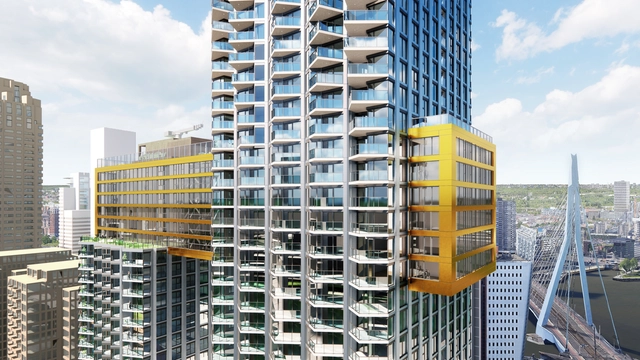
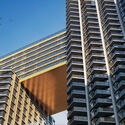
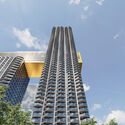
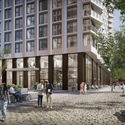
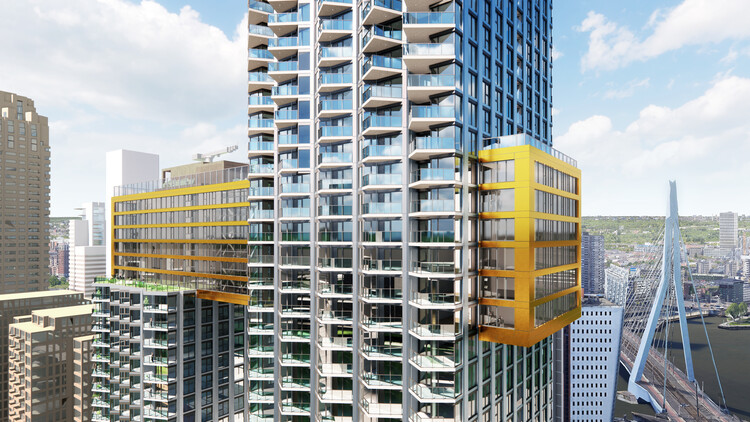
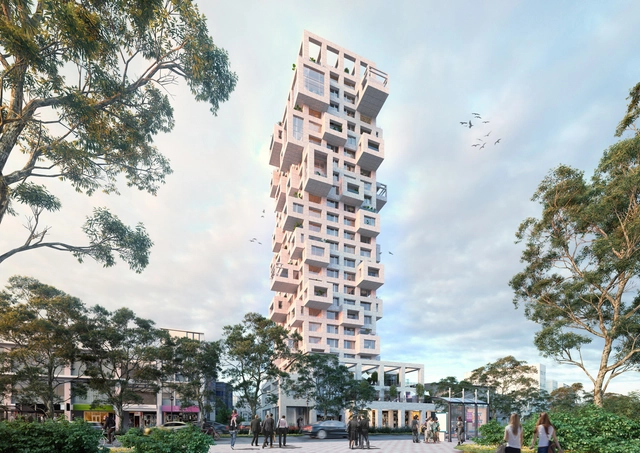
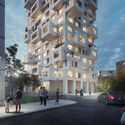
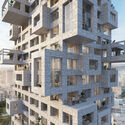
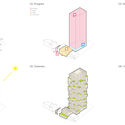
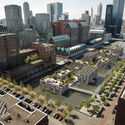
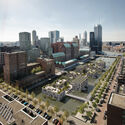
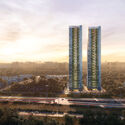
The Sax residential towers by MVRDV. Render. Image Courtesy of MVRDV
The City of Rotterdam, developers BPD and Synchroon, and architecture firm MVRDV have officially begun construction on The Sax, a major residential project located on Rotterdam's Wilhelminapier. Designed to contribute to the city's ongoing densification efforts, the development will deliver 916 apartments within two interconnected towers. Once completed, The Sax will make Wilhelminapier the most densely populated area in the Netherlands, making the project an example of compact urban growth. The design comprises two towers, combining a wide mix of housing types and shared amenities with strong connections to public transport and sustainable mobility solutions, including parking for 1,800 bicycles and a fully automated car garage. With its silver façade and undulating balconies, the building's form echoes the shape of a saxophone, reflecting the character of Rotterdam.
"Out of the Box" tower exterior render. Image Courtesy of MVRDV
MVRDV has released images of "Out of the Box", a 12,025 sqm residential tower in Tianmu, one of Taipei's northernmost neighborhoods. Designed for Win Sing Development Company, the project began in 2019 and was developed using a system of standardized elements digitally distributed based on criteria such as habitability, efficiency, and access to community services. These elements are expressed in the tower's irregular, gridded façade, which features a layered marble cladding.
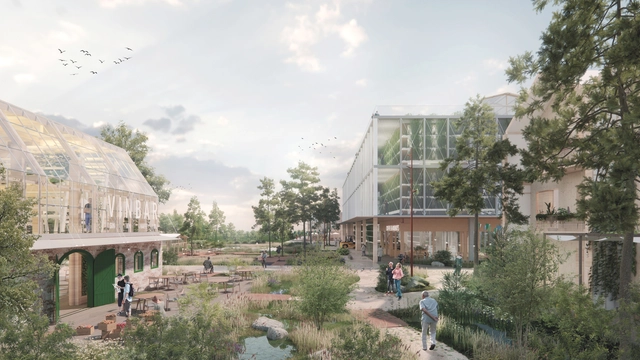
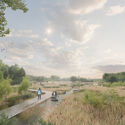
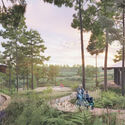
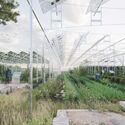
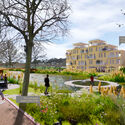
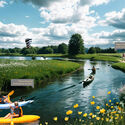
New settlement and production in Øm. Render. Image Courtesy of THIRD NATURE
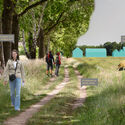
Danish architecture firm Third Nature, together with Sophie Sahlqvist Landskab, Arkaia, ILC, and Artelia, recently shared images of Øhjem, their proposed strategic vision for the re-naturalization of Denmark's Greater Copenhagen region toward 2050. The regenerative plan is part of the Water's Ways program under the Agenda Earth initiative, an interdisciplinary project run by the Danish Association of Architects in collaboration with the Dreyers Foundation and the Danish Bar Association. Led by urbanist Boris Brorman Jensen, the program calls for long-term solutions to restore 15% of Danish agricultural land while also protecting 600,000 homes from water-related threats. Third Nature's Øhjem masterplan reimagines the 25 km Ramsø Dale as a step toward implementing the land management objectives outlined in the Danish Green Tripartite Agreement (Grøn Trepart), signed in June 2024.
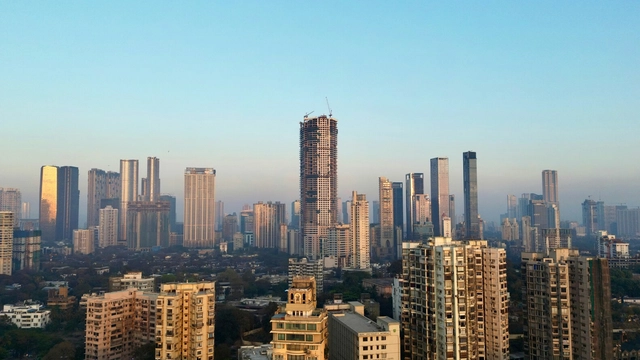
India finds itself a watershed moment with its urban evolution. With the United Nations projecting urbanization to reach 68% by 2050, the country's metropolitan regions needs to adapt to increasing populations while maintaining equity and quality of life. India's urban population is expected to exceed 600 million by 2030, drawing attention to both urban density and sprawl. As an emerging player in the domain of high-rise development, India is restructuring how it engages with urban growth by shifting from horizontal sprawl to vertical expansion.
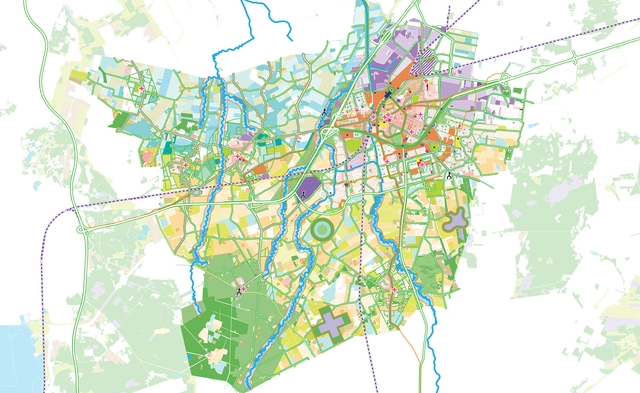
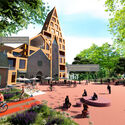
In 2021, the Municipality of Roosendaal began collaborating with MVRDV as an urban development consultant. The firm's partner, Winy Maas, was subsequently appointed as urban advisor, conforming a team that included MVRDV, Rebel Group, Transitiefocus, and other experts. Their task was to consolidate existing projects and initiatives into a unified strategic vision, seeking a mix of bottom-up and top-down planning approaches. The vision, also called "The Mosaic", was developed through a participatory process involving residents. It provides insight at multiple scales, from land-use adjustments across the municipality to over 40 potential projects aimed at harnessing the potential of specific locations. Published as a series of seven interconnected documents, the vision aims to provide Roosendaal with strategies to accommodate growth.
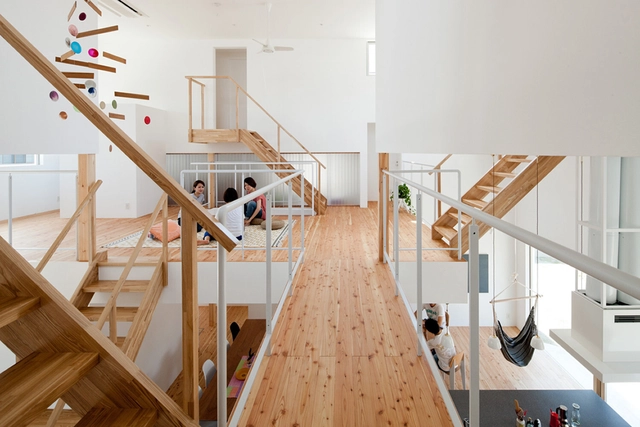
Rising populations and soaring real estate prices pose significant challenged to urban housing. In a desperate hunt for affordable living options, communal co-living spaces have emerged as a creative solution, offering quality living conditions through clever space optimization strategies. By implementing innovative design techniques, these shared living communities maximize every square foot to create functional spaces within compact footprints.
Naturally, a higher population density prevents the formation of ghost towns and vacant shops, which can become hotbeds for crime. However, these positive views on dense living environments often rest on optimistic assumptions about urbanism, such as minimal friction among individuals, easily maintained hygiene and a natural formation of diversity.
Following the recent announcement of Aedas' demerger into two separate companies - one retaining the Aedas name and the other now known as AHR - we spoke to Keith Griffiths, Chairman of Aedas' global board and a practicing architect for close to three decades. The company, which was recently ranked by the Architects' Journal as the 5th largest and most influential practice in the world, have now moved their head office to London's Chandos Place and are championing a new approach to urban regeneration in the UK's capital. Alongside discussing how an international practice of Aedas' scale successfully operates, Griffiths offered his insight into how the future looks for European cities based on a tried and tested Asian model of densification.
To find out how Aedas approach sustainability in flourishing Asian markets, as well as the significance of the 'urban hub' typology for London's metropolitan future, read the interview in full after the break.
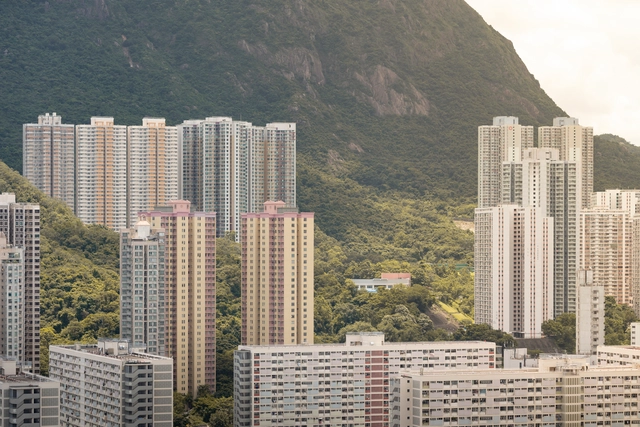
Romain Jacquet-Lagrèze is a French photographer who captures the dizzying heights and uncommon densities of Hong Kong. Inspired by "the geometry of the urban environment and the vivid lives it shelters," Jacquet-Lagrèze has not only captured the verticality of Hong Kong's built environment, but also compiled a new book, Vertical Horizon, "a photographic journey between the buildings of a relentlessly growing city." See more of Jacquet-Lagrèze's images, and read an excerpt from Vertical Horizon, after the break.
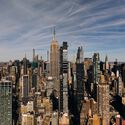
In an article published by The Wall Street Journal called For Creative Cities, the Sky Has Its Limit, Richard Florida discusses the development of urban environments and their relative successes. As human migrations are trending towards big cities, the design and appropriation of space within these cities is increasingly important. Florida cites that trends indicate that by 2050 cities will make up 70% of the global population. With so many people, elevate density within cities will be unavoidable, but what Florida emphasizes is that it isn’t just density that makes a vibrant and thriving city. Citing Shanghai and New York City as examples of dense urban environments, Florida explains the differences in their relative architectural and urban developments and the prosperity that follows. The fundamental difference? The prevalence of mixed-use neighborhoods in New York City that overpower the innovation of strictly financial districts of either New York or Shanghai.