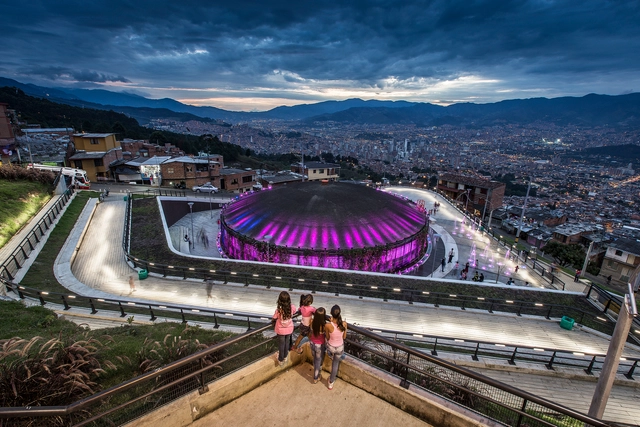
While developing a master plan for Medellin's urban lighting system, EPM, Medellin's public utility company, analyzed the Colombian city's infrastructure and nocturnal lighting system by superimposing a map of the system over a map of the city. What they found was an urban landscape blotted by "islands" of darkness.
Much to the surprise of the utilities company, the dark spots were actually 144 water tanks that were initially built on the city's outskirts; however, thanks to the progressive expansion of Medellin's city limits, the tanks now found themselves completely surrounded by the informal settlements of the Aburra Valley. Even worse, they had become focal points for violence and insecurity in neighborhoods devoid of public spaces and basic infrastructure.
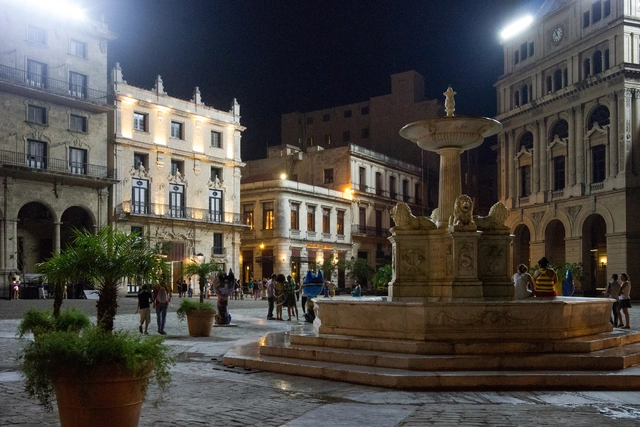
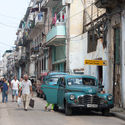
Havana appeals to those who romanticize the idea of a city that seems to be completely frozen in time. The capital’s urban fabric proudly displays its history, as it experienced waves of Spanish, Moorish, and Soviet influence. What really lies beyond the Revolutionary kitsch of vintage Buicks parked in front of colorful, yet crumbling homes, is the deprivation that Cuba has experienced throughout history.
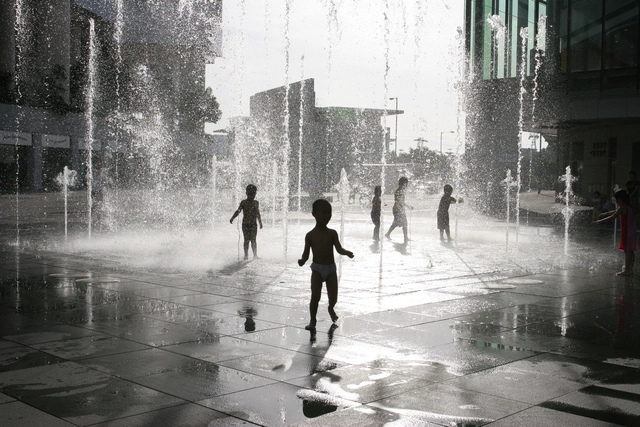
"Public space" is a legal terminology that tackles the notion of land ownership, suggesting that this type of parcel does not belong to anyone in particular, but to the state itself. Open, free, accessible to all, and financed by public money, these spaces are not only the results of planning, but the consequences of the public practices they hold. Actually, people define how public space is used and what it means.
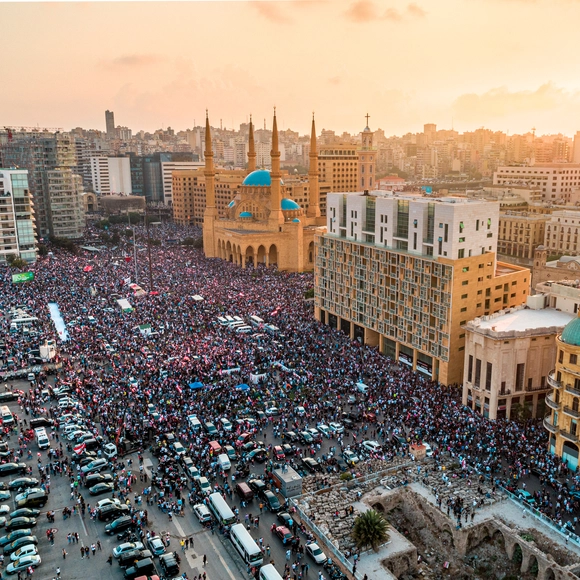
Protests - powerful political tools for change - from the March on Washington in 1963, the Arab Spring in the early 2000s to recent Black Lives Matter Movements, are altering the world. In times like these, while people still need to "take their issues to the streets" to be heard and seen, public spaces have resurfaced as a topic of discussion.
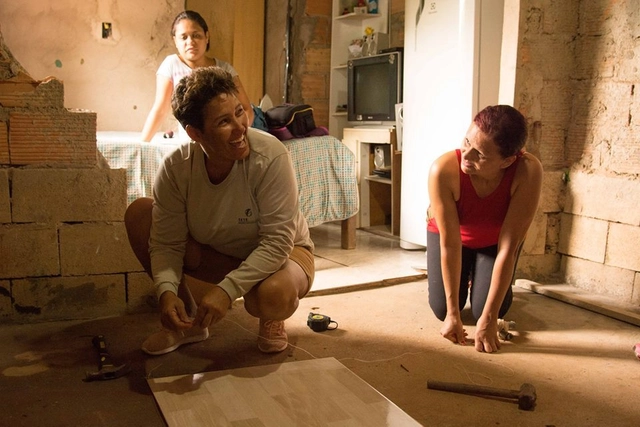
The spirit of the women who participate in the movements fighting for housing in Brazil is as hard as lime and wood. As a majority in land occupations, they vigorously coordinate organizational and political practices of settlement and popular housing construction. It is no wonder that many of the occupations of the MST (Landless Rural Workers' Movement) or the MTST (Homeless Workers' Movement) carry the names of women such as Dandara, a quilombo leader from the colonial period.
The World Health Organisation (WHO) supports that even if vaccines are found, COVID-19may never go away. ‘Post-virus’ recovery mechanisms suddenly become out-of-place and obsolete. If we wait for the coronavirus crisis to be over to tackle climate change, then many of us may be swimming in deep waters. Coordinated and immediate actions, coupled with planetary-scale cooperation, to tackle both crises in parallel is now needed. For cities, this means adopting mechanisms that enable both economic recovery and sustainable transitions.
https://www.archdaily.com/939930/a-call-for-global-cooperation-for-sustainable-urban-transitionsZaheer Allam, Gaetan Siew and Felix Fokoua
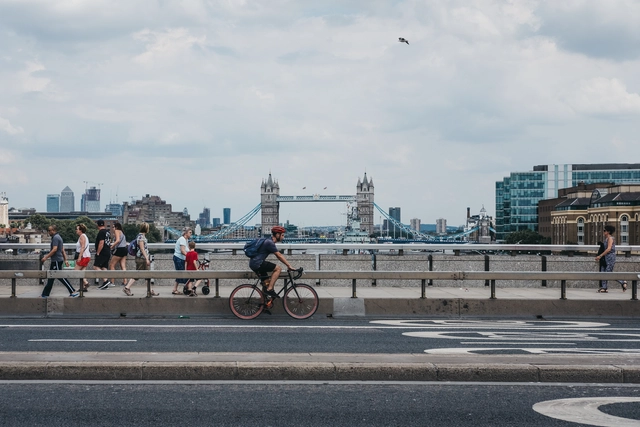
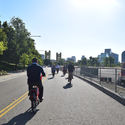
Cyclist and pedestrians on London Bridge, London, UK, River Thames and Tower Bridge on the background. Image via Shutterstock/ By Alena Veasey
After Milan and Paris, London has announced its plans to transform large areas in the city, converting streets to car-free zones, as the coronavirus lockdown loosens up. Repurposing the city for people, London aims to emerge differently from the pandemic, supporting a low-carbon and sustainable recovery. Works have already started and are expected to be completed within six weeks.
Stores in Santiago, Chile, ran out of yeast in mid-March, such as it happened after the beginning of the social crisis in 2019. Given that Chile has the second-highest bread consumption per capita in the world, it would seem that Chileans handle uncertainty stocking up ingredients for bread making. Everybody wants to make bread, including myself.
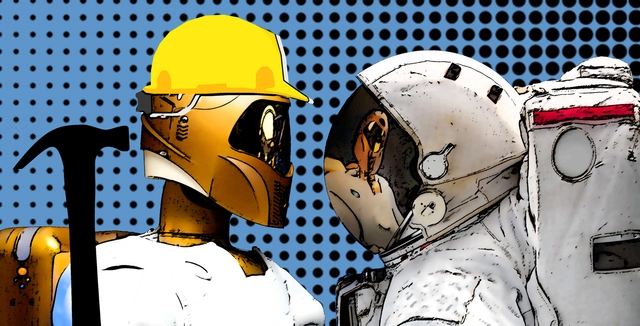
The use of artificial intelligence (AI) is based on the idea of optimizing, streamlining and expanding the reach of the most diverse operations. Their systems are programmed to identify patterns and carry out predictions, decisions, and ultimately perform and actions with speed and accuracy. The efficiency of the models depends on the quantity and quality of the data, which can be obtained by applications, cameras, and sensors. In the urban context, technology based on the use of artificial intelligence has been seen as a way to improve the management of cities, especially those that are denser and have larger footprints.
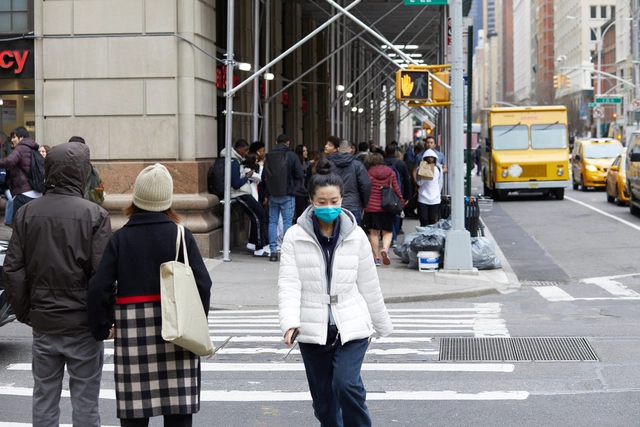
New York, NY / USA - March 12, 2020. Image via Shutterstock/ By hector de jesus
As social distancing becomes the new norm in the fight against COVID-19, people are finding it harder to keep up with the six-foot rule in dense cities. Urban Planner Meli Harvey developed a map of New York that shows the width of sidewalks in the city, aiming to highlight public areas where social distancing can be maintained.
Yesterday, on the 20th of April, we passed the cap of 111 days of the pandemic. During this time, we’ve been busy fighting in supermarket aisles over toilet paper in Australia, lining up for marijuana purchases in Amsterdam and boosting gun demand in the USA. We are conscious none of those will help in fighting the virus, but we do it, nonetheless. Beyond the bizarre human psyche, this pandemic unveils interesting trends that will, whether we like it or not, impact on Architecture and Cities.
https://www.archdaily.com/937928/introducing-an-illustrated-series-architecture-and-cities-post-virusZaheer Allam, Gaetan Siew and Felix Fokoua
Hashim Sarkis, the curator of the 17th International Architecture Exhibition organized by La Biennale di Venezia, launched a striking visionary theme at the beginning of this year: “How will we live together?”. This fundamental question finally transcends all disciplines and opens an existential portal for humanity. It does not refer only to humans but all species, the nonhuman organisms as well.
From Wuhan to New York, the epicenter of the coronavirus is moving from east to west and leaving a staggering number of corpses behind. We read of alarming reports, contradictory news, and reminded every day that we live in unprecedented and difficult times. One good news, however: emissions in cities are on the decline, and nature is running its regenerative course. But how long will this last?
Design and the City is a podcast by reSITE, raising questions and proposing solutions for the city of the future. In the seventh episode, Christopher Cabaldon, the longest-serving mayor in West Sacramento’s history, an LGBTQ+advocate, talks about the urban regeneration of his city, from a former industrial town to an urbanized, livable community.
For nations worldwide, the course of action to fight the spread and effects of coronavirus COVID-19 has been to implement quarantines; restricting the movement of the general population while isolating people infected by the disease, albeit indefinitely. The result: both public and private spaces have closed in a bid to curb the number of new cases. At the same time, the rising number of deaths has added to both social and economic uncertainty, with people across the globe asking "how are we going to work?" or, better yet, "how are we supposed to eat?"
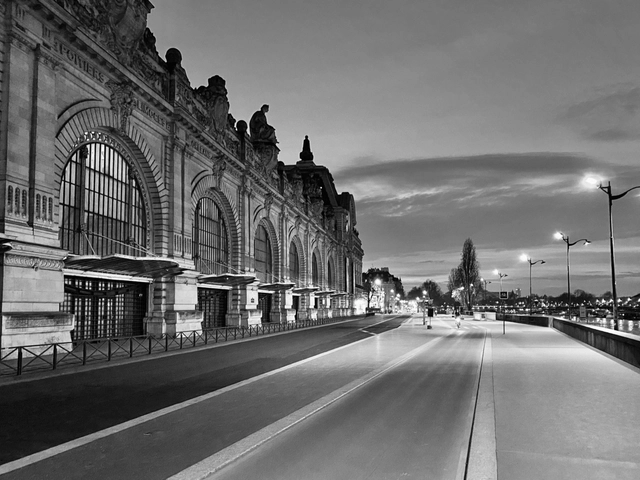
The COVID-19 pandemic has reshaped urban life, and so too has it left many streets and buildings empty as people practice social distancing. From Times Square to the Place de la Concorde in Paris, photographers are capturing these "empty cities" in a defining moment across the globe. In turn, The New York Times recently published a piece dubbed "The Great Empty", showcasing a new side to urban life in these structures and streets. Now five photographers have been commissioned to photograph Rotterdam during the pandemic.
Design and the City is a podcast by reSITE, raising questions and proposing solutions for the city of the future. In the sixth episode, Marianthi Tatari, Associate Director and Senior Architect at UNStudio, talks about creating inclusive spaces to connect people and generating 24/7 activity within their projects.
via Cities for Play. Designing Child Friendly High Density Neighbourhoods
'Cities for Play' is a project whose main objective is to inspire architects and urban planners to create stimulating, respectful, and accessible cities for children.
Natalia Krysiak, its creator, is an Australian architect who believes that children's needs should be placed at the center of urban design to ensure resilient and sustainable communities. In 2017, she produced 'Cities for Play,' studying examples of cities that are concerned with providing environments that are capable of promoting the health and well-being – physical and emotional – of children through a focus on play and "active mobility” in public spaces.
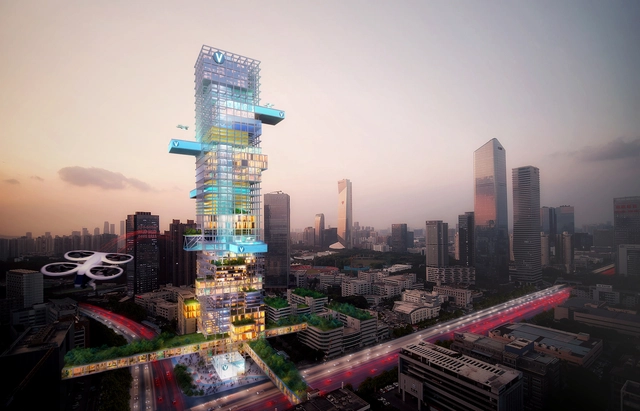
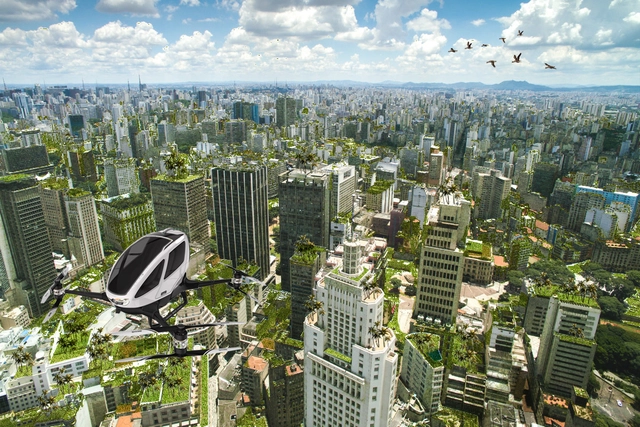
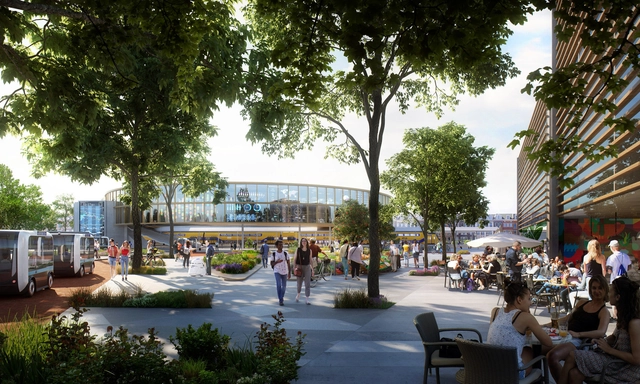
MVRDV in collaboration with Airbus, Bauhaus Luftfahrt, ETH Zurich, and Systra, is developing a plan for the future of Urban Air Mobility (UAM). The investigation tackles the integration of “flying vehicles” into our urban environments and envisions a comprehensive mobility concept.



















JakubCervenka_1_(481_of_589).jpg?1585311385&format=webp&width=640&height=580)


JakubCervenka_1_(481_of_589).jpg?1585311385)
JakubCervenkai_1_(131_of_589).jpg?1584354067 "© Jakub Cervenkai")


TomasPrinc-265.jpg?1584353916 "© Tomas Princ")