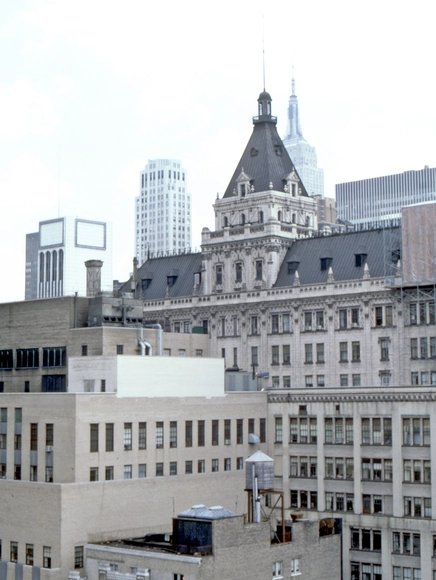
Almost a century ago, the world was introduced to a new architectural typology that changed the entire construction industry. Starting off with the Home Insurance Building in 1885, leading to the Empire State and Chrysler Buildings in Manhattan, skyscrapers became a symbol of power and financial abundance. Soon enough, they were being constructed in almost every city across the world with state-of-the-art designs that defy engineering norms. But with all the changes taking place in the architecture practice, what does the future hold for these heavily criticized yet constantly developed buildings?
Rem Koolhaas, co-founder of Office for Metropolitan Architecture (OMA), receiver of the Pritzker Prize Award in 2000, and leading urban theorist, was one of the first to question the high-rise phenomenon and its influence on city transformation. Particularly intrigued by the Gulf region and the urban ambitions of this area, in 2009, during the 9th edition of the Sharjah Biennial, he delivered a lecture on the potential of re-inventing urbanization in the Emirates.
On the occasion of the golden jubilee of UAE, marking 50 years since the Emirates were founded in 1971, 50U, published by Archis explores the different developments in the Gulf, this region that “witnessed the transformation of a partly nomadic, partly town-based community into a globally active metropolitan society”. After Al Manakh, in 2007, followed in 2010 by Al Manakh Cont’d, 50U tells the story of the UAE through 50 portraits of people, plants, and places. The book also shares an excerpt of Koolhaas’ 2009 talk that reflects on contemporary conditions, focusing specifically on his reading of Dubai, his architectural involvement as well as his future urban predictions.
KPF and Heatherwick Studio have revealed the design for the fifth terminal of Changi Airport in Singapore. The concept behind it revolves around the concept of “airport as a city”, presenting itself as a social extension of the namesake district of Changi, at the eastern end of Singapore. The terminal is planned to add a capacity of 50 million passengers per year. Instead of a single monotonous structure, the terminal is comprised of a series of human-centered social spaces, offering different qualities of light, atmosphere, and experience to both visitors and residents of Singapore.
In 2007, New York City Mayor Michael Bloomberg proposed congestion pricing for Manhattan. The state legislature rejected the plan. Fifteen years later, we’re still debating the idea, fiddling while the planet burns.
The newest problem is that a new environmental study and traffic model from the MTA, The Central Business District Tolling Program Environmental Assessment, says that what’s good for 1.63 million residents of Manhattan and the planet, in general, will increase the pollution in the already unhealthy air in the Bronx. Yes, that’s a problem. Turning the perfect into the enemy of the good is also a problem. We need a plan that benefits all.
Reinvention is one of the founding myths of the United States of America. For those lucky enough to come here on the decks of ships rather than chained in the hold, this country offered a chance to be someone else, somewhere else. For them and generations of immigrants who followed, America seemed to put a safe distance between their pasts and a boundless future.
But the illusion was eventually flipped on its head. Around the turn of the millennium, reinvention was a prevailing theme for movie characters intent on getting out of small-town America; in architecture, that sentiment took the form of building dream cities anywhere but here. In Dubai and Shanghai our brightest design minds conjured up hermetically sealed towers, malls, and museums largely disconnected from history, community, and climate.
Grimshaw Architects has revealed the design for a 16-soundstage studio production campus for the independent company East End Studios. Located on a 15-acre former industrial site in the Arts District in Los Angeles, the campus will provide creative workplace buildings and production support spaces connected via a series of outdoor terraces and walkways. The project responds to its location and context by moving away from the traditional studio layout and instead opting to create a “vertical campus”. This composition creates a more open public relationship with the downtown neighborhood while ensuring that all campus facilities are well connected.
Boston is the latest city to announce a city-wide plan that, if passed, would eliminate the use of fossil fuels in new constructions and major renovation projects. This measure expands upon the commitment to enact climate action and make Boston a Green New Deal city. Other US cities like New York, Los Angeles, San Jose, Seattle, and Berkeley have all imposed similar measures in recent years. Seven European cities - Bilbao, Bratislava, Dublin, Munich, Rotterdam, Vienna, and Winterthur - have also developed a project to phase out fossil fuel from urban heating and cooling.
Landmark Project 'Swivel' by Sabine Marcelis. Image Courtesy of Sony Design
The London Design Festival is an annual event that brings together designers, practitioners, retailers, and educators from across the globe. This year’s program of events, exhibitions, and installations invites creative leaders to exchange ideas and solutions for some of the most pressing issues of our time, like climate change, pollution, and resource depletion. The festival includes the Landmarks Projects. As part of this initiative, Rotterdam-based designer Sabine Marcelis has created “Swivel”, an outdoor installation in central London. Other installations like Sony Design’s “Into Sight” pavilion or Sou Fujimoto’s “Medusa” exhibition explore visual and sensorial effects through physical and virtual mediums.
The metaverse promises to revolutionize our way of life. By integrating immersive technologies like virtual and augmented reality (VR and AR), it hopes to add another layer to the way we experience everyday life. It is suggested that the metaverse will create virtual spaces where people can meet and share experiences regardless of geographical constraints. The possibilities seem endless: exchanging knowledge, encouraging professional collaboration, developing and democratizing art, education, culture, and even enabling political engagement. Social interactions are at the core of the idea of a metaverse. This raises the question: how can the new, virtual spaces acquire the properties of public spaces?
Bjarke Ingels Group has unveiled the vision for the Masterplan Esbjerg Strand, which will form the framework for a campus environment that aims to bring a new approach to education. The Education Esbjerg project will accommodate an innovative educational platform that rethinks the traditional education system in the country. BIG’s concept is to recreate an entire city in one building. Education and development will create a frame of life for the new communities, while the island will welcome a varied array of functions to create a sustainable, human-centered ecosystem.
March 20, 2020: I am in New York, “the epicenter of Covid-19,” the news on TV keeps blaring, as if proud of the achievement. New York has always been excessive, so why not now? More cases, more hospitalizations, more ICU admissions, more intubations, more deaths. The news is terrifying and at the same time completely at odds with the day-to-day experience of the city, which has become so strangely quiet, so peaceful. No traffic, no construction noise, no annoying car alarms, no random screams in the middle of the night. Even the ambulances are mostly silent without cars to fight against.
The new apartment complex designed by Venhoeven CS and DS Landschapsarchitecten is characterized by the intention to stimulate biodiversity. Located on a four-acre plot in the Sluisbuurt on the Zeeburgereiland in Amsterdam, the complex will include 82 homes, a parking garage, and spaces for shops and businesses. The nature-inclusive project pays special attention to the design of green roofs, terraces, and facades to create micro-environments for local flora and fauna and to optimize energy consumption.
On August 19th, the world photography day is celebrated, a fundamental tool for the imagery record of our society. If, on the one hand, photography is the protagonist in dialogues that involve architecture and the city, portraying historical moments and enhancing buildings, on the other hand, it guides us through the context and backstage of the moment, eternalizing the process.
One Brickell City Centre by Arquitectonica. Image Courtesy of Swire Properties Inc and Related Companies
Arcquitectonica unveiled the design of One Brickell City Centre, an approximately 1,000-foot (approximately 300 meters) office tower planned to become the tallest commercial tower in Florida. Located in Miami’s financial district on Brickell Avenue, the office building represents the second phase of Brickell City Centre, a 4.9-million-square-foot (450,000 square meters) mixed‐use development that opened in 2016. One Brickell City Centre is developed by Swire Properties Inc. and Related Companies. Construction it set to begin in 2023.
“In recent years, we have been confined to our homes more and more,” says health mentor and entrepreneur, Enitor Joiner. “This has made us more aware of the (dis)comforts of our immediate living environment. For example, sitting still for long periods while working at home leads to physical complaints such as RSI. A poor living environment can also cause stress and and mental challenges. Loneliness is a growing problem in society, and a general lack of knowledge of healthy living patterns has led to an increase in disease. With this in mind, Marc Koehler Architects and I got to work by asking ourselves: how can we create a pleasant living environment that automatically contributes to a healthy lifestyle?”
https://www.archdaily.com/987445/is-comfort-killing-usMarc Koehler Architects and Enitor Joiner
Architects assume a significant amount of responsibility when it comes to considering designs that will be successful for not just their clients, but any person who inhabits or is impacted by their spaces. Topics of sustainability, social inclusion, economic opportunities, and overall urban equity, have consistently been top of mind in recent years, ultimately creating a new holistic approach to designing for a better future, that many people are referring to as Environmental, Social, and Governance metrics, more commonly known as ESG.
Snøhetta has unveiled the design of its largest project in Japan to date, the Shibuya Upper West Project for Tokyu Corporation, L Catterton Real Estate, and Tokyu Department Store. The project aims to offer cultural experiences in tune with the vibrant Shibuya district of Tokyo, known for its bustling crowds, big screens, and the crossing in front of the Shibuya Station Hachikō. The 36-story tower will include a cultural complex, retail spaces, a contemporary hotel, and rental residencies.