Videos
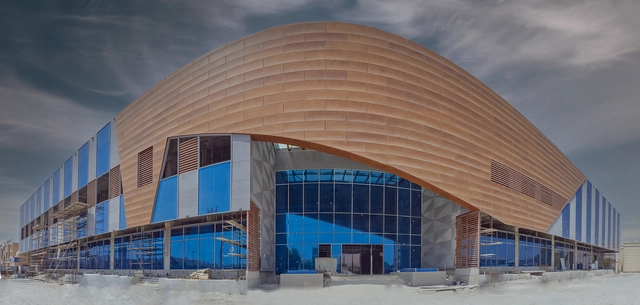
Hospital Mirdiff, Dubai, U.A.E. Image Courtesy of Equitone
Made of cement reinforced with cellulose fibers, fiber cement cladding is a building material used to cover the exterior of a wide range of buildings, including hotels, schools, office buildings, retail centers, hospitals, corporate centers, and residential buildings. Fibre cement panels are aesthetically pleasing, long-lasting, and highly resistant to fire and weathering.
Architect Diana Najib Hamad provides interesting case studies for the use of fiber cement in three recent Dubai-based commissions.
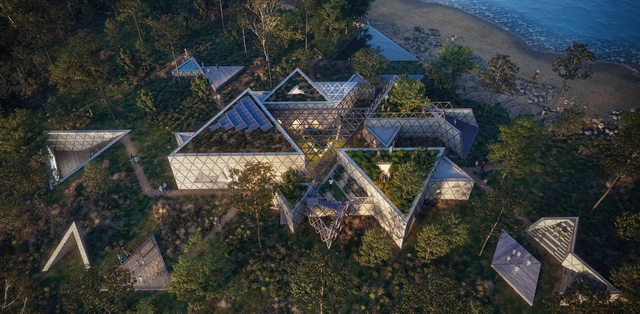
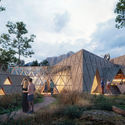
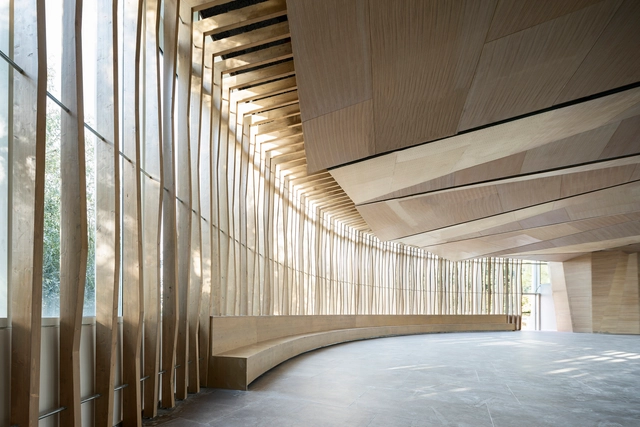
noa* network of architecture has unveiled a prototype of a Centre for Culture and Community (CeCuCo) questioning "what form flexibility takes, how nature can be embedded in the project and how far the role of the architect goes, in the belief that a project only works when people make it their own". The center is a research project that explores how to create flexible and multifunctional spaces without a fixed context, giving the community the chance to decide, act, and circulate within the architecture.
As the restoration and rebuilding of Notre DameCathedral progress, heritage experts are faced with essential and sensible decisions regarding the future architectural expression of the elements that need replacing. The latest developments saw France’s National Heritage and Architecture Commission approving a contemporary take on the cathedral’s interior, involving a re-arrangement of the furniture items, as well as the inclusion of contemporary artworks and light projections. The proposal was put forward by the diocese of Paris as a way of creating a better visitor experience; however, critics of the decision argue that it would diminish the architectural value of the Gothic monument.
Home workspaces must combine all the tools of the shared office with the user's personality for an inspirational and creative solitary environment. Many new home offices are unplanned additions to the family floorplan. Often, with no space for a dedicated office room, they’re hustled into a corner, a dark cave under the stairs or a thin, cold alcove, instead. So, home-workers are forced to squeeze in all their professional needs, such as printers, storage, and task lighting, into this small multi-functional area.
Few cities have a growing design culture like Austin, Texas. Ranked as one of the best places to live in the United States, the city is experiencing a building boom in recent years. With a wide variety of residential styles, architects are continuing a legacy of modernist design. With an emphasis on craft and detailing, these new homes use simple geometry and forms as they open up to hills, lakes and the urban fabric.
Beinecke Rare Book Library, Yale University, Gordon Bunshaft, 1963.. Image via Barry Winiker / Getty Images
Some years end up being cultural pivot points. 2021 was one such year, with COVID-19 as the first existential threat to our culture since World War II. Architecture will change as a result, and may evolve in public perception to value motivations as a criteria for understanding it, versus valuing outcomes as the validation of any particular aesthetic.
Today, drywall and gypsum-based systems are currently present in almost all architectural works. These allow you to coat buildings with products that combine, among other attributes, construction ease, fire safety and the possibility of recycling, both in historic structures or completely new constructions. Since 1998, Saint-Gobain - one of the largest distributors of these types of systems - has awarded the projects that best apply them in their solutions, dividing them into 6 categories (Ceilings, Plaster, Plasterboard, Innovation & Sustainability, Residential, and Non-Residential). The submitted projects are meant to demonstrate how the architects managed to ingeniously unite the company's products with innovative solutions to overcome each of the difficulties that the works or contexts impose.
In its 12th edition, participants came from 30 different countries and showcased 74 projects. See the 14 awardees below:
2021 was the year of a new reality, with humankind adapting to what is known as the second year of the pandemic. While some countries witnessed a return to alternative normality, opening up to the world through travel and events, others stayed in lockdown, expanding furthermore the inequality gaps. Nevertheless, this year also brought a lot of hope in all aspects, raising questions and building solutions for the near future. With a major focus on climate urgency, biomedical research as well as notions of hybridity, 2021 has triggered new understandings of the environment that surrounds us and of our place in this world.
Highlighting contextual topics, bringing both a local and global perspective, while shedding light on overlooked historical narratives, ArchDaily's diverse team of editors has been front and center, reacting to everything that has been happening. Always seeking "to empower everyone who makes architecture happen to create a better quality of life", the editorial content, generated across all sites, in our 4 languages, English, Spanish, Portuguese, and Chinese, provided tools, inspiration, and knowledge to widen horizons and help our users build a better future.