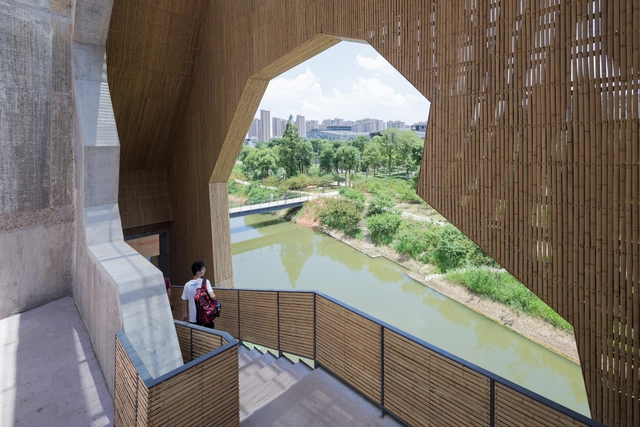
Until April 30th, the Louisiana Museum of Modern Art in Denmark is exhibiting the work of Wang Shu. The first in a new series of monographic exhibitions collectively titled "The Architect's Studio," this show of the work of the 2012 Pritzker Prize winner features an exhibition catalog that includes essays from Kenneth Frampton, Ole Bouman, Yiping Dong and Aric Chen. The following excerpt from the exhibition catalog, written by Kenneth Frampton, is republished here with the permission of the author and publisher.
The work of the Amateur Architecture Studio has come into being in categorical opposition to the recent, rapacious development that has engulfed large tracts of the Chinese continent, and which was first set in motion by Deng Xiaoping’s 1983 decision to open up the People’s Republic of China to foreign trade, first with special economic zones and later with regard to the entire country. Based in Hangzhou, Wang Shu and Lu Wenyu have witnessed firsthand the juggernaut of maximizing Chinese modernization from its impact on their own city. Three decades ago, Hangzhou had been expressly chosen by them as a desirable place in which to live and work, largely because of its venerable artistic traditions and its harmonious report with nature, symbolized for them by the virtually sacred West Lake, set in the very heart of the city and traversed, then as now, by the flat-bottomed boats plying across its surface. Wang Shu’s unique sensibility takes as its point of departure the equally panoramic tranquility of traditional Chinese painting. As Wang Shu has written:
“I am always amazed by these paintings when I see that the trees, the buildings and mountains are not just placed haphazardly... every building is laid out in a certain way in relation to the landscape and the trees, the direction it faces depending on the light and the features of the location, which make it suitable for human habitation.”
This is the inaugural column “Practice Values,” a new bi-monthly series by architect and technologist Phil Bernstein. The column will focus on the evolving role of the architect at the intersection of design and construction, including subjects such as alternative delivery systems and value generation. Bernstein was formerly vice president at Autodesk and now teaches at the Yale School of Architecture.
This semester, I’m teaching a course called “Exploring New Value Propositions for Practice” that’s based on the premise that the changing role of architects in the building industry requires us to think critically about our value as designers in that system. After studying the structure and dynamics of practice business models, the supply chain, and other examples of innovative design enterprises, they’ll be asked to create a business plan for a “next generation” architectural practice. I’m agnostic as to what this practice does per se, as long as it operates somewhere in the constellation of things that architects can do, but there is one constraint—your proposed firm can’t be paid fixed or hourly rate fees. It has to create value (and profit) through some other strategy.
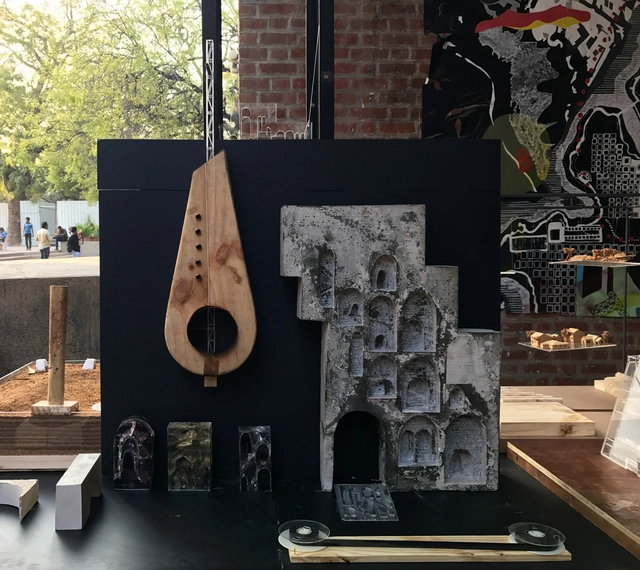
Once every two years architecture schools around the world are invited to submit their single, finest graduation project to the Archiprix International competition and exhibition. Since its inception in 2001 (born out of the Dutch Archiprix), an ever increasing number of schools choose to participate. This year, Archiprix International selected Ahmedabad, in India, to exhibit the results. Arjen Oosterman, Editor-in-Chief of Volume, spoke to Archiprix Director and "Mister Archiprix" Henk van der Veen.
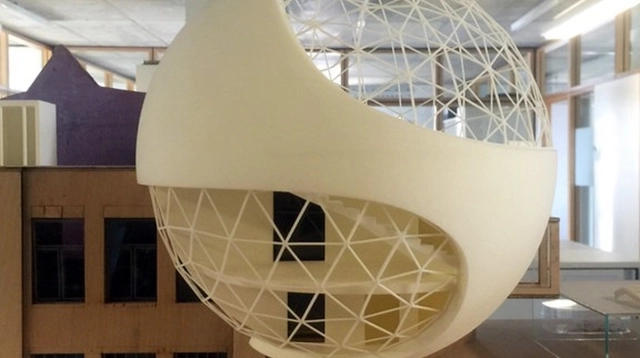
One of Brazilian architect Oscar Niemeyer’s final designs, a 12-meter-diameter glass and concrete sphere perched on the corner of a factory building, is set to be completed in Leipzig, Germany, reports Mitteldeutscher Rundfunk (Central German Broadcasting, MDR).
If an architecture firm is lucky, it can hit two birds with one stone on a single project—for example, prioritizing both historic preservation and energy efficiency. But a team at KieranTimberlake, based in Philadelphia, is aiming for four ambitious goals with its pro bono project, the Mars City Facility Ops Challenge.
Architects Fátima Olivieri, Efrie Friedlander, and Rolando Lopez teamed up with National Institute of Building Sciences (NIBS), NASA, and the Total Learning Research Institute (TLRI) to create a virtual working city on Mars—one that might reap multiple rewards.
https://www.archdaily.com/867605/kierantimberlake-is-using-virtual-reality-to-design-a-home-for-future-life-on-marsKim A. O'Connell
We're all used to seeing buildings in urban settings, surrounded by glass high-rises and tidy green parks. Yet around the world, there are many buildings in much more extraordinary spaces. Some have made it to the news because of their unusual locations, while others remain relatively hidden or even abandoned. Whether historic or brand new, protected or restored, grand or humble, flooded or floating, the following 13 buildings have one thing in common: their less-than-normal locations.
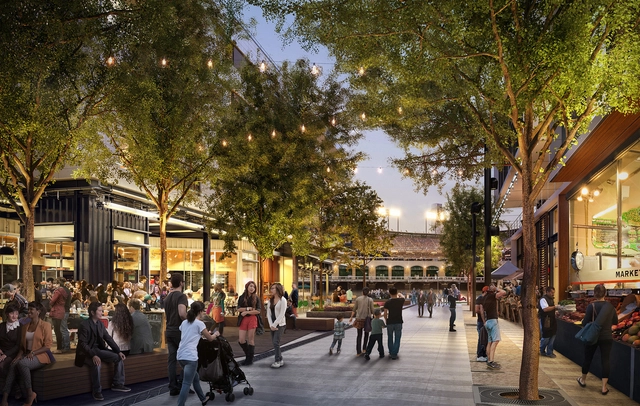
Utopia Arkitekter wants to start a discussion in Stockholm: how do we manage and develop our public spaces? The definition of the word public, according to the Oxford Dictionary, is something “open to or shared by all the people of an area or country.” However, as commercialism continues to rise, Utopia Arkitekter has a problem with our new applications of indoor “public” spaces. As architecture critic Rowan Moore writes in Why We Build, “Identity, desire and stimulation become things you have to buy, as clothes, restaurant meals of calculated diversity, and rides on the ski slope or up the Burj Khalifa.” The problem is that as our inner cities adopt more commercial indoor
The problem is that as our inner cities adopt more commercial indoor public spaces such as shopping malls, cafés or restaurants, the “public” is no longer represented by “all the people of an area,” simply due to economic restrictions. In a city like Stockholm, where darkness and temperatures below 10 degrees celsius prevail for 6 months of the year, the economic boundaries set up around indoor public spaces mean reduced opportunities for people to socialize outside of the home. Utopia Arkitekter’s proposal in response to this conundrum? An indoor park.
Go to any medieval European city and you will see what streets looked like before the advent of the car: lovely, small narrow lanes, intimate, and undisputedly human-scale. We have very few cities in the US where you can find streets like this. For the most part what you see is streets that have been designed with the car in mind—at a large scale for a fast speed. In my native San Francisco, we are making the streets safer for walking and biking by widening sidewalks, turning car lanes into bike lanes, and slowing down the cars. We are working with the streets we have; a typical San Francisco street is anywhere from 60 to 80 feet (18 to 24 meters) wide, as compared with a medieval, pre-car street which is more like 10 to 20 feet (3 to 6 meters) wide.
As an urban designer, I work on lots of projects where we take large parcels of land and subdivide them into blocks by introducing new streets. These new streets are a rare opportunity to take a fresh look at the kinds of car-oriented roads that we are used to, and instead try to design streets that prioritize the safety and comfort of pedestrians. These projects give us a chance to design streets that are just for people. Imagine that we made these people-only streets into narrow, medieval-style lanes that are intimate and human-scaled. But even as we try to design streets that might not ever see a single car, we find that the modern street design has become so much more than just places for walking or driving. There are therefore a number of things for socially-minded designers to consider, beyond the commonly talked about pedestrian-car dichotomy.
https://www.archdaily.com/867390/4-important-things-to-consider-when-designing-streets-for-people-not-just-carsKristen Hall
#donotsettle is an online video project created by Wahyu Pratomo and Kris Provoost about architecture and the way it is perceived by its users. Having published a number of videos on ArchDaily over the past two years, Pramoto and Provoost are now launching an exclusive column, “#donotsettle extra,” which will accompany some of their #donotsettle videos with in-depth textual analysis of the buildings they visit.
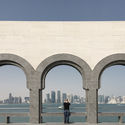
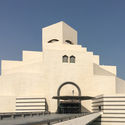
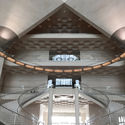
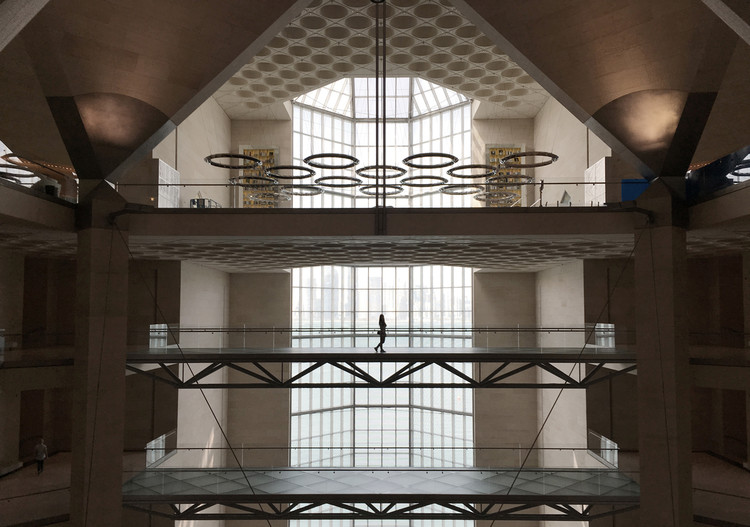
In our first installment we are taking you to Doha, the capital of Qatar, where we visited the Museum of Islamic Art. For some years, this museum was the only architecture fix you could find in Doha, but recently this has changed, with projects almost completed by Jean Nouvel and Rem Koolhaas, and will continue to change leading up to the 2022 World Cup. The building was designed by IM Pei who, when the building was constructed in the mid-2000s, was retired but was persuaded to commit his time to design this prominent museum. And prominent it for sure is. Mister Pei, you know how to make your building stand out. Standing off the mainland, a solid natural stone structure rises out of the water.
Singapore’s first Housing and Development Board (HDB) housing blocks were erected in November of 1960, in response to a severe lack of adequate housing for the country's 1.6 million citizens. Fast forward to 2017, and over 80% of the Singaporean population live in HDBs, with over 90% of them owning the home they live in. Often painted in vibrant colors, HDBs have a focus on community social spaces, more often than not maintaining the ground floor of the apartment blocks as open public space, exclusively for public meeting areas. These can include hawker centers, benches, tables, grills and pavilions where residents can socialize under cover from the hot Singaporean sun.
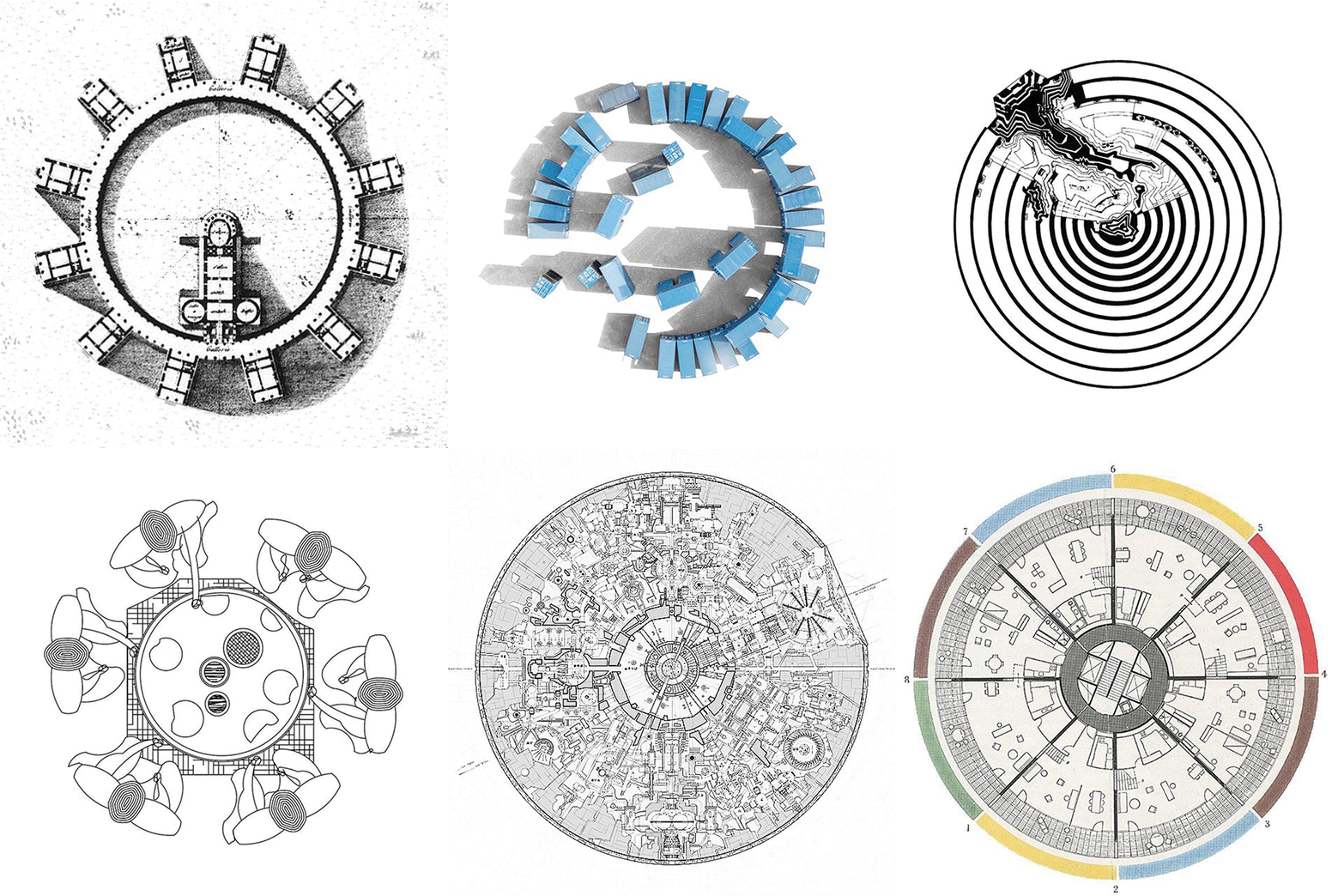
“The circle . . . is the synthesis of the greatest oppositions. [It] combines the concentric and the excentric in a single form, and in equilibrium. Of the three primary forms [triangle, square, circle], it points most clearly to the fourth dimension.”
Inspired by this obsession, one Instagram account titled “Circular Spaces” has collected many of the best examples of circles found in architecture. The account tracks the geometries at all scales, from the planet-sized plan of the Death Star to the familiar intimacy of a round dining table. Check out a selection from “Circular Spaces” below.
Experimentation in architecture is what propels the discipline forward. In an ideal scenario, once a project gets as far as the planning stage, large amounts of careful research and collaboration between the architect, contractor, and client contribute to a smooth execution of an exploratory idea, and ultimately a successful end product. But it’s not uncommon for even the most skilled architects to design work that has a misstep somewhere along the line, whether it has to do with shrinking budget, unforeseen contextual changes, lack of oversight, or anything in between. In some way, the projects here all fall into the second category of failed experiments, but some have also become potential models for revitalization of existing buildings, rather than (less sustainable) demolition and reconstruction. Read on to discover what went wrong in these notable disasters.
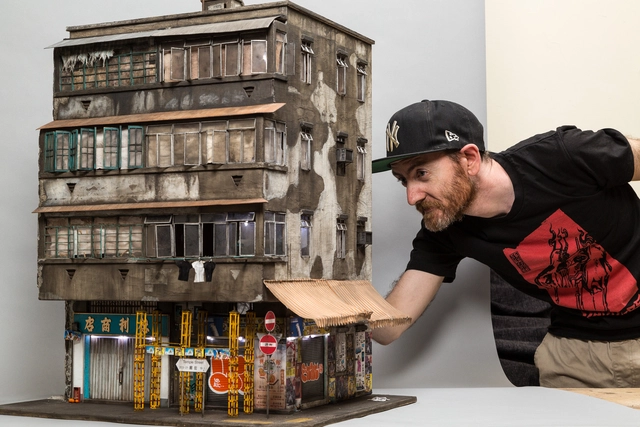
Joshua Smith, a miniaturist and former stencil artist based in South Australia, constructs tiny, intricate worlds for a living. His work, which exhibits astonishing observational and representational skills, focuses on the "overlooked aspects of the urban environment – such as grime, rust and decay to discarded cigarettes and graffiti," all recreated at a scale of 1:20. Smith, who has been making model kits for around a decade, only recently chose to move away from a 16-year-long career creating stencil art. With his creative talents now focused on model-making, and all those skills which accompany the craft, ArchDaily asks: how do you do it?
The Star Wars universe contains some impressive buildings. However, in the original trilogy, it's actually the Millennium Falcon, Han Solo's non-descript yet highly tuned ship, that provides the most important architectural setting for the story's events, acting as the de facto base for our heroes' scheming. While it's certainly not the largest or most complex floor plan in the universe, the interior of the Millennium Falcon is intriguing for the way it resolves the ship's circular shape.
With this model from Archilogic of the Millennium Falcon's main floor, Star Wars fans can get a sense of what it's like to tag along with Luke, Han, and the rest of the group—whether that's by hanging out in the living area, traversing the ship's curved corridors, or even sitting in the cockpit as an Imperial Star Destroyer approaches, the model has it all.
https://www.archdaily.com/867015/take-a-virtual-fly-through-of-the-star-wars-millennium-falcon-with-this-3d-modelAD Editorial Team
Architect and illustrator Diego Inzunza has created a new series titled "Architectural Classics," which presents and analyzes 20 iconic architectural works from the 20th-century. Using a graphic technique based upon axonometric views, the style allows each building to be seen from multiple sides, creating a comprehensive overall interpretation of the architecture.
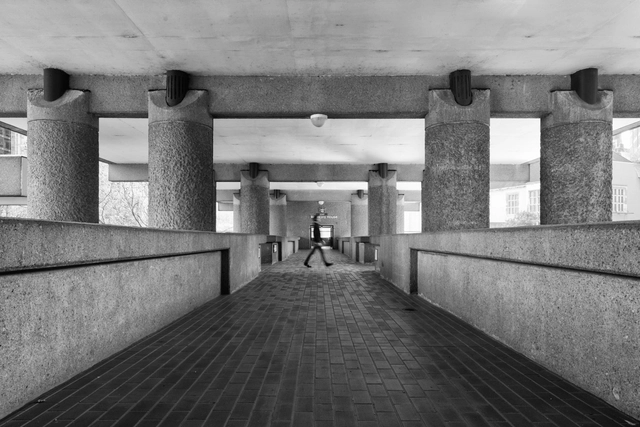
In this second installment of his revamped “Beyond London” column for ArchDaily, Simon Henley of London-based practice Henley Halebrown discusses a potential influence that might help UK architects combat the economic hegemony currently afflicting the country – turning for moral guidance to the Brutalists of the 1960s.
Before Christmas, I finished writing my book entitled Redefining Brutalism. As the title suggests I am seeking to redefine the subject, to detoxify the term and to find relevance in the work, not just a cause for nostalgia. Concrete Brutalism is, to most people, a style that you either love or hate. But Brutalism is far more than just a style; it is way of thinking and making. The historian and critic Reyner Banham argued in his 1955 essay and 1966 book both entitled The New Brutalism: Ethic or Aesthetic that the New Brutalism began as an ethical movement only to be hijacked by style. Today, it is a mirror to be held up to the architecture of Neoliberalism, to an architecture that serves capitalism. More than ever, architecture relies on the brand association of the big name architects whose work has little to do with the challenges faced by society, which are today not unlike the ones faced by the post-war generation: to build homes, places in which to learn and work, places for those who are old and infirm, and places to gather. We can learn a lot from this bygone generation.
9 years ago today, ArchDaily launched with a challenging mission: to provide inspiration,knowledge and tools to the architects tasked with designing for the 3 billion people that will move into cities in the next 40 years. Over these 9 years, as we have developed innovative approaches to help architects tackle the urban challenges facing our world, our work has brought us into contact with some of the most creative and respected architects in the world. To help us celebrate our 9th birthday, we asked 9 architects who are renowned for their creative and imaginative abilities to create drawings inspired by our logo, to show the world what ArchDaily means to them.
https://www.archdaily.com/866860/9-drawings-to-celebrate-our-9th-birthdayAD Editorial Team
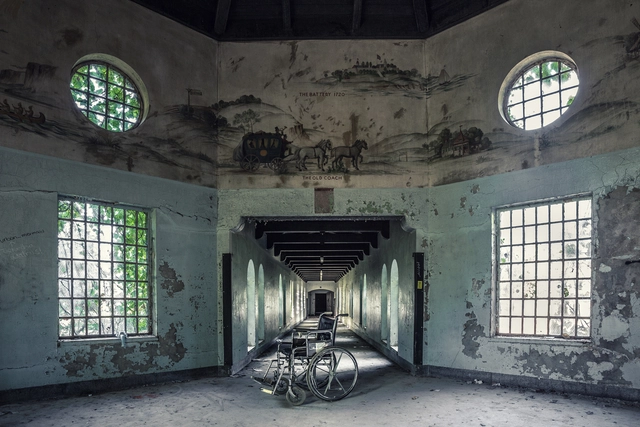
With cracked paint, overgrown vines, rust, and decay, abandoned buildings have carved out a photographic genre that plays to our complex fascination with the perverse remnants of our past. While intellectual interest in ruins has been recorded for centuries, the popularity and controversy of contemporary "ruin porn" can be traced back to somewhere around 2009, when photographer James Griffioen’s feral houses series sparked a conversation about the potential harm in the aesthetic appropriation of urban collapse.
A favorite subject within this field is the American insane asylum, whose tragic remains carry echoes of the unsavory history of mental illness treatment in the United States. These state-funded asylums were intensely overcrowded and often housed patients in nightmarish conditions in the 20th century. Beginning in 1955, with the introduction of the antipsychotic drug Thorazine, these institutions were closed in large numbers, never to be reopened [1]. Now, these closed but un-demolished asylums that dot the country are the subject of "ruin porn" that neglects an equally important piece of the buildings’ narrative: the beginning. In his recent photobook Abandoned Asylums, Photographer Matt Van der Velde depicts this earlier period of asylum architecture, when the institutions were built in the belief that the built environment has the power to cure.

















_copy.jpg?1488996934 "Casa Gropius / Walter Gropius + Marcel Breuer / 1938 . Image Cortesía de Diego Inzunza - Estudio Rosamente")
_copy.jpg?1488997079 "Prairie Chicken House / Herb Greene / 1961. Image Cortesía de Diego Inzunza - Estudio Rosamente")
_copy.jpg?1488996911 "Casa de Vidrio / Philip Johnson / 1949. Image Cortesía de Diego Inzunza - Estudio Rosamente")
_copy.jpg?1488996891 "Casa Farnsworth / Mies van der Rohe / 1951 . Image Cortesía de Diego Inzunza - Estudio Rosamente")
_copy.jpg?1488996826)



.jpg?1488577068 "Courtesy of Matt Van der Velde")