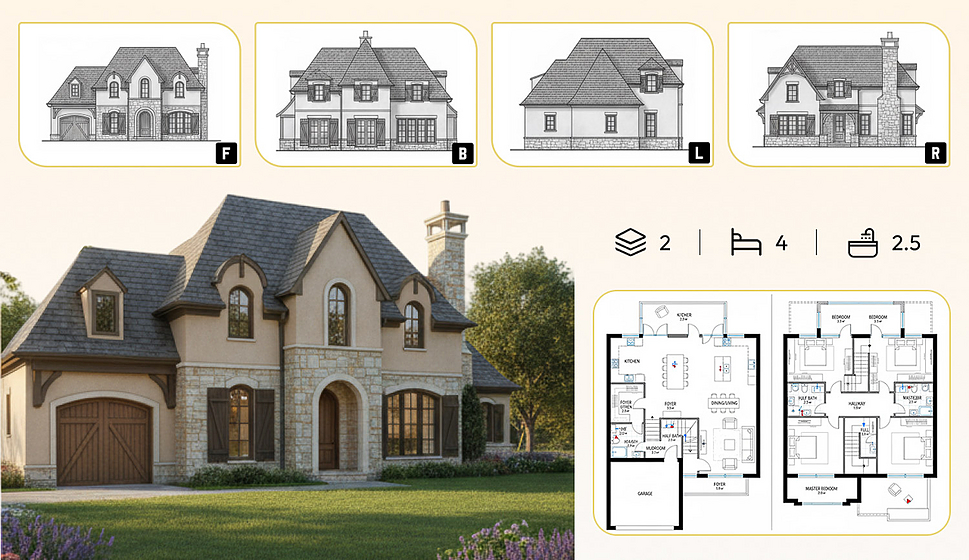
This guide covers a workflow that moves from project parameters to generated floor plans, 3D perspective views, exterior design exploration, and site context visualization, using AI tools in place of preliminary CAD and rendering work.
This guide covers a workflow that moves from project parameters to generated floor plans, 3D perspective views, exterior design exploration, and site context visualization, using AI tools in place of preliminary CAD and rendering work.
Legendary American architect Steven Holl has collaborated again with Spirit of Space to produce two short videos on the recently completed Campbell Sports Center in New York City. While always compelling to hear an architect discuss a project, these videos integrate the architect's narration with different dynamic shots of the building's detail and context, thus truly immersing the viewer in the project.
The first video (above) features Steven Holl and senior partner Chris McVoy explaining the project's inspiration, design concept and program; simultaneously, the filmmakers take us into the space and show how the new athletic facility is being used by the student athletes. The second, shorter, video (after the break) shows the building in the city, revealing the fascinatingly complex relationship between the passing subway cars, the field hockey players, the movement of shadows and the building itself.
See the second video, after the break...

This article, by Alexandra Lange, originally appeared on Metropolis Magazine as "Architecture's Lean In Moment."
“Women are the ghosts of modern architecture, everywhere present, crucial, but strangely invisible,” writes historian Beatriz Colomina in “With, Or Without You,” an essay in the Museum of Modern Art’s 2010 catalog, Modern Women. “Architecture is deeply collaborative, more like moviemaking than visual art, for example. But unlike movies, this is hardly ever acknowledged.”
Colomina goes on to chronicle the history of modernism’s missing women, acknowledged, if at all, as working “with” Mies van der Rohe, Le Corbusier, Alvar Aalto, or Charles Eames. To put yourself in the shoes of Lilly Reich, Charlotte Perriand, and Aino Aalto, simply watch the cringe-worthy video of the Eameses on the Home show in 1956; Ray['s] introduced as the “very capable woman behind him” who enters after Charles has bantered with host Arlene Francis.
This spring, these ghosts came back to haunt us: Arielle Assouline-Lichten, a student at the Graduate School of Design at Harvard, read excerpts from an interview with Denise Scott Brown in which she mentioned her own absence from partner Robert Venturi’s 1991 Pritzker Prize. “They owe me not a Pritzker Prize but a Pritzker inclusion ceremony,” Scott Brown said. “Let’s salute the notion of joint creativity.”
Read all of Alexandra Lange's essay, after the break...
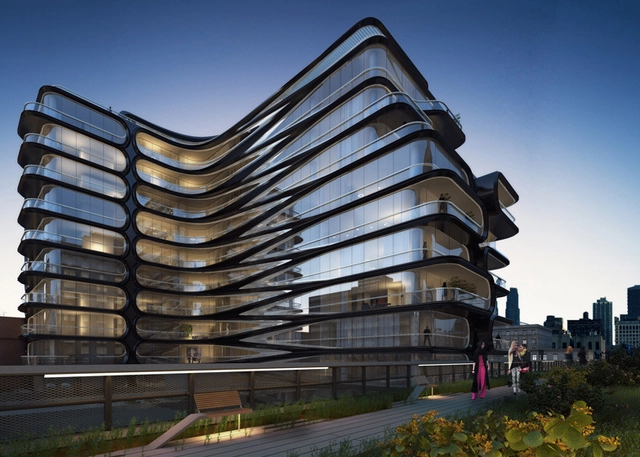
Zaha Hadid has unveiled her first New York City commission: an 11-story, luxury apartment block planned alongside the second section of the High Line in Chelsea at 520 West 28th Street.
Spearheaded by New York developer Related Companies, the “sculpted” glass and steel residential development hopes to lure buyers with its expansive, double-height entrance lobby, communal garden, generous terraces, private courtyards, and, of course, exclusive views of New York’s most beloved attraction: the High Line.
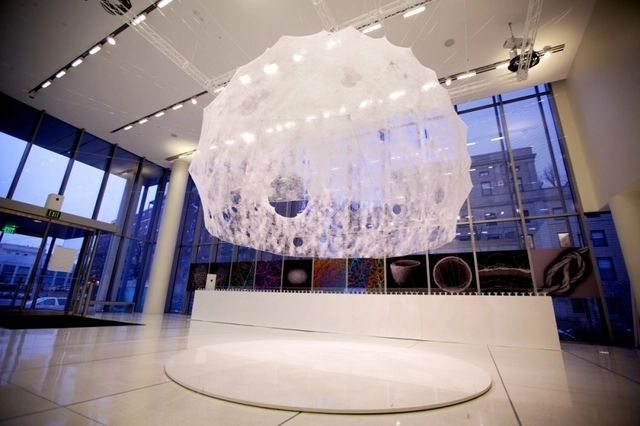
I get most of my knowledge about the current trends and interests of architects through social media and various websites. My Facebook newsfeed constantly shows an array of pictures, articles, and videos of things ranging from new buildings to data algorithms to bacteria evolution to (usually confusing) romantic, poetic statements about architecture.
They all share one thing in common: they are posted on Facebook by architects and architecture students. To me, this shows the current disarray and lack of focus in the field. Architecture publications and websites only confirm my thoughts further. And nothing reaffirms this more than my daily experiences at MIT.
Read more, after the break...

Figures released last month by the National Endowment for the Arts offer telling insight into the architecture profession across the US, with a helpful breakdown of the representation of various demographic groups.
The data, collected between 2006-2010, reports the number of architects in each state and their race, gender, age and income. The data reveals which states have the highest/lowest income, the best/worst gender discrepancies, and also offer insights into the average age and races of architects, per state.
Read more about what the NEA statistics reveal after the break.

Our friends at Arup Connect spoke with Matt Williams, a leader of the façade engineering group in Arup’s Americas region and one serious sketcher, about the role of sketching in the digital age. The following interview, originally titled "To Sketch or Not to Sketch," discusses how sketching enables communication and how our over-reliance on technology isn't really as efficient as we may think.
One of the things we’ve been trying to develop in the façades group is people who can relate to the architect, developing and responding to the key architectural requirements. Having come from an architectural background myself, historically there seems to be a bit of a conflict, if that’s the right word, between architects and engineers. There shouldn’t be, though. Everyone wants the same thing at the end of the day: a successful project.
Read the rest of the interview, after the break...
.jpg?1373142317&format=webp&width=640&height=580)
David Mirvish, founder of Mirvish Productions, and Toronto-born starchitect Frank Gehry have released updated renderings of their massive, mixed-used project planned to transform Toronto's downtown arts and entertainment district. The Mirvish+Gehry vision will include a triad of residential towers perched on top a six-story, wooden podium inspired by the site’s industrial past and covered in a ‘cloud-like’ sculptural skin.
The towers, rising over 80 stories each, will house condos, a new OCADU campus, and a gallery space to house the Mirvish's collection of modern art.
More renderings after the break...
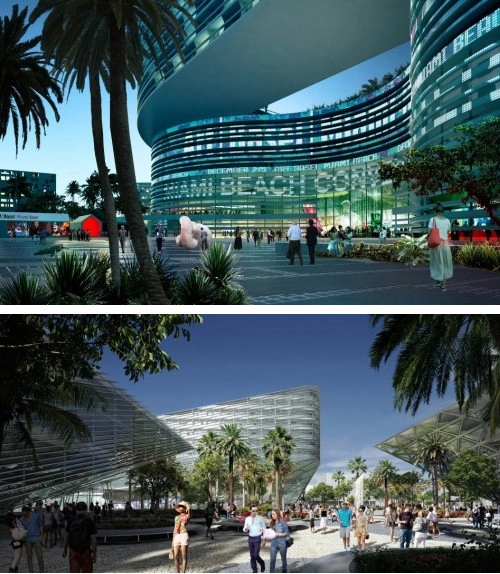
OMA, BIG and their partnering developers have until later today to decide whether they want to alter their plans for the Miami Beach Convention Center or walk away from the competition entirely.
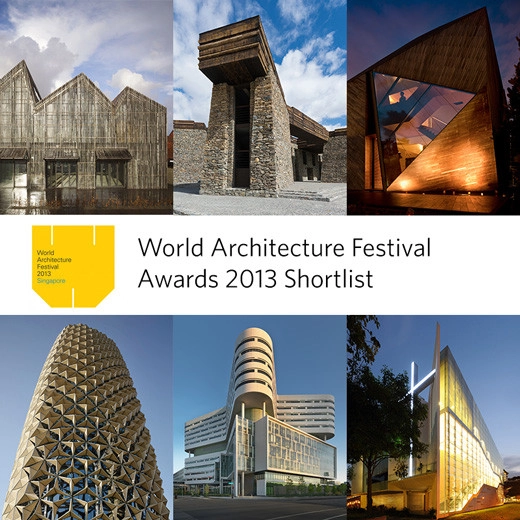
More than 300 projects from almost 50 countries have been shortlisted for the World Architecture Festival 2013 - the world's biggest architectural awards programme - taking place between October 2 - 4 at the Marina Bay Sands, Singapore.
The WAF is the world's largest, live, inclusive and interactive global architecture event. Projects designed by global architects such as Zaha Hadid, Tadao Ando, and Robert A.M. Stern will compete with smaller, local practices across 29 individual award categories.
Paul Finch, WAF Programme Director, said: ‘Following such strong competition at last year’s awards, expectations were understandably high for the WAF Awards 2013, and the entries did not disappoint. From the subtle to the spectacular, from a four room house to an 80 storey tower, the sheer quality and diversity reflected in the array of projects shortlisted today demonstrates the increasingly global nature of the event. All eyes are now on the festival's venue, the Marina Bay Sands in Singapore, where the architects will battle to win their individual categories, with the victorious projects competing for the coveted World Building of the Year award.”
You can see the complete shortlist after the break. For more information, please visit WAF's official website.
_oma__photo_by_philippe_ruault.jpg?1372972907)
The Council on Tall Buildings and Urban Habitat (CTBUH) has named _ distinctive towers from Canada, China, the UK and UAE as the best tall buildings in the world for 2013. Each selected project, judged by a panel of industry executives, have been selected for their “extraordinary contribution in the advancement of tall buildings and the urban environment, as well as for achieving sustainability at the broadest level.”
“The winners and finalists include some of the most striking buildings on the global landscape,” said Jeanne Gang, awards jury chair and principal of Studio Gang Architects. “They represent resolutions to a huge range of contemporary issues, from energy consumption to integration with the urban realm on the ground.”
The 2013 winners are...
A version of this essay was originally published in Thresholds 40: “Socio-” (2012)
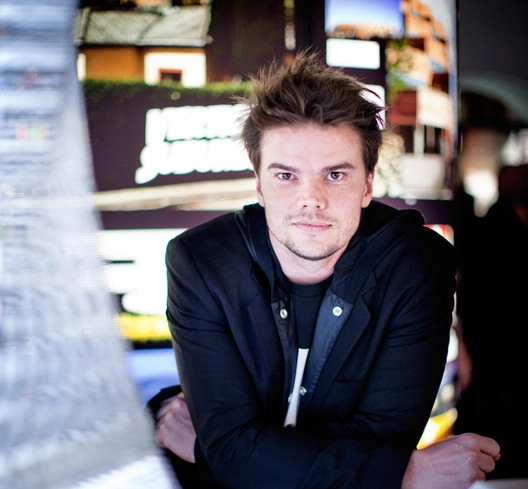
Few architects working today attract as much public acclaim and disciplinary head-scratching as Bjarke Ingels. Having recently arrived in New York, this self-proclaimed futurist is undertaking his own form of Manifest Destiny, reminding American architects how to act in their own country.
While his practice is often branded by the architectural establishment as naïve and opportunistic, such criticism is too quick to conflate Ingels’s outwardly optimistic persona with the brash formal agenda it enables. In the current economic climate, there are any number of gifted purveyors of form languishing in New York City. Despite this, Ingels has somehow managed to get away with proposing a pyramidal perimeter block in midtown New York, a looped pier in St. Petersburg Florida, and an art center in Park City, Utah massed as torqued log cabin while maintaining a straight face. Why, then, is his mode of operation considered unsophisticated by so many within the discipline?
Clearly, Ingels has figured something out about harnessing and transforming “the social” that American architects would do well to identify. So, in the manner of any good conspiracy theorist in search for the hidden method, let’s go to the chalkboard, or rather, the diagram...
Part of the answer may lie with Ingels’s brand of populism, which is as much about being social as it is about the social.
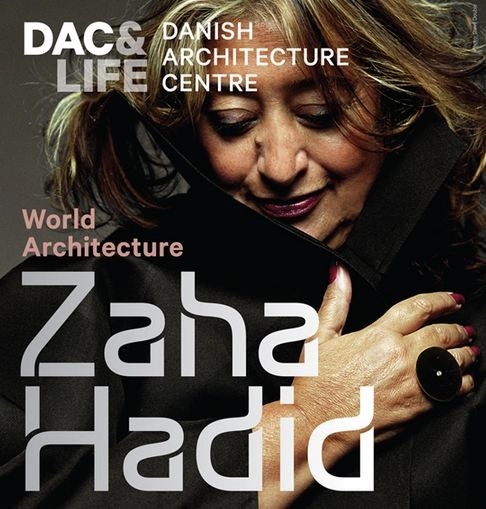
Opening Friday, June 28, the Zaha Hadid - World Architecture exhibition will be the first solo show in Copenhagen, which runs until September 29. Iraqi-British architect and Pritzker Architecture Prize winner Zaha Hadid is one of the most sought after, admired and discussed architects in the world, and has developed this extraordinary experience in collaboration with the Danish Architecture Centre. The pre-opening talk begins on opening day at 5:00pm with Patrik Schumacher (director and senior designer at Zaha Hadid Architects), and Kent Martinussen (CEO - Danish Architecture Centre). For more information, please visit here.
.jpg?1372283662&format=webp&width=640&height=580)
It’s hard to imagine an entire category of architecture slipping off history’s grid, and yet that seems to be the case with India’s incomparable stepwells. Never heard of ‘em? Don’t fret, you’re not alone: millions of tourists – and any number of locals - lured to the subcontinent’s palaces, forts, tombs, and temples are oblivious to these centuries-old water-structures that can even be found hiding-in-plain-sight close to thronged destinations like Humayun’s Tomb in Delhi or Agra’s Taj Mahal.
But now, India’s burgeoning water crisis might lead to redemption for at least some of these subterranean edifices, which are being re-evaluated for their ability to collect and store water. With any luck, tourist itineraries will also start incorporating what are otherwise an “endangered species” of the architecture world.
Learn more about these stepwells' curious histories, after the break...
Derived from 40 years of research by architect, professor and author Jan Gehl, The Human Scale takes a critical look at the way we build and use our cities. Assumptions about modernity are questioned, as director Andreas M. Dalsgaard urges the viewer to imagine what would happen when we put “people into the center of our equations”.

With one of his largest installations to date, American artist James Turrell has transformed the rotunda of Frank Lloyd Wright’s iconic Guggenheim Museum into a mesmerizing Skyspace. Shifting between natural and artificial light, Aten Reign - James Turrell’s main attraction - illuminates the central void with a brightly colored, banded pattern that imitates the museum’s famous ramps. This presents a dynamic perceptual experience in which the materiality of light is exposed.
More images of the luminous and immersive Skyspace after the break.

Scheduled for completion later this year, Bosco Verticale, by Boeri Studio, will be the world’s first vertical forest. The project’s inspired many supporters, but also many detractors. Speaking to its controversiality, Lloyd Alter, the architect, sustainable design enthusiast, and managing editor of Treehugger, called it “the rendering that launched a thousand blog posts.”
And perhaps no blogger caused more stir in the architecture community than Tim De Chant, who implored “can we please stop putting trees on skyscrapers”? De Chant’s article set off a maelstrom of comments from ArchDaily users, who vigorously debated both for and against the idea of putting trees on buildings.
To get to the bottom of this, we talked with Lloyd Alter himself about vertical forests and the real challenges and benefits they present. Lloyd is a regular contributor to Inhabitat, The Huffington Post and numerous other publications; he also teaches at Ryerson University School of Interior Design. Read on for Lloyd’s take on this controversial trend, after the break.
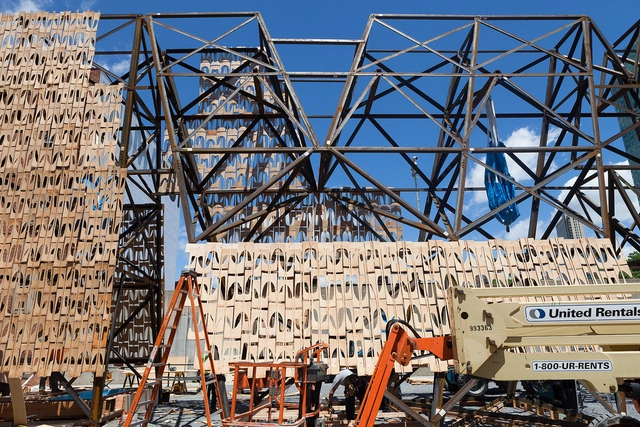
Starting this Saturday, the public will finally be able to admire the winner of this year's Young Architects Program - Party Wall - at the MoMA PS1 courtyard in Long Island City. Every Saturday this summer through September 7, Party Wall will be the multi-functional backdrop (at once wall, water feature, shading and seating storage device) for Warm Up 2013, an outdoor music series.
We spoke with Party Wall's designer, Caroline O'Donnell, principal of CODA, just this morning; she told us that although much has been made of Party Wall's ingenious material (skateboarding scraps) and multi-functionality, it's most important feature is it's referentiality to the urban language of Long Island City.As O'Donnell told us: "we started to understand the relationship between the wall and the other languages—Long Island City, the billboards, the graffiti. We realized we had entered into a dialogue with a bigger urban context."In fact, the wall itself is a legible sign - written in the shadow it forms.
Read our interview with O'Donnell on Party Wall's ingenious design, after the break...

"It's not where you start in life, it's where you end up and all the places you went in between." - United States General Colin L. Powell
For the closing keynote speaker of the stimulating, three-day “Building Leaders” convention in Colorado, the American Institute of Architects (AIA) selected one of America’s most admired public figures to share wisdom and insight to becoming a great leader.
General Colin L. Powell, a first-generation American born from Jamaican immigrants in 1937, is the epitome of the American dream. Starting life in the South Bronx, Powell paved his way to becoming a highly respected, four-star general in the United States Army and the first African American to serve as Secretary of State. A natural storyteller, Powell effortlessly captivated the audience of architects with a series of experiences and lessons he had learned throughout his lifetime of service.
General Colin Powell’s top ten lessons of leadership after the break...
.jpg?1372283651 "Rudabai Vav, Adalaj. Image © Victoria S. Lautman")
.jpg?1372283874 "Dada Harir Vav, Ahmedabad. Image © Victoria S. Lautman")
.jpg?1372284281 "Neemrana Baoli, Neemrana, Rajasthan. Image © Victoria S. Lautman")
.jpg?1372284239 "Mukundpura Baoli, Narnaul. Image © Victoria S. Lautman")
.jpg?1372283662)