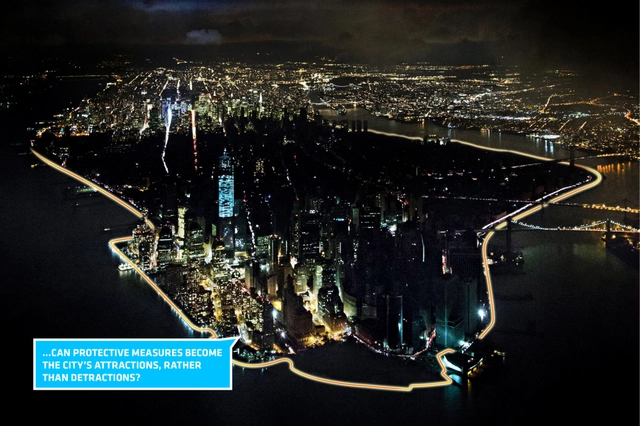
After three months of in-depth analysis and public outreach, the U.S. Department of Housing & Urban Development (HUD) has shortlisted 10 design “opportunities” for the third and final round of Rebuild by Design. The design competition, focused on making New York’s Sandy-effected regions more resilient, sustainable, and livable, will now have the final project teams collaborate with local and regional stakeholders in developing their projects over the next five months. The goal is to arrive at projects that are implementable and fundable, leveraging the variety of federal recovery investments being made in the region.
OMA, BIG and WXY are just a few practices involved in the final round. Read on to review a glimpse of each shortlisted proposal.
With completion aimed for 2018, the Nobel Center plans to become on of Stockholm’s most attractive destinations. Not only will the Center’s large auditorium host the annual Nobel Prize Award Ceremony, but it will offer key amenities to serve its surrounding public; In addition to a library, restaurant and retail shop, the Center will include spaces for exhibitions, school programs, events, and interdisciplinary meetings.
The proposals, listed in no particular order, are:
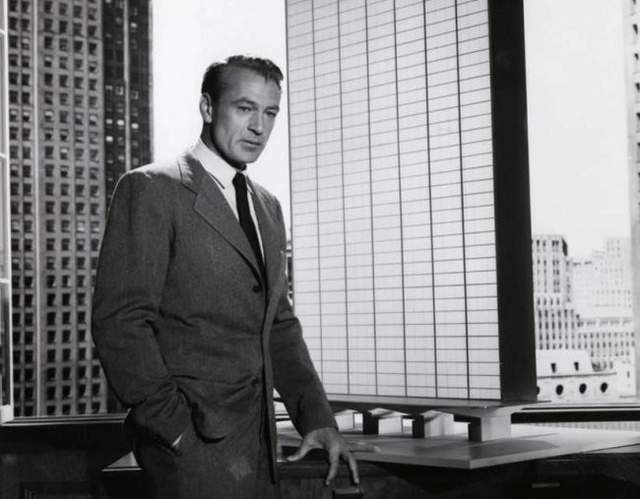
Gary Cooper as Howard Roark in a film adaptation of The Fountainhead. Via Courtesy King Vidor, The Fountainhead (Warner Brothers, 1949).. Image Courtesy of Metropolis Magazine
Howard Roark, the fictional architect envisioned by Ayn Rand in The Fountainhead, has possibly done more for the profession in the past century than any real architect at all - inspiring hundreds to enter architecture and greatly shaping the public's perception. And, according to Lance Hosey, Chief Sustainability Officer at RTKL, that couldn't be more damaging. In his recent article "The Fountainhead All Over Again," for Metropolis Magazine, he details why it's such a problem, going so far as to accuse Ayn Rand's dictatorial protagonist of committing architectural terrorism.
It came out in 1943, exactly 70 years ago this summer. In the movie version a few years later, Gary Cooper played Howard Roark, the character famously modeled after Frank Lloyd Wright. Since then, Ayn Rand’s The Fountainhead, her “hymn in praise of the individual” (New York Times), has made legions of young people want to become architects. The late Lebbeus Woods wrote that the story “has had an immense impact on the public perception of architects and architecture, and also on architects themselves, for better and for worse.” I’d say worse. In fact, the Fountainhead remains the perfect representation of everything that’s wrong with the profession.
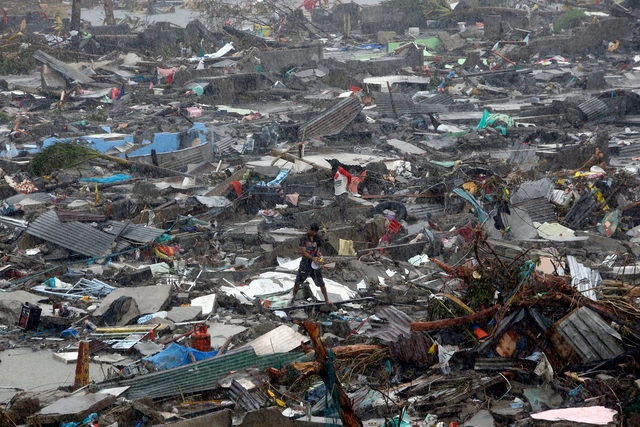
A man stands atop debris as residents salvage belongings from the ruins of their houses after Typhoon Haiyan battered Tacloban city in central Philippines November 10, 2013. Image Courtesy of Flickr user, mansunides
On Friday, one of the strongest storms ever to hit land left 660,000 Filipinos homeless, with countless more desperately needing basic supplies to survive.
Both organizations will be aiding local volunteers to help rebuild in the coming days and weeks. Through speaking with local stakeholders and construction professionals, they are working to begin understanding the on-the-ground situation to prioritize rebuilding needs and help affected regions build back better and stronger. Relief and reconstruction, however, cannot happen without your support. Learn how you can send aid to typhoon victims today after the break.
https://www.archdaily.com/447855/architects-and-aia-respond-to-devastation-in-the-philippinesJose Luis Gabriel Cruz
Having been officially in the role for only two months, Hodder spent some time with us discussing his hopes for the next two years. Find out why he described himself as a fan of Scandinavians and prog-rock after the break...
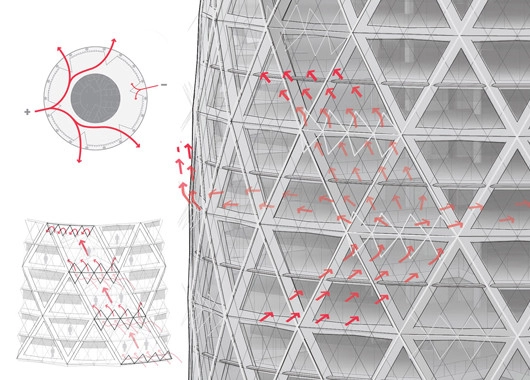
This four part series (originally published on Aggregate’s website) examines The Gherkin, the London office tower designed by Foster + Partners, showing how the urban icon engaged and leveraged perceptions of risk. In part one, author Jonathan Massey introduced the concept of "risk design” to describe how the Gherkin’s design managed the risks posed by climate change, terrorism, and globalization. In part two, below, Massey examines the Gherkin’s enclosure and ventilation systems in detail to explain how the building negotiated climate risk.
In a poster promoting London’s bid to host the Olympic Games, the Gherkin supported gymnast Ben Brown as he vaulted over the building’s conical peak. The image associated British athleticism and architecture as complementary manifestations of daring and skill, enlisting the Gherkin as evidence that London possessed the expertise and panache to handle the risk involved in hosting an Olympic Games.
But a poster created three years later offered a very different image. Created by activists from the Camp for Climate Action to publicize a mass protest at Heathrow Airport against the environmental degradation caused by air travel, this poster shows the Gherkin affording only precarious footing to a giant polar bear that swats at passing jets as its claws grasp at the slight relief offered by spiraling mullions and fins.
Chris Baribeau of Modus Studio is the exemplar of a “community builder.” With a mantra that moves beyond the building and believes the architect to be responsible for the creation of healthy and thoughtful places, Baribeau and his Fayetteville-based practice have built works that transcends ordinary design. Embodying everything in which drives Modus Studio, the award-winning Eco Modern Flats serves as a prime example of community-based, sustainable design.
"Let’s meet on the red square.” The artists behind Superkilen explain how this colorful wedge shaped public park in Copenhagen, Denmark, was a collaboration based on extreme civic participation.
A public park in the Nørrebro district of Copenhagen, Denmark, Superkilen was developed by artists’ group Superflex in collaboration with architectural firms Bjarke Ingels Group (BIG) and Topotek1. The park was officially opened in June 2012.
In this interview two members of Superflex, Jakob Fenger and Bjørnstjerne Christiansen, tell us about the ideas behind the project, and how it came about as an extreme example of citizen inclusion and collaboration: "We found it interesting to look at this very diverse group of people in regard to culture, social standing, nationality, etc., and then see it as a rich and significant foundation for impacting the area these people live in."
Iwan Baan's recent TED talk on ingenious informal settlement 'architecture' became instantly popular, clearly striking a chord with people across the globe. The lecture has been called everything from heartwarming to condescending, but for Parsons graduate students Meagan Durlak and James Frankis it was reaffirming. Durlak and Frankis have spent time working in Sao Paolo's favelas and understand that finding a balance between the good and the bad is key to the revitalization of these settlements. This article, originally published in Metropolis Magazine as "Response to Iwan Baan's TED Talk," journals some of their experiences working in South American slums, and why we need to stop treating those slums as a blight.
Meagan Durlak and I were excited to see the TED talk by architectural photographer Iwan Baan on the ingenuity found within informal settlements. In his presentation he walks us through a range of communities across the world, capturing many such settlements, including houses above a lagoon and a repurposed office block.
Baan’s view of informal settlements resonates with our own work; it’s an under-told story that we very much applaud. He shows an overview of people’s lives and their unique methods for adapting to difficult conditions. Perhaps as interesting as his film are the reactions to it from TED viewers. Many found the innovation in informal settlements to be inspiring and heartwarming; others claimed that this talk is just a life affirming story for the rich 1% of the world, perpetuating inaction for areas which need immediate aid. The two sides of the argument reminded us of our own work and the battles we have gone through in trying to wrap our heads around the systems of informal settlements, as well as the difficulties we have had in explaining their hidden properties to others.
https://www.archdaily.com/446864/why-iwan-baan-s-ted-talk-was-rightMeagan Durlak & James Frankis
For years, rivers were a source of transport and power, upon whose banks our cities were born. But as cities industrialized, many of them clogged with filth and disease – making them not only ugly, but dangerous. Unless they were useful, rivers were often diverted, covered, pushed underground, and forgotten.
Not anymore. Reclaiming rivers seems to be the newest trend in urban design, and cities across the world are hopping on the bandwagon. In the UK, the Environment Council is working to restore 9,500 miles of river; in Los Angeles, the eponymous river is about to undergo a complete transformation.
https://www.archdaily.com/445637/reclaiming-rivers-the-latest-trend-in-urban-designKatherine Allen
In the latest of NOWNESS' spectacular videos, Ole Scheeren - a former partner at OMA and now principal of Büro Ole Scheeren in Beijing - reflects on the past decade he has spent in China overseeing construction of the CCTV Headquarters. He muses over the delicate balancing act that Western architects maintain when they work in China, simultaneously bringing change to the city and allowing the city to change who they are and how they see the world. In this context, where change is "something that you are immediately and instantly confronted with" he believes that the CCTV Building is "both confrontational and complicit".
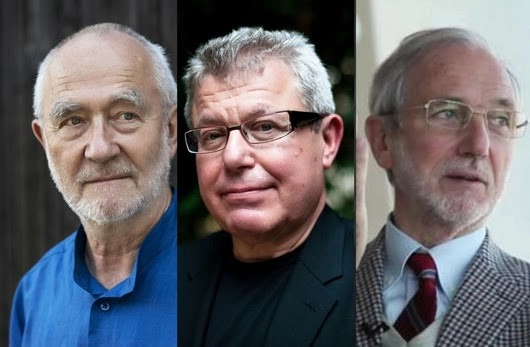
According to some, Peter Zumthor, Daniel Libeskind, and Renzo Piano should not be referred to as architects (at least in the UK), since they are not registered with the Architects' Registration Board.. Image Courtesy of Keystone / Christian Beutler (Zumthor); Flickr CC User Tomasz Kulbowski (Libeskind); Architectural Review (Piano)
In August, the AIA posted a topic on its LinkedIn discussion board entitled "Misrepresenting Oneself as an Architect on LinkedIn". Ever since (and once again), the issue of protecting the title of "Architect" has been a hot topic, as explained in this article on Fast Company. This follows the revelation in BD last year that the Architects' Registration Board ordered the British architectural media to cease referring to Renzo Piano and Daniel Libeskind as Architects. With the topic appearing so frequently, and in different countries each time, Fast Company conjures images of a "raging global debate". But what, really, is going on in the world of architecture to fuel such a debate? Read on to find out more.
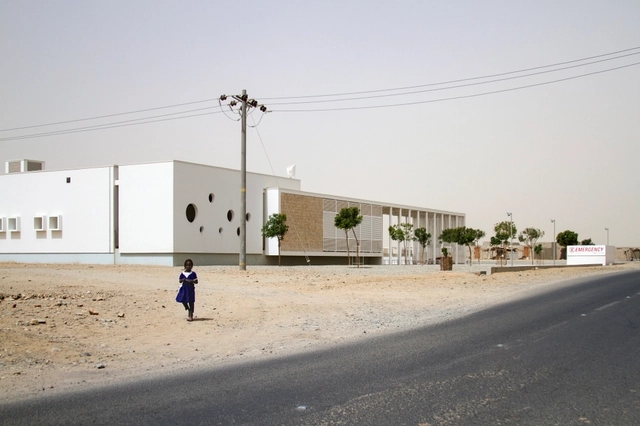
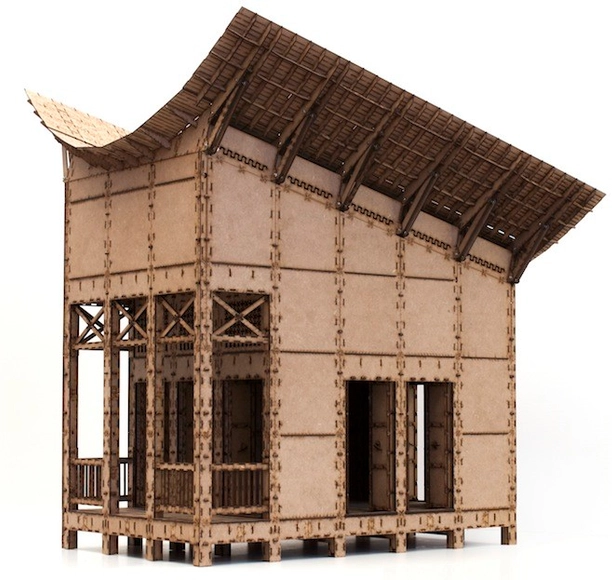
The Curry Stone Foundation has named three winners of the 2013 Curry Stone Design Prize: Hunnarshala (Bhuj, India), Proximity Designs (Yangon, Myanmar), and Studio TAMassociati / Emergency (Venice/Milan, Italy). The annual prize, now in its sixth year, awards talented designers who “harness their ingenuity and craft for social good.” More on each winner, after the break.
By now, we have all heard the mantra. In twenty years time, the world's cities will have grown from three to five billion people, forty percent of these urban dwellers will be living at or below the poverty line facing the constant threat of homelessness - scary statistics and even scarier implications.
ECOnnect, a Holland-based design firm, envisions a solution for these future housing shortages, one that could build a one-million-inhabitant city per week for the next twenty years for $10,000 per family. Peter Stoutjesdijk, architect at ECOnnect, created the concept after widespread devastation in Haiti caused by a massive earthquake left of hundreds of thousands of people homeless depending on tents for temporary relief.
https://www.archdaily.com/445418/puzzle-piece-homes-a-solution-for-rapidly-growing-populationsJose Luis Gabriel Cruz
A few weeks ago the RIBA doled out the 18th Stirling Prize to London-based architects Witherford Watson Mann. The decision was a good one. It was good for WWM and good for the profession – a youngish practice being recognized for a small but beautiful piece of work.
The scheme’s application of brickwork and joinery removes the work from the expediencies of modern construction technology and building products, which almost exclusively characterize the contemporary built environment. It genuinely feels like a project made at a different point in history, the result of the quite particular interests of three minds, Stephen Witherford, Chris Watson and William Mann. It is direct and personal. It reminds me of Stirling’s work..
And not just for its powerful draftsmanship, plan and restricted palette of materials, but for its intimacy. An intimacy that is apparent in much of Stirling’s oeuvre. I do not refer to the production of intimate spaces per se but the formulation of an architecture that is authored not by a factory but a few minds.
The latest Stirling prompted me to look back, and reconsider the work of Stirling himself.
The Battle of Ideas is an annual, weekend-long series of panel discussions hosted at the Barbican in London, ranging across subjects from neuroscience to music and everything in between. With a strong thread of architecture and urbanism, this year offered a spectacular chance to probe the popular trends and fads in today's design culture.
Read on after the break for the highlights of the event.
In a world where people live more mobile lifestyles than they have for centuries, cities are facing a problem they rarely planned for: their citizens move away. When jobs and resources start to decline, modern cities, such as Detroit, suffer difficult and often wasteful processes of urban contraction. In contrast to this, Manuel Dominguez's "Very Large Structure," the result of his thesis project at ETSA Madrid, proposes a nomadic city that can move on caterpillar tracks to locations where work and resources are abundant.
Of course this is not the first time that the idea of a nomadic city has been proposed. Ron Herron's Walking City is one of the more recognizable Archigram designs from the 1960s, and has been influential to architectural theory ever since. However, the design for the "Very Large Structure" expands on the Walking City by including strong proposals for energy generation on board the city.
Read on to see more on this provocative project - including a full set of presentation boards in the image gallery.