For years, rivers were a source of transport and power, upon whose banks our cities were born. But as cities industrialized, many of them clogged with filth and disease – making them not only ugly, but dangerous. Unless they were useful, rivers were often diverted, covered, pushed underground, and forgotten.
Not anymore. Reclaiming rivers seems to be the newest trend in urban design, and cities across the world are hopping on the bandwagon. In the UK, the Environment Council is working to restore 9,500 miles of river; in Los Angeles, the eponymous river is about to undergo a complete transformation.
https://www.archdaily.com/445637/reclaiming-rivers-the-latest-trend-in-urban-designKatherine Allen
In the latest of NOWNESS' spectacular videos, Ole Scheeren - a former partner at OMA and now principal of Büro Ole Scheeren in Beijing - reflects on the past decade he has spent in China overseeing construction of the CCTV Headquarters. He muses over the delicate balancing act that Western architects maintain when they work in China, simultaneously bringing change to the city and allowing the city to change who they are and how they see the world. In this context, where change is "something that you are immediately and instantly confronted with" he believes that the CCTV Building is "both confrontational and complicit".
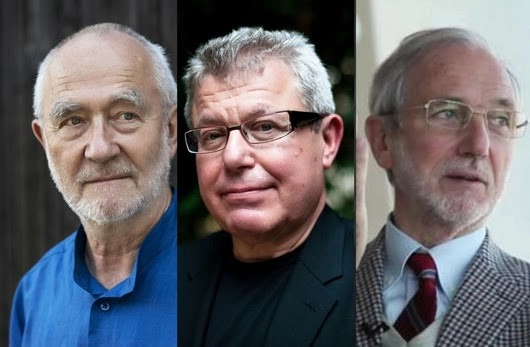
According to some, Peter Zumthor, Daniel Libeskind, and Renzo Piano should not be referred to as architects (at least in the UK), since they are not registered with the Architects' Registration Board.. Image Courtesy of Keystone / Christian Beutler (Zumthor); Flickr CC User Tomasz Kulbowski (Libeskind); Architectural Review (Piano)
In August, the AIA posted a topic on its LinkedIn discussion board entitled "Misrepresenting Oneself as an Architect on LinkedIn". Ever since (and once again), the issue of protecting the title of "Architect" has been a hot topic, as explained in this article on Fast Company. This follows the revelation in BD last year that the Architects' Registration Board ordered the British architectural media to cease referring to Renzo Piano and Daniel Libeskind as Architects. With the topic appearing so frequently, and in different countries each time, Fast Company conjures images of a "raging global debate". But what, really, is going on in the world of architecture to fuel such a debate? Read on to find out more.
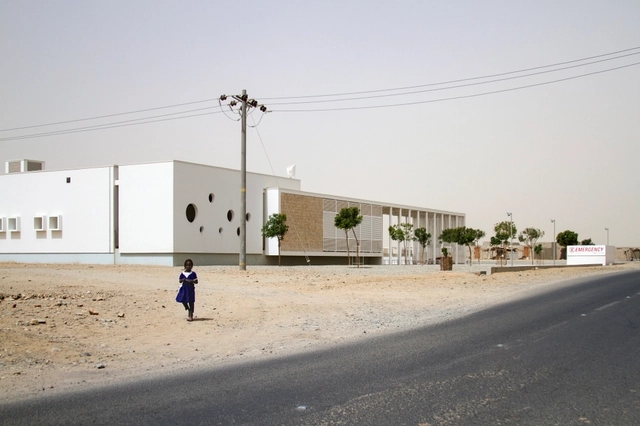
The Curry Stone Foundation has named three winners of the 2013 Curry Stone Design Prize: Hunnarshala (Bhuj, India), Proximity Designs (Yangon, Myanmar), and Studio TAMassociati / Emergency (Venice/Milan, Italy). The annual prize, now in its sixth year, awards talented designers who “harness their ingenuity and craft for social good.” More on each winner, after the break.
A few weeks ago the RIBA doled out the 18th Stirling Prize to London-based architects Witherford Watson Mann. The decision was a good one. It was good for WWM and good for the profession – a youngish practice being recognized for a small but beautiful piece of work.
The scheme’s application of brickwork and joinery removes the work from the expediencies of modern construction technology and building products, which almost exclusively characterize the contemporary built environment. It genuinely feels like a project made at a different point in history, the result of the quite particular interests of three minds, Stephen Witherford, Chris Watson and William Mann. It is direct and personal. It reminds me of Stirling’s work..
And not just for its powerful draftsmanship, plan and restricted palette of materials, but for its intimacy. An intimacy that is apparent in much of Stirling’s oeuvre. I do not refer to the production of intimate spaces per se but the formulation of an architecture that is authored not by a factory but a few minds.
The latest Stirling prompted me to look back, and reconsider the work of Stirling himself.
By now, we have all heard the mantra. In twenty years time, the world's cities will have grown from three to five billion people, forty percent of these urban dwellers will be living at or below the poverty line facing the constant threat of homelessness - scary statistics and even scarier implications.
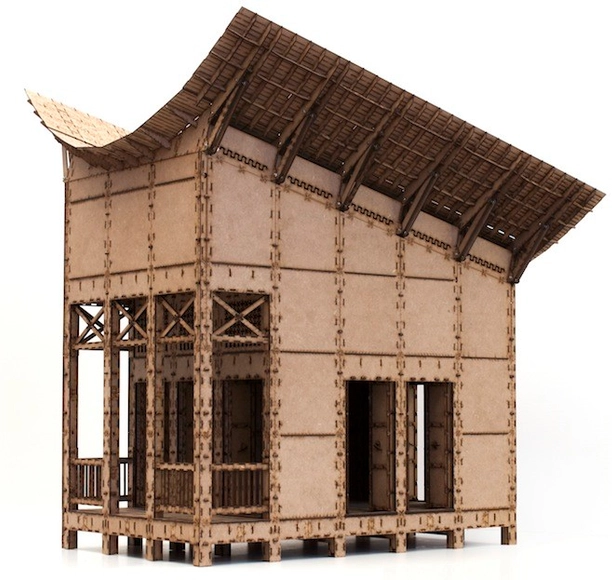
ECOnnect, a Holland-based design firm, envisions a solution for these future housing shortages, one that could build a one-million-inhabitant city per week for the next twenty years for $10,000 per family. Peter Stoutjesdijk, architect at ECOnnect, created the concept after widespread devastation in Haiti caused by a massive earthquake left of hundreds of thousands of people homeless depending on tents for temporary relief.
https://www.archdaily.com/445418/puzzle-piece-homes-a-solution-for-rapidly-growing-populationsJose Luis Gabriel Cruz
In a world where people live more mobile lifestyles than they have for centuries, cities are facing a problem they rarely planned for: their citizens move away. When jobs and resources start to decline, modern cities, such as Detroit, suffer difficult and often wasteful processes of urban contraction. In contrast to this, Manuel Dominguez's "Very Large Structure," the result of his thesis project at ETSA Madrid, proposes a nomadic city that can move on caterpillar tracks to locations where work and resources are abundant.
Of course this is not the first time that the idea of a nomadic city has been proposed. Ron Herron's Walking City is one of the more recognizable Archigram designs from the 1960s, and has been influential to architectural theory ever since. However, the design for the "Very Large Structure" expands on the Walking City by including strong proposals for energy generation on board the city.
Read on to see more on this provocative project - including a full set of presentation boards in the image gallery.
The Battle of Ideas is an annual, weekend-long series of panel discussions hosted at the Barbican in London, ranging across subjects from neuroscience to music and everything in between. With a strong thread of architecture and urbanism, this year offered a spectacular chance to probe the popular trends and fads in today's design culture.
Read on after the break for the highlights of the event.
Christine Outram’s rant “Why I Left the Architecture Profession” is an honest and seemingly spontaneous attempt at staking out a position against an “outdated” profession. It’s explosive in its assertion that “you,” meaning all you architects, are out of touch. “You” don’t listen to your clients. “You” are obsessed with form-making. “You” are a soulless machine, designing by code templates and cut and paste, with no regard for humanity. Her essay hits like a splatter bomb, throwing shrapnel in all directions. It’s a drone strike that has killed innocents. It’s clumsy and reckless.
It begs to be deconstructed. It demands a counterattack. And, judging from the lengthy comment thread, this is what it has reaped. Be that as it may, the issues are obvious. Telling architects they are “outdated” or that they don’t listen seems like a calculated attempt to get the attention of architects and to get them to somehow prove themselves, to make them mad in ways equal to her own anger.
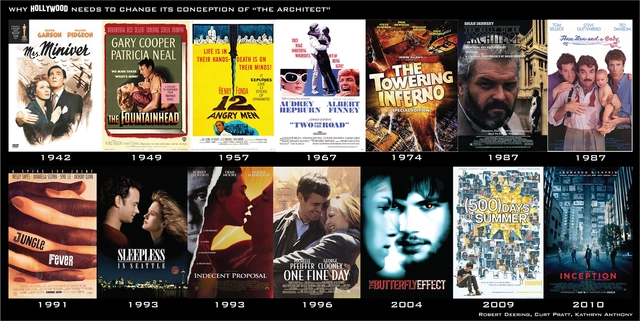
Courtesy of Kathryn Anthony, Robert Deering & Curt Pratt
Writers, directors, producers, and actors in the Hollywood film industry play major roles in shaping how millions around the world perceive architects and the architectural profession. Television shows, too, create stereotypes of professions that are repeatedly drummed into the brain with each successive episode. Both make long-lasting impacts that may encourage or dissuade young people from pursuing architecture as a career.
https://www.archdaily.com/441844/why-hollywood-needs-to-change-its-conception-of-the-architectKathryn Anthony, Robert Deering & Curt Pratt
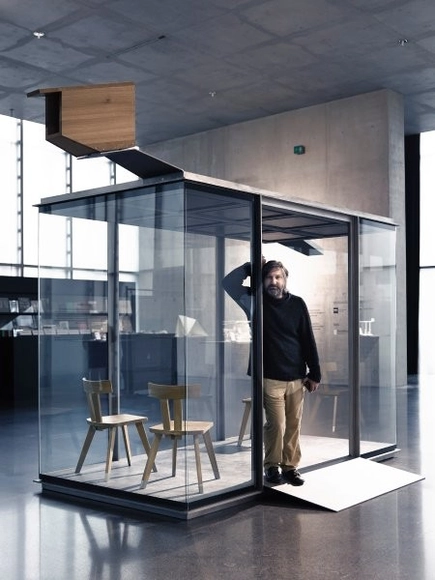
Most architects are familiar with the work of Iwan Baan, the eminent photographer who has documented some of the most famous buildings of our time. But what you may not know is that Baan had not originally intended to photograph architecture. Had it not been for a chance meeting with Rem Koolhaas, things may have turned out quite differently.
In the video above, Baan speaks with ERCO at the Louvre Lens, a SANAA-designed offshoot of the Paris Louvre located in a small mining town in the north of France. As he traipses around the museum's campus, he speaks about everything from his approach to photography (one that is less wrapped up in architecture than you might think) to the importance and transformative properties of light .
Krumbach, a small Austrian village of 1000 inhabitants, is not the place you'd expect to find structures from a variety of architecture's biggest names. But thanks to Verein Kultur Krumbach, a new association dedicated to encouraging culture in the village, that's exactly what's happening, with seven international architecture firms agreeing to design bus stops for Krumbach.
Read after the break to find out more about the seven designs.
When the concrete cloverleaf of Prentice Hospital sprouted from the Chicago ground in 1975, its award-winning design met the praise of critics and the admiration of many Chicagoans. Architect Bertrand Goldberg drew from Brutalism, but with a symmetry and grace that distinguished Prentice from more angular works in that style.
This week, as Goldberg’s famous work is pulled apart by wreckers, nothing about its loss seems symmetrical or graceful. Within 40 years, the building transitioned from a proud symbol of civic renewal and design innovation to the victim of old-fashioned Chicago politics. The controversy surrounding the demolition of Prentice, however, injected the preservation movement into an urban design discussion with a presence not seen in a long time.
https://www.archdaily.com/441977/is-the-demolition-of-prentice-hospital-another-penn-station-momentMichael R. Allen
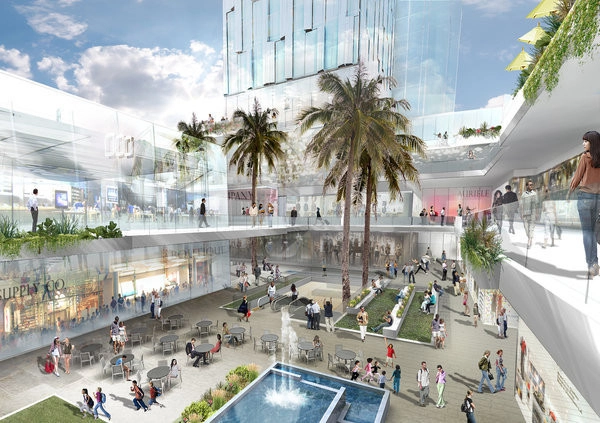
Related Cos. rendering of a conceptual plan for a retail and residential complex across Grand Avenue. Image Courtesy of Related Cos., via LA Times
"Will Grand Avenue finally turn around? Most likely not until they make it a two-way, add more trees, bike lanes, and pedestrian amenities. Buildings alone can’t do it, no matter how daring, novel (or expensive) the architecture." -- Guy Horton, The Indicator, "Ten Years Later, Has the Disney Concert Hall Made a Difference?"
The latest controversy surrounding the Grand Avenue re-design, the long-awaited project to develop the stretch of land east of the Walt Disney Concert Hall, is the re-instatement of Frank Gehry, a move which occurred after the city of LA rejected plans from mega-developers Related Cos. (designed by Gensler in collaboration with Robert A.M. Stern) for being "overly commercial."
Of course, while the Related Cos. plans may have failed to wow the city, the decision to bring Gehry back to the project hasn't exactly been embraced either. A must-see article in Zócalo Public Square asks four urban planning experts, "what would you do with Grand Avenue?" In his latest ArchDaily column, Guy Horton offers his opinion: any re-design must rely on activating life on the street-level, rather than on one architectural solution. Well, ArchDaily readers, now we'd like to know your thoughts on the matter.
David Zahle, a partner at Bjarke Ingels Group (BIG) and Lead Architect on the recently opened Danish National Maritime Museum, spoke to Mies. UK earlier this year. The practice, widely known for its creative approach to the issue of sustainability (sustainability should be experienced rather than hidden), recently won an an international competition to design a new Waste-to-Energy plant in Copenhagen.
Read more and watch the interview after the break...
View from Pier. Image Courtesy of White Arkitekter
Stockholm-based White Arkitekter, along with partners ARUP and Gensler, has been announced as the winner of the two-phase “For a Resilient Rockaway” (FAR ROC) design competition in New York. Selected from a shortlist of four and an international pool of 117, White Arkitekter’s “untraditional” proposal aims to transform an 80-acre shoreline site in the Rockaways into a resilient and affordable community through a series of small interventions that can be tested, adjusted, or redesigned overtime during the development process.
In the last few decades, rapid advances in both medical and consumer technologies have created revolutionary possibilities for every aspect of healthcare, from prevention to diagnosis to treatment and beyond. From DNA-based preventative care to digital appointments with doctors thousands of miles away, the future holds enormous potential for improving longevity and quality of life for people around the world.
These dynamics present significant challenges for designers working to shape a built environment that will meet healthcare needs both today and in the future. We spoke with Arup experts from around the globe — Phil Nedin, who heads the firm’s global healthcare business from London; Bill Scrantom, the Los Angeles-based healthcare leader for North and South America; and Katie Wood, who recently relocated from Australia to Toronto to build the Canadian practice — to learn more.