
South African Architecture

  1. ArchDaily
  2. Countries
  3. South Africa

Latest projects in South Africa

Latest news in South Africa

Architecture as Translation: Africanfuturism in Folklore, Film, and Speculative Art

Audio available

"Take your dream suppressants." The opening line in Wanuri Kahiū's Pumzi, directed at our protagonist Asha, enforces the order of severing ties with hopeful futures and ancestral memories in pasts shared to compel her focus on the perpetual present in the Maitu Community's heterotopia of an enclave. The bird's-eye view shot of the Maitu reveals a sterile, drone-like structure with a panoptic sphere at its center where normal human behavior is medicalized. The layout is built around closed-loop recycling systems as apt as a self-sufficient organism, designed to escape the toxic environment of a sickly Earth, where every pipe and corridor is engineered to harvest human excretion for water generation, thereby absorbing the roles of nature and state both. The community's architecture perfectly translates the film's message with its physicality.

From Garden to Monument: Liberation Landscapes in African Cities

Audio available

Liberation does not always begin with a monument. It may begin in a garden, a yard, a clearing, a field; in the occupation of land and the possibility of gathering there. Across histories shaped by colonialism and dispossession, space has been more than the setting in which liberation takes place. It has been one of its practices: cultivated, occupied, hidden within, moved through and collectively remade.

The Role of Urban Design in Women's Safety: Lessons from Four Public Spaces

Audio available

Public space is often intended to be perceived as universal, but access is unevenly experienced. For many women, moving through the city involves a continuous assessment of exposure, visibility, proximity to others, lighting, transport access, escape routes and the likelihood of harassment. These calculations are shaped by spatial conditions as much as social ones. Safety is a question of urban form, maintenance, mobility, governance and the distribution of public investment. While the built environment may not cause gender-based violence, it can intensify vulnerability and normalize unequal access, especially to public spaces.

Architecture as Nation-Building: Modernism and Independence in Africa

Audio available

This article is part of "Thresholds", a special edition printed newspaper by Cobe Notes x ArchDaily.

Launched in September 2024, the Rediscovering Modernism in Africa series joined a growing worldwide interest in this topic. Previously underrepresented in architectural discussions, the work of architects and researchers on the continent and abroad has continued to tell the story of these high-quality modern works of architecture. These buildings represent designers striving to create locally suited architecture using global concepts and technologies, coinciding with huge political changes as most African countries gained their independence.

The World's Largest Cities in 2026 by Population

Audio available

Every year on July 11, World Population Day draws attention to the demographic trends reshaping societies around the globe. In 2026, the United Nations marks the occasion under the theme, "Realizing the Hopes and Aspirations of Young People – Today and for the Future," highlighting how young people's decisions about education, employment, housing, relationships, and family life are increasingly influenced by the cities they inhabit. Drawing on Lives, Choices and Futures, a global survey of more than 108,000 young adults across 73 countries, this year's campaign underscores the close relationship between demographic change and the social, economic, and spatial conditions of cities.

City-Making Through Participation: Lessons from Utopian Hours 2026

Audio available

Who has the right to the city? Henri Lefebvre's writings question the structures that control urban space and, instead, put the citizens at the center of decision-making. His ideas have influenced the way architecture and urban design are practiced, bringing about community participation and co-design. These have been some of the most prominent themes at Utopian Hours 2026, the festival of city-making, the first part of which was held in the Dutch city of Rotterdam to mark its tenth anniversary edition.

Unearthing the Ground: Architecture and the Politics of Soil

Audio available

What architecture leaves in the ground outlasts what it puts in the air. A demolished building disappears from the skyline in a matter of days, but its foundations remain embedded in the soil for generations. The contamination caused by an industrial complex does not clear when the complex is torn down. The legal boundaries inscribed across colonial territory do not dissolve when the colonial administration ends. The ground holds what architecture quickly forgets.

6 Unbuilt Retreats Exploring Hospitality Through Landscape and Refuge

Audio available

Spaces of retreat continue to offer fertile ground for unbuilt exploration, revealing how architecture can support rest, reflection, and immersion in nature amid shifting environmental and cultural conditions. In this Unbuilt edition, submitted by the ArchDaily community, the selected projects assemble a diverse range of proposals that reconsider hospitality through the lens of refuge. These works position accommodation not as spectacle or excess, but as spatial frameworks shaped by landscape, climate, material restraint, and shared experience.

Shaping Architectural Continuity: 25 Revitalization Projects Across Historic, Industrial, and Natural Sites

Audio available

Heritage sites constitute complex spatial archives in which architecture, history, and collective memory converge. They encompass a wide spectrum of contexts—from archaeological remains, ancient and historic townscapes, UNESCO-listed landscapes, to early modern civic structures and industrial infrastructures. Yet these environments confront challenges: climate change, urban transformation, disaster, shifting social needs, and the gradual erosion of material fabric. Revitalization and restoration projects respond to these conditions by positioning architectural and spatial practice as an active mediator between preservation and the contemporary topologies.

The Bathroom, Reawakened: Contemporary Design Concepts for a Sensory Experience

 | Sponsored Content

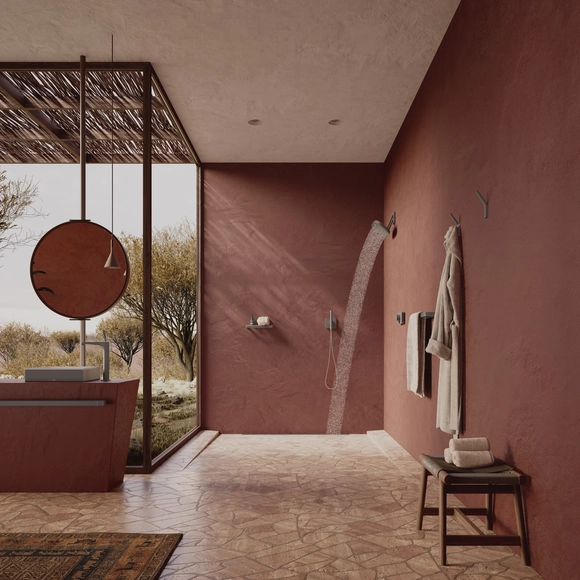
Water is a catalyst for sensory experiences: it manifests through direct contact when touched, through its presence when heard or seen reflected, and through its transformations—whether by temperature, from cold to heat, or by state, from liquid to vapor. It is a key element in designing for the senses, capable of evoking physically and emotionally perceived atmospheres. As Juhani Pallasmaa suggests, architecture does not address the eye alone but involves the whole body and sensory memory. The bathroom, in particular, concentrates much of the physical and emotional experience associated with water, opening up possibilities for creating environments that intensify that sensory connection. Consequently, the question arises: what elements or concepts should shape this space so that the shower experience escapes the ordinary?