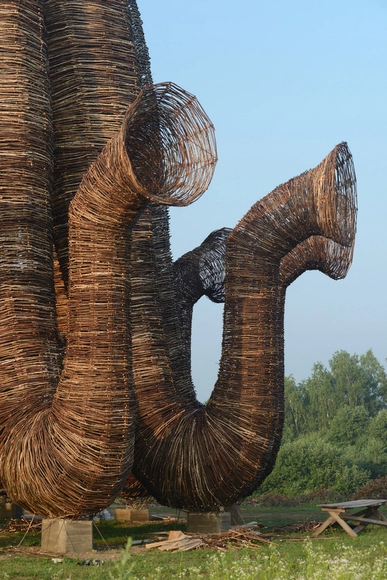
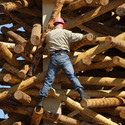
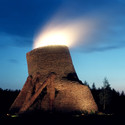
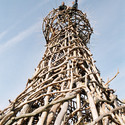
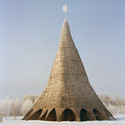
Born in 1957 in Moscow, artist Nikolay Polissky creates impressive, handcrafted structures in the middle of Russia's vast landscapes. Mostly carried out in the town of Nikola Lenivets -- located 200 km from the Russian capital -- his works are built entirely by the area's residents, using local materials, such as branches, trunks and wooden tables. Traditional construction techniques are used as a starting point for the projects.
His work is inspiring not only because of its imposing form, but also because he managed to re-activate a semi-abandoned village through art and architecture, involving residents in the creative process and transforming the region into a sort of open cultural center. Since 2003, his work has been part of Archstoyanie, the largest Land-Art festival in Russia.
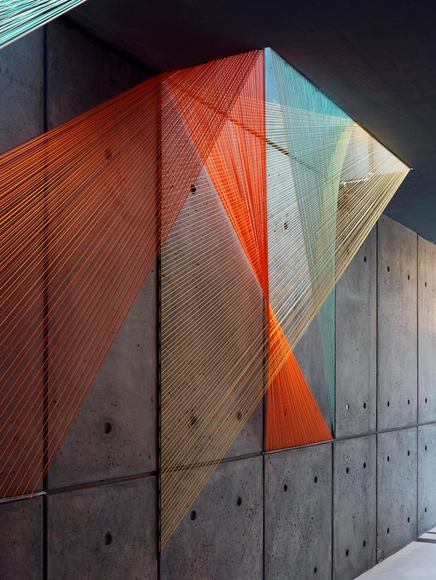
Artist and architect Inés Esnal’s Prism installation uses colorful elastic rope to form triangular spaces that filter light into the lobby of a new residential building in New York.
The installation's vivid colors and optical illusions provide a bold contrast to the concrete walls.
View images and learn more about the project after the break.
A design team from Belgium is developing a new way to add real estate to your laptop. The Sliden’joy, founded by Charlee Jeunehomme, Laurent Wéry and Thomas Castro, is an attachment for Mac and PC that adds up to two extra displays to your laptop.
With the ability to rotate each (13”, 15” or 17”) monitors 180°, the attachment gives you 360° visibility of your screen. The thickness of the unit varies, depending on how many screens and which finish the user selects; the 2-screen unit is currently 1.7 centimeters thick, though the designers claim it could be thinner. Finishes include wood, leather and carbon.
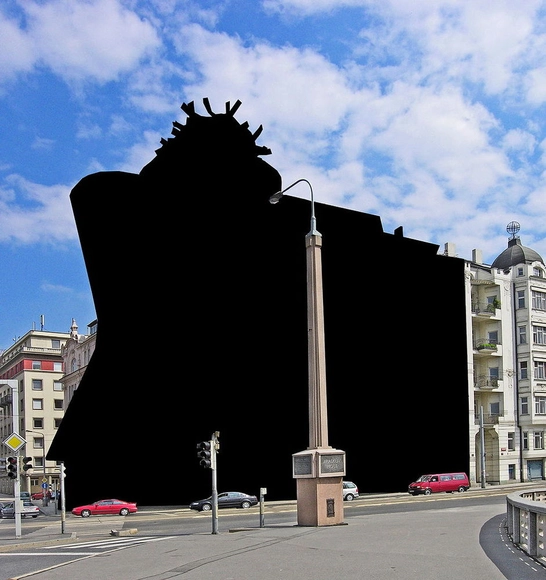
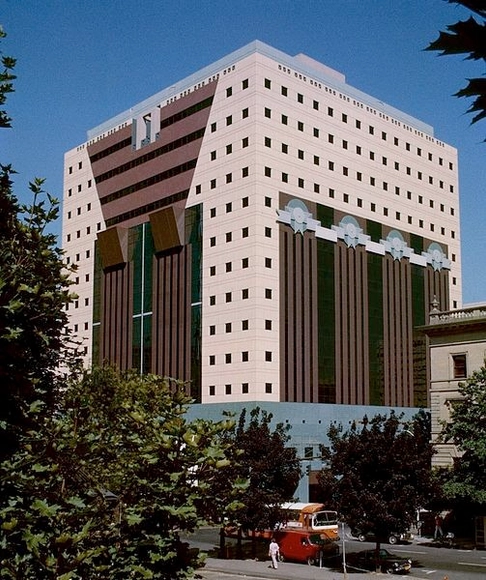
Freedom of Panorama is an exception to copyright rules, allowing photographs of public spaces and buildings to be used without restriction, while protecting the rights of the architect or artist. Currently some countries in the EU have full Freedom of Panorama, while other countries have it in place only for buildings or only for non-commercial uses -- or not in place at all.
Happy Fourth of July! In recognition of Independence Day in the United States, ArchDaily has assembled six of our favorite "American Classics." Featuring projects by Louis Kahn, Mies van der Rohe, Richard Neutra, Paul Rudolph, Eero Saarinen, and Richard Meier, each of these canonical works occupies a prominent place in twentieth-century American architecture. See them all after the break.
A new project in Detroit aims to repurpose a vacant house into a public performance space – but it needs your help. House Opera is the result of a collaboration between V. Mitch McEwen and her partner at A(n) Office, Marcelo Lopez-Dinardi. After McEwen purchased a vacant, stripped down house from the city of Detroit two and a half years ago, the two began removing elements of the “house” in order to transform it into an open theater space, meant to showcase Detroit storytelling.
Joined by Detroit curators and community organizers, as well as design and art collaborators from around the country, the project has received a $10,000 Knight Arts Challenge grant to fund half of the project. But support is needed to fund the other half. They have launched a fundraiser, which ends on July 2, 2015 12:59 AM, and donations can be made here. Learn more about the project after the break.
Traces of human life lingering behind, forms carving their way through the land and sky, objects left in disuse and air that seems frozen in time -- whether morbid or sublime, abandonedbuildings and settlements are an object of fascination and intrigue to architects and non-architects alike. As Shanghai-based photographer Jane Qing's photos of an abandoned village on Gouqi Island in China demonstrate, there is a rare kind of beauty to be found in the left-behind and the neglected.
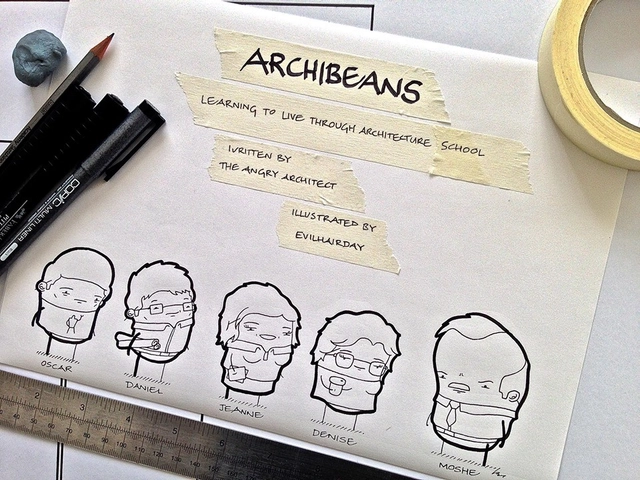
Born from the collaboration of illustrator EvilHairDay and blogger The Angry Architect, Archibeans is a look into the daily trials of architecture students with a touch of humor. Whether it's all-nighters, overdoses of caffeine, random bursts of inspiration or crushing final reviews, Archibeans shows that we’ve all been there and offers a laugh at our own expense.
During the past few months we have been working hard to upgrade our Materials catalog to improve search functionality and user experience. Today we are happy to launch the first of many improvements!
https://www.archdaily.com/641265/introducing-our-new-materials-catalogAD Editorial Team
The Metropolitan Regional Government of Santiago, Chile has launched a Two Stage International Public Competition for the development of the urban design and engineering of the urban axis Alameda Providencia. This axis is not only the main avenue of the city of Santiago de Chile, but is also considered to be the “heart of the metropolis” and the republic's most representative public space. The 12 km corridor integrates civic, symbolic and economic functions, represented by the highest concentration of retail, business and civic activities of the Metropolitan Region.
Based on the national relevance of this space, this competition not only aims to select the best team of professionals, but also the best comprehensive urban design, public space, landscape and urban mobility proposal, which considers the demands of the inhabitants of the city of Santiago for a better quality of life and the need for revitalized public spaces and public transport improvements. The Master Plan should take into account the surrounding buildings and natural heritage, land uses and existing and future social activities along this metropolitan axis.
The Conceptual Master Plan should consider that Santiago's Metropolitan Transit System is an open system. Therefore, the proposals should be functional for bus services entering or leaving at various points along its 12 kms and/or at its ends; that is, the infrastructure must allow for intermediate points where buses can enter and/or exit, in addition to at the ends. Due to this, bus courtyards are not required, yet spaces for frequency regulation are.
View competition details after the break.
https://www.archdaily.com/634573/open-call-santiago-launches-international-competition-for-nueva-alameda-providenciaSponsored Post
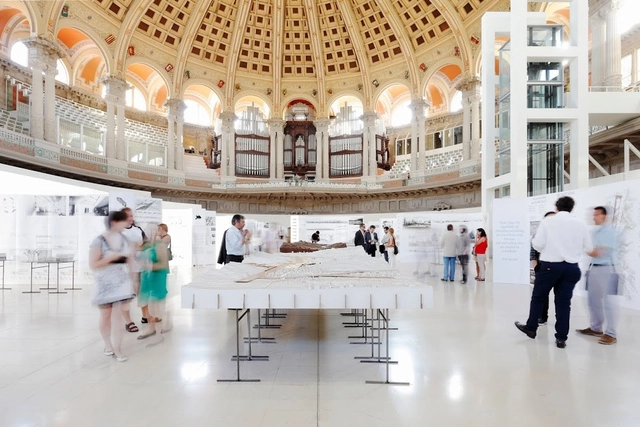
UIC Barcelona School of Architecture has adapted to recent changes in the field of architecture to offer an education that provides an overarching perspective of the profession and the opportunity to learn a wide-range of skill sets. Learn more about what makes the school unique after the break.
https://www.archdaily.com/635314/gain-an-international-perspective-by-studying-architecture-in-barcelonaSponsored Post
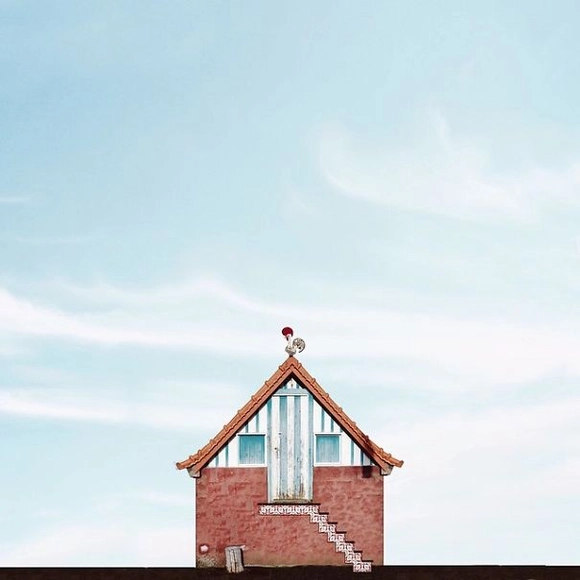
The son of Portuguese immigrants in Venezuela, Manuel Pita, also known as “Sejkko,” is a scientist and photographer who expresses his creativity on Instagram. In his latest series, “Lonely Houses,” Sejkko’s surreal photos capture the traditional houses of Portugal, edited to “bring them as close as possible to the way my eyes see them,” he explains.
Romanian photographer Laurian Ghinitoiu has shared his photos of the Expo Milan, along with his ranking of the top 5 pavilions. Read on to see his beautiful collection of images accompanied by his short remarks on the merits of the designs.
https://www.archdaily.com/632916/gallery-the-top-5-world-expo-pavilionsAD Editorial Team
With a clear international outlook and universal approach, the UIC Barcelona School of Architecture's Bachelor's Degree in Architecture offers students a holistic approach to architectural education, improving competitiveness by encouraging multiple skill sets, teamwork, responsibility, and entrepreneurship. The university employs a unique teaching method, where each student is tasked with undertaking a project at every step of the process.
https://www.archdaily.com/629707/study-architecture-with-an-international-focus-at-uic-barcelonaSponsored Post
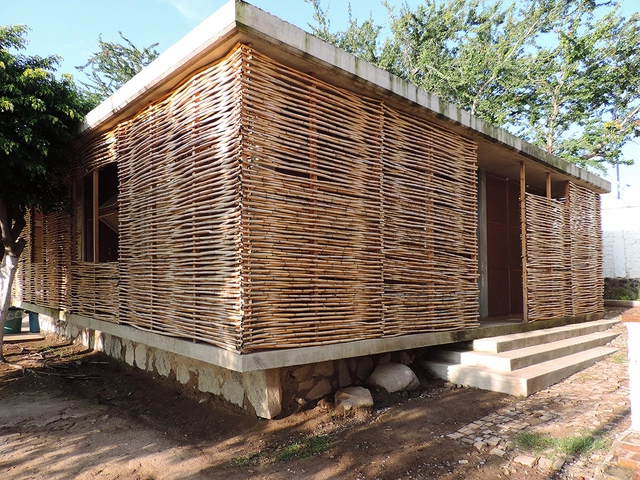
Developed by architects from Colectivo bma in Barranca de Huentitán, Guadalajara, Mexico, this new building for the Mexican Institute for Community Development (IMDEC) was built in just four days with the help of 100 volunteers.
The new facility includes both housing and meeting space, and was constructed using local building techniques and materials. Built with a concrete base, the walls were made using bahareque (reed frames and mud) and woven reed lattices that cover most of the building’s exterior.
Learn more about the construction process after the break.
Swedish firm Studio Esinam's new print series depicts "Elevations" of architectural landmarks across the globe. Using minimalist line drawings, the illustrations attempt to "capture the unique feeling of various cities around the world".
Meticulously recreating the facades of landmarks in Berlin, Brooklyn, Copenhagen, Gothenburg, London, Paris, Stockholm, and Tokyo, the growing collection of prints reframes technical drawings as works of art. By distilling iconic facades to their barest and most essential elements, Studio Esinam aims to direct "attention to details that mostly pass unseen."
View selected prints from the "Elevations" series after the break.
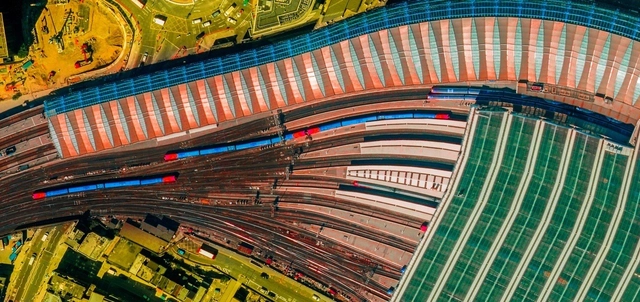
Courtesy of Federico Winer @Google Earth and satellite data providers
Hovering high above the earth's surface and presenting a serenely distant view of the terrain we inhabit, ULTRADISTANCIA is the latest photographic project from Argentinian artist, academic, and veteran traveller Federico Winer. The experimental series uses "the marvelous screens of Google Earth" to present stunning images of environments both built and natural.
Learn more about the project and view selected images after the break.








.gif?1433941458/)





.jpg?1432088311&format=webp&width=640&height=580)

.jpg?1430382174)