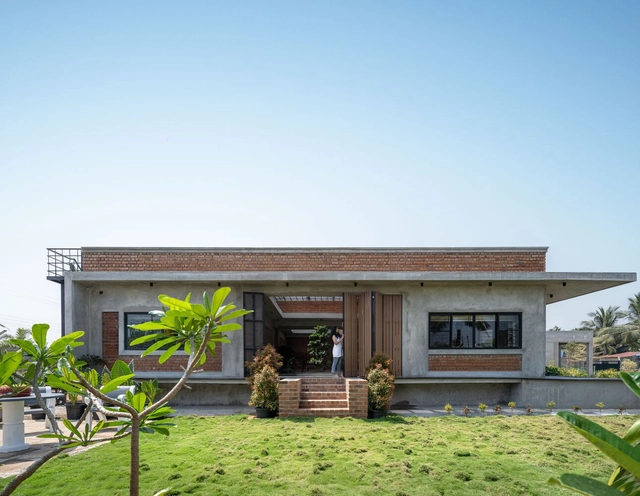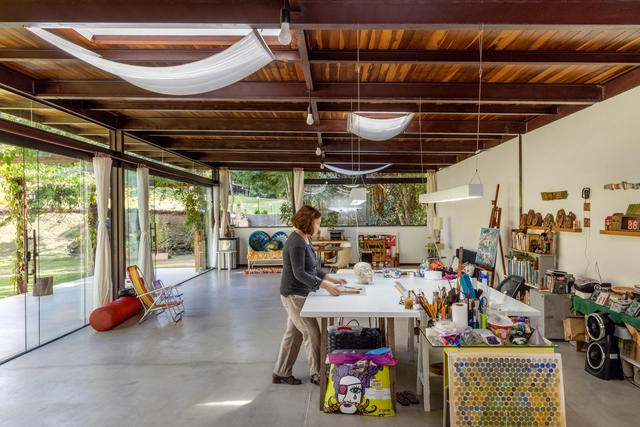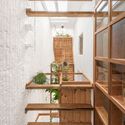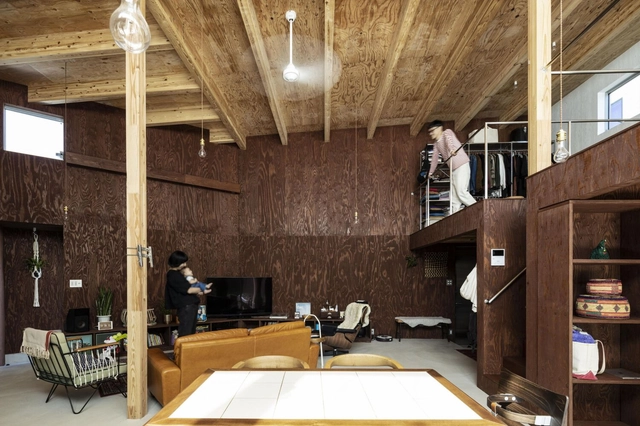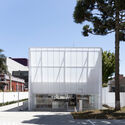
Funchal 05 House / Paulo David + Luz Ramalho

Location: Neves – Funchal, Madeira, Portugal
Architect: Paulo David + Luz Ramalho
Structure: Mário Rui
Electrical: Fernando Sousa Pereira
Plumbing: Marco Coelho
Project: 2002
Construction: 2006
Photography: Leonardo Finotti
Inside UN Studio’s Burnham Pavilion
After our UN Studio’s Burnham Pavilion gallery, many of you wondered how it was built. This photo reveals the woodenstructure for this pavilion, which was later finished with a plastic-like material.
Photo via Construmatica.
El Roble Chapel / 57 Studio
Nestled into a forest of Australian mimosa trees, a small family chapel designed by 57 Studio provides a quiet and serene place for religious contemplation. The chapel can hold approximately 40 seated people and focuses on providing ” the proper sense of religious spaces…through its communication with the natural surroundings.”
More about the chapel after the break.
Garden house / Tham & Videgård Hansson

Architects: Tham & Videgård Hansson Arkitekter
Location: Södermanland, Sweden
Architects in charge: Bolle Tham & Martin Videgård Hansson
Site Area: 1,006 sqm
Constructed Area: 360 sqm + roof terrace
Project year: 2006-2008
Client: Private
Photographs: Åke E:son Lindman
Fictional Architects in Movies
Via mirage.studio.7 we ran into this list of fictional architects in movies. There are some classic ones, like Henry Fonda. Some new ones like Adam Sandler. And there’s even an actual architect who made it to The Simpsons.
Which one do you like the most? The least? Is there anyone missing in this list? Some actor/actress you would really like as an architect in a movie? Tell us what you think. Full list after the break.
Update: Images and sources were taken from mirage.studio.7. They did this article with different sources like DanStewart, Ajolote Boletin, Archinect, ArchitExploitation, and more.
Balga House / Bellemo & Cat

Australian architects Bellemo & Cat have sent us a few interesting projects that we’ll feature on ArchDaily. The first one is Balga, a coastal house located in the state of Victoria, southeast of Australia. The house was completed in 2006 in Point Lonsdale. See more images and architect’s description, after the break.
University of La Verne / Gonzalez Goodale Architects
Architects: Gonzalez Goodale Architects
Project team: Armando L. Gonzalez, FAIA, Project Principal, David L. Goodale, AIA, Design Principal, John Ferguson, AIA, Project Manager, Gerda Buss, Interiors/FF&E
Mechanical / Plumbing: Khalifeh & Associates
Electrical: N.A. Cohen Group Inc.
Structural: Englekirk & Sabol
Food service: Ricca Newmark Design
Acoustical: McKay Conant Hoover
Landscape: EPT Design
Signage: Biesek Design
Area: 40,000 sqm
Construction: 2007-2009
Photography: Magnus Stark Photography
Autodesk Assistance Program
Although it seems that the economy has left behind it’s worst days, the fact is we are still going through an economic crisis. Many architecture offices and companies have had to let good people go. If you were one of them, you might be wondering how to advance your career in this challenging global job market.
In order to get ahead in the workplace, you need to invest in yourself by increasing your knowledge and expanding your skills. And the good news is that Autodesk can help you get back in the game.
With the Autodesk Assistance Program you can take action today to gain a competitive advantage in your field. The program offers free software license, free online training, reduced-cost classroom training and certification. You can go to Autodesk official website to learn all the details.
Tjuvholmen / Kristin Jarmund Architects

Architects: Kristin Jarmund Architects
Location: Tjuvholmen, Oslo, Norway
Building Type: Office building
Project Scope: Full Contract
Client: Tjuvholmen KS, Eitzen Group
Size: 5000m2
Schedule: Completed 2007
Project Team: Kristin Jarmund, Ola Helle, Nils Herland, Patrik Larsson, Leif D.Houck,
Marlene F. Andersen, Geir Messel, Line Strand, Aud Randi Astad, Arild Eriksen
Jerusalem / ARJM

Architect: ARJM (Abdelmajid Boulaioun)
Location: rue de Jerusalem, Chaussée de Haecht, Schaerbeek, Brussels, Belguim
Project: 5 logements Social + Cabinet médical
Project Team: Abdelmajid Boulaioun, Jean-Marie Bertin, Michel Cuypers, Emmanuel Toglet, Ryo Inagaki
Structural Engineer: Michael Nguen, Brussels
Client: Renovas ASBL
Contractor: Balcan, Brussels
Project Year: 2009
Photograph: Filip Dujardin
AIR Apartments / Rothe Lowman
Rothe Lowman Architects‘ 18 storey tall AIR Apartments will be the first true high rise residential apartment building ever built in Coburg. The tower is comprised of 259 apartments and will bring “high density living to one of Melbourne’s five designated activity centers.” The tower is expected to be one of the most striking buildings in the city. “Its dynamic new architectural profile and sculptural façade foreshadows a renewed sense of place, taking Coburg’s exciting transformation to unscaled heights,” explained the architects.

More about the AIR Apartments after the break.
The lobby for the Burj Dubai / SOM

Curious about how the lobby for the world´s tallest building will look like? SOM shared with us some renderings of their design.
The building was designed by the Chicago office of Skidmore, Owings & Merrill LLP, who also designed the interiors for all the lobbies, public and common spaces for the tower. The design team is lead by Ms. Nada Andric (Associate Director with SOM) and reinterprets the region’s heritage in a contemporary way.
The materials used include glass, stainless steel, polished dark stones, Silver Travertine flooring, Venetian stucco walls, handmade rugs, and stone flooring. Commissioned local and international fine art pieces will be used to decorate these spaces.
I can´t wait to see actual images of this building completed, and see how both the structure and these interiors are materialized. The Burj Dubai is expected to be completed by December, 2009.
You can see some photos during the construction on our previous article.
More images after the break:
Jasmax Studio / Jasmax

Architects: Jasmax
Location: Auckland, New Zealand
Program: Jasmax Auckland Studio
Building Owner: KCL Property
Construction Year: 2008-2009
Project Area: 2400 m2
Photographs: Simon Devitt
Hungarian Pavillion for Shanghai Expo 2010
Hungary inveiled the design for their pavillion for next year’s Shanghai World Expo, designed by Tamás Lévai. Gömböc, as a hungarian invention, is the central element of the exhibition, a two meter high solid plexiglass moving object.
What is Gömböc (pronounced as ‘goemboets‘)? ‘Gömböc’ is the first known homogenous object with one stable and one unstable equilibrium point, thus with two equilibria altogether on a horizontal surface. It can be proven that no object with less than two equilibria exists. The discovery of the inaccessible path has led to the idea of GÖMBÖC. The pavilion as wood is intended to represent this path, and since it is of immaterial nature, we are trying to evoke it with non materials: empty space, light and sounds.
More images, a video and architect’s description after the break.
The Shard / Renzo Piano
Renzo Piano‘s latest project, the Shard, has recently moved to the construction phase. The 1,016 ft high skyscraper will be the tallest building in Western Europe and will provide amazing views of London. The mixed use tower, complete with offices, apartments, a hotel and spa, retail areas, restaurants and a 15-storey public viewing gallery, will sit adjacent to London Bridge station as part of a new development called London Bridge Quarter. Replacing the 1970′s Southwark Tower on Bridge Street, the Shard is a welcomed addition to the London skyline, and its central location near major transportation nodes will play a key role in allowing London to expand.
More about the tower after the break.
Apartment in Carcavelos / Hugo Proenca
Architects: Hugo Proença
Location: Carcavelos, Cascais, Portugal
Project year: 2009
Contractor: Bloco Zero
Constructed area: 65 sqm
Budget: 35.000€
Photographs: FG + SG – Fernando Guerra, Sergio Guerra
Production Laboratories and Administrative buildings / Roberto Puchetti, Max Rengifo
Architects: Roberto Puchetti, Max Rengifo
Location: Caracas, Venezuela
Cient: Instituto Nacional de Higiene “Rafael Rangel”
Built Area: 13,000 sqm
Year: 1998–2007
Project Manager: TEXNE Consultores de Arquitectura, S.A.
Civils and Structure engineer: Ing. Manuel Ramírez
Electrics and Data engineer: Ing. Roberto De Adessis
Mecahnical engineer: Ing. Víctor Salazar Amana
Fire strategy: Arq. Miguel Sureda
Quantity Surveyour (COVENIN): Ing. Carlos Otamendi
Technical Consultants (Laboratorios): Instituto Butantãn, São Paolo, Brasil
Photograhs: Roberto Puchetti, Max Rengifo
Landscapes of Quarantine
Several times I haves asked myself what is inside Geoff Manaugh’s mind. The author of the BLDG Blog has been pushing architectural thinking (or more like stretching, bending, twisting…) by proposing views of an uncertain future (while linking this to our past), leaving an open door that invites us to think about architecture in a non traditional space-restricted way.
Sounds weird, but I can´t really define it. Maybe we should stick to his definition: ”Architectural Conjecture, Urban Speculation, Landscape Futures”.
A couple of days ago Geoff told me that he is going to be in NY during the fall, where he will run an an independent design studio, called Landscapes of Quarantine, “meeting to explore the spatial implications of quarantine”. The studio will run from Oct 6 to Dec 5, and he has already confirmed a group of ten people, whose backgrounds include architecture, sound design, urban gaming, comic books, film, photography, art, landscape, and food. The studio will conclude with an exhibition at the Storefront Gallery.
But the interesting part, at least for our readers, is that the studio is open for public applications. If this sounds interesting to you, just head to BLDG Blog and read the details about Landscapes of Quarantine and on how to apply.
p.s.: I also recommend you to follow Geoff at Twitter, as he is constantly sharing ideas and links worth reading. And another thing worth reading is his book: The BLDGBLOG Book.
Burnham Pavilion / UN Studio

A couple of days ago we featured Zaha Hadid’s Burham Pavilion at the Millenium Park in Chicago. Some of you asked about the UN Studio pavilion, and I got Guillermo Hevia to share with us a very good set of photos of the project.
If you want to know more about this pavilion’s background read our previous article.
More photos after the break.
Cover Up / Visiondivision
Our friends at Visiondivision passed along their Cover Up project which is part of a bigger commission to improve several power plants for an energy company. The firm created a storage facility for several heating containers that could be quickly outsourced and serve as back-up power should the city experienced a black-out. Working in an industrial area where the company was used to break ins and vandalism, the firm designed a “good looking, roofless, and flexible-as-an-anaconda building.” Good looking in the sense that this storage facility could better the rough surroundings; roofless due to the fact that the large containers needed to be transported with a special crane truck; and flexible since the need for additional containers in the future should also be considered.
More about the project after the break.