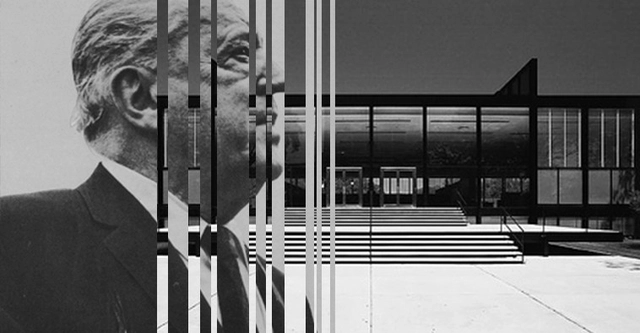
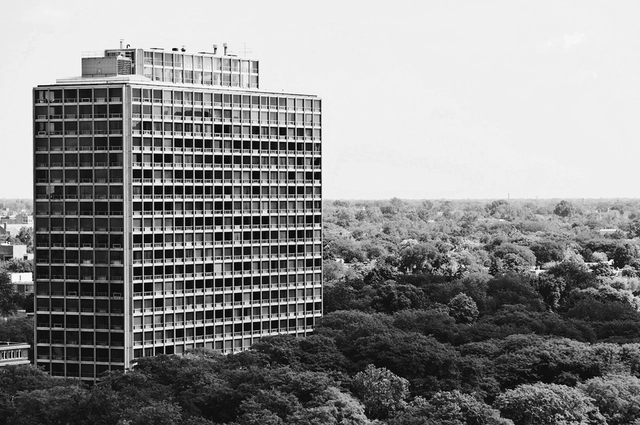
One of the first and most successful examples of urban renewal, Detroit's 78-acre Lafayette Park is known for being the world's largest collection of works by Mies van der Rohe. Now, the mid-century modern "masterpiece" is the first urban renewal project to be declared a National Historic Landmark. This is partially due to the fact that, as Ruth Mills, architectural historian for Quinn Evans Architects told the Detroit Free Press, "Lafayette Park was one of the few urban renewal projects that's done it successfully." It is now Michigan's 41st landmark.
Farnsworth House, the temple of domestic modernism designed by Mies van der Rohe as a weekend retreat for a Chicago doctor, is one of the most paradoxical houses of the 20th century. A perfectionist mirage, it floats like a pavilion in a park, but its history has been beset by plagues, floods and feuds. As the second installment of a series of three modernist classics presented by Archilogic, we’ve modeled the Farnsworth house so that you can see if—in spite of its austere reputation—it can be lived in after all. In this model you can explore the spatial arrangement of the house, and refurnish it with Eames chairs, deck it out with your IKEA favorites, or booby-trap it with children’s toys.
https://www.archdaily.com/770612/a-virtual-look-into-mies-van-der-rohes-farnsworth-houseAdam Jasper & David Tran, Archilogic
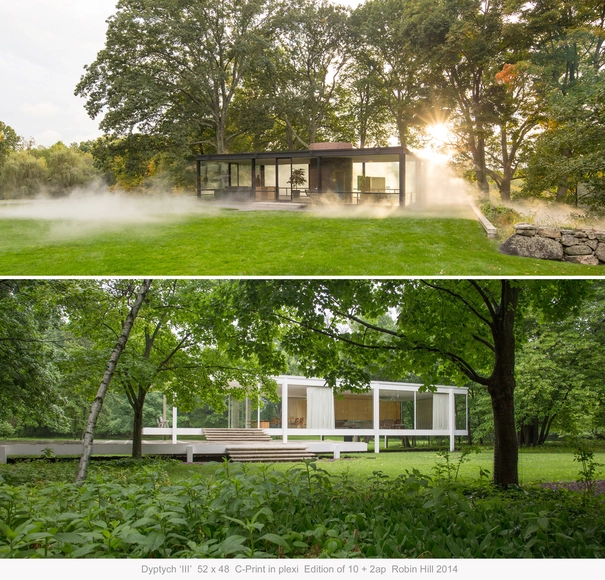
Exhibition print for Side by Side. Top: The Glass House. Bottom: The Farnsworth House
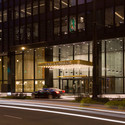
Side by Side is an exhibition by photographer Robin Hill that explores the similarities and differences between two of America's most iconic houses. The Glass House by Philip Johnson and The Farnsworth House by Mies van der Rohe. Through a series of dyptychs, Mr. Hill's lens explores both the geometry of the structures and their place in the environment. Tellingly the exhibition is housed in the Seagram Building designed by Mies van der Rohe and assisted by Philip Johnson. The lobby of The Four Seasons is an ideal venue for this exhibition as much of the design aesthetic of both architects is prevalent in the space as well as in the photographs.
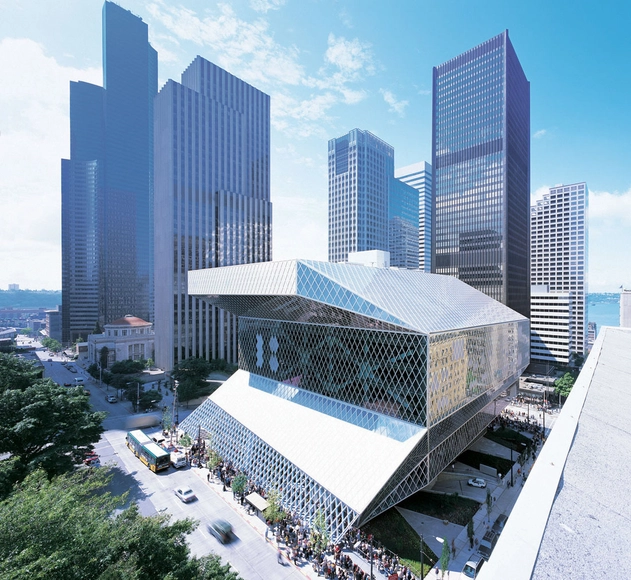
Bjarke Ingels worked on the Seattle Central Library during his time at OMA. Image Courtesy OMA
The world of architecture is small. So small in fact, that Rem Koolhaas has been credited with the creation of over forty practices worldwide, led by the likes of Zaha Hadid and Bjarke Ingels. Dubbed “Baby Rems” by Metropolis Magazine, this Koolhaas effect is hardly an isolated pattern, with manifestations far beyond the walls of OMA. The phenomenon has dominated the world of architecture, assisted by the prevalence and increasing necessity of internships for burgeoning architects.
In a recent article for Curbed, Patrick Sisson dug into the storied history of internships to uncover some unexpected connections between the world's most prolific architects. With the help of Sisson's list, we've compiled a record of the humble beginnings of the household names of architecture. Where did Frank Gehry get his start? Find out after the break.
Happy Fourth of July! In recognition of Independence Day in the United States, ArchDaily has assembled six of our favorite "American Classics." Featuring projects by Louis Kahn, Mies van der Rohe, Richard Neutra, Paul Rudolph, Eero Saarinen, and Richard Meier, each of these canonical works occupies a prominent place in twentieth-century American architecture. See them all after the break.
In 1951, Mies van der Rohe completed a house in Plano, Illinois that was the epitome of his modernist ideals; with a steel structure surrounded entirely by glass walls the building perfectly connected the user with its idyllic natural setting, and it was - and is - venerated as a masterwork. A lesser-known story about the work is how its owner Dr Edith Farnsworth attempted to sue her architect, in a story of bitterness and unrequited love - but even less well-known, argues Nora Wendl, is the story of what really happened. In this excerpt from her essay "Uncompromising Reasons for Going West: A Story of Sex and Real Estate, Reconsidered," published in Thresholds issue 43: "Scandalous," Wendl examines the overblown and dubious assertions made about Farnsworth's intentions, finding that the truth may be much more simple: perhaps the Farnsworth House is just not a pleasant place to live.
“I have decided to speak up.”
Such is the threshold between a private affair and a public scandal: one person speaks. These are also the opening lines to “The Threat to the Next America,” which appears in the April 1953 issue of House Beautiful. Penned by editor Elizabeth Gordon, the article describes an unnamed, but “highly intelligent, now disillusioned, woman who spent more than $70,000 building a 1-room house that is nothing but a glass cage on stilts.”[1] Gordon warns readers of a design movement sweeping the nation:
Something is rotten in the state of design—and it is spoiling some of our best efforts in modern living. After watching it for several years, after meeting it with silence, House Beautiful has decided to speak out and appeal to your common sense, because it is common sense that is mostly under attack. Two ways of life stretch before us. One leads to the richness of variety, to comfort and beauty. The other, the one we want fully to expose to you, retreats to poverty and unlivability. Worst of all, it contains the threat of cultural dictatorship.[2]
“While not final, these renderings demonstrate the amazing possibilities as we work to transform this historic building into a center for learning, innovation and engagement for the District,” says the D.C. Public Library. Updated images and more information about the design, after the break.
The Victoria and Albert Museum (V&A), named after the Queen and Her Consort, has its foundations in the Great Exhibition of 1851 amidst the wealth, innovation and squalor of the Industrial Revolution. Britain was flooded by prosperity which allowed for the development of major new institutions to collect and exhibit objects of cultural significance or artistic value. The institute’s first director, Henry Cole, declared that it should be “a schoolroom for everyone,” and a democratic approach to its relationship with public life has remained the cornerstone of the V&A. Not only has it always been free of charge but it was also the first to open late hours (made possible by gas lighting), allowing a more comprehensive demographic of visitor.
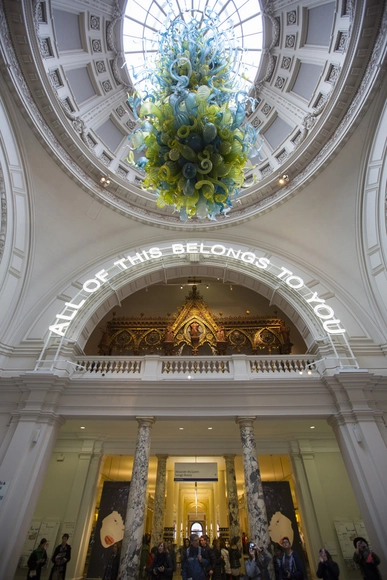
Their latest exhibition, which opens today, seeks to realign the museum’s vast collection and palatial exhibition spaces in South Kensington with these founding concepts. The interventions of All of This Belongs to You attempt to push the V&A’s position as an extension of London’s civic and cultural built environment to the fore, testing the museum’s ability to act as a 21st century public institution. To do this in London, a city where the notion of public and private is increasingly blurred, has resulted in a sequence of compelling installations which are tied together through their relevance either in subject matter, technique, or topicality.
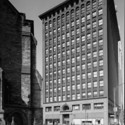
The former IBM Building in Chicago. Image Courtesy of DesignCurial
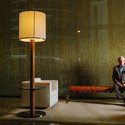
In 2013 the former IBM Building in Chicago, Mies van der Rohe's last completed skyscraper, underwent a significant renovation as a part of the tower was converted into a hotel. In this article, originally published in Blueprint issue #338 as "Lobbying for Mies van der Rohe," Anthea Gerrie catches up with Dirk Lohan - the Chicago architect who helped his grandfather design the building nearly 50 years ago, and who was called back in to design the new hotel's entrance lobby.
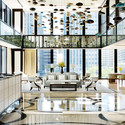
"It's not very Mies," says Dirk Lohan dubiously, in one of the great understatements of the year. We are standing in the double-height reception hall of the Langham Chicago hotel with what looks like dozens of multicoloured glass balloons swimming above us and a mirror-glass frieze adding to a cacophony of glitz and dazzle.
It is indeed the very antithesis of the aesthetic of the architect known for the phrase "less is more". But then the audacious idea of converting an office building by the most functionalist of architects into a five-star hotel was always going to be problematic.
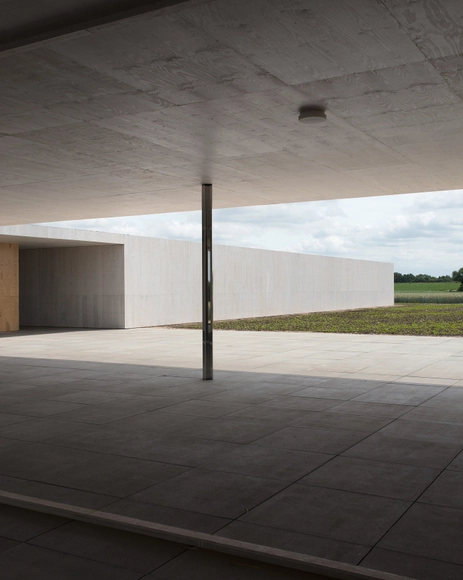
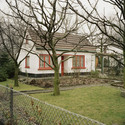
On the surface, Mies van der Rohe's minimalist linear designs have little in common with the kitsch of vernacular architecture in the German countryside. Enter Joachim Brohm, who rose to prominence in the 1980s as one of the first European architecture photographers to work in colour, and now in a current exhibition draws an unexpected parallel between van der Rohe's designs for the unrealized Krefeld Golf Club in Germany and the rudimentary constructions of vernacular post-war architecture.
In "Vernacular & Modern," the latest exhibition at London's Grimaldi Gavin gallery, two of Brohm's photo series are juxtaposed to create a new narrative on architectural context. In Typology 1979, Brohm documents a series of vernacular houses in Ruhr, Germany; while in Mies Model Study, Brohm enters the temporary installation of van der Rohe's unbuilt golf club through a life-size model. Together, the two series contrast the highly aestheticized minimalist world of Mies van der Rohe with highly functional buildings of necessity in the German countryside.
To celebrate the first anniversary of our US Materials Catalog, this week ArchDaily is presenting a three-part series on "Material Masters," showing how certain materials have helped to inspire some of the world's greatest architects.
Mies van der Rohe, famous for his saying “less is more,” was one of the preeminent modernist architects, well known for pioneering the extensive use of glass in buildings. His works introduced a new level of simplicity and transparency, and his buildings were often referred to as "skin-and-bones" architecture for their emphasis on steel structure and glass enclosure. In addition to Mies van der Rohe, glass was a major influence for many architects of the modernist movement and reshaped the way we think about and define space. Today, glass has become one of the most used building materials, but its early architectural expression is perhaps best exemplified in the works of Mies.














.jpg?1421764224 "© Raimondas Urbakavičius, Genadij Ignatovič, Diana Garbačauskienė")




.jpg?1421375959 "© Jannes Linders")


.jpg?1421375909 "© Jannes Linders")