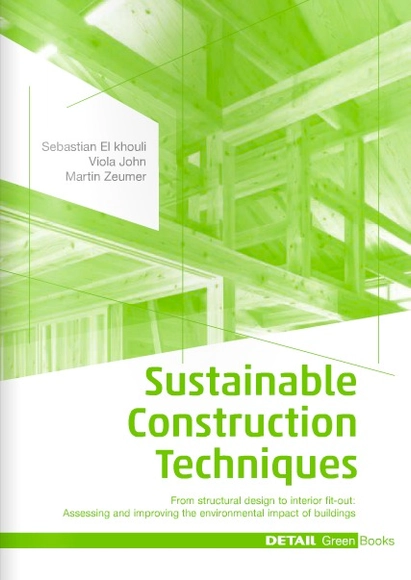
From the publisher. From structural design to interior fit-out: Assessing and improving the environmental impact of buildings
What makes building materials sustainable? How to reduce the amount of embodied energy in building constructions? And how does a Life Cycle Analysis work? These are questions which are becoming increasingly more common in the context of sustainable construction.
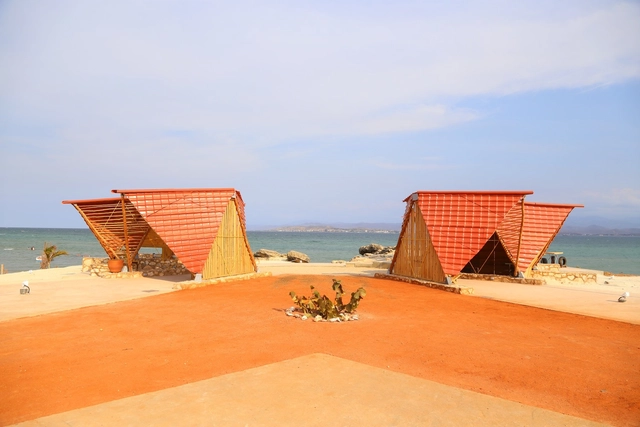
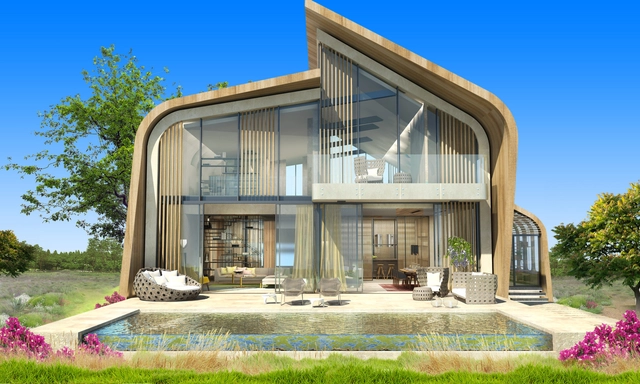
The AHK Kundu Villas, a collection of homes by GAD Architecture, has recently been shortlisted for the World Architecture Festival (WAF) for Future Residential projects. The project, comprising 17 large, 56 medium and 50 small housing units, is sited next to a tourism zone in Antalaya on the Mediterranean coast of southwestern Turkey. Designed with sustainability in mind, the project makes use of resources available on the site.
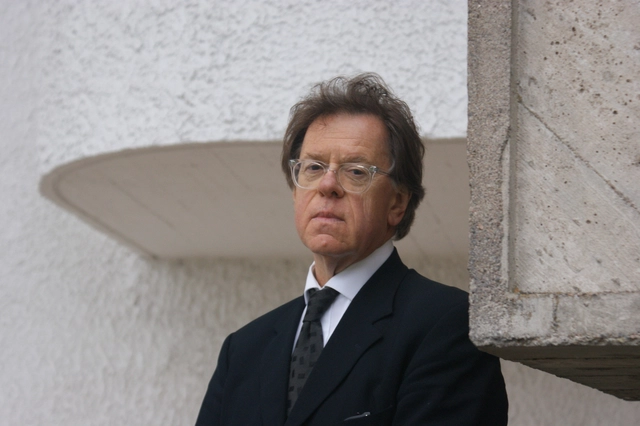
Following the conclusion of a new radio series featuring in-depth interviews with inspirational names in global politics, business and the arts, we've picked out and compiled four of our favourites for you to listen to. Thirty minutes each, Monocle 24's collection of Big Interviewshave heard from the likes of London-based designer Thomas Heatherwick, architectural critic, writer and broadcaster Jonathan Meades, plus developers and hoteliers Ian Schrager and André Balazs.
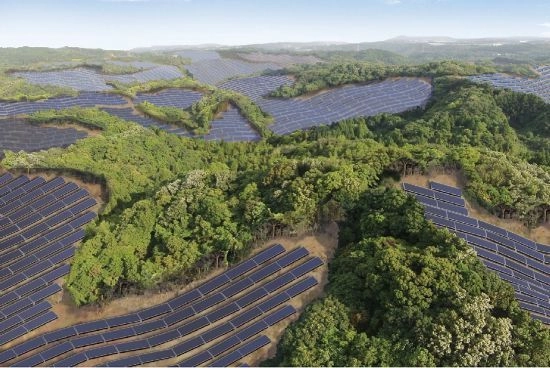
With a goal to double the amount of its renewable energy power sources by 2030, Japan has begun to transform abandoned golf courses into massive solar energy plants. As Quartz reports, Kyocera, a company known for its floating solar plants, has started construction on a 23-megawatt solar plant on an old golf course in the Kyoto prefecture (scheduled to open in 2017). The company also plans to break ground on a similar, 92-megawatt plant in the Kagoshima prefecture next year. Pacifico Energy is also jumping on the trend; with the help of GE Energy Financial Services, the company is overseeing two solar plant golf course projects in the Okayama prefecture. The idea is spreading too; plans to transform gold courses into solar fields are underway in New York, Minnesota and other US states as well.
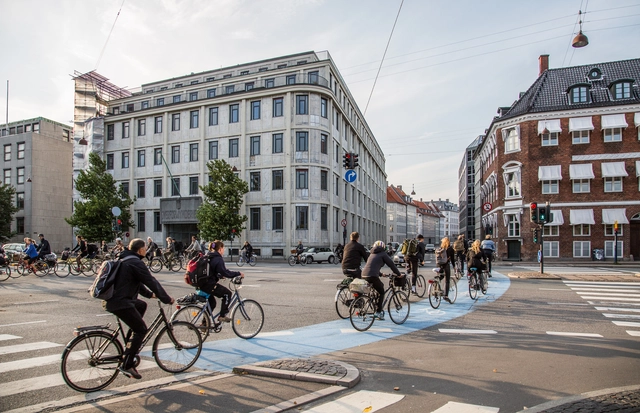
As a part of its EMBARQ Sustainable Urban Mobility initiative, the WRI Ross Center for Sustainable Cities has created a global reference guide called Cities Safer by Design “to help cities save lives from traffic fatalities through improved street design and smart urban development."
Causing over 1.24 million deaths annually, traffic fatalities are currently estimated to be the eighth leading cause of death worldwide, a ranking that is expected to rise to the fifth leading cause of death by 2030.
With these staggering numbers in mind, the Cities Safer by Design guide discusses ways to make cities less dangerous, particularly with its section entitled, “7 Proven Principles for Designing a Safer City.” Learn what the 7 concepts are, after the break.
Air pollution in urban areas is quickly racing to the forefront of the environmental discussion, with several major cities facing a serious deterioration of breathable air supply. New Delhi, Beijing, Los Angeles, Moscow and Karachi represent a handful of cities facing the world's worst urban pollution, each with recorded amounts of particulate matter exceeding acceptable levels. In 2014, the World Health Organization issued a report estimating that 7 million people suffered premature deaths in 2012 due to air pollution exposure.
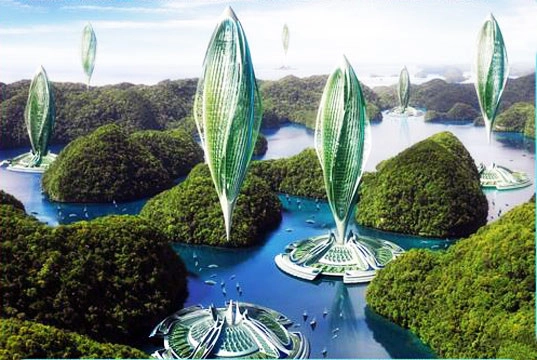
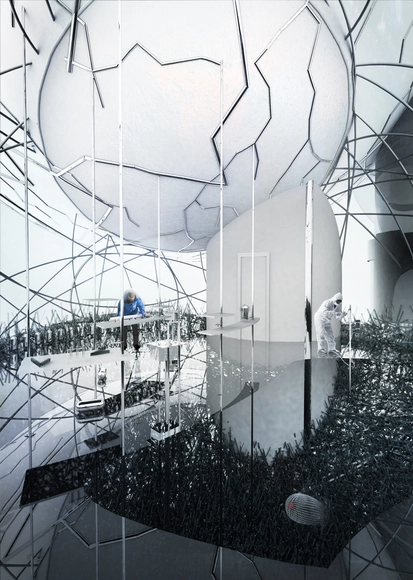
Enter Aeriform Ecologies: An Atmospheric Archive for Industrial Effluvium. Conceived as a thesis project by Jennifer Ng, University of Michigan with thesis advisor Kathy Velikov, Aeriform Ecologies delves into the possibilities for byproducts of petroleum production by proposing a network of solutions for the 'spatial runoffs' created by fossil fuel extraction. Based on a futuristic approach that includes a network of unmanned atmospheric gas harvesting dirigibles, the project blurs the lines between science, technology, and architecture.
Explore the effervescent world of Aeriform Ecologies after the break
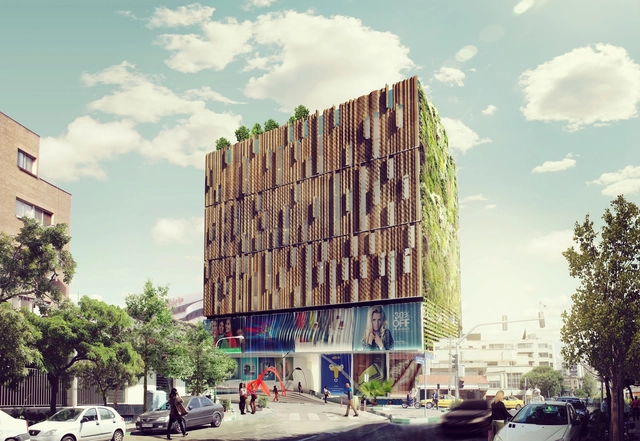
The winner of a competition for a mixed-use building scheme, London-based Kamvari Architects has unveiled the design for Zartosht, a 300,000 square-foot retail and office building in Tehran, Iran. The building's design is based largely on local cultural contexts, like the region’s reputation for renowned fabric and textile shops, and environmentalism, particularly with respect to solar energy.
KAMJZ have unveiled their proposal for the UIA’s MOLEWA (Mount Lu Estate of World Architecture) competition, which tasked participants with designing several cultural and commercial complexes near one of the world’s largest flower theme parks in Ruichang, China. Titled Ruichang Flower Market, KAMJZ's design contemplates a series of shopping streets with high-end, as well as more vernacular shopping spaces, in particular a specialty area carrying flowers grown in the neighboring Flower Theme Park, traditional crafts, and souvenirs.
This article is part of ArchDaily Essentials, a series of articles which give you an overview of architecture's most important topics by connecting together some of our best articles from the past. To find out more about ArchDaily Essentials, click here; or discover all of our articles in the series here.
When the term “sustainability” is brought up in architectural discourse, everyone seems to have a different opinion on the matter. Sustainability is wrought with controversy politically, economically, socially and pedagogically, and while the definition has shifted over time, many new branches of design have developed from sustainability with the aim of driving progressive and innovative change in the world. But what exactly is sustainability, and how do we encounter it in the architectural world?
https://www.archdaily.com/769365/ad-essentials-sustainabilityAD Editorial Team
Neutelings Riedijk Architects has begun construction on the Herman Teirlinck Building, which, when complete, will be the largest passive office building in Belgium, serving as a mixed-use center for the Flemish government.
The 66,500 square-meter building, located in Brussels, will be built along the canal on the site of Tour & Taxis, one of the last large-scale development locations in the heart of the city, in hopes that it will transform the area into “a new high-quality green urban district with mixed functions.”
“You can teach certain things. You can teach people how to do a CD package, you can teach people how to draw certain details, you can teach people how to work through a process. You can’t teach someone how to be a good designer. And that might be subjective […] but it’s about speaking kind of a common language.”
'I just blew off the architecture profession, really. I mean, I have blown it off in my mind as a profession because it’s not addressing the issues that we face. So I coined a new word called ‘biotechure,’ and I use that. I would say I’m a ‘biotect.'
“If you look at just carbon emissions, what we do for a living—building buildings, running buildings, all that— is 50 percent of all the carbon emissions in the United States. […] Well that’s both sort of dreadful and wonderful at the same time. […] The opportunity is, because it’s so concentrated, a relatively smaller group of people can do something about it. ”
As a part of its Archicultureseries, Arbuckle Industries has interviewed HOK president Bill Hellmuth on his experiences in architecture school and working in a large practice. In the interview, Hellmuth discusses his path in architecture school, how large firms allow for the creation of teams, and issues involving sustainability and livable cities.
The 20th century was an era of unbelievable change, with more revolutionary ideas and scientific developments than perhaps any era before it. But among the many developments in the material sciences, one stands as perhaps the most revolutionary: plastics. An experimental group of materials at the turn of the century, artificial plastics are so ubiquitous now that it's almost impossible to imagine life without them.
However, in the 21st century plastics have gained a bad reputation; commonly produced from oil, plastics are a non-renewable resource and, after spending decades or even centuries polluting our environment, most plastics will eventually degrade to release their carbon into the atmosphere. Recycling plastic will go some way to slow this problem, but with so many modern products relying on plastic - and our tendency toward increasing consumption showing no signs of slowing - recycling can only do so much.
But what if there was a way to use plastics to actually reverse the release of greenhouse gases? That's exactly what Newlight Technologies is attempting to do with their carbon-negative plastic, AirCarbon.
Videos
Proposals such as Vincent Callebaut's "Hydrogenase" have always been science fiction as much as they are architecture - but with Arx Pax's MFA technology, is it time to think more carefully about how to design levitating buildings?. Image Courtesy of Vincent Callebaut Architectures
Could Hovering Buildings be the Future of Sustainability?
If Arx Pax, a cutting-edge technology firm led by Greg and Jill Henderson, has its way, levitating objects could become a common sight. The team is developing what they call Magnetic Field Architecture (MFA), a technology which controls electromagnetic energy to make objects hover, and at the several months ago, they used it to produce Hendo Hover, a hoverboard capable of carrying a person. While the fact that Arx Pax was able to produce a hoverboard is fascinating, the technology could have much more serious applications: as an architect, Greg Henderson envisions that one day MFA technology could be used in buildings to produce sustainable structures which can better survive earthquakes and other natural disasters. Is this goal realistic?
In 2007, when the late Mayor Thomas Menino announced his intentions to demolish Kallmann, McKinnell and Knowles' iconic Boston City Hall, he gave voice to a tragic but all-too-common popular discomfort with midcentury concrete architecture. Concerned that this threat was only the latest symptom of a pervasive misunderstanding of the significance of the concrete tradition, three architects - Mark Pasnik, Chris Grimley, and Michael Kubo - joined forces shortly thereafter to launch "The Heroic Project" and share their appreciation for this unfairly maligned chapter of architectural history. In addition to creating an internet web archive, Pasnik, Grimley, and Kubo jointly authored a forthcoming historical survey, Heroic: Concrete Architecture and the New Boston, scheduled to be released by The Monacelli Press in October 2015, which recasts the cultural and political story behind America's concrete heritage.







.jpg?1437157057&format=webp&width=640&height=580)


.jpg?1436267488&format=webp&width=640&height=580)
.jpg?1436267442 "© Michel Kievits")
.jpg?1436267467 "© Michel Kievits")
.jpg?1436267424 "© Michel Kievits")
.jpg?1436267408 "© Michel Kievits")
.jpg?1436267488)