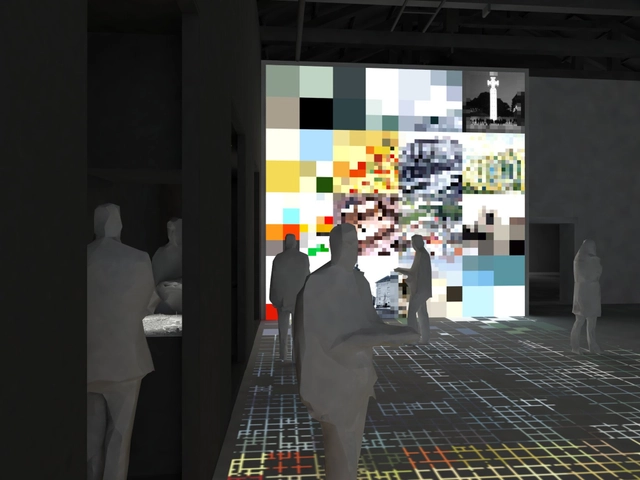
The curators of the U.S. Pavilion for the 2014 Venice Architecture Biennale has unveiled OfficeUS, a “radical experiment” that explores the ways in which “space, structures, and protocols of the U.S. architectural office” have influenced the construction of Modernity.
New York based architects Leong Leong, graphic designer Natasha Jen (Pentagram) and technology consultants at CASE have been commissioned to re-design the U.S. Pavilion in Venice’s Giardini as a modern architectural practice. Eight architects will be selected from an international open call to serve as the ad-hoc practice’s acting principles, collaborating with 90 satellite offices from around the world to revisit and re-envision historical projects from an onsite archive of 1,000 buildings so that they may construct an agenda for the future production of architecture.
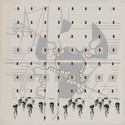
Conceptual Cross Sections. Image Courtesy of the Romanian Pavilion
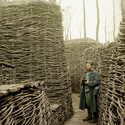
In Eastern Europe the assimilation of modernism proved a rather divergent process, correlated with tumultuous and contradictory socio-political events. The urban space suffered successive destructuring, caused by massive industrial insertions with direct impact at urban and demographic level.
Thus the Romanian Pavilion's exhibition for the 2014 Venice Biennale, Site Under Construction will bring industrial architecture as generator of modernity into discussion. It suggests creating an initiatory journey from inter-war and socialist industrialization to post-industrial urban voids. Glory and void, past and present are mirrored and laid out to be contemplated, to raise awareness and be re-approached. Once industrial sites were closed down, the remaining locations became modern urban ruins, devoid of content, bare of utility, leaving behind an outer landscape, shattering and desolate.
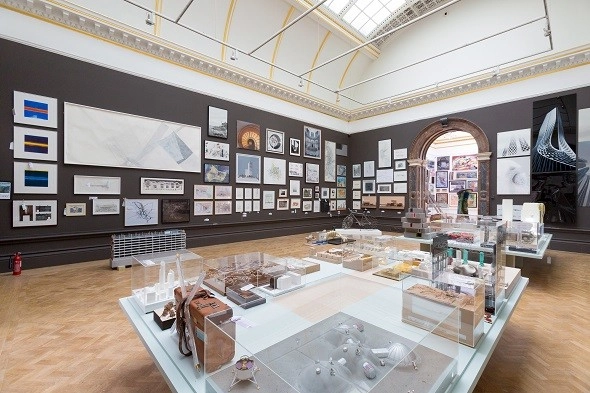
London'sRoyal Academy of Arts (RA) is selling off parts of their blockbuster architectural exhibition, Sensing Spaces. The Great Architecture Fair will see the seven practices behind the enormous installations select objects and materials from the exhibition to be repurposed as beautiful, unique items available to buy. In addition to these, the RA are offering members of the public the chance to experience the spaces out-of-hours "to give you your own exclusive moment in the exhibition."
With Le Corbusier casting a long shadow over the last century of France's architectural history, it is not surprising that, faced with Rem Koolhaas's theme of 'absorbing modernity' at the 2014 Venice Biennale, the country might have a unique reaction.
Jean-Louis Cohen's initial proposal for the French Pavilion, titled "Modernity: Promise or Menace?" reflects this history: “since 1914 France has not so much 'absorbed' modernity as it has shaped it with significant contributions made by French architects and engineers in order to meet the requirements of different segments of society. As is the case in many countries, modernity has had to come face to face with social reform and by doing so it has made great dreams such as quality housing and community services for all partially come to fruition. But this encounter has come about in a original way, also generating considerable anxiety.”
Read on after the break for more about the themes explored by the French Pavilion
Parliament, “the place where the power of the people has found its home,” will be the focus of Austria’s contribution to the 2014 Venice Architecture Biennale. With over 200 national parliament buildings from around the world modeled at a scale of 1:500, the exhibition, “Plenum. Places of Power.” will explore how the architecture of parliament connects to the public, influences national identify, and more.
“The idea of democratic legitimation of power is so widespread today that no nation can do without building such a place, at least in name, for a representative popular assembly,” described commissioner Dr. Christian Kühn. “What do these places look like? And how are they connected to a public whose trust in democratic formation of will seems to be dwindling around the globe?”
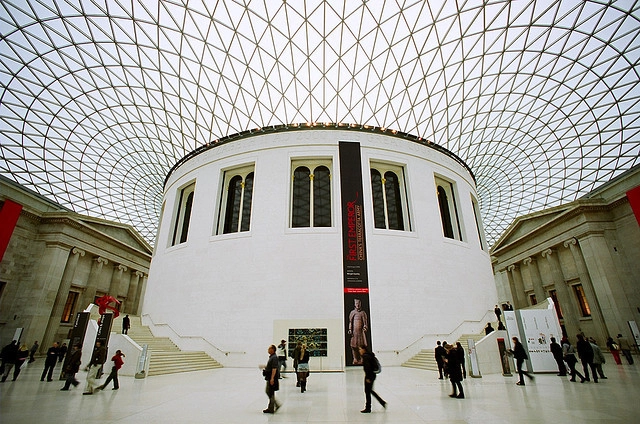
"A Clockwork Jerusalem will offer the opportunity to explore and rethink fundamental aspects of British modernity, beyond architecture,” described Vicky Richardson, Director of Architecture, Design and Fashion at the British Council. “As the Venice Biennale evolves into a global research project, we are keen to make a significant contribution to the cultural debate around the past, present and future of UK and global architecture.”
The National Museum in Norway has been chosen to curate the Nordic Pavilion for the 2014 Venice Architecture Biennale, in collaboration with the Museum of Finnish Architecture, the Swedish Centre for Architecture and Design in Stockholm, and architectural firm Space Group. The exhibition, “FORMS OF FREEDOM: African Independence and Nordic Models” will study modern Nordic architecture’s role in the liberation of East Africa during the 1960s and 70s.
As the most ambitious architecture exhibition hosted by the Royal Academy of Arts in a generation, Sensing Spaces was inevitably going to be under a lot of scrutiny from architecture and art critics. According to the Academy's Chief Executive Charles Saumarez-Smith, the momentous exhibition "represents a shift away from postwar modern architecture where it was about problem solving, to thinking about architecture in terms of experience, material, light and space."
Fortunately the exhibition seems to have struck a chord with critics, who have almost universally praised the exhibition's premise and have, to varying extents, been highly complementary about the individual exhibits.
Read on after the break for a round-up of the critics' opinions
"As Autumn Leaves" (AAL) is a spatial installation designed and built by students of the Laboratory for Computational Design (LCD) for Beijing's 2013 Design Week. Located in a historic hutong district in Beijing, AAL highlights the existing entrance to Dashilar Factory where emerging creatives exhibit their design. The concept is based on ephermerality of nature. As temperatures change, autumn turns to winter, and trees shed their leaves, AAL recalls the passage of time through changing seasons.
https://www.archdaily.com/451572/lcd-exhibits-as-autumn-leaves-at-beijing-s-2013-design-weekJose Luis Gabriel Cruz
Arup Associates was founded in 1963 by the legendary engineer Ove Arup as a design practice in which engineers and architects worked on an equal footing; it later became a subsidiary of Arup (also founded by Arup as Arup and Partners in 1946). These early origins marked Arup Associates as a forward-thinking and revolutionary practice in an era where truly multi-disciplinary practices were almost unheard of.
In light of the strong responses to their Lodge on the Lake competition, organized in collaboration with the University of Canberra and won by Henry Stephens, Nick Roberts and Jack Davies in May, the Gallery of Australian Design is hosting an exhibition of the submissions to the competition, including models of the entries created specially created for the exhibition.
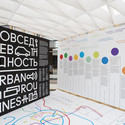
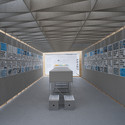
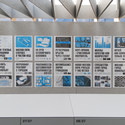
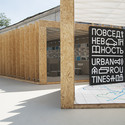
The BMW Guggenheim Lab, a mobile think-tank focused on the study of urban life, has returned to New York City for its homecoming exhibition currently on view at the Guggenheim Museum till January 5, 2014. After two years of research and touring Berlin and Mumbai, the lab aims to present major urban themes in art, architecture, education, science, sustainability and technology."100 Urban Trends: A Glossary of Ideas" is a compilation of definitions of the most pressing issues in urban centers today, contextualized to reflect how different cities interpret them. Architects, planners and students take note: From street facades to bailouts, gentrification to trash mapping, this resource archives years of discussion into one user-friendly interface. Explore the glossary, here.
https://www.archdaily.com/441064/100-urban-trends-a-glossary-of-ideasJose Luis Gabriel Cruz
Five proposals for reconnecting Londoners with the River Thames have gone on display at London's Royal Academy of Arts (RA). The competition, organised by the Architecture Foundation, "launched an open call for multidisciplinary design teams to put forward new ideas and visions for self-selected sites along the Tidal Thames" earlier this year. The five selected teams were shortlisted earlier this year and recently discussed their designs at a public design workshop. The schemes are now being exhibited as part of the Richard Rogers RA: Inside Outexhibition.
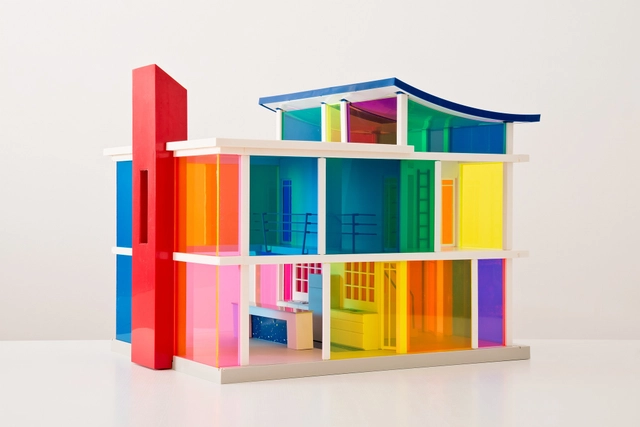
Shikiri, meaning "to divide space using colors," is a made-up term the French architect has embraced in her art and architecture. She aims to "use colors as three-dimensional elements, like layers, in order to create spaces, not as a finishing touch applied to surfaces."
“Architecture is too complex to be solved by any one person.”
Richard Rogers is an architect who understands the significance of collaboration. As a man with an intense social mind and a thirst for fairness in architectural and urban design, Rogers’ substantial portfolio of completed and proposed buildings is driven by the Athenian citizen’s oath of “I shall leave this city not less but more beautiful than I found it.”
In honor of his success, London’s Royal Academy (RA) is currently playing host to a vast retrospective of Richard Rogers’ work, from his collaborations with Norman Foster and Renzo Piano, to the large-scale projects that define Rogers Stirk Harbour + Partners (RSHP) today. The RA’s extensive exhibition has been condensed into a series of motifs that have defined his architectural work, punctuated by memorabilia which offer personal insights into how Rogers’ career has been shaped by the people he’s worked with and the projects that he has worked on.
Continue after the break for a selection of highlights from the exhibition.
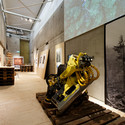
The Pinakothek der Moderne in Münich by Stephan Braunfels (2002) recently went through a complete renovation, and for the re opening of the museum Audi debuted the design wall, an installation that has become part of the permanent collection of the Die Neue Sammlung (The International Design Museum).
Once labeled 'an empty useless city center,' by architectural commentator Norman Day, the city of Melbourne's transformation since the 1980s has been dramatic. Today, Melbourne is internationally recognized as one of the world’s most liveable cities, with a vibrant, urbane downtown. Currently on show until December 21st at City Gallery in Melbourne, this exhibition examines the impact and legacy of the Postcode 3000 planning policy. Curated by Rob Adams, the exhibition looks at the genesis and typologies of this change and its ongoing impact on the form and vitality of central Melbourne. It asks the question: do we fully comprehend the impact of this latest boom? For more information, please visit here.