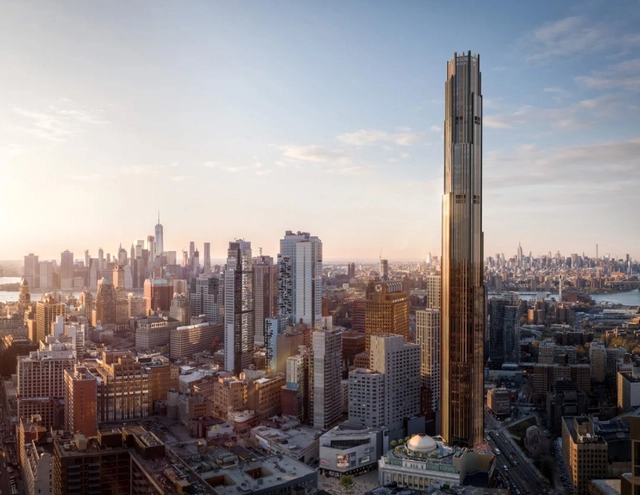
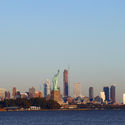
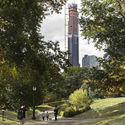
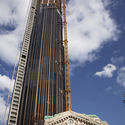
SHoP Architects and JDS Development Group's The Brooklyn Tower at 9 DeKalb Avenue has reached its final height. The monumental tower stands at 1,066 ft. formed by interlocking hexagons that create a dramatic facade of reflective bronze and black panels, providing residents with panoramic views of the city, river, and harbor. The tower is expected to launch residence sales in early 2022, and open for occupancy late 2022.
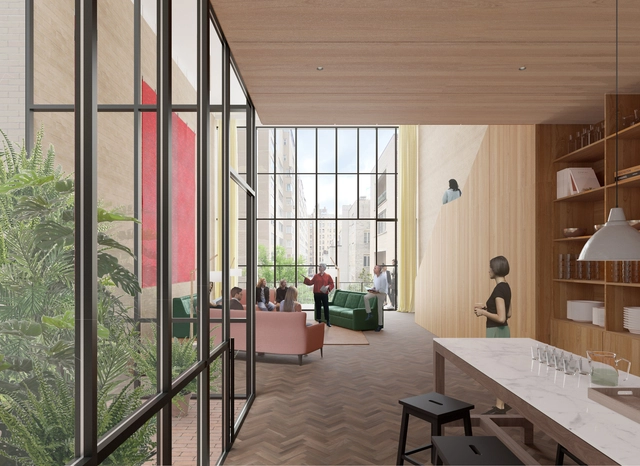
David Chipperfield Architects won the competition to redesign 1014 Fifth Avenue, a historic 1907 townhouse owned by the German government and used for cultural programming, into a space for meeting and dialogue. The project, titled "An Open House" and developed together with New York-based practices KARO Architects and Patarus Group, reorganizes the interior and creates the framework for cultural exchange while honouring the history of the building. Inspired by the interplay of public and private space within an ambassador's house, the project draws inspiration from the building's history as the home of the German Ambassador, with a design that balances public and private functions in establishing a new cultural institution.
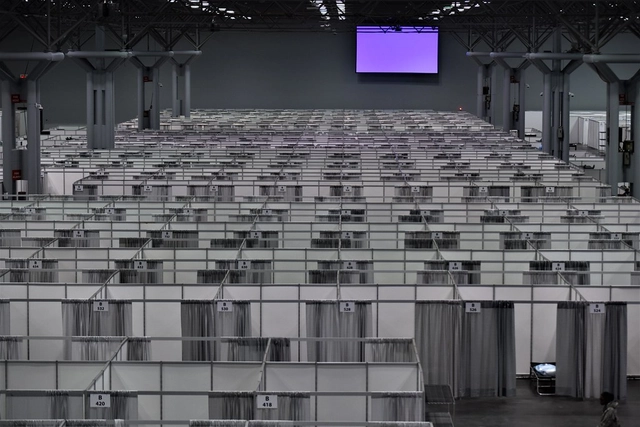
Jacob K. Javits Convention Center in New York City, April, 2020. New York National Guard. (U.S. Air National Guard photo by Major Patrick Cordova)
Cities have always been a stage for transformations. The directions, the flows, the different ways of using the spaces, the desires, all change and give way to new places and needs. Such richness provides the city with an innovative and mutable character, but it also implies demand for more flexible architecture in terms of the functional program and structure. Especially during the past year, we have witnessed - at breakneck speed - great changes in the cities and urban spaces. The pandemic brought new paradigms that suddenly disrupted long-established norms. Houses became offices, offices became deserts, hotels turned into health facilities, and stadiums turned into hospitals. Meanwhile, architecture has had to reveal its flexibility to support purposes that could not be foreseen. This adaptability seems to have become the key to creating spaces that are coherent with our current lifestyle and the speed of modern times.
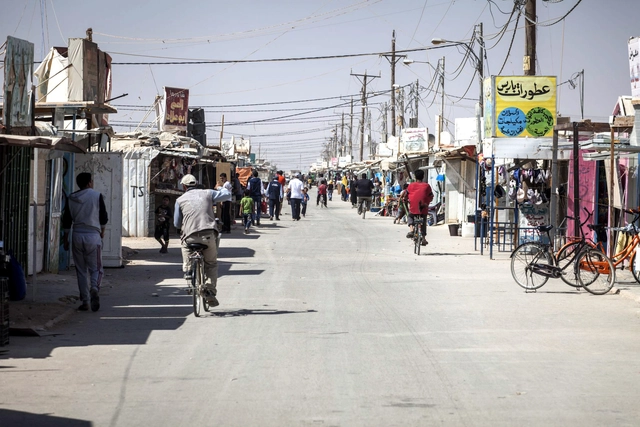
All over the globe, countries are facing a housing crisis. United Nations statistics put the number of people who live in sub-standard housing at 1.6 billion, and 100 million of the world’s population are without a home. As conflicts and climate change forces refugees to move to new countries, and as housing prices around the world continue to rise, cities are having to grapple more and more with how to provide safe and affordable housing for their residents.
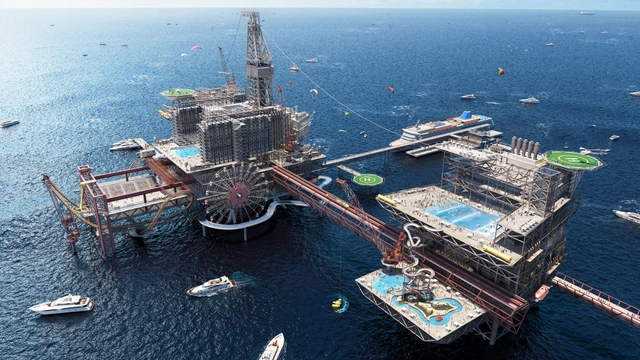
Saudi Arabia's Public Investment Fundhas announced that it will convert an oil rig into a 150,000 square meter amusement park and resort located in the Arabian Gulf. Titled "THE RIG.", the project is expected to be the world's first touristic destination built on offshore oil platforms, featuring three hotels, eleven world-class restaurants, roller coaster rides, and extreme sports and activities like bungee jumping and skydiving, all accessible via a ferry, yacht, cruise, or helicopter.
COP26, The United Nations Climate Change Conference, is scheduled to be held in Scotland soon, in the last week of October 2021. Against the backdrop of this conference is a heightened global awareness of climate change, as discussions take place on how a sustainable, more equal future can be achieved. The present and future state of architecture is a key component of this conversation, as criticism is levelled at architecture firms that “greenwash” and questions are raised on if the term “sustainability” is increasingly merely being used as today’s buzzword.
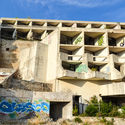
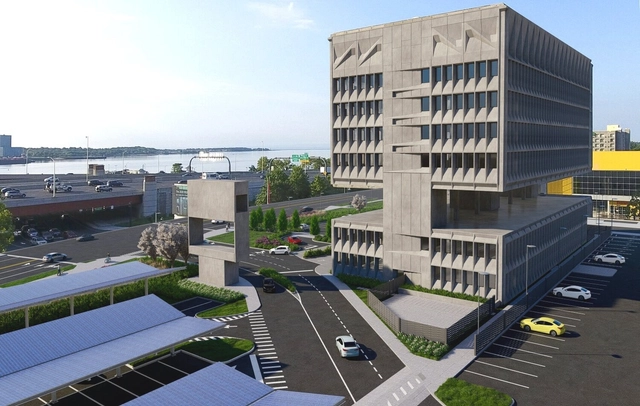
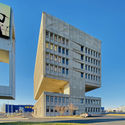
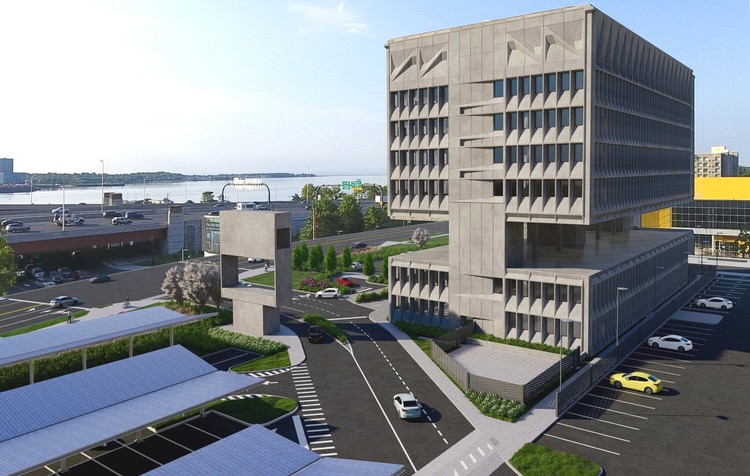
Marcel Breuer’s Pirelli Tire Building, a beacon of Brutalist architecture in the United States, is being reimagined as a hotel by development company Becker and Becker. After being abandoned for years, the structure was sold to architect and developer Bruce Redman Becker in 2020 with plans to transform it into a sustainable 165-room hotel. The sculptural concrete structure aims to be a model for passive design hotels using its unique architectural features and innovative adaptive reuse techniques.
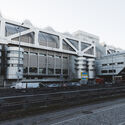
For 10 days, Berlin's abandoned International Congress Centre (ICC) was transformed into a stage for performance, acrobatic and visual arts, films, concerts and talks during Berliner Festspiele's "The Sun Machine Is Coming Down" event. The 1970s futuristic building that remained closed for the last seven years provided the framework for a multi-layered experience, illustrating its potential for reactivation and adaptive reuse.
It is easy to show cool images of adaptive reuse. The contrast of living history and control over it makes for dynamic visuals. But there is a deeper meaning to adaptive reuse. Architecture embodies humanity and humanity changes, so our buildings change.
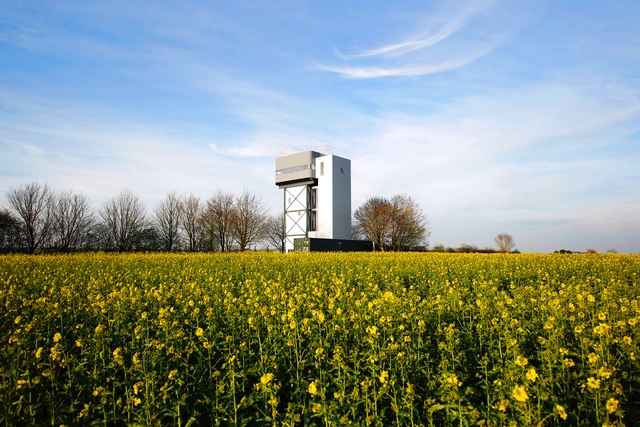
The Royal Institute of British Architects (RIBA) awarded the 2021 Stephen Lawrence Prize to Tonkin Liu’s Water Tower, an adaptive reuse project which converts a disused industrial structure in the countryside into a residential space. The design has a strong attitude towards material recycling, retaining much of the original structure while creating adaptable interiors. The utilitarian aesthetic blends with a creative re-engineering of the project, showcasing an architectural approach in tune with contemporary sustainability values.
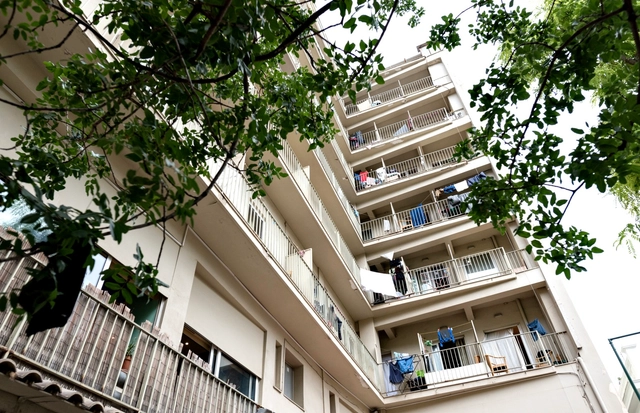
Office Building Conversion- Spain. Image via Foster + Partners
Cities around the globe have widely adopted the concept of adaptive reuse and the importance of investing in historic sites and bringing them into the present day. Instead of focusing on brand new, ground-up construction, many are seeing the value in repurposing structure for new programs. Old churches are becoming restaurants, factories are transformed into museums and apartments, and warehouses are designed to become iconic office spaces. But beyond individual buildings, some planners and preservationists are reimagining what it means to revitalize in a similar way, but at a city scale, and how we can determine the buildings that would benefit our neighborhoods if they are repurposed.
The housing shortage has long been the catalyst for architectural speculation over adaptive resue scenarios or the valorisation of underused places in cities. At the same time, the health crisis and its work from home imperatives have brought into sharp focus the adaptive reuse potential of offices spaces into housing. The probability that some office buildings remain vacant post-pandemic opens up the possibility of bringing back housing to city centres, enabling the implementation of a 15-minute city vision. The following discusses the challenges and opportunities of transforming office spaces into housing, highlighting this limited phenomenon's long-term feasibility and impact.
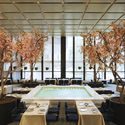
Belmont (Monty) Freeman (b. 1951) founded his New York-based, currently eight-person practice, Belmont Freeman Architects in 1986. Its active projects are half institutional and half residential, with a special focus on adaptive reuse, predominantly in New York and nearby states. Among the firm’s most exemplary projects are the LGBT Carriage House on the University of Pennsylvania campus, a series of restorations at the Four Seasons restaurant in the Seagram Building, renovations at the Yale Club in Manhattan, and the renovation of the Ezra and Cecile Zilkha Gallery at Wesleyan University in Connecticut, designed by Kevin Roche. Current projects include an expansive but minimalist residential compound on Martha’s Vineyard, branch library renovations in New York City, and redevelopment of a former meatpacking building into a new Innovation Hub for Columbia University’s Business School.
“Local” is a word that is broadly used to describe something particular about a place that makes it different from somewhere else. Across the globe, the “local-ness” of our cities is what makes them unique- in the way that people live, work, socialize, and especially in the way that they plan and construct cities and infrastructure. To someone living in a suburb, the way that they move from place to place might be through a car, while someone who lives in a dense metropolis might use a subway or bus system as part of their everyday lives.
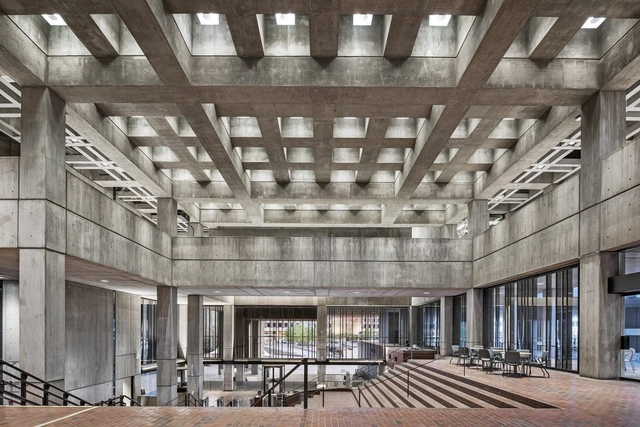
Boston City Hall . Image Courtesy of Utile and Reed Hilderbrand
"Demolition is a waste of many things – a waste of energy, a waste of material, and a waste of history,"says Pritzker-winning architect Anne Lacaton. In recent years, refurbishment and adaptive reuse have become ubiquitous within the architectural discourse, as the profession is becoming more aware of issues such as waste, use of resources and embedded carbon emissions. However, the practice of updating the existing building stock lacks consistency, especially when it comes to Brutalist heritage. The following explores the challenges and opportunities of refurbishment and adaptive reuse of post-war architecture, highlighting how these strategies can play a significant role in addressing the climate crisis and translating the net-zero emissions goal into reality while also giving new life to existing spaces.
Too often buildings end up as waste at the end of their lifecycle. How can the built environment move towards a circular economy, and in turn, reimagine how valuable materials are tracked and recycled? Looking to address this issue, material passports are one idea that involves rethinking how materials are recovered during renovation and demolition for reuse. The result is when a building is ready to be demolished, it becomes a storage bank for useful materials.
"For more than a generation, federally funded historic tax credits (HTCs) have been instrumental in incentivizing developers to revive and reuse historic buildings and keep them economically viable, rather than replace them with shiny new objects. These credits create jobs, promote responsible development, and leverage billions in private investment to enable income-generating buildings". Read the interview between Justin R. Wolf and Meghan Elliott, founding principal of New History, a firm specializing in adaptive reuse.
https://www.archdaily.com/966687/why-use-is-the-best-form-of-preservationJustin R. Wolf