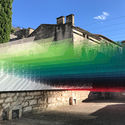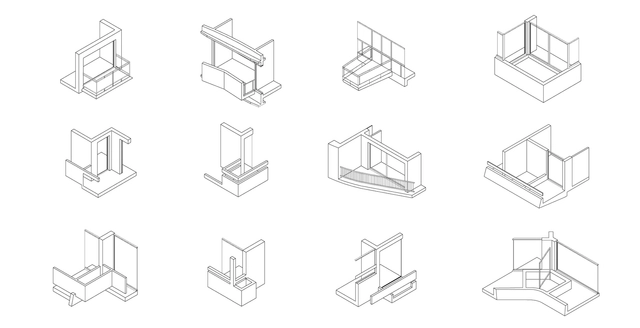
Public/Private, the Spring 2015 issue of ArchitectureBoston (out now) examines current trends in how we view public and private space and the effect these have on architecture. Tackling spaces as diverse as social space, the workplace, residential life, transportation, or civic territory, the issue examines what happens when notions of public an private space intersect. In the following article, originally published under the title "Quiet, please," Laura Wernick FAIA explores the need for enclosed, private spaces within educational facilities.
I walk by William Rawn’s Cambridge Public Library extension twice a day on my way to and from work. I love the transparency of the south façade. It is sharp and crisp, and I can see right through to all of the exploring, socializing, reading, and working taking place within. When I go into the library for research or study, however, I tend to move quickly away from the openness of the new building into the old one. I find a semi-enclosed quiet spot away from the crowds, turn off social media, and get to work.
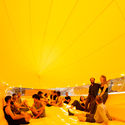
A few months ago, we announced that Izaskun Chinchilla Architects emerged as one of two winners of FIGMENT’s international “City of Dreams” pavilion competition in New York. Their proposal entitled “Organic Growth” is slated for assembly on Governors Island this summer, but they need your help! Due to the split funding of selecting two winners and FIGMENT’s non-profit status, the design team has launched a kickstarter campaign to make their proposal a reality through public contributions.
Learn more about how you can get involved, after the break.
We will be publishing Nikos Salingaros’ book, Unified Architectural Theory, in a series of installments, making it digitally, freely available for students and architects around the world. The following chapter expands on the phenomenon of “life” in buildings introduced in Chapter 3, and also introduces a simple test which can be used to determine the degree of “life” in a structure. If you missed them, make sure to read the previous installments here.
Approaching architecture from the entirely new perspective of organized coherence — what Christopher Alexander calls “wholeness” — unifies many phenomena. The traditional distinctions between ornament and function, between buildings and ecology, and between beauty and utilitarian structure are blurred. We can look for the “life” in artifacts and structures, which explains our experience of them.
Later in this course we are going to count features, and measure parameters that contribute to our impression of “life” in an object. These measures will show that the phenomenon of life is not idiosyncratic, but is, to a very large degree, shared among all people.
Danish urban planner and committed pedometer user Jan Gehl is an expert in creating “cities for people.” Following a recent talk he gave on sustainable cities in Basel, Gehl sat down with Tages Wocke to discuss what makes a city desirable and livable. “We found people’s behavior depends on what you invite them to do,” says Gehl. “The more streets you have, the more traffic you get. A more attractive public realm will be used by more people.” Read the full interview and see why Gehl thinks social and psychological sciences should be taught in architecture school, here.
3-D printing is slow; it’s really just “2-D printing over and over,” says chemist and material scientist Joseph DeSimone. Addressing the three main issues that has prevented 3-D printing from being a mainstream manufacturing process - time, structural and material limits - DeSimone has unveiled Carbon3D at TED2015. A process inspired by the T-1000 from Terminator 2, Carbon3D uses light and oxygen to continuously (and quickly) grow parts out of a vat of liquid resin using a new technology known as CLIP - Continuous Liquid Interface Production. While the process’ potential has been immediately correlated with the medical industry, one can only imagine its effect on manufacturing as a whole.
Skidmore, Owings & Merrill's (SOM) latest endeavor, a Four Seasons Hotel called Bahrain Bay, has been officially opened. Occupying a private 12-acre island, the hotel creates a dynamic new focal point and a thriving destination for the developing Bahrain Bay district. As part of SOM's masterplan, the hotel is an important milestone in activating the waterfront area.
Read on after the break for more on the hotel's program.
A casual observer might be forgiven for wondering how Thomas Heatherwick has developed such a reputation among architects. A scan of the works of Heatherwick Studio reveals relatively few completed buildings, and many of those that do make the list are small projects: kiosks, retail interiors, cafés. Indeed, to the average Londoner he is probably better known as the designer of the new homage to the iconic red Routemaster bus and as the creator of the wildly popular cauldron for the London 2012 Olympics - both unveiled in a year in which Heatherwick all but officially became the state-approved designer of 21st century Britain.
A look at the website of Heatherwick Studio sheds some light on this conundrum. With projects separated into “small,” “medium” and “large,” it is clear that a progression in scale is mirrored by a progression in time, with many of the smallest projects completed in the Studio’s early years, and most of those in the “large” category either recently completed or (more frequently) still on the drawing board. Their most recently completed project is also one of their largest, a “Learning Hub” for Nanyang Technical University in Singapore. How does a design studio that made its name in small projects adapt to such scale? ArchDaily spoke to Thomas Heatherwick about the Learning Hub and the increasing size of his projects to find out.
"If London doesn’t grow up, it will need to grow out." Following last year's report, New London Architecture (NLA) in cooperation with GLHearn (an independent property consultancy) have released the results of their annual London Tall Buildings Survey. In 2014, they forecast 236 new tall buildings for the British capital, a figure which has risen to 263 buildings over twenty stories for 2015. Alongside this, they believe that around 14,800 new homes are "under construction for London."
Images have been released of a new mosque planned for Copenhagen. Designed by Henning Larsen Architects, the mosque will replace an existing one on the corner of Dortheavej and Tomsgårdsvej in the Nordvest district of the city. ”One of Copenhagen's slightly forgotten districts will receive a new architectonic pearl,” says Morten Kabell, the city's deputy mayor for technical and environmental issues. The Copenhagen Municipality has approved the project’s planning application and completion is expected for February 2016.
Pulitzer Prize-winning photographer Vincent Laforet has made his way to San Francisco as part three of his dizzying series of city aerials. Capturing the tightly packed metropolis from 7,200-feet, Laforet became mesmerized by the city’s “clashing grids,” stunning bridges and overwhelming feeling of “peace and order.”
“There’s just something about this city’s vibe - a perfect balance between the hectic go-getter pace of New York and the more relaxed, laissez-faire rhythm of Los Angeles,” says Laforet. “It feels like every little piece of the puzzle has somehow found its place in what is an absolutely chaotic topography.”
See a selection of Laforet’s San Francisco series, after the break.
London firm Leslie Jones Architecture has received a commission from Dubai Airports for Al Maktoum International Airport at the yet unbuilt Dubai World Centre. The latest firm to join development on the 140-square-kilometer site, it is hoped that Leslie Jones will deliver a mixed-use transit hub to cater for burgeoning local tourism and aviation industries.
It's a well-known fact that architects, almost without exception, love the 1982 film Blade Runner. Architects also love scale models. So what could possibly be more exciting than seeing photos of the model shop of the film? Enter this Imgur album of 142 photos from behind the scenes, posted earlier this week by user minicity. After the break, check out our selection of images of the Tyrell Corporation's imposing pyramidal fortress, among other things, under construction.
But, unlike much of the press coverage that has greeted Calatrava in recent years, the New York Magazine article is much more forgiving, taking the time to investigate the twists and turns of the project's controversial 12-year history and offering the architect the opportunity to give his side of the story. Read on after the break for a breakdown of six takeaways from the article.
The 2015 Australian Achievement in Architecture Awards have been allocated by the Australian Institute of Architects in Melbourne. The prestigious awards honor emerging and seasoned architects, students, and academics whose interdisciplinary designs have excelled in embracing the possibilities of the profession. Granting 14 awards in 9 categories, the recipients’ work spans a wide range of subject matter and addresses various aspects of architecture’s inherent influences both locally and globally.
The highest award, the Gold Medal, was awarded to Peter Stutchbury, whose lifelong commitment to architecture has spanned education, professional practice, and involvement in organizations. His international work consistently speaks to its specific cultural and site conditions, while adhering to sustainable design principles.
This sculptural installation, created by Swiss artist Romain Crelier, was exhibited at Bellelay Abbey in 2013. Although the structure dates back to the 12th century, the current Abbey Church of the Assumption was built by Franz Beer in a Vorarlberg Baroque style and completed in 1714.
Almost three hundred years later Crelier's piece, entitled La Mise en Abîme (which roughly translates to, 'to have put into an abyss'), placed two shallow pools of used engine oil to act as reflective mirrors. These 'puddles' "allow the viewers to interact with the architecture of the church by being pulled into the reflection so that they, in turn, become part of the sculpture themselves." According to We Find Wildness' interpretation, "the installation not only dispenses multiple visual thrills and mysteries but also offers a moment where sculpture creates another reading of space."
A dynamic post-professional program in Emerging Systems, Technologies, & Media (ESTm) offered by the Southern California Institute of Architecture (SCI-Arc) in Los Angeles has been charged with examining core contemporary issues facing architecture and design today. Spanning topics from advanced manufacturing methodologies to new building systems, this one year Master of Design Research track allows professionals to rethink architecture and design through the experimental hands-on approach of the SCI-Arc community.
The ESTm program tests new levels of environmental performance as it prepares students to successfully integrate formal, technical, logistical, and material processes into advanced architectural designs. The program is open to graduates in architecture, engineering, product design, computer sciences and other professionals who wish to develop advanced research and design skills in light of continuously evolving materials and new production paradigms of the 21st century.
https://www.archdaily.com/611103/sci-arc-offers-emerging-systems-technologies-and-media-post-professional-programSponsored Post
Source: Table of 2013 American Community Survey estimates, U.S. Census Bureau
In 2013, there were 145,439 full-time, year-round architects in the United States - roughly 31,000 of which were women. Making up just over 21 percent of the workforce, these women were on average paid just 80 percent the salaries of their male counterparts, according to the latest statistics released by the US Census Bureau. This means the median income for male architects was $14,877 more than female architects.
The Westminster City Council has granted Rogers Stirk Harbour + Partners planning permission for their competition-winning scheme to redevelop part of The London School of Economics and Political Science (LSE) campus. The largest project in the school’s 120-year history, the “Center Building Redevelopment” plan will replace an existing cluster of LSE buildings along Houghton Street - Clare Market, The Anchorage, the East Building and part of St. Clements - with a modernized, sustainable and multifunctional academic building.
Los Angeles-based practice Synthesis Design + Architecture has created a 3-D printed chair which uses the latest gradient 3-D printing technology to apply different material properties to different parts of the chair. Originally asked by leading 3-D printing company Stratasys to design a piece that would not be possible without utilizing 3-D printing, Synthesis Design + Architecture chose to go one better, designing a chair that would not be possible without the Stratasys Objet 500 Connex3, which is capable of combining a range of material properties into a single print run.
Winning Entry: Exhibition Space. Image Courtesy of UNESCO
Last month the UNESCO office in Afghanistan, in collaboration with the Afghan Ministry of Information and Culture, announced the winning design for the Bamiyan Cultural Center. An Argentina-based team, led by Carlos Nahuel Recabarren alongside Manuel Alberto Martínez Catalán and Franco Morero, was selected from 1,070 design entries from teams in 117 different countries. Now, all of these submissions will be posted in an online gallery on the Bamiyan Culture Centre website for the next three months. “The competition achieved beyond expectation and contributed to portray a new and positive image of the culture sector in Afghanistan. This exhibition aims to showcase the extraordinary effort that the architectural community and each and every applicant put into this competition,” writes UNESCO.
With generous financial aid from the Republic of Korea, the culture center will be built on land adjacent to the Cultural Landscape and Archaeological Remains of Bamiyan World Heritage property. The center aims to promote art, history, music and community interaction. When evaluating the submissions the seven-member jury focused on “design principles emphasizing innovation, community needs, environmental consciousness, sustainability, and connection to the natural and cultural landscape of the Bamiyan Valley.”
Read on after the break for a round-up of images from some of the most interesting, unusual and unique proposals. You can search by ID number, Team Leader or Country to view the full project board with descriptions, renders and plans on the online gallery.
In their notes on the selection of Frei Otto as the 2015 Pritzker Prize Laureate, the jury described him as an architect that took his work beyond the boundaries of the discipline, as an architect who was also a “researcher, inventor, form-finder, engineer, builder, teacher, collaborator, environmentalist, [and] humanist.”
To learn more about Otto’s multidisciplinary approach to architecture as well as his emphasis on experimentation, we turned to an interview he did with Juan María Songel in 2004, published in the book A Conversation with Frei Otto. In the interview, Otto discusses numerous topics of interest and relevance to architecture in the 21st century, and in particular the importance of experimentation and research, declaring: “Productive research must be brave!”
At the World Architecture Festival (WAF) in Singapore we had the chance to speak with Richard Francis-Jones, the Design Director of Australian-based practice FJMT. FJMT has a strong focus on public buildings and community work, and their Aukland Art Gallery was selected as WAF’s 2013 World Building of the Year, after winning the Culture Category. “The role of the architect in society is an evolving question. I think in a way we reflect and represent the values of a society, the values of the culture that we’re part of,” he told us. “I think what an architect should do is perform that reflection in a very thoughtful and potentially critical way so that in a sense we’re mirroring the society, its values and its challenges, but at the same time providing a kind of potential insight into the way things could go, a kind of a promise of how things could evolve.”