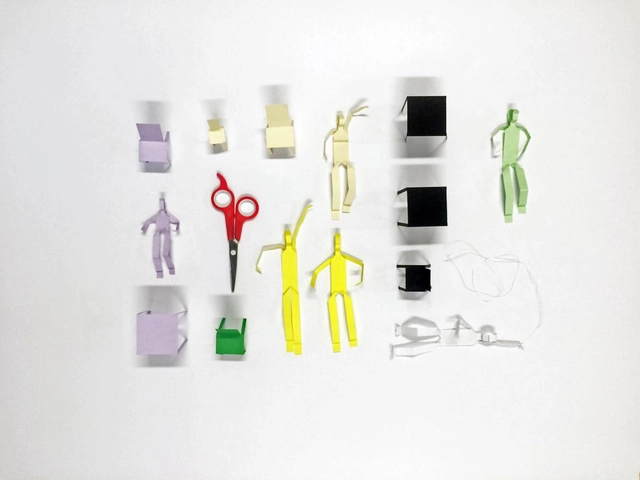
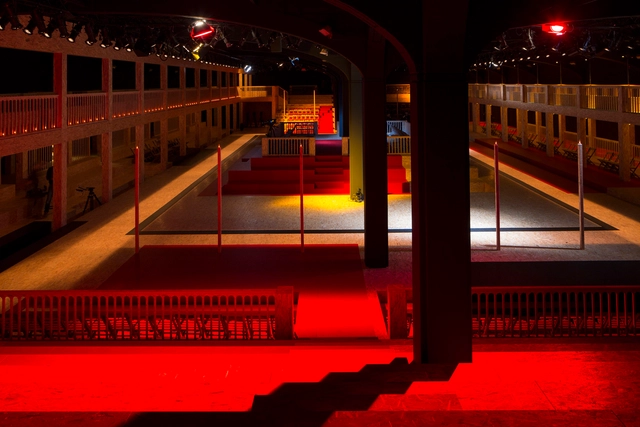
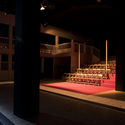
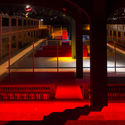
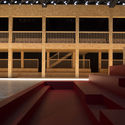
When it comes to the modern-day fashion show, the internet has fundamentally changed the way audiences interact with models and designers, say OMA/AMO, arguing: "The assemblage of recorded impressions and digital reactions inserts itself into the once autonomous narrative of the fashion show. The statement of the collective spreads. The mass of fragmented instant data is uploaded and critiqued by a multitude of voices."
With their latest fashion show design for Prada, which was used to showcase the designer's upcoming fall/winter menswear collection in Milan yesterday, the firm sought to enhance this sense of public judgement. "This consumption of images is like a public trial, a contemporary transposition of the Auto-da-fé," explains their press release, referring to the ceremonies of public penance which took place in the Portuguese and Spanish Inquisitions in the 15th-17th centuries.
Where were you when it happened? On February 27, 2010 an 8.8-magnitude earthquake and subsequent tsunami struck Chile, causing destruction across the country. Ask any Chilean what they were doing at the time, and they will have a story to tell.
Oriana Pinochet Villagra and her family were in Constitución when the ground started to shake. A town centered around the forestry industry, Constitución is surrounded by green mountains, and situated where the Maule river meets the Pacific Ocean.
It was one of the cities most affected by the earthquake in 2010. The ocean water flooded the river, wrecking everything that the earthquake hadn’t already destroyed. Those that lived along the riverbank were left in the street with mud burying their houses -- Oriana's family lost 30 years of memories.
Almost six years after the natural disaster, we visited Constitución where Oriana Pinochet showed us one of the major reconstruction projects in the city: Villa Verde Housing, a residential neighborhood for 484 of the affected families. With partial financing from housing subsidies and based on the idea of incremental housing, the project is designed by ELEMENTAL, the “Do Tank” of 2016 Pritzker Prize laureate, Alejandro Aravena.
As the first month of 2016 draws to a close, we decided to tap into our network and ask an esteemed group of architects, critics, theorists and educators to tell us what they are looking forward to this year in architecture.
What are you looking forward to in architecture this year?
https://www.archdaily.com/780498/50-architects-tell-us-what-they-are-looking-forward-to-in-2016AD Editorial Team
In an age when companies of all types are seeking diverse and creative ways to achieve their goals, the traditional model of architectural practice appears to be increasingly old-fashioned. Last year, one of the most dramatic changes in the make-up of architectural practice was the foundation of product design firm BIG Ideas, an off-shoot of Bjarke Ingels Group, which is tasked with solving problems that are usually outside the scope of an architect's work. In this interview, originally published by Archipreneur in their "Archipreneur Insights" series as "Making BIG Ideas Happen Through Design With Jakob Lange," the head of BIG Ideas speaks to Tobias Maescher about the foundation of this entrepreneurial company and the value of keeping such close connections between a product design company and its parent architecture firm.
Today’s interview is with Jakob Lange, Partner at BIG (Bjarke Ingels Group) and Head of the BIG Ideas project unit, which was established in 2014. With this unit, BIG is broadening the scope of their architectural practice to a wider field. Combining technology and product design, this remarkable incubator creates prototypes, products and new materials within the building industry.
The Friday Smart Lock, an electronic door lock that pairs with a user’s mobile device, is one great example of an innovative product the team at BIG have helped to produce. They have also utilized creative methods for financing their projects, including a recent Kickstarter campaign for the prototype of a steam ring generator at a BIG-designed power plant in Copenhagen.
We think it is fascinating that one of the world’s most innovative and successful architectural offices is moving into other fields of practice—a very archipreneurial move! However, this is just one of many ways that architects can apply their skillsets to future business innovations. Here are Jakob’s thoughts on architecture, design and product development.
Following the recent completion of 432 Park Avenue in New York City, The Council on Tall Buildings and Urban Habitat (CTBUH) has announced that there are now 100 supertall (300-plus-meter) skyscrapers in the world. The majority of these skyscrapers are in Asia and the Middle East, mirroring construction trends that have emerged over the past decade. Dubai leads the rankings with 18 supertall buildings, while New York City now falls in second place with a total of seven, including 432 Park Avenue.
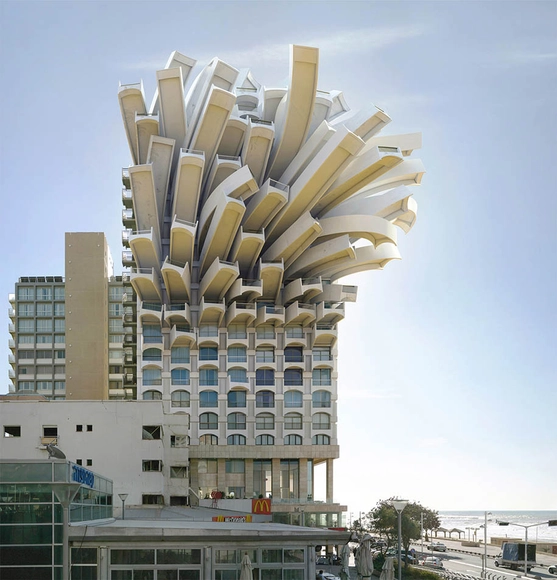
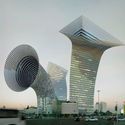
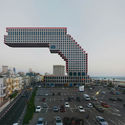
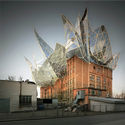
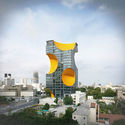
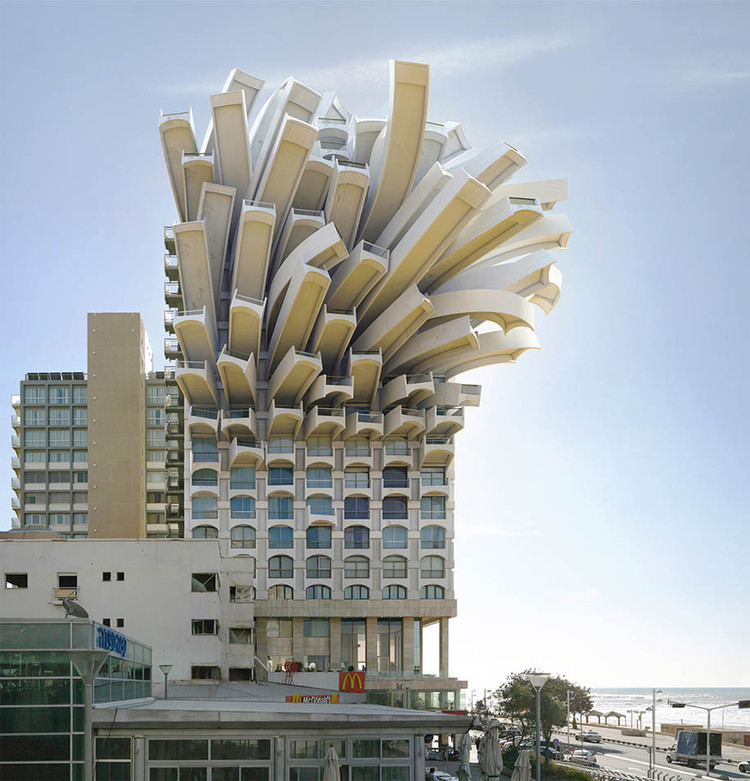
Since 2006, artist Victor Enrich has been working on his project, City Portraits, a series of digitally manipulated images that transform photos into architectural illusions.
As part of OMA co-founder Rem Koolhaas' sixth interview with Charlie Rose, the Rotterdam-based Architect discusses why the Dutch port-city is his practice's base – and why he switched from journalism and scriptwriting to architecture. In the discussion, of which four snippets have been made available, Koolhaas also explains why he feels that smart technology has a "sinister dimension," and on how he—and his practice—have a tendency to "resist aesthetic."
https://www.archdaily.com/780502/why-rem-koolhaas-switched-from-scriptwriting-to-architectureAD Editorial Team
At this year’s Chicago Architecture Biennial the directors Joseph Grima and Sarah Herda asked participating architects to demonstrate the “State of the Art of Architecture" by submitting projects that they felt told a story about architecture’s importance in society. As explained in this video by Politico Magazine, native Chicagoan Jeanne Gang of Studio Gang Architects responded to this call by looking at an issue that has plagued American cities in startling ways in recent years: the troubled relationships between communities and their police forces. Often hidden behind fortress-like buildings, police stations in their current form tend to project an image closer to hostile than welcoming. But Gang believes it doesn’t have to be that way.
In the latest episode of The Urbanist, Monocle 24's weekly "guide to making better cities," the team tackle the 'establishment'. From small businesses to citizen collectives, the show discovers how "championing transformative change from the ground up can be the best way to alter the status quo in our cities." Investigating how the Ministry of Space is reclaiming public spaces in Belgrade, how ordinary citizens in Vienna are welcoming refugees, and how a collective in Rio de Janeiro wants to reshape the politics of the city, the episode also explores how small businesses in London’s West End are fighting against increasing rent.
2015 Winning Entry by Jacques Gaffigan. Image Courtesy of The Knight Foundation
The John S. and James L. Knight Foundation has announced the names of the 158 finalists in the Knight Cities Challenge. The nationwide call was for innovative ideas to make the 26 communities where the Knight Foundation invests more social and vibrant places to live. More than 4,500 entries were submitted proposing a range of ideas from opening the world’s largest African American history museum in Detroit to a card game that encourages residents of Charlotte to visit new neighborhoods. The winners, who will split a prize of $5 million, will be announced in the spring of 2016.
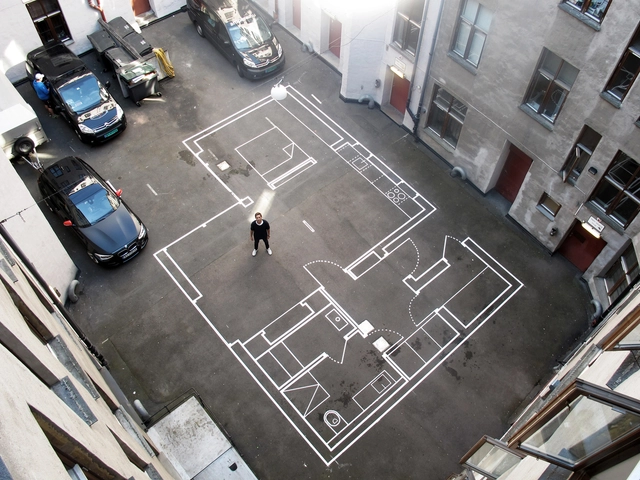
Norway based architecture studio Vardehaugen has created a series of life-sized project drawings in its own backyard. Inspired by the idea that the "bodily sensation of scale, or the notion of simply walking through a room, cannot be experienced through traditional 3D visualizations or scaled models," the 1:1 models allow for better understandings of dimensions and spatial sequences, even before the projects are built.
As an idea that was developed fairly early on in the movement for sustainability, and picked up significant traction a few years into the new millennium, "Design for Deconstruction" has been around for some years. Yet still, considered on the scale of building lifespans, the idea is still in its infancy, with few opportunities to test its principles. In this post originally published on Autodesk's Redshift publication as "Recycled Buildings or Bridges? Designing for Deconstruction Beyond Adaptive Reuse," Timothy A Schuler looks at the advances that have been made, and the challenges that still face, the design for deconstruction movement.
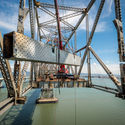
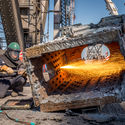
This summer, the Oakland Museum of California announced a new public arts grant program. Except instead of money, selected artists would receive steel. Tons of it.
The Bay Bridge Steel Program emerged out of a desire to salvage and repurpose the metal that once made up the eastern span of San Francisco’s Bay Bridge, originally constructed in 1933 (it was replaced in 2013). The steel in question, sourced from “spans referred to as ‘504s’ and ‘288s’ (in reference to their length in feet),” according to the application material, would be available for civic and public art projects within the state of California.
The program represents a unique opportunity to adaptively reuse infrastructure, upcycling what might have been waste. And yet any instance of adaptive reuse is inherently reactive because the design process is dictated by an existing condition.
Architect, illustrator and cofounder of the Miniatura project, Bruna Canepahas shared with us a stunning collection of her illustrations and collages, which offer a fresh gaze onto one of architecture’s most common tools: the drawing. Beyond depicting examples of unreal architecture, her works present architecture that replaces firmitas, utilitas and venustas for complexity, wonder and irony.
From extrusions and explosions of familiar typologies to surreal and sterile atmospheres of empty spaces, we suggest three subcategories to frame Bruna’s illustrations as shown below: Houses, Cubics, and Displacements.
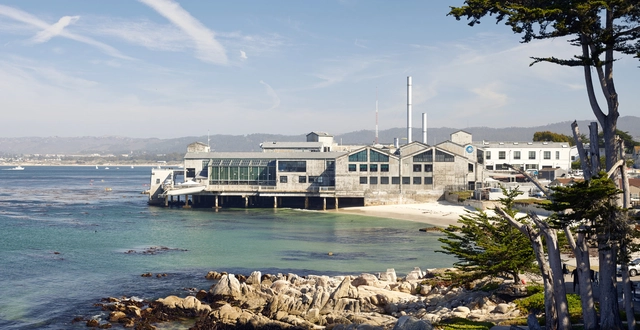
Monterey Bay Aquarium / EHDD. Image Courtesy of Bruce Damonte
The Monterey Bay Aquarium in Monterey, California, has been selected for the 2016 American Institute of Architects' (AIA) Twenty-five Year Award. Designed by EHDD of San Francisco, and completed in 1984, the Monterey Bay Aquarium is a "light-filled ensemble of diverse spaces, unique among aquariums in its interweaving of indoors and out," says the AIA. The award is presented yearly to a project that has "stood the test of time by embodying architectural excellence for 25 to 35 years."
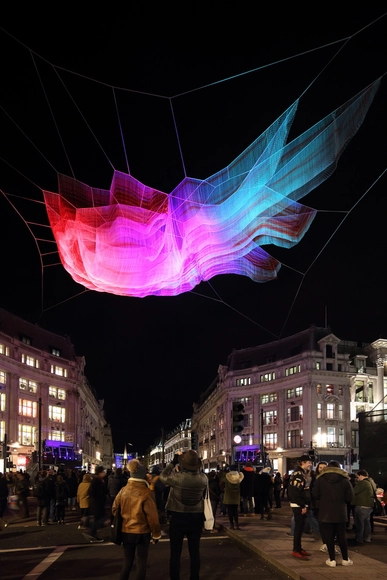
London is the latest city to host one of Janet Echelman's stunning net sculptures. Suspended 180 feet above Oxford Circus, the city's busiest intersections, the colorful floating form was inspired by 1.8 - "the length of time in microseconds that the earth’s day was shortened" as a result of Japan's devastating 2011 earthquake and tsunami.
"The sculpture’s form was inspired by data sets of the tsunami’s wave heights rippling across the entire Pacific Ocean," says the studio. "The artwork delves into content related to our complex interdependencies with larger cycles of time and our physical world. The sculpture’s net structure is a physical manifestation of interconnectedness – when any one element moves, every other element is affected."
Museums, restaurants, shops, theaters. These are the types of spaces the public interact with on a regular basis in a city. But these spaces alone do not make a city - in fact, the vast majority of buildings house spaces that 99 percent of the population will never see. Yet a true city experience cannot exist without these buildings. What is the true value of private buildings to the tourist or the passer-by on the street? Is it simply a matter of aesthetic and identity? Could the same result be achieved with a streetwall made up of only facades? These are the implicit questions embedded in “Apparences,” the new video from Claire and Max of Menilmonde. The duo uses video editing and CGI to alter iconic Paris views, making the city of romance appear to be little more than the world’s largest movie set.
A city with the history and imagery of Paris cannot be mistaken for a Potemkin Village - the city functions still as one of the preeminent economic centers in the world. Yet its status as one of the world’s most visited cities and tales of its beauty and luxury often plant false visions of grandeur in visitors’ minds.
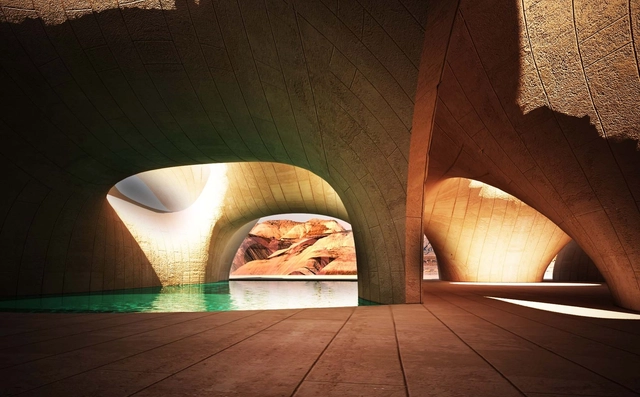
Aysu Aysoy and Roman Hajtmanek have been announced as the winners of the ArchDaily + IIDEXCanada Virtual Spaces Competition, which sought proposals for un-built, fantastical spaces. The designs were then developed into virtual spaces by Invent Dev as a part of a virtual reality exhibition at IIDEXCanada.
Learn more about both of the winners, after the break.
Based on the concept of listening to the sounds of the ocean inside a shell, STUDIOKCA, commissioned by NASA, has created the NASA Orbit Pavilion to immerse visitors in the sounds of satellites orbiting in outer space.
The traveling, nautilus-shaped pavilion provides a space in which to experience the trajectories of 19 satellites orbiting Earth. Made with 3,500 square feet of water-jet cut aluminum panels, the pavilion is "scribed with over 100 'orbital paths' fitted together and bolted to a curved framework of aluminum tubes."
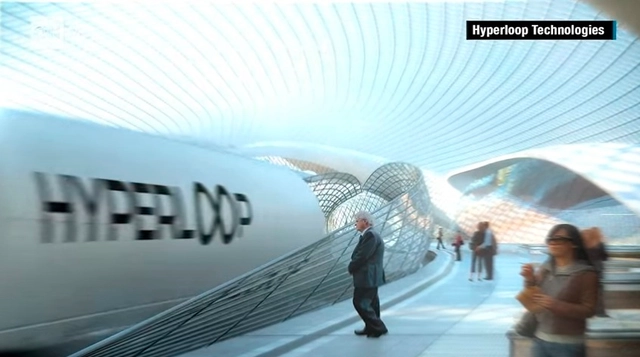
Hyperloop Technologies is starting to realize its high-speed transit system. As Tech.Mic reports, pipes for the project's first test tube are showing up in Nevada. Hyperloop was first outlined by Elon Musk in 2013 as a response to California's pricey bullet train plan that aim to connect Los Angeles to San Francisco. The ultra-fast, energy efficient Hyperloop proposes to send pods of people through a depressurized tube at speeds up to 700 miles-per-hour. It is believed that the new system could be running as soon as 2020.
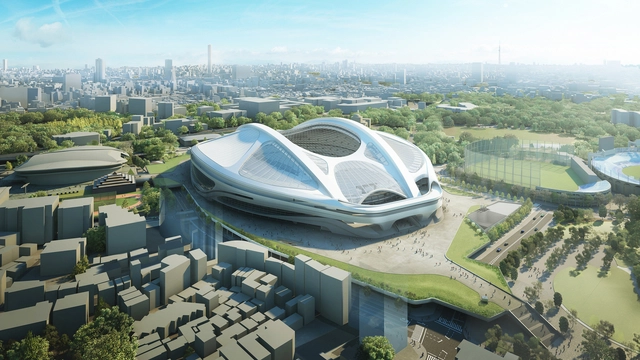
Zaha Hadid is facing new hurdles regarding her scrapped Tokyo National Stadium design; according to the architect, the Japan Sport Council (JSC) is withholding an overdue payment until ZHA agrees to relinquish ownership of their original designs.
After working on the design for more than two years, the British practice was decommissioned from the project over cost objections last summer. Since, Japanese architect Kengo Kuma has been reassigned the project, offering a design that ZHA says is suspiciously similar to their original proposal "in the structure, layout and numerous elements."
Now, the JSC has requested ZHA agrees to new "Compliance Rules" that would allow the stadium's new architect to "use any product of work ... regardless of its copyright."
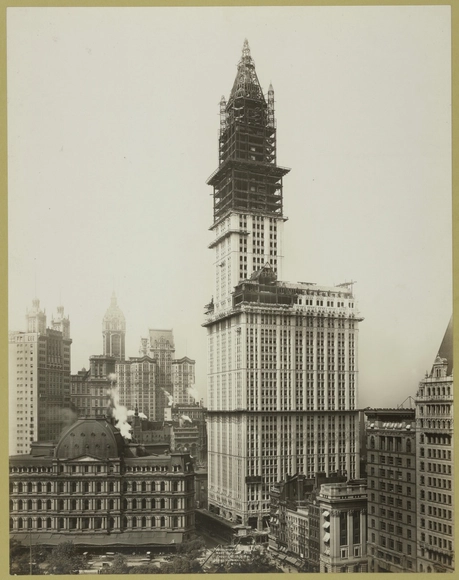
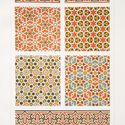
Of course, the archive also includes a significant assortment of captivating architectural images that range from everyday scenes to historic treasures. We've trawled the database to find some of the most unusual and insightful examples - read on to see a selection of the most interesting architectural images from NYPL’s digital archives.
In response to the question posed by the curators of the Chicago Architecture Biennial – what is The State of the Art of Architecture today? -- Colombian firm El Equipo de Mazzanti (Giancarlo Mazzanti) developed their exhibition “Speaking Architecture,” which looks at architecture as “a living process rather than a finished and static object.”
The installation puts the visitor in control, breaking with the typical conception of an exhibition as something controlled, static, limited and unidirectional, and creating “a place to play.”
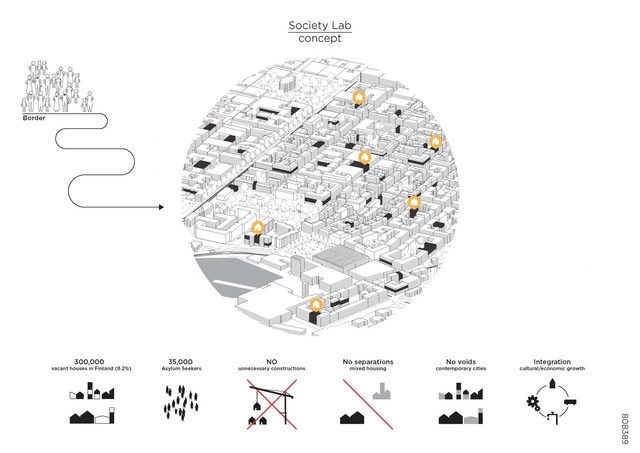
The Museum of Finnish Architecture, in collaboration with the Finnish Association of Architects (SAFA), has announced the winners of its “From Border to Home” competition, which sought solutions for temporary housing seekers who are awaiting a decision on their refugee status, prior to finding more permanent housing in Finland. Ninety-three entries were submitted from countries around the world including Finland, Sweden, Norway, China, Belarus, the United States, and Brazil, among others. Submitted proposals included solutions that would provide a positive social impact, and also support future ideas about long-term living arrangements.
The jury, comprised of architects, members from the Ministry of the Interior, the Finnish Red Cross, and the Finnish Refugee Council, shortlisted seven entries in the first round of judging. They praised the overall quality of the submissions, stating that they ranged in strategies from tackling national issues to creating new buildings, repurposing old sites, and even transforming housing solutions to digital platforms.
From those, three winners tied for first place, chosen due do their “logical coherence and compelling social impact,” according to the jurors. These entries will be showcased in the Finnish Pavilion at the Venice Architecture Biennale this upcoming summer.






_Macklowe_Properties.jpg?1452745763&format=webp&width=640&height=580)
.jpg?1452893796&format=webp&width=640&height=580)


.jpg?1452893796)



_Hedrich_Blessing_(3).jpg?1452884759 "WMS Boathouse at Clark Park / Studio Gang Architects. Image © Hedrich Blessing")