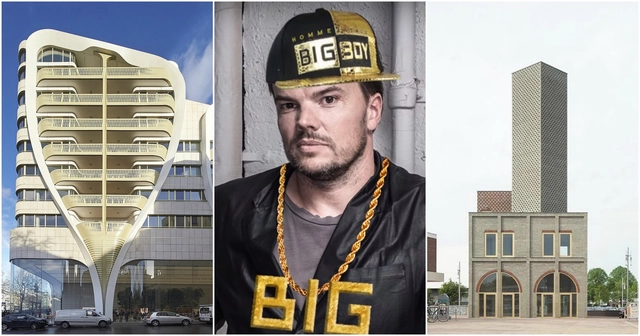
In the past two weeks, the topics of discussion in the ArchDaily comments section have been incredibly diverse: from a debate over a light-hearted approach to getting the architectural job of your dreams, to a serious argument over the exploitation of young workers in the industry; and from criticism of a Zaha-like “melted yellow cheese” design to a favorable analysis of an intellectual postmodernist landmark. Read on to find out what our readers had to say.
The Basílica i Temple Expiatori de la Sagrada Família, more commonly known simply as the Sagrada Família, has been under construction in Barcelona since 1882, but now completion of the church is finally in sight. As this video from the Basilica’s YouTube page illustrates, the six final towers are set to be completed by 2026, timed to coincide with the 100th anniversary of the death of Antoni Gaudí, the Catalan architect who devoted much of his life to the design and construction of the building. These six towers, representing the Virgin Mary, the four evangelists, and Jesus Christ, will be the last and tallest of 18 spires on the church, and will make the Sagrada Família the tallest church building in the world.
DIY wooden pallet creations are an increasingly popular trend, with projects ranging from building pieces of furniture to even making an outdoor pool. In their latest how-to, Interesting Engineering brings the DIY trend to a much larger scale with a video showing how to build a house using wooden pallets. Watch the video above to learn how to make a wooden pallet house and check out some tips from the video after the break.
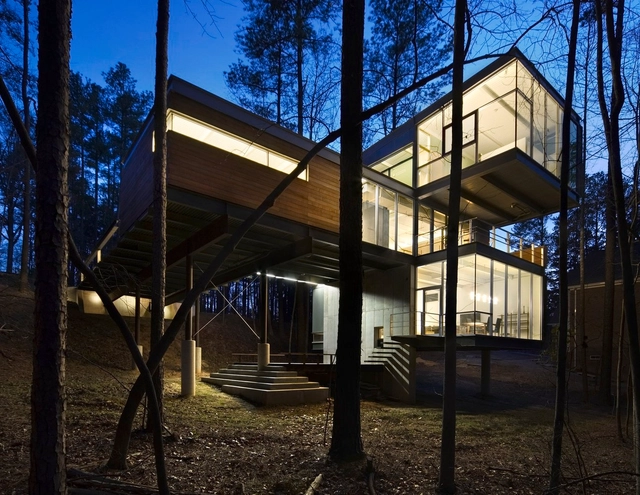
The AIA has selected George Smart as the winner of the 2016 Collaborative Achievement Award for his work with North Carolina Modernist Houses (NCMH), which creates “fresh awareness” of modern architecture through its mission to "document, preserve, and promote modernist architecture" across the US. The award, to be presented at the 2016 AIA National Convention and Design Exposition in Philadelphia, recognizes and encourages distinguished achievements of allied professionals, clients, organizations, architect teams, knowledge communities, and others who have had a beneficial influence on or advanced the architectural profession.
Metropolis has released their list of five design thinkers leading the world in innovation for their 2016 Game Changers issue. The Metropolis Game Changers issue was created in 2011 to showcase transformational changes that are national in scope, but global in impact, and can be awarded to individuals, firms, projects or ideas within the various spheres of design. Past nominees from the realm of architecture include Michael Maltzan, MASS Design Group, Edward Mazria, Vincent Scully, SOM’s Great Lake Century Project, and former SHoP Principal Vishaan Chakrabarti.
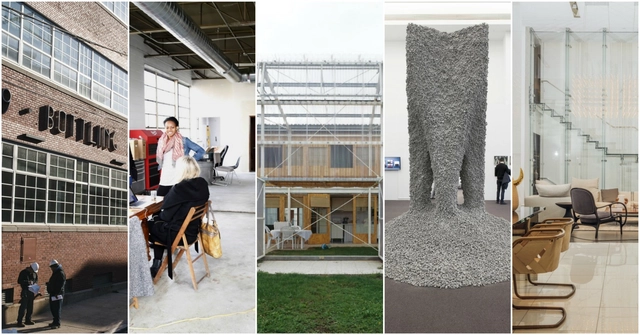
With two architectural firms, an architecture curator and a co-working space driving urban renewal all making the five-strong list, this year's Game Changers issue offers plenty of interest for architectural readers.
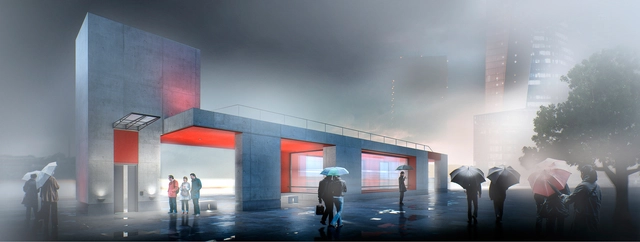
Timur Bashkayev Architectural Bureau. Image Courtesy of Strelka KB
Strelka KB has announced two Russia-based design teams, Timur Bashkayev Architectural Bureau and BuroMoscow, as the winners of the design competition for two Moscow metro stations. The stations, Nizhniye Mnevnik and Terekhovo, are both located to the northwest of the capital. These two new stations, which include designs for an outdoor pavilion, a street underpass, a ticket booth and a street underpass, will extend the Moscow Metro network and are expected to be fully functioning in 2018.
A’ Design Award has once again launched its call for entries for Architectural Projects, Interior Design Work, Furniture Designs, Innovative Lighting Products and Building Materials. Everything related to architecture and design, including but not limited to new products, real estate, construction projects and even machinery can be submitted for awards consideration.
https://www.archdaily.com/781386/call-for-entries-a-design-award-architecture-interior-design-furniture-lighting-and-building-materialsSponsored Post
Could you be one of TED's first Residents? TED is offering a new space in their New York SoHo headquarters for a brand-new program: TED Residency. Searching for creative individuals who believe their work deserves more exposure and can benefit from interdisciplinary interactions, the TED team will give each resident a chance to develop their idea for four months with the support of their team. If chosen, you will be provided an office space, technical assistance, and an opportunity to present your idea in the TED theater.
Submissions are due February 24. This year's residency program will run from April 1 to July 31. Apply here!
The American Institute of Architects New York Chapter has named six firms as the recipients of its New Practices New York 2016 award. Under this year's theme of "Prospect," the winners were selected for having "leveraged multiple aspects of the architecture profession, utilizing unique and innovative strategies, both in the projects and the practices they have started."
For many architects, an obsession with design came at a very young age - often, an architectural career begins with toys such as wooden blocks or that old classic, LEGO. In recent years though, a new contender has emerged to inspire young architectural minds: Minecraft. In this article, originally published on Autodesk's Redshift publication as "Minecraft Architecture: What Architects Can Learn From a Video Game," Kim A O'Connell looks into the growing influence of Minecraft in architectural design and education, including the growing presence of the global "Blockworks" team.
Since it burst onto the gaming scene in 2009, Minecraft has become one of the world’s most popular video games—so much so that Microsoft bought the game and its parent company for a whopping $2.5 billion in 2014.
Today, the world-building platform has also garnered the attention of architects and designers. Could a video game actually change the way architecture is taught and practiced?
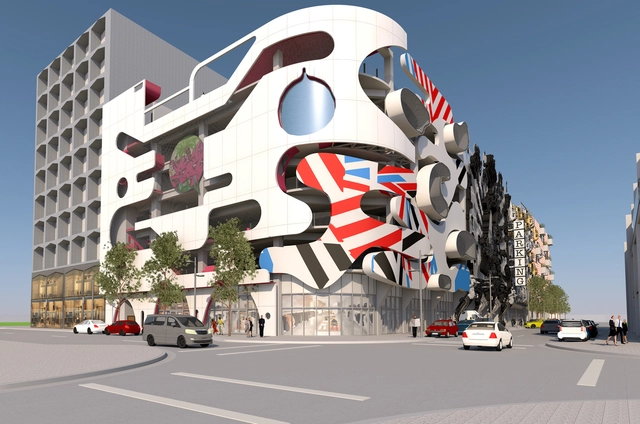
The Miami Design District, a neighborhood dedicated to innovative art and architecture, has commissioned The Museum Garage to be built as a part of Phase III of development. Curated by Terence Riley of K/R Architects, the garage will feature six different facades each designed by a different firm: Work Architecture Company (WORKac); J. Mayer H.; Clavel Arquitectos; Nicolas Buffe; K/R Architects; and Sagmeister & Walsh.
The facades will include a wall of recycled cars, a wall of traffic barriers repurposed as screens, a mural of cartoon characters mixed in with baroque details, a corner design of interlocking puzzle pieces, façade cutouts that serve as an “ant farm” which expose the activity inside, and a painting of a candle being burned at both ends.
Scheduled for completion this year, the garage will serve as a seven story mixed-use building with ground-floor retail and a garage for 800 vehicles.
Learn more about each of the facade designs after the break.
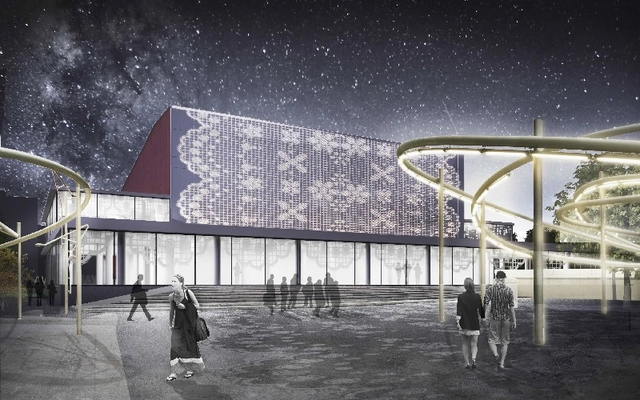
Varshava / Spektrum Consortium + EMBT + A2OM. Image Courtesy of the Architectural Council of Moscow
Moscow’s Chief Architect Sergey Kuznetsov has announced the winners of the Open All-Russia Competition for a Concept of Redevelopment of two modernist cinema theaters: Varshava and Voskhod. An initiative of ADG Group, in collaboration with the Committee on Architecture and Urban Planning of Moscow City, the competition awarded one winner for the Voskhod theater, and two winners for the Varshava theater. The organizer of the competition is the agency for strategic development "CENTER."
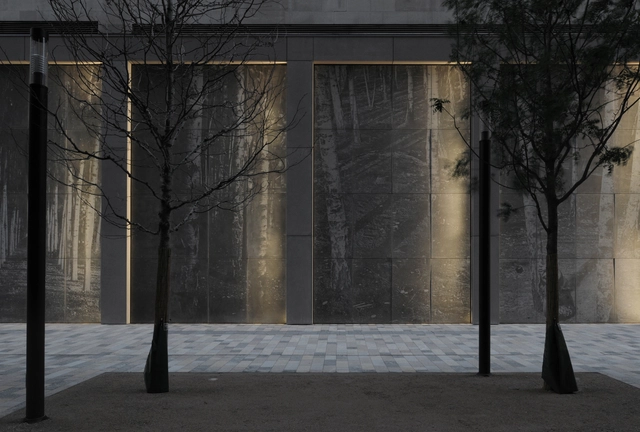
The textured surface of the frieze changes according to ambient light, creating a perplexing effect in the image from day to night. Image Courtesy of Lynch Architects
A new type of greenery has arrived in central London. Placed along the western façade of Westminster City Hall (known as Kingsgate Walk), a sprawling concrete frieze in relief depicts shimmering nocturnal birch trees photographed in forests from Beijing to London. Created using emerging technology, the relief was rendered through the concrete casting of a photograph by artist Rut Blees Luxemburg, a photographic artist and a reader in Urban Aesthetics at London's Royal College of Art. The textured surface of the frieze changes according to ambient light, creating a perplexing effect in the image from day to night.
Realized through a unique collaboration between artist Blees Luxemburg, London-based Lynch Architects and developer Land Securities as a part of Kingsgate, Silver Forest completes the major urban regeneration project for London Victoria in its new home in a public square adjacent to Westminster City Hall.
Find out more about the interdisciplinary partnership formed for Silver Forest after the break.
AMO has released the 16th edition of PradaReal Fantasies - a conceptual reinterpretation of the 2016 Spring/Summer Prada collection.
"AMO graphically reinterprets the Indefinite Hangar as a synthetic sunset fixed within a 3 dimensional blank space. The abstract hangar is populated with geometric objects and furniture. Characters move through a neutral scene between the undefined and distilled fragments of daily life. The horizon and scale constantly shifts, manipulating the frame and disrupting a linear sequence: an artificial landscape where fiction and collection collide," says the OMA research studio.
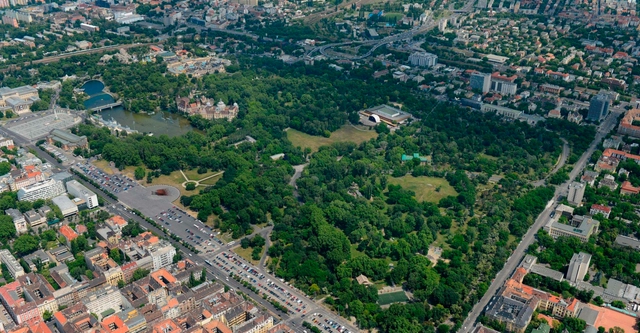
"For the first time since the foundation of the Museum of Ethnography that is, for over 140 years now, it has become possible to permanently place the museum in a building worthy for the collection, to be built specifically for this function. In addition, the construction of the new building of the Museum of Ethnography will solve another more than half a century problem: by relocating the institution, the Kúria (former Ministry of Justice) building, recently housing the museum, can regain its original function," says Liget Budapest.
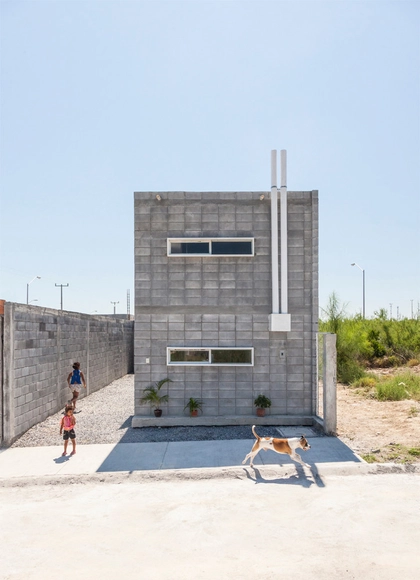
Eight practices from the US, Canada and Mexico have been selected to receive The Architectural League of New York’s 34th annual Emerging Voices award - one of the most coveted awards in North American architecture. Each recipient was selected for being a “distinct design voice” with the “potential to influence" disciplines of architecture, landscape architecture, and urbanism.
“The 2016 ‘Voices,’ each responding to distinct geographic sites and typologies, all compellingly address the relationship between architecture and place by resourcefully synthesizing programmatic invention with computational production and the craft of building,” said Program Director Anne Rieselbach.
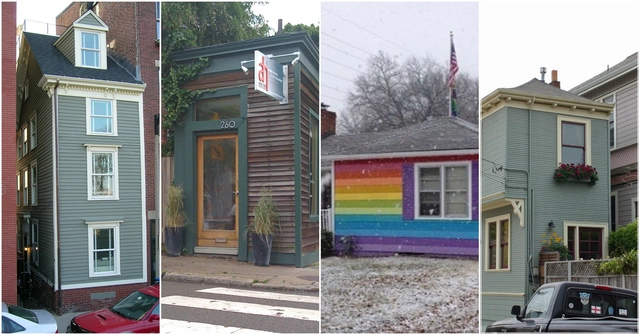
There are many good reasons to build a house: shelter, economics, or self-expression. But spite? In this article, originally published on Curbed as "Spite Houses: 12 Homes Created With Anger and Angst," Patrick Sisson delves into the "small but ignoble tradition" of people who constructed houses to enrage their neighbors, family members or the authorities.
What's not to love about a building called a "spite house?" In an essay in the New York Times, writer Kate Bolick discusses her dream of owning the Plum Island Pink House, a forlorn, decaying structure in Newbury, Massachusetts set in the middle of a salt marsh. The romantic, reclusive home stands alone for a reason; built by a recently divorced husband for his ex-wife as a condition of their separation, it's an exact duplicate of their shared home, just uncomfortably moored in the middle of remote wetlands and constructed without any running fresh water. The square loner is part of a small but ignoble tradition of spite houses, buildings created for malice instead of comfort meant to irritate or enrage neighbors, or occasionally piss off anyone unfortunate enough to be dwelling inside. Normally built to block a neighbor's light or access, they can be found as early at the 18th century. Here are some examples of homes or apartment that were built, or painted, out of anger.
We've all been there: it's time to write a cover letter to apply for the job you've always dreamed of, but all that you can seem to muster are tired phrases and generic expressions. Well, in walks Étienne Duval to put us all to shame. Duval, a 30-year old architect, wanted to work at BIG, with "Yes is More"-man Bjarke Ingels. And what kind of cover letter did Étienne write? A rap... with an accompanying video. It's witty, well-done and (in our humble opinion) a perfect fit for BIG.
After the video made the rounds here at ArchDaily, we had some burning questions for Étienne. Check out the video, which has racked up over 20,000 views, and the short interview below.
ArchDaily: What inspired you to create a video for your application?
https://www.archdaily.com/781534/the-story-behind-the-most-creative-job-application-weve-ever-seenAD Editorial Team
The Royal Institute of British Architects (RIBA)’s Future Trends Survey for December 2015 showed a dip in UK architects’ confidence, reflecting the low number of new inquiries received by practices at the end of the year. The Future Trends workload index dropped substantially to +15 in December from +27 in November, showing a decrease in expected new projects. However, all regions in the UK, with the exception of Wales and the West (balance figure -3) and Scotland (balance figure -50), showed positive balance figures, with Scotland’s low numbers possibly related to the impact of oil price changes. The South of England was the most optimistic region with a balance figure of +30.
Zaha Hadid, who was named as the the first sole woman to be awarded the UK's highest honour for architects in her own right in 2015, received the Royal Institute of British Architects (RIBA) 2016 Royal Gold Medal at a ceremony in London yesterday. Hadid, who was appointed a Dame of the British Empire in 2012, received the Pritzker Prize in 2004. Her practice also took both the 2010 and 2011 RIBA Stirling Prizes.
In 2013, Skylar Tibbits of the MIT Self-Assembly Lab introduced a new phrase to the architectural lexicon: 4D Printing. The concept, which built on the hype surrounding 3D printing and added the dimension of time, describes materials that can be constructed through 3D printing in such a way that they later react and change shape in response to an external stimulus such as heat or moisture.
Tibbits demonstrated his idea with a composite of two materials, but now researchers led by materials scientist Jennifer Lewis at Harvard have gone one better, creating a method that produces the same effects with just one material.
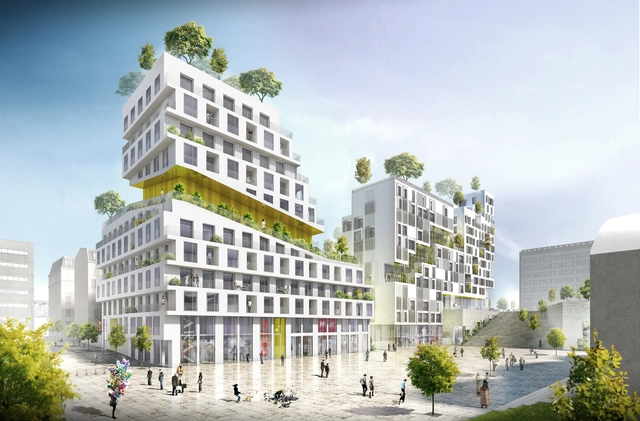
Amsterdam-based SeARCH has won a competition in collaboration with Atelier Phileas and LA architectures to design a housing block in the new Paris Rive Gauche district. With each practice focused on one building, the project resulted in the combining of three interconnected high-rises united by a "green ribbon," "cut skyline" and a common expression of function projected onto the facades. Together, they offer 55 family apartments, 180 student flats, 75 middle income apartments, offices, a commercial area and underground public parking.
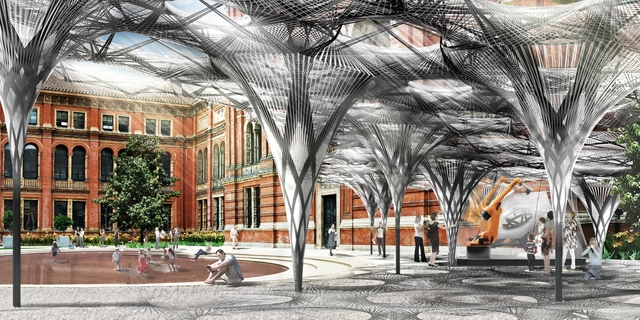
Stuttgart experimental architect Achim Menges has been commissioned to kickstart the V&A's first ever Engineering Season with a site specific, nature-inspired installation fabricated by robots. Complemented by Ove Arup's first major retrospective, Engineering the World: Ove Arup and the Philosophy of Total Design, the Elytra Filament Pavilion will be Menges' first public commission in the UK. He will work with Moritz Dörstelmann, structural engineer Jan Knippers and climate engineer Thomas Auer to complete the project.
"Elytra Filament Pavilion will explore the impact of emerging robotic technologies on architectural design, engineering and making," says the V&A. "Inspired by a lightweight construction principle found in nature, the fibrous structures of the forewing shells of flying beetles known as elytra, the Pavilion will be an undulating canopy of tightly-woven carbon fibre cells created using a novel robotic production process."
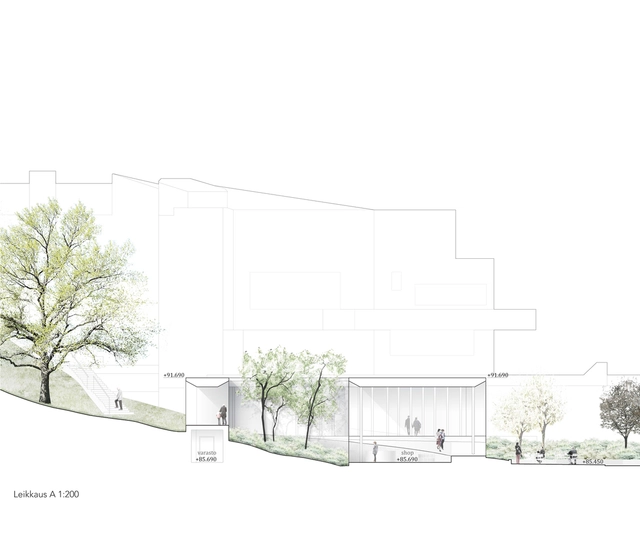
A group of young Finnish architects - Sini Rahikainen, Hannele Cederström, Inka Norros, Kirsti Paloheimo, Maria Kleimola - has won an open competition seeking ideas to "connect and integrate" two Alvar Aalto masterpieces - the Alvar Aalto museum and the Museum of Central Finland in Jyväskylä's Ruusupuisto park. With their entry, "Silmu," the winning team was selected over 689 other entries for creating a sensible proposal that met the competitions main goal - "to adapt to its worthy environment in a balanced way, and to find a natural connection with the architecture of Alvar Aalto."
“The high-end entries stand out from the rest with their clear, striking ideas and formal properties. The best things about Silmu were its atmosphere and the subtle contours. It was also seen as adding an extra, tranquil element between the Alvar Aalto Museum and the Museum of Central Finland, while further increasing the functionality of the outdoor spaces,” says Director of the Alvar Aalto Foundation Tommi Lindh.