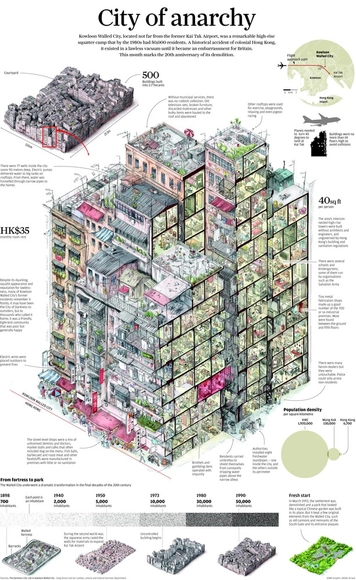
It has been twenty years since the demolition of the Kowloon Walled City. To mark this, the South China Morning Post has created an info-graphic that details the facts and figures of what life was like inside this architectural oddity.
Read more about the madness that was KWC after the break...
Toshiko Horiuchi MacAdam is known for her massive, colorful architectural sculptures/playgrounds. The most famous example of her work is the expansive net-structure inside the "Woods of Net" Pavilion at the Hakone Open Air Museum in Japan - which Horiuchi MacAdam knitted, entirely by hand, over the span of a year.
We took a moment to speak with Ms. Horiuchi MacAdam about the Pavilion and her other works, how they bridge the worlds of art and architecture, and how they irresistibly invite the world to play. You can read our interview, and see more images of her fascinating work, after the break...
In an article published by The Wall Street Journal called For Creative Cities, the Sky Has Its Limit, Richard Florida discusses the development of urban environments and their relative successes. As human migrations are trending towards big cities, the design and appropriation of space within these cities is increasingly important. Florida cites that trends indicate that by 2050 cities will make up 70% of the global population. With so many people, elevate density within cities will be unavoidable, but what Florida emphasizes is that it isn’t just density that makes a vibrant and thriving city. Citing Shanghai and New York City as examples of dense urban environments, Florida explains the differences in their relative architectural and urban developments and the prosperity that follows. The fundamental difference? The prevalence of mixed-use neighborhoods in New York City that overpower the innovation of strictly financial districts of either New York or Shanghai.
There is no other comic saga more influenced by architecture than Batman. Gotham, and the fictional architects that built the city, have been main characters since the first plots. Writer and architect Jimmy Stamp describes in these essay the fascinating architectural references and metaphors that have filled Batman stories for the last 60 years.
Batman, Gotham City, and an Overzealous Architecture Historian With a Working Knowledge of Explosives
By Jimmy Stamp
New York, Dubai, Tokyo, Moscow, Gotham. Every city in every atlas—real and fictional— has a unique character shaped by history and geography. More than a mere sense of place derived from architecture and planning, cities have a feeling that pervades the consciousness of those who live there until themselves become a a piece of the urban fabric, a fractional embodiment of the city itself. Perhaps more than any other person—real or fictional—Batman is integrally linked to his city, the city he has sworn to protect. In every sense of the word, he is a true avatar of Gotham. And Gotham City itself is an avatar, not only of the dreams of its fictional architects, but of our collective urban paranoia.
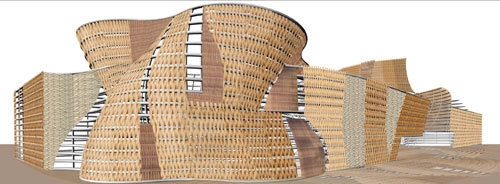
The SpainPavilion will have a steel structure and a wicker cover. Spanish handcrafters will weave out different patterns by using different colors of wicker, said Benedetta Tagliabue, designer of the pavilion. The wicker will be covered by a special material that is water-proof. It will also keep the pavilion at a comfortable temperature, said Tagliabue.