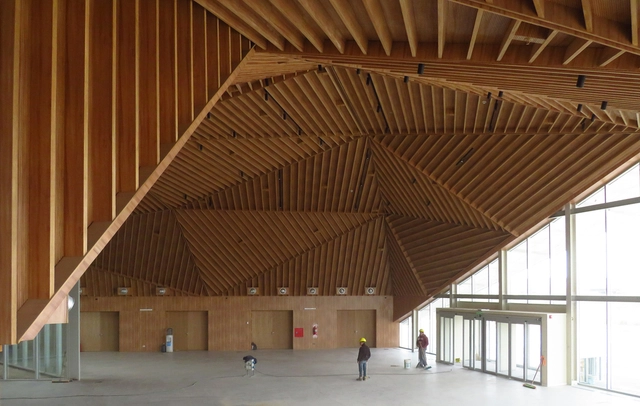
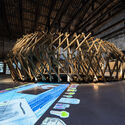
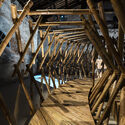
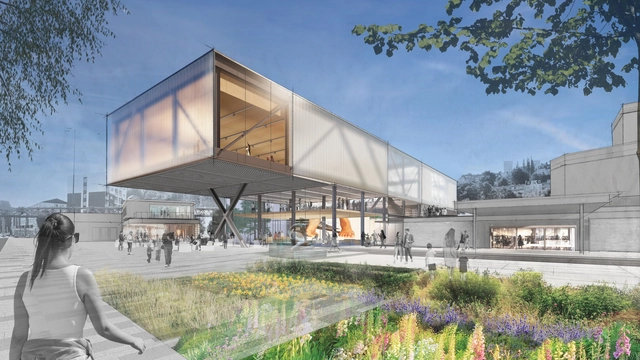
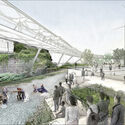
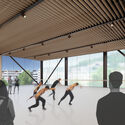
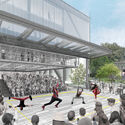
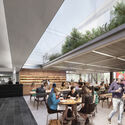
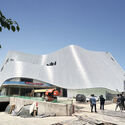
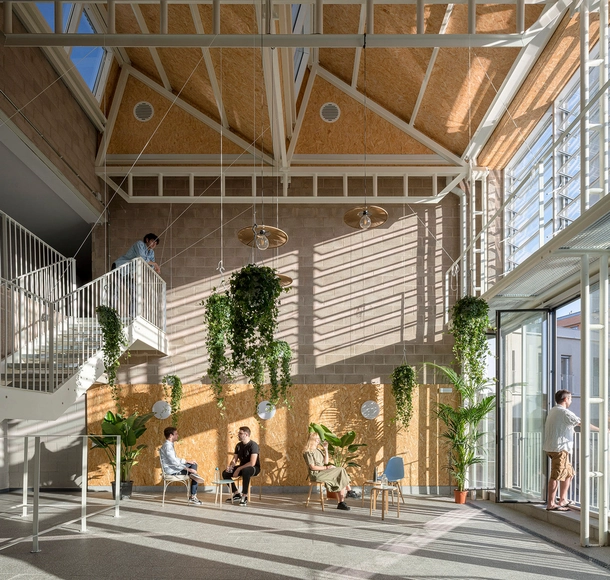
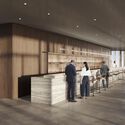
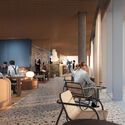
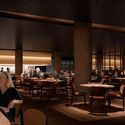
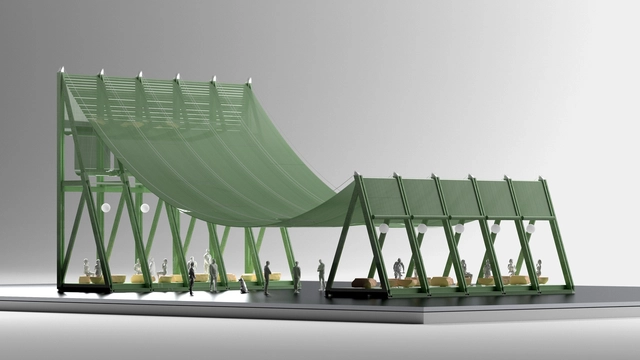
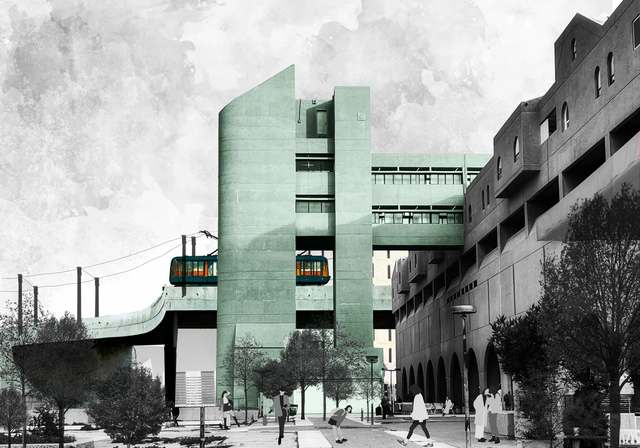
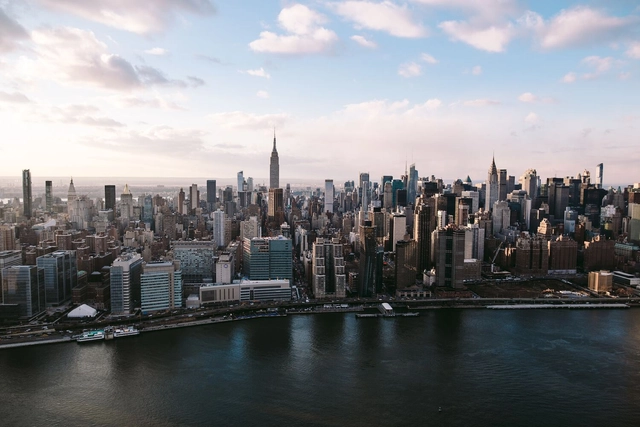
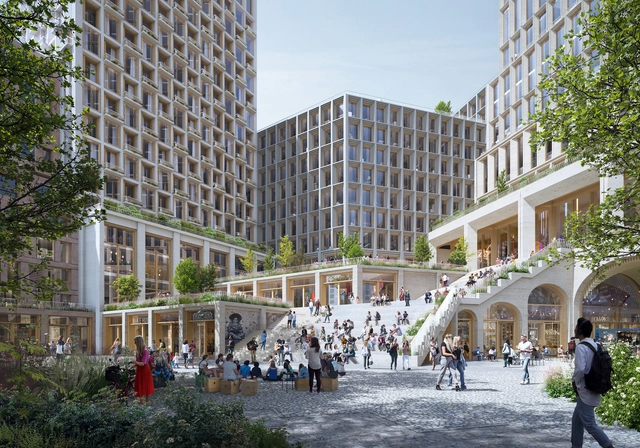
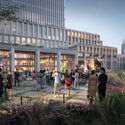
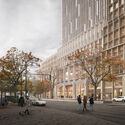
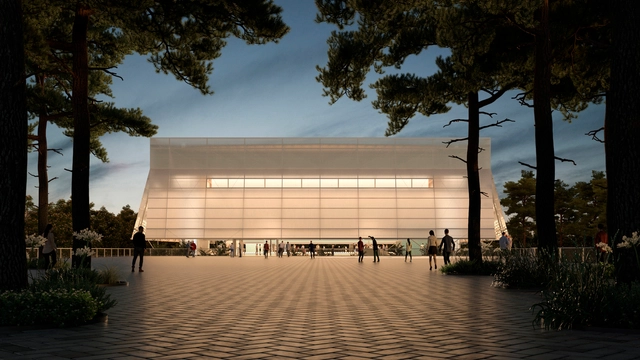
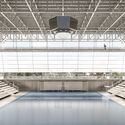
With the goal of constructing a dynamic and participatory space, the Government of the Province of Neuquén aimed to create a new metropolitan facility, seeking to promote the creation, training, and dissemination of the province's cultural scene, while also establishing itself as a productive platform for the region, as well as nationally and internationally. Bares-Bares-Bares-Schnack: Estudio de Arquitectura, Poggi-Schmit Arquitectura, and Franklin Consultora worked together to envision a spatial, architectural, and landscape model through a contemporary building that represents the aesthetic and technological criteria of the spirit of an era.
The Smithsonian Institution selected Perkins&Will to design the Bezos Learning Center at the National Air and Space Museum in located on the prominent National Mall in Washington D.C. Perkins&Will was one of the five shortlisted finalists for the competition. According to the Smithsonian, the selection was based on the architects’ ample experience in designing cultural and educational spaces, the reliability of their management team and the team’s aesthetic approach.
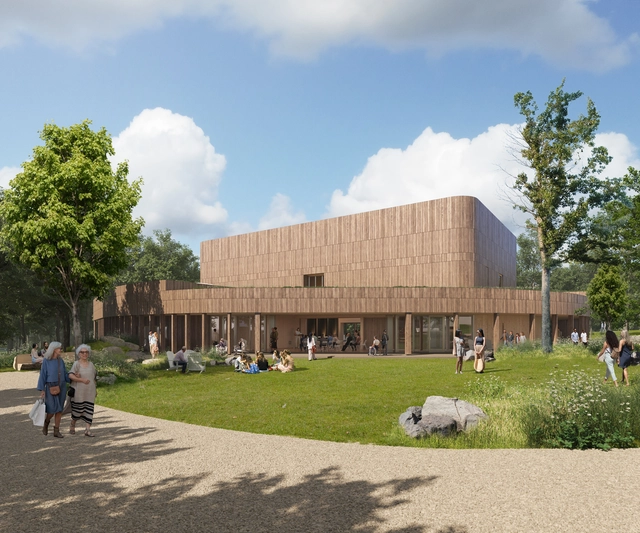
Rendering depicts a ground-level view of the planned new Doris Duke Theatre, viewed from a perspective right outside the Perles Family Studio. The new building will feature two lobbies with sliding doors, which will create multiple entrances and exits to the building. The lobby on the west side of the new Duke is visible in this image. Image Courtesy of Mecanoo Architects and Marvel
Jacob's Pillow has revealed its plans for the redesigned Doris Duke Theater, which will be built on the original site of the theater that was destroyed by a fire in November 2020. Mecanoo, based in the Netherlands and led by Creative Director and Founding Partner Francine Houben, has taken on the role of lead architect for the new building project, collaborating with Marvel, based in New York and led by Jonathan Marvel, who serves as the project's architect of record and landscape architects.
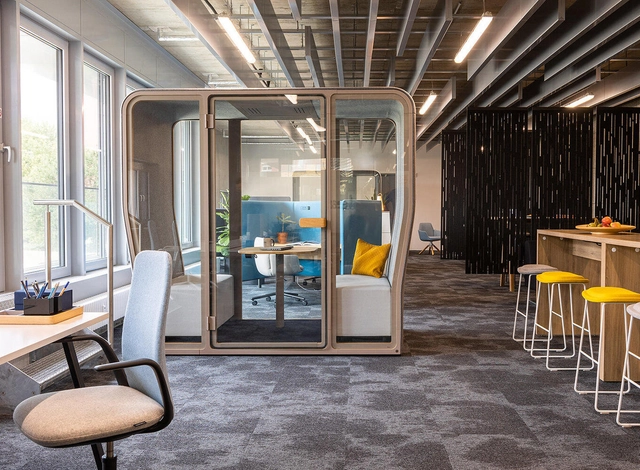
Neuro-diverse individuals might have sensitivity to light, colour or sound. It is important that flexibility is factored into an office design, with booths for quiet work and lighting options. Image Courtesy of Haworth
Global office furniture brand Haworth's concept of inclusion stretches well beyond simply accommodating disabilities, rather it involves a far-reaching philosophy that puts the well-being of all users in primary focus.
https://www.archdaily.com/1002463/making-workspaces-inclusive-through-designEmma Moore
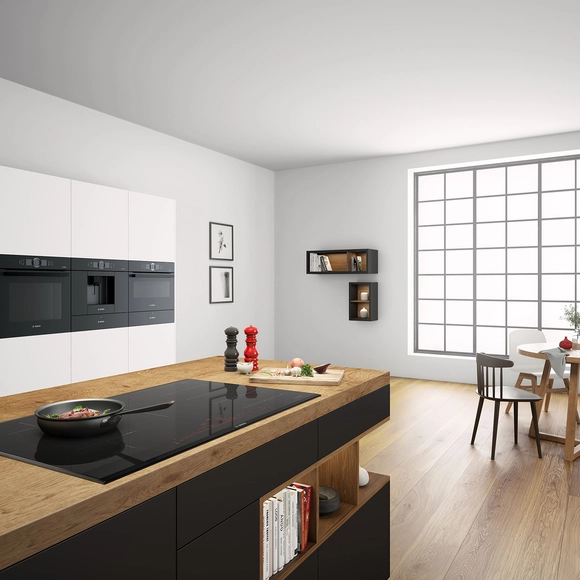
The world is increasingly electric, from our cars to our homes, making our lives more efficient and sustainable. Electricity overtook natural gas as the leading home heating source for the first time in 2020, and natural gas consumption hit a five-year low in January and a four-year low in February. This shift toward electrification is especially prevalent in the kitchen, a central hub of energy use. The U.S. Department of Energy estimates 15% of energy consumption in the average American home happens in the kitchen between cooking, refrigeration, hot water heating, and dishwashing.
Architects and homeowners looking to increase efficiency and sustainability are finding the benefits of induction. According to ENERGY STAR, gas cooktops are only 32% efficient at transferring heat, and traditional electric stovetops are 75-80% efficient — induction is even better at 85% efficiency.
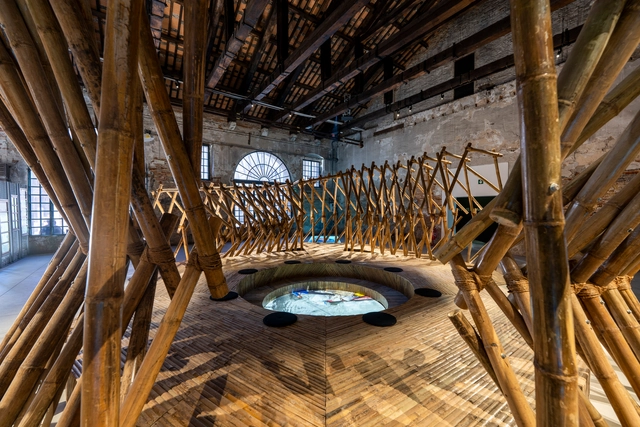
At the 18th International Architecture Exhibition of La Biennale di Venezia, The PhilippinesPavilion presents an exhibition that investigates the ecology and social implication of the Tripa de Gallina estuary in Manila. The body of water, once a mechanism for flood mitigation, has now become congested and polluted, affecting the lives of the nearby communities. The Pavilion aims to present the initiative that set out to gather and investigate the guts of the estuary and to work with the residents to find adequate and sustainable architectural solutions. Titled “Tripa de Gallina: Guts of Estuary,” the exhibition in Venice is co-curated by Architect Choie Funk and Sam Domingo and presents the work of the Architecture Collective, represented by Bien Alvarez, Matthew Gan, Ar. Lyle La Madrid, Noel Narciso and Arnold Rañada.
Pina Bausch Center in Wuppertal, Germany. Image Courtesy of Diller Scofidio + Renfro
Diller Scofidio + Renfro has won an international competition to design the new Pina Bausch Zentrum in Wuppertal, Germany. Pina Bausch’s legacy as a dancer and choreographer will be celebrated in the design and revitalization of the Tanztheater Wuppertal, as well as in the creation of a new production center. The building will emerge out of the ethos of Pina Bausch, setting an example for a new generation of leadership in the world of choreography.
Apart from the production stage centers, the design includes an archive of Pina Bausch's enormous artistic legacy, comprising a library, study, and research areas, and a public platform to promote community involvement with many creative and academic disciplines. Various contrasting and flexible spaces that encourage and foster conversation across the project's numerous program components are found throughout the proposed design.
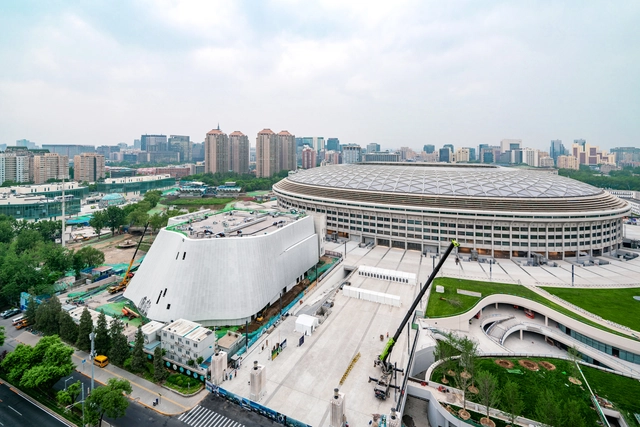
The China Philharmonic Concert Hall in Beijing, China, designed by MAD Architects led by Ma Yansong, is nearing completion. The design of the concert hall began with a competition, won by MAD in 2014. Upon completion, the 26,000-square-meter building will become the first permanent residence for the China Philharmonic Orchestra, transforming the area into a new locus for classical music and cultural exchange. The project is scheduled to be completed in 2024.
The XVI Spanish Biennial of Architecture and Urbanism (BEAU) has presented the 50 finalist proposals from its ‘Works’ call. Organized by the MITMA through the Directorate-General for Urban Agenda and Architecture, in collaboration with CSCAE and Fundación Arquia, the upcoming event seeks to reflect on how architecture can transform the future under the theme ‘Me–dio Pla–zo’ (Medium Term).
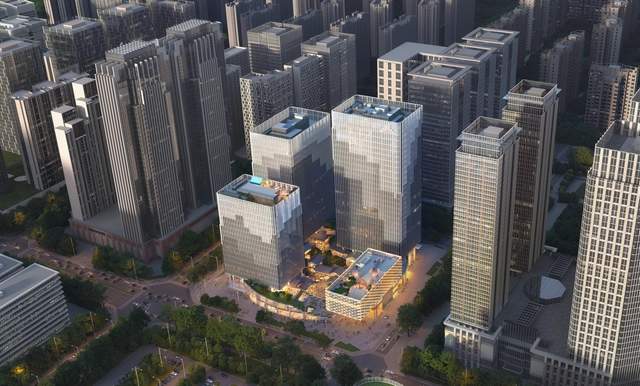
Construction has begun at the last remaining empty sites in Chengdu’s Jiaozi Park Financial and Business District, where MVRDV has designed a complex comprised of three mixed-use office towers and a conference center united by a ring-shaped plinth. The building shape and functional structure are informed by its surrounding context, with a retail village that references the traditional structures that were once located on the site.
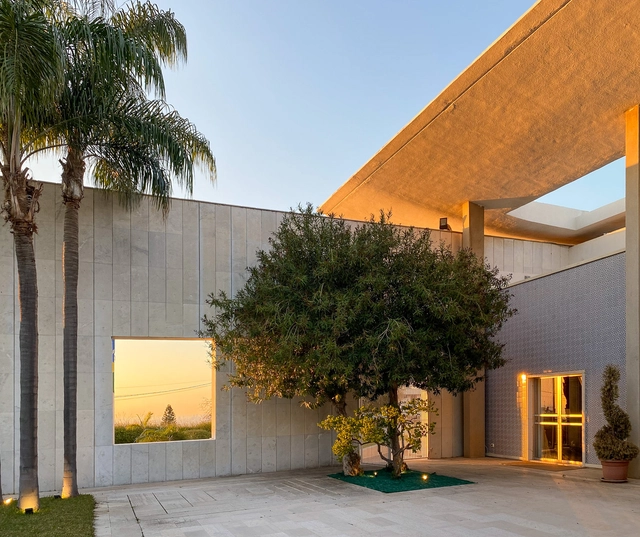
More than ten thousand kilometers away from the capital Brasilia, a jewel of Brazilian modern architecture overlooks the Mediterranean Sea. Located in another Brasilia, a district in Beirut named after the Brazilian capital, the Residence of the Ambassador of Brazil in Lebanon, designed by Olavo Redig de Campos, combines tropical modernism with elements of Middle Eastern culture.
For the first time, the house will be open to the public through guided tours focused on historical heritage. Geared towards architecture, design, and art professionals and students, the visits will be guided by Dr. George Arbid, director of the Arab Center for Architecture, a renowned institution in modern architecture in the region.
Mediterráneo de Manuel Bouzas, proyecto ganador para diseñar el pabellón de València. Image Cortesía de TAC! Festival de Arquitectura Urbana 2023
The upcoming TAC! Urban Architecture Festival announced that the two winning projects of its ideas competition are "Mediterráneo" by Manuel Bouzas and "Lost Forest" by Julia Ruiz-Cabello Subiela and Santiago Del Águila.
The American Institute of Architects has elected Evelyn Lee as the 2025 President-elect. During the AIA annual meeting, Lee has been selected to take the position of 2024 First VP President-Elect, and afterward to become president in 2025. AIA has also elected Heather Philip-O'Neal to serve as Treasurer between 2024-2025, and Latoya N. Kamdang as the elected At-large Director.
Evelyn Lee is the Global Head of Workplace Strategy and Innovation at Slack Technologies, Founder of the Practice of Architecture, and Co-Host of the Podcast Practice Disrupted. She is also a member of the National Organization of Minority Architects (NOMA). From 2020 to 2021, she served as the first female Treasurer to the AIA National Board. She is also widely published, having managed a monthly column for Contract magazine, in addition to various other online publications, where she developed recurring content on the business of architecture. Additionally, Evelyn Lee has been featured as a speaker, panelist, and moderator at national design and architecture conferences, including AIA National Convention, Dwell on Design, and Women in Green.
Rabab Raes Kazem, Envisioning the future of Kuwait, 2023. Collage, Print on Mylar, 42cmx29.7cm. Image Courtesy of NCCAL
The Kuwait Pavilion, titled 'Rethinking Rethinking Kuwait,' at the 18th International Architecture Exhibition — La Biennale di Venezia, delves into innovative architectural and urban design methods arising from space and time. The project is an ongoing exploration addressing the consequences of modernist urban planning, which erased much of Kuwait's historic built environment.
Researchers from the Graduate School of Oceanography at the University of Rhode Island have published a study showing that New York City is sinking under the weight of its countless, massive buildings. The skyscraper density of the Big Apple is increasing the risk of flooding in the city.
In addition to flooding and sea level rise driven by climate change, the risk for New Yorkers is growing because the city is sinking by an average of 1 to 2 millimeters per year, with some areas sinking at twice that rate.
Henning Larsen has been selected as the winner of an international competition for the design of Kurfürstendamm 231, a new mixed-use urban development in western Berlin, Germany. Other finalists in the competition included Cobe, David Chipperfield, and Mäckler Architekten. The winning concept centers the neighborhood around an urban courtyard which acts as a large-scale meeting place for the local community. Nine buildings define the courtyard, including the existing Agrippina House, which is set to be rehabilitated through the project.
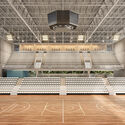
The firms Effect Arquitetura, from Brazil, and Ben-Avid, from Argentina, have partnered to design a multi-sport and events arena with a capacity of approximately 3,000 spectators. The building was designed to serve as the main venue for the 2021 Central American Games in Santa Tecla, El Salvador.
Located on a plot of land approximately 260 meters long by 60 meters wide, the building is bordered by a creek, a main avenue connecting it to the rest of the city, and a small local street. The topography features three stepped levels, sloping down toward the rear of the site along the avenue.