Building and growing are two actions that should be considered more often than not at the same time. This is how the 2017 "Build to Grow" social housing competition, looked to establish bases that sustain a flexible way of living. The event took place in the Belén district in the city of Iquitos, on 3.7 hectares plot of land. The project that received first place proposed to locate 120 incremental homes, that alternatively allowed users to modify and expand it according to their needs and economic means. In short, a home with a solid nucleus formed by a structure that supports changing activities.
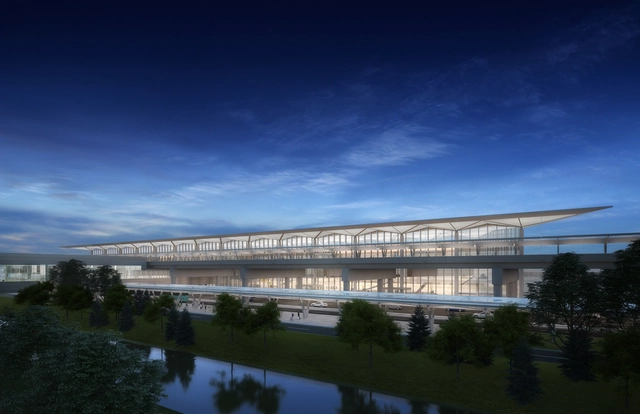
London-based Grimshaw Architects has been selected to serve as Lead Architect for the design of Newark Liberty International Airport’s new Terminal One building in New Jersey. Grimshaw will work in partnership with STV to design the $1.41 billion terminal, featuring 1 million square feet (93,000 square meters) of space and 33 gates spread across a two-level T-shaped building. The scheme represents the largest transportationinfrastructure design-build project in New Jersey’s state history.
https://www.archdaily.com/891218/grimshaw-to-lead-design-of-newark-liberty-international-airport-terminalNiall Patrick Walsh
3D printing – also known as additive manufacturing – turns digital 3D models into solid objects by building them up in layers. The technology was first invented in the 1980s and has since found its way into our everyday life – and in architecture and interior design. Architecture firm DUS has a vast expertise in architectural 3D printing and is now applying its expertise to interiors and retail spaces.
“3D printing is an ideal technique to tailor-produce to a space or a brand,” says Inara Nevskaya, head designer at DUS. “We can link a furniture’s functionality with unique form features to create statement pieces, special focal points that frame new experiences for the consumer in the retail landscape.”
https://www.archdaily.com/890494/interior-design-and-3d-printing-giving-unique-forms-to-functional-spacesLidija Grozdanic for Archipreneur.com
Public spaces are having a moment. People from outside the field of urban planning are beginning to notice the vital contributions that they make to our quality of life: inserting nature and cultural memory into the everyday, reminding us of our collective responsibilities, supporting democratic expression. People are also beginning to notice the subtle ways in which those contributions are being eroded by threats of privatization, corporate appropriation, and apathy.
Most acutely, this moment is brought to us by Apple, which has begun an aggressive retail rebranding effort to re-conceptualize its stores as “town squares,” and wrought a wave of well-founded concern. Technology continues to beckon us away from the need to leave our homes or interact face-to-face with other humans. If for every action there is an equal and opposite reaction, it would follow that opportunities for such interpersonal interaction become a luxury we begin to seek, a call to remember our origin as social beings.
Before airplanes, it took mail carriers on horseback months to transport letters across the country. Before washing machines, it took a full day of physical exercise to wash and dry a family’s laundry. And before cranes, it took decades—sometimes centuries—to build large structures such as castles and cathedrals.
The point being: Whatever you do, technology probably gives you a better way to do it.
Beginning a multi-division examination with pass rates in the 50-60% range is a seriously daunting task. That’s without even mentioning the overwhelming amount of study materials and opinions floating around in cyberspace. Never fear, ArchDaily is here to help you navigate the tools and techniques available to you when cracking open the books and (hopefully) passing your first exam.
Last week, ArchDaily covered a story about the gender pay gap at Foster + Partners. We thought such a story was "unsurprising" given that the gender pay gap is something that is widely reported on, and present in almost every industry, and we wanted to share a case of it happening in an architectural firm many of us are familiar with. What we did not expect was that readers would think it is a non-issue, or that such reporting was sensational. Is it possible for us to talk about gender in the workplace without being up in arms? Why does the gender pay gap issue make people uncomfortable?
Some of our editors discussed how gender plays into their workplace experiences as well as some hopeful recent signs that we are on a path to change.
The 3D-printed Cabin of Curiosities is a research endeavor and “proof of concept” investigation into the architectural possibilities of upcycling and custom 3D-printed claddings as a response to 21st-century housing needs.
This exploratory project is an output of Bay Area-based additive manufacturing startup Emerging Objects, founded by Ronald Rael and Virginia San Fratello, who are professors at the University of California Berkeley and San Jose State University, respectively. They also co-founded the architecture studio Rael San Fratello, whose work primarily focuses on architecture as a cultural endeavor.
Amorepacific, Korea's largest beauty company, occupies a site in the centre of Seoul, Korea. Their headquarters was designed by David Chipperfield Architects as a single clear volume, with large urban openings and a central void. In the middle of a bustling downtown landscape, the building strikes a bright, open figure.
The Amorepacific HQ took three years to complete and opened in 2017. The firm described the building as "abstract and gestural," with hanging gardens that provide dramatic views over the city and the mountains in the distance. The design echoes aspirations of mediating between local and global, private and public, collective and individual, formal and informal. Laurian Ghinitoiu captures the identity of this dynamic headquarters.
This article was originally published by Ezra Schwartz on LinkedIn. It has been reprinted here with permission from the author.
Following a recent family visit to Chichén Itzá, I became somewhat obsessed with a couple of design enigmas I found there:
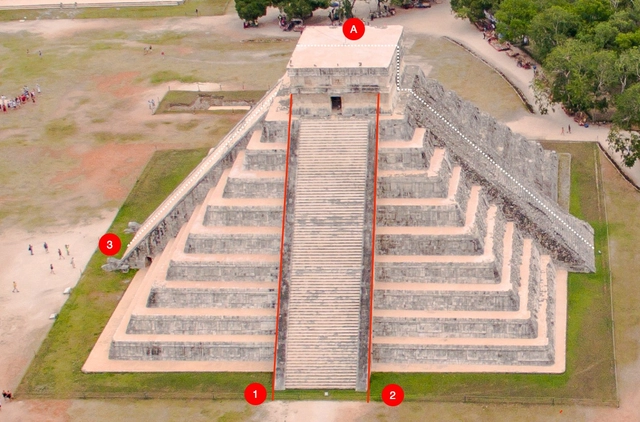
Design Enigma 1: The large pyramid in this amazing archeological complex, known as the Temple of Kukulkán, is highly symmetrical. But the first thing I observed when we approached it and stood in front of its west side, is that the structure on top of the pyramid (A above), is not center-aligned relative to the 9 terraces below it, as one would expect*. The visual guides 1 and 2 show the misalignment (images above and below).
With its Mies Crown Hall Americas Prize, the Illinois Institute of Technology College of Architecture seeks to recognize the most distinguished works of architecture in the Americas. Every two years, the Prize is awarded at an event that takes place in the masterpiece of Mies van der Rohe, the S.R. Crown Hall, the home of the Chicago-based school.
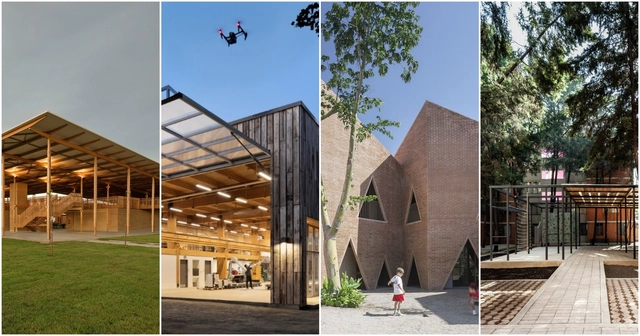
The jury, comprising Ricky Burdett, Jose Castillo, Ron Henderson, Rodrigo Pérez de Arce, and Claire Weisz, has announced four finalists in the prize's latest version of the MCHAP.emerge award, which covers architecture built in 2016 and 2017. MCHAP.emerge award aims to recognize outstanding built work by emerging practices, offering a prize of $25,000 to the winner.
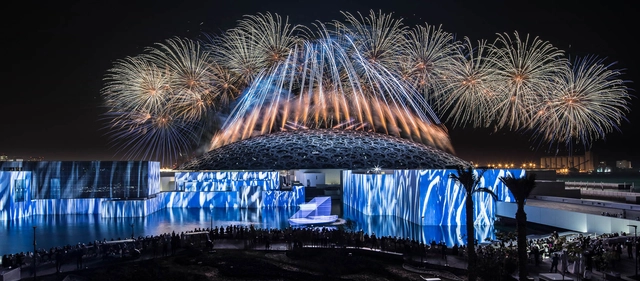
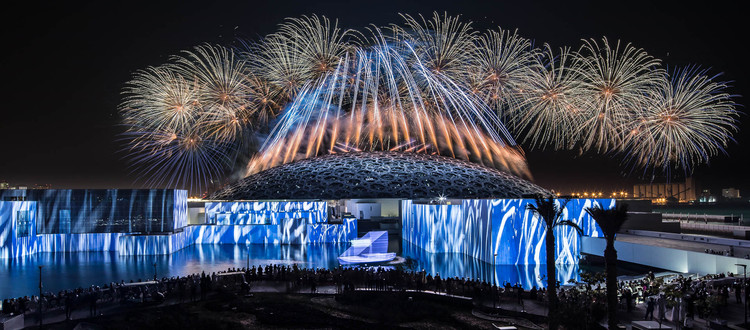
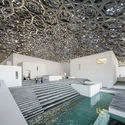
After finishing a building, the client is faced with an important question: How do they celebrate the new architecture? This moment offers an essential opportunity to inform the public about the existence and mission of the building. Therefore, the designs of opening ceremonies are often loaded with symbolic imagery to construct a new identity. Fireworks and light shows are an especially common part of the powerful repertoire used to magnify the aura of architecture. This luminous storytelling can underline the client’s uniqueness and superiority on both a local level and an international stage. I spoke with two leading designers to get their insights on how opening ceremonies have changed in recent years: Christophe Berthonneau, Creative Director at Groupe F, who introduced the Louvre Abu Dhabi, and Fred Thompson, Creative Director at Laservision Mega Media, who worked on the opening of the Marina Bay Sands in Singapore.
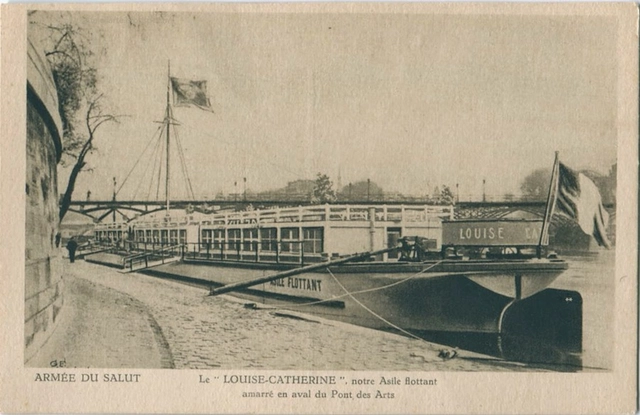
This winter, France experienced some of the heaviest rains it has seen in 50 years. In Paris, the Seine flooded its banks, submerging parks, streets, and disrupting metro service. The deluge also claimed an architectural curiosity. On February 8th the Louise-Catherine, a concrete barge renovated by Le Corbusier, slipped below the murky waters of the Seine and came to rest on the bottom of the river by Quai D’Austerlitz on the east side of Paris.
As the floodwaters receded, the 100-year-old barge’s bow became stuck on the wharf, tipping it into the river, according to Le Parisien. Though firefighters were present and attempted to save the historic vessel, it filled with water and sank in a matter of minutes.
The first few times I received negative feedback I was surprised about how I felt. I could feel my body getting tight, my temperature rising and a feeling of tension. For a brief moment, I felt as if the air had left my body and could feel myself getting defensive.
What if the one thing that makes BIG "BIG" was suddenly stripped away right at the apex of its potential? That's the question posed by the trailer for Kaspar Astrup Schrøder’s documentary BIG TIME, which ominously illustrated a possible problem with Bjarke Ingels’ health.
Schrøder's documentary highlights the intense journey of Bjarke Ingels, the founder of Bjarke Ingels Group, through the past few years of his life. This unique insight into what exactly it's like to be an architect on top of the world ultimately poses a question that needs to be answered by anyone seeking to reshape the world through design. How do you handle the responsibility of forming the future you want to live in?
In this interview with ArchDaily, the founders of O-office speak about their philosophies regarding refurbishments and the current state of architecture in China.
In this video, architecture vloggers #donotsettle take us inside Ateliers Jean Nouvel's "museum city" in the sea: the Louvre Abu Dhabi. Filmed one month after the museum’s opening in November, Kris Provoost winds his way through the galleries to the much-talked-about mega-dome—with a diagrammatic key plan in the bottom corner of the video helping us to follow his path.
Last Wednesday the world knew the name of the latest Pritzker Prize laureate: Balkrishna Doshi, the first Indian architect to receive architecture’s highest honor. The jury stated that "with an understanding and appreciation of the deep traditions of India’s architecture, Doshi united prefabrication and local craft and developed a vocabulary in harmony with the history, culture, local traditions and the changing times of his home country India".
While architects all in India are rejoicing and celebrating him, Anupama Kundoo, Professor at IE School of Architecture and Design, shared her thoughts on Doshi’s Pritzker Prize. "It is timely that there is recognition of a holistic understanding of the role of the architect, where the design of the built environment is seen as sensitive interventions that retain human scale in the man-made built landscape", stated Kundoo.





.jpg?1521632435&format=webp&width=640&height=580)



_(1).jpg?1521456027)


.jpg?1521224014)
.jpg?1521223950 "© Laurian Ghinitoiu")
.jpg?1521223961 "© Laurian Ghinitoiu")
.jpg?1521224085 "© Laurian Ghinitoiu")
.jpg?1521224100 "© Laurian Ghinitoiu")
.jpg?1521224014)








.jpg?1520626310 "© Roland Halbe")

