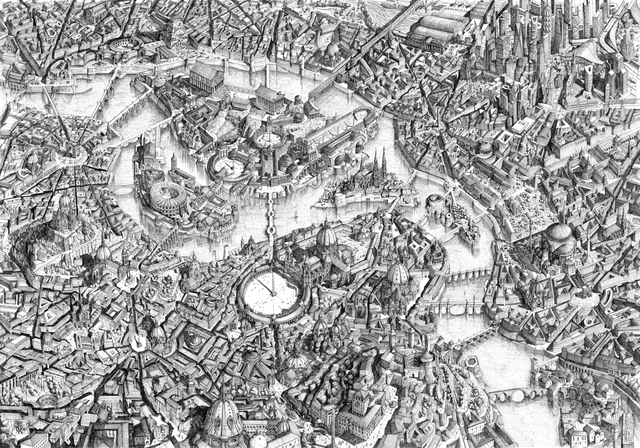
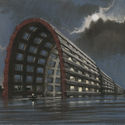
Ubaldo Occhinegro (commended, Hand-Drawn category): Utopia. Image Courtesy of Sir John Soane's Museum
The Architecture Drawing Prize received 166 entries from 26 different countries, offering a fascinating cross-section of approaches to and uses of architectural drawing today: from highly sophisticated design drawings to lyrical hand-drawn sketches, and everything in between. The exhibition retains a sense of this variety so along with the three category winners, it was decided to showcase the ten entries that received commendations from the judges.
The Bibliothèque nationale de France has given its architect Dominique Perrault ‘carte blanche’ to develop an exhibition dedicated to the building he designed in 1989 : with an original ‘mise en abyme’, a large-scale scenography presents the story of the conception and construction of the BnF, one of the most important contemporary public buildings in France.
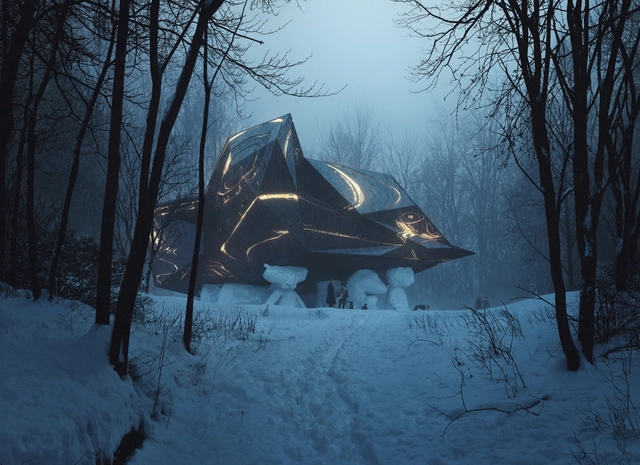
The result of an 8 year collaborative process between Snøhetta and Norwegian artist Bjarne Melgaard, “A House to Die In,” is now on display at a new exhibition Tjuvholmen in Oslo, Norway.
Organized by the architects and artist with Selvaag Art Collection, the exhibition shows the artistic process of designing the unique home and studio that is currently seeking approval for its construction. To be located on the grounds of painter Edward Munch’s former house and workshop in western Oslo, the sculptural proposal has prompted discussion over how it honors the legacy of one of Norway’s most famous artists.
Videos
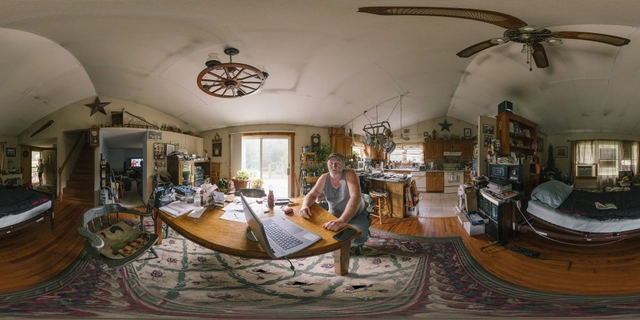
Sex and the So-Called City. Office for Political Innovation. Storefront for Art and Architecture, 2018.. Image Courtesy of Imagen Subliminal
Storefront for Art and Architecture in 97 Kenmare St, New York, opened yesterday “Sex and the So-Called City,” an alternative version of Sex and the City (SATC) made by the architect Andrés Jaque / Office for Political Innovation with Miguel de Guzmán (Imagen Subliminal) on occasion of the show’s 20th anniversary.
Capilla de Palmira (Chapel of Palmira) Lomas de Cuernavaca, Morelos, Mexico, 1958 – 1959
This exhibition roots Félix Candela (1910-1997) as one of the most prolific architects of the 20th century in his advanced geometric designs and lasting influence in contemporary architecture. It originated through the research of scholar Juan Ignacio del Cueto and is curated by the architectural theorist and designer Alexander Eisenschmidt. The exhibition spotlights Félix Candela’s Concrete Shells through photographs, architectural models, and plans, as well as archival material from his time as a professor at the School of Architecture at the University of Illinois at Chicago from 1971 to 1978.
Architect Emmanuelle Moureaux’s latest art experience, “COLOR OF TIME,” allows observers to experience the passage of time through color. Moureaux’s installation is one of a series called, “Art and Design, dialogue with materials,” for Toyama Prefectural Museum of Art & Design’s opening ceremonies. Throughout the series artists played with different materials, showing their varying potentials and characteristics.
Moureaux chose paper; layering over 100,000 number cutouts into a 3D grid. From sunrise at 6:30 to 19:49, the numbers turn over 100 shades of color, ending in black. A color changing experience totaling 799 minutes.
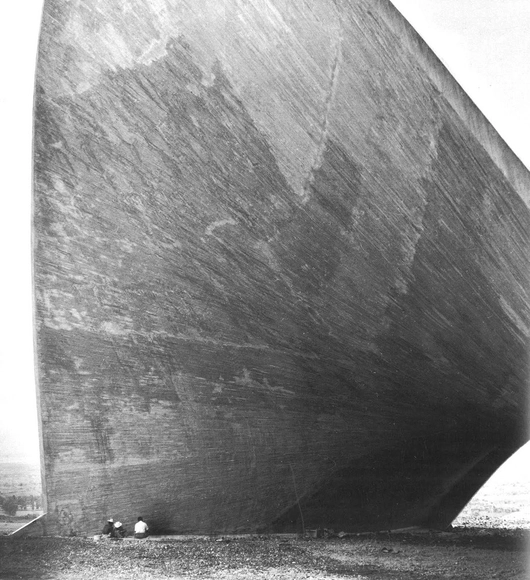
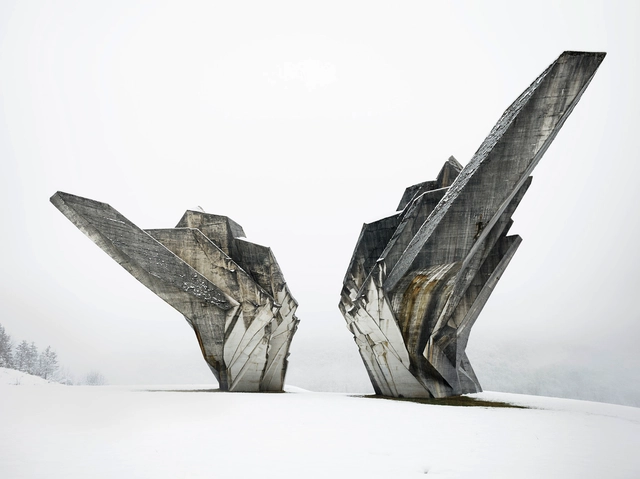
Miodrag Živković, Monument to the Battle of Sutjeska, 1965-71, Tjentište, Bosnia and Herzegovina. View of the western exposure. Photo: Valentin Jeck, commissioned by The Museum of Modern Art, New York, 2017.
The Museum of Modern Art will explore the architecture of the former Yugoslavia with Toward a Concrete Utopia: Architecture in Yugoslavia, 1948–1980, the first major US exhibition to study the remarkable body of work that sparked international interest during the 45 years of the country’s existence. The exhibition will include more than 400 drawings, models, photographs, and film reels culled from an array of municipal archives, family-held collections, and museums across the region, introducing the exceptional built work of socialist Yugoslavia’s leading architects to an international audience for the first time.
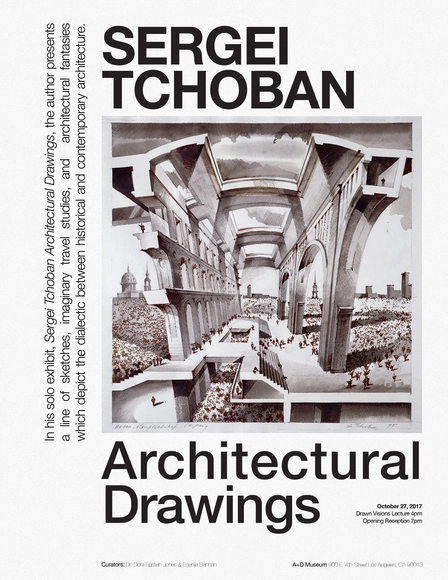
In his first solo exhibition in the United States, Sergei's 18 works on paper reveal his memories in Russia. The themes span monuments, fantastical scenes of Berlin, cities under water, exceptional sections and compositions of historical and contemporary architecture.
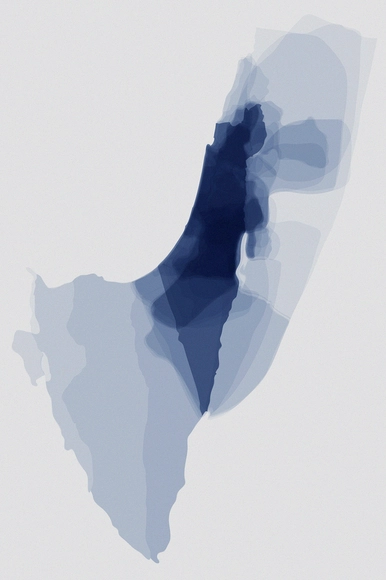
Overlapping border fluctuations Israel, Palestine from 1040 BCE to present day from Atlas of the Conflict. Israel-Palestine by Malkit Shoshan.
Borders shape and consolidate relations between states, people, jurisdictions, political entities, and territories. While some borders are stable, others are in a constant flow. The demarcation of borders is a body politic. It regulates economic relations and people’s access to places, resources, and rights. Borders are powerful instruments that determine the way our surroundings are organized, inhabited and controlled, and the ways communities relate to one another—while some break through borders to survive, others fence themselves off.
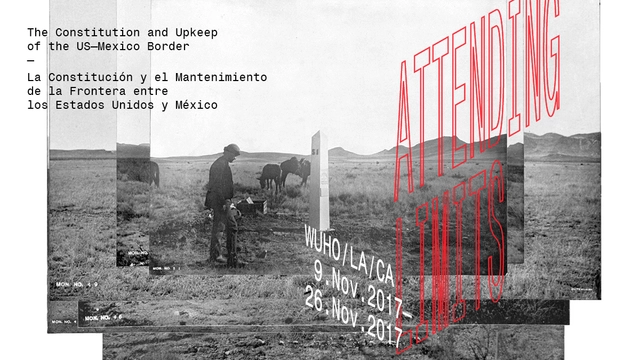
277 obelisk monuments mark the US–Mexico boundary line. Constructed in three distinct phases (1849–1856, 1891–1912, and 1964–1968), these monuments were the product of territorial negotiations, disputes that were settled ranging from the violent expansion of sovereign limits to the shifting course of a historic boundary river. Commissioned, inscribed, and placed by both the United States and Mexico, they served as unique bilateral artifacts that operated across and reflected on separate territories, forms of settlement, and philosophies of nationhood. Attending Limits: The Constitution and Upkeep of the US–Mexico Border presents the international boundary through a history of its material artifacts and the modes of representation they have motivated. Through the display of original text, animation, photographs, scale models, and maps, the exhibition theoretically frames an evolution of the US–Mexico border from single line to geopolitical territory.
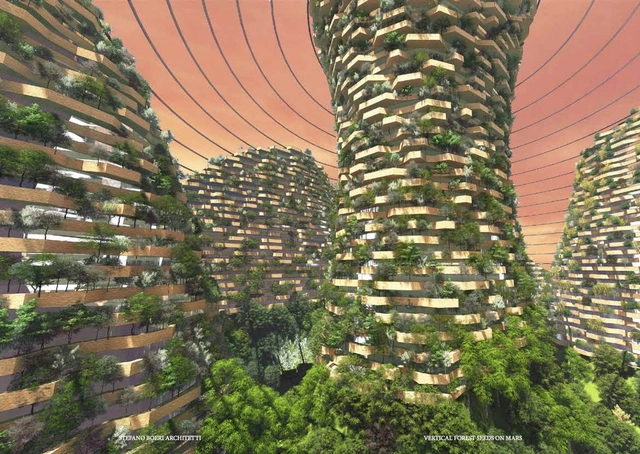
Can architecture and design reverse climate change? Architect and founding partner of Stefano Boeri Architetti (SBA), Stefano Boeri believes it can. Boeri’s Vertical Forest, a project which marries the natural and urban spheres through biodiversity and reforestation, has already come to fruition in Milan, is currently under construction in Beijing, and soon to be constructed in Shanghai. (Watch the video to learn more about Boeri’s Vertical Forest projects.)
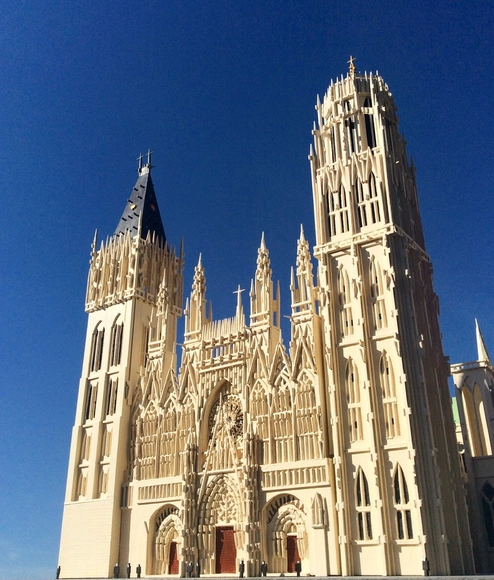
The exhibition "Gothic: The Age of the Great Cathedrals" will begin in Switzerland in December 2017 in the choir of the Cathedral of St. Nicholas in Fribourg. It will go to the Cathedral of Bern (Berner Münster, Cathedral of Bordeaux and Church of St. Germain l'Auxerrois in Paris. The idea of this project is a journey through the extraordinary saga of these great medieval buildings. This adventure begins with the construction of the Basilica Cathedral of Saint-Denis, the place where Gothic art was born. Throughout the exhibition, the visitors will discover secrets of 17 monuments chosen among the most beautiful, the most emblematic. They will encounter this medieval art movement that has overwhelmed Europe and wished to build always higher, larger and more beautifully!
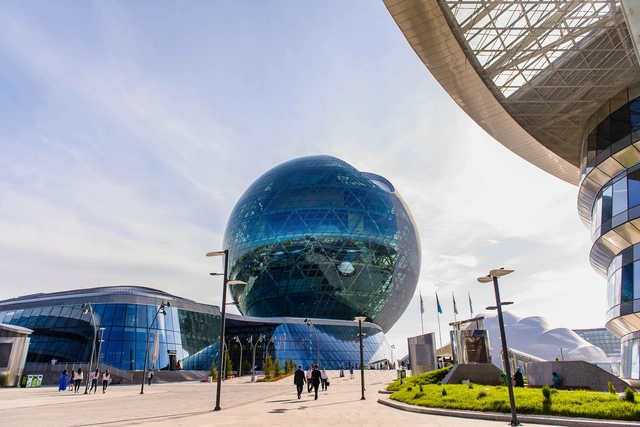
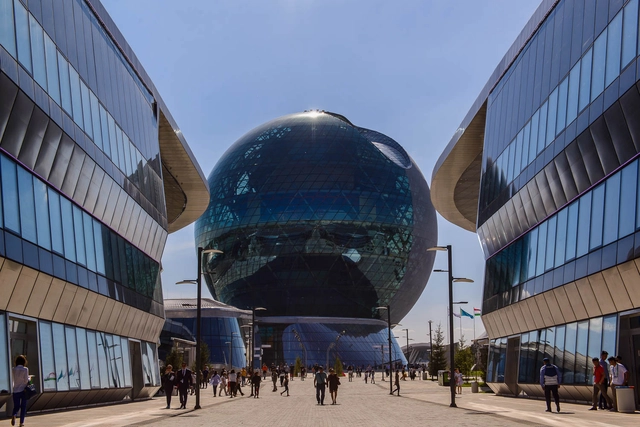
The International Specialized Exhibition Astana EXPO 2017 dedicated to Future Energy was an expositional and recreational event that took place between June 10 and September 10, 2017 in the capital of Kazakhstan. The exhibition lasted 93 days and became one of the most spectacular cultural venues of the year. Overall, 115 countries and 22 international organizations took part in the event.
As part of Astana EXPO 2017, global policy documents were drafted in order to promote an energy-efficient lifestyle and wide use of renewable energy sources.
The International Specialized Exhibition Astana EXPO 2017 dedicated to the theme "Future Energy" was an expositional and recreational event that took place between June 10 and September 10, 2017 in the capital of Kazakhstan. The exhibition lasted 93 days and became one of the most spectacular cultural venues in 2017. Overall, 115 countries and 22 international organizations took part in the event.
The exhibition presents around 50 drawings which can be grouped into three categories: the Tallinn School, Paper Architecture from Moscow and that from Novosibirsk. It includes works by renowned artists such as Leonhard Lapin, Yuri Avvakumov, Alexander Brodsky and other architects. Although the artists belong to different architectural groups and come from three diverse cities, they were united by the impulse to break out of the routine of late Soviet planning bureaus, dare something new, develop bold projects and confront the issues of environmental change, authority and technology.
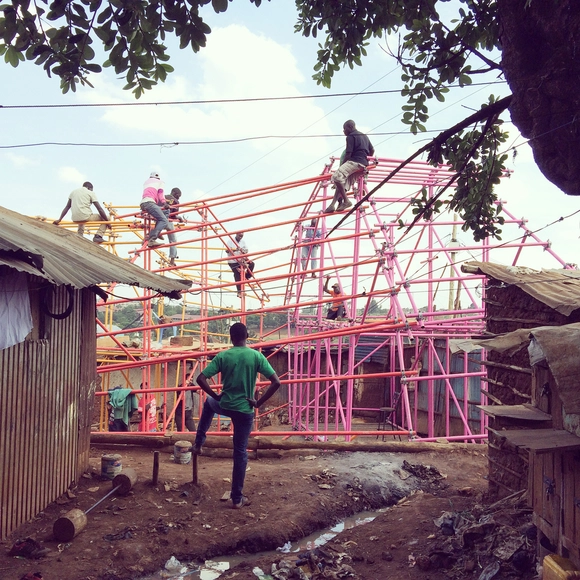
Image: Kibera Hamlets School by SelgasCano, Helloeverything, and studio.14, photo credit: helloeverything
Scaffolding curated by Greg Barton, examines the extraordinary applications of scaffolding as a kit-of-parts technology to provide novel forms of inhabitation and access. Through an installation designed by Shohei Shigematsu and OMA New York with graphic design by MTWTF, Scaffolding will disrupt the architectural space of the Center for Architecture, instilling a new appreciation of scaffolding and its transformative potential.
Of particular interest to our local New York City audience, scaffolding is a flexible and accessible system hiding in plain sight. Despite its indispensable link to architecture, scaffolding is too often maligned as a necessary nuisance. The exhibition demonstrates how this
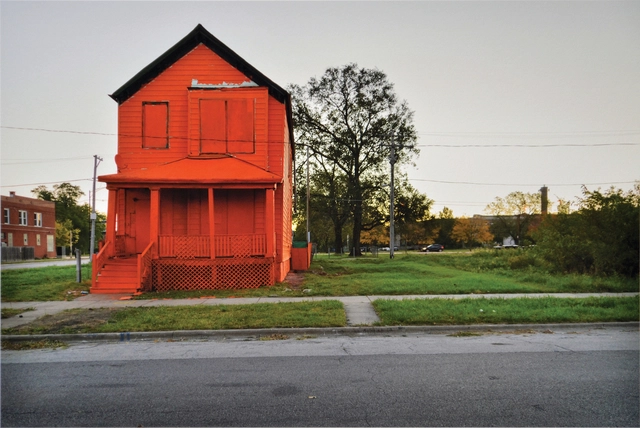
Amanda Williams, Flamin’ Red Hots from Color(ed) Theory Suite, 2014–16. Courtesy of the artist/ McCormick Gallery
The Museum of Contemporary Art Chicago presents the first-ever museum exhibition of breakout Chicago artist Amanda Williams, featuring a new addition to her highly acclaimed project, Color(ed) Theory, which debuted at the first Chicago Architecture Biennial. The bright, monochromatic houses painted as part of Color(ed) Theory bring attention to the overwhelming number of vacancies on Chicago’s South Side, reflecting Williams’ perspective that architecture serves as a microcosm for larger social issues. Together with new works such as A Dream or Substance, a Beamer, a Necklace or Freedom? -- where Williams invited Englewood-based collaborators to gild a room in imitation gold leaf in the same proportion of a Chicago lot, and then sealed off the room with just a small gap for viewing the gleaming interior -- Williams’ solo debut creates an experience that comments on race, class, and urban space. Chicago Works: Amanda Williamsis organized by MCA Curatorial Assistant Grace Deveney and is on view from July 18 to December 31, 2017.
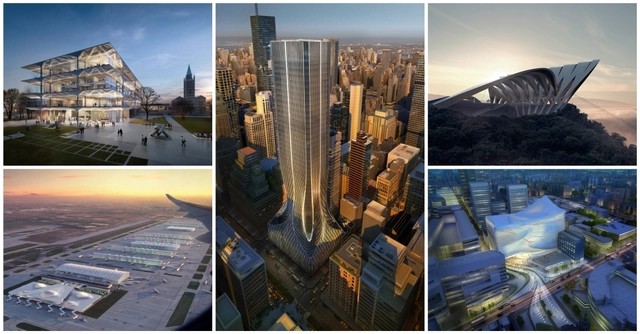
Now on display at the Jaroslav Fragner Gallery as part of the third Prague Experimental Architecture Biennial is “ZHA: Unbuilt,” an in-depth look into some of the firm’s best projects that could have been.
Arranged within the space by typological concepts (towers, atriums, stadiums, shells, masterplans, ribbons, and bubbles), the exhibition serves as an exploration into the evolution of the work of Zaha Hadid Architects, showing how earlier research and innovations have become the foundations of the firm's architectural projects currently in development.