Grab your cardboard, parcel tape, and model building skills: Halloween masks are no longer just for witches and warlocks, but for architects too. A furniture designer turned mask creator based in the United Kingdom has created a series of geometric masks for the creatively inclined, available as a template online. A great way to use up leftover model-making materials, the masks were designed "to create a set of masks that could be built by anyone using local materials removing the need for mass manufacturing or shipping and with the minimum environmental impact," says their creator Steve Wintercroft.
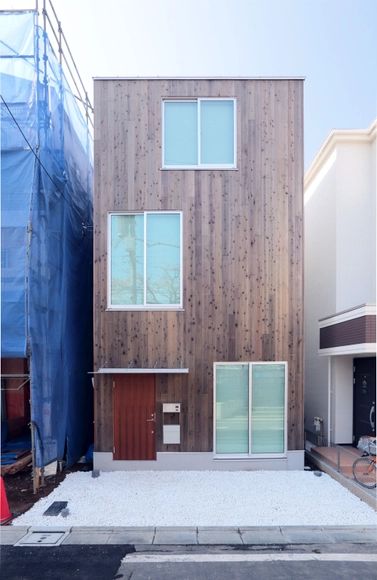
Japanese design brand MUJI has taken a bold step into architectural territory. A few years after a collaboration with Kengo Kuma to design two prefab houses, the company has come forth with a Vertical House in Tokyo. Streamlined and efficient, the home accommodates all the demands of residential living within a small plot of land.
Interior images and more information, after the break.
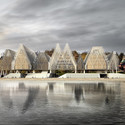
JHK Architecten and Broekbakema have shared with us their competition entry for a higher education school in the field of transport for Rotterdam. The building, envisioned as part of Rotterdam’s transport and logistics district, was inspired by the “distinctive sturdy structures of the port.”
The Courtowers (currently under construction). Image Courtesy of Hashim Sarkis Studios
Hashim Sarkis - a prominent scholar of architecture and urbanism, a practicing architect whose works have been built in the United States and the Middle East, and a leading expert on design in the Middle East - has been named the new dean of MIT’s School of Architecture and Planning (SA+P), effective in January. Sarkis is currently the Aga Khan Professor of Landscape Architecture and Urbanism in Muslim Societies at Harvard University’s Graduate School of Design (GSD). He has been on the Harvard faculty since 1998, and has been a full professor since 2002.
“The energy and forward-looking attitude I have encountered at one of the oldest schools of architecture and planning in the country makes it feel like the youngest,” Sarkis says. Read the complete press release here.
"Don't fight forces, use them." - R. Buckminster Fuller
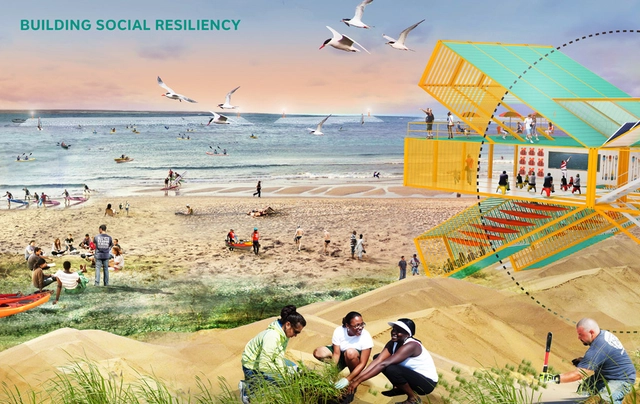
SCAPE’s comprehensive climate change adaptation and community development project, Living Breakwaters has been announced as winner of the 2014 Fuller Challenge, “socially responsible design’s highest award.” Announced by the Buckminster Fuller Institute (BFI), the proposal was selected over seven shortlisted humanitarian initiatives and will receive a $100,000 prize for their innovative solution to solve one of humanity’s most pressing problems.
"Living Breakwaters is about dissipating and working with natural energy rather than fighting it. It is on the one hand an engineering and infrastructure-related intervention, but it also has a unique biological function as well. The project team understand that you cannot keep back coastal flooding in the context of climate change, but what you can do is ameliorate the force and impact of 100 and 500 year storm surges to diminish the damage through ecological interventions, while simultaneously catalyzing dialog to nurture future stewards of the built environment," said Bill Browning of Terrapin Bright Green, a 2014 senior advisor and jury member.
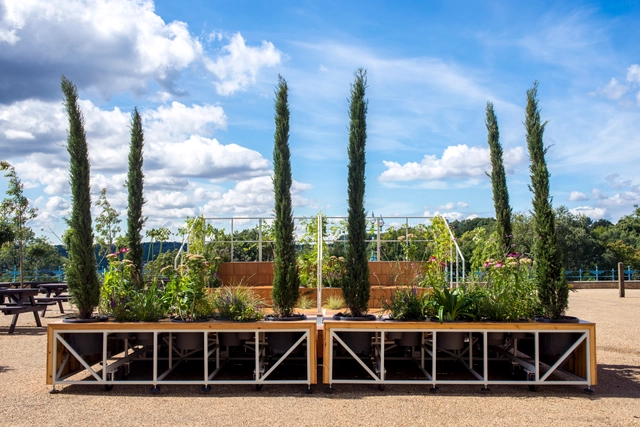
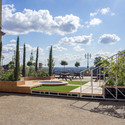
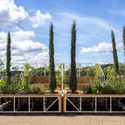
The Decorators, an interdisciplinary group of practitioners working with space in London, recently transformed the terrace overlooking the city at Alexandra Palace by installing a mobile Italian garden. As a "landscape of scattered objects" which geometrically piece together to resemble a formal garden, the designers describe the project as somewhere between "grotto and folly, garden and landscape, stage and amphitheater," all the while drawing from the historical character of the surrounding context. The scheme ultimately "breaks the monumental proportions of the main building to meet visitors with a more intimate scale on their first encounter" with the palace.
Architects can do far more than design buildings. In fact, some of history’s most acclaimed innovators were not only architects, but also inventors. Leonardo da Vinci himself, the epitome of the Renaissance man, sketched buildings alongside ideas for flying machines. Buckminster Fuller was the ultimate futurist and invented the geodesic dome in addition to his Dymaxion Car, an automobile that was far ahead of its time. Now, an architect has developed “the world’s first hoverboard,” and the technology has far-reaching implications for not only transportation, but also buildings themselves. Read on after to break to learn more about what this technology could mean for the future.
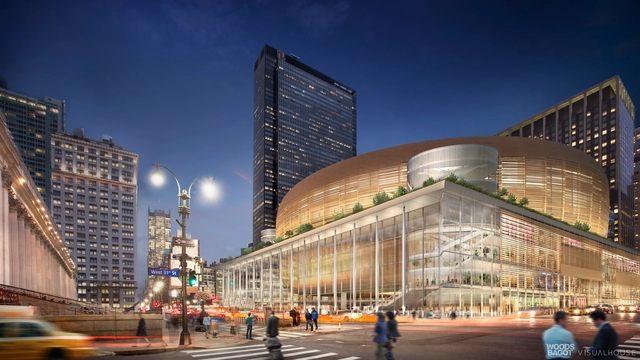
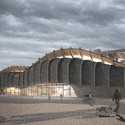
Invited by the Municipal Arts Society (MAS) and the Regional Plan Association (RPA), Woods Bagot has created an alternative design for the future of New York's Penn Station which would allow Madison Square Garden to remain in its current location above the station's entrance. The design, produced as part of MAS and RPA's report into the future of the station, the design was unveiled yesterday at Penn 2023: Where will the Garden Go?, the first session of the Municipal Arts Society's 2014 Summit for New York City, which discussed the possible options for the site at the end of Madison Square Garden's current 10-year permit.
Though the report by MAS and RPA favors the idea of moving Madison Square Garden - identifying Farley Post Office’s Western Annex and the Morgan Postal Facility and Annex as potential new sites - it also says that "there needs to be a Plan B... In the event a deal between the state, city, railroads and Madison Square Garden does not get done in the next eight years, there needs to be a plan for improving Penn Station and the surrounding district with the Garden still in place." This is where Woods Bagot's designs come in.
Read on after the break for more on Woods Bagot's proposal
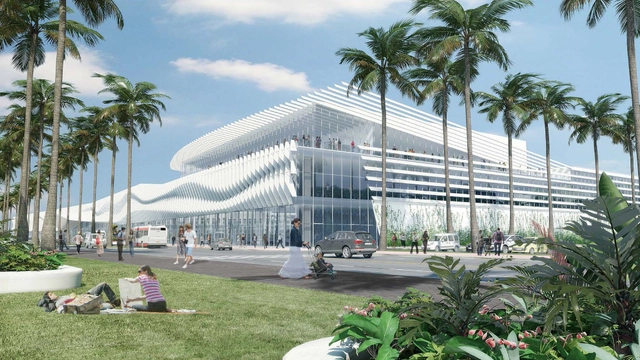
Fentress will be working with Arquitectonica and West 8 on a significantly scaled-down masterplan that will include the renovation of the 500,000-square-foot exhibition hall and 200,000-square-feet of existing meeting space, as well as a new 80,000-square-foot ballroom and outdoor event space.
Marijin van Oosten of MVO& has revolutionized the way visitors navigate museums: The Dutch graphic designer has designed a collapsible, 3D paper model of Amsterdam’s Rijksmuseum to help ease visitor confusion through the 19th century museum's 100 rooms. Dubbed the “Paper Pathfinder,” the innovative concept was awarded a Dutch Design Award this week.
An image of the Paper Pathfinder collapsed, after the break.
ODA Architecture has shared with us “510 Driggs,” a multi-family residential project that aims to provide residents with the “qualities of a private house” within Brooklyn’s dense urban landscape. Each of the six-story building’s 100 units will be equipped with a large, functional outdoor space and at least two exposures to maximize light and air.
The competition for the new Guggenheim Museum in Helsinki closed last month, becoming the most popular architectural competition in history with 1,715 entries. Now, competition organizers Malcolm Reading Consultants have made every single one available to view online, with each anonymous proposal presented in a series of two images, and a short description fro the architects. "Since its inception, this competition has been organized to be welcoming, inclusive, and transparent, and the gallery presents a singular opportunity for the public to explore and consider the broad expanse of entries," says Richard Armstrong, Director of the Solomon R. Guggenheim Museum and Foundation.
Competition organizer Malcolm Reading added: "For anyone interested in design, the gallery is a tremendous resource that offers rare insight into the design process and further illustrates how the vision for a Guggenheim Helsinki... [has] captured the imagination of architects around the world."
And indeed, the website does provide a tremendous tool: with such a huge volume of entries, the database and its associated tagging system offer an interesting way to probe the architectural zeitgeist: for example, it seems 'curved' buildings are almost twice as popular as 'straight' buildings; and 'opaque' buildings are still unpopular, being outpaced by 'transparent' buildings by almost five to one, despite the traditionally opaque museum typology.
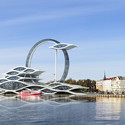
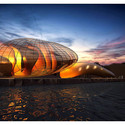
But when it comes to architectural quality, where do you even begin with 1,715 proposals? The competition's website has that covered too, with a favorites button, a six-building shortlist tool and a search-by-registration tool. ArchDaily is here to help too: after the break, we've hand-picked 50 of the most exciting, unusual, interesting and simply absurd proposals for you to start talking about.
The Royal Institute of British Architects (RIBA)'s Future Trends Survey for September showed that, for yet another month, confidence is high among UK architects, with the workload index up fractionally to +29 from +28 in August. Again, this positive figure was spread right across the country, with the most optimistic reports coming from Northern Ireland and the North of England, reporting workload index figures of +80 and +46 respectively - promising figures considering that these two areas were "slowest to show signs of recovery" after the recession, according to the RIBA.
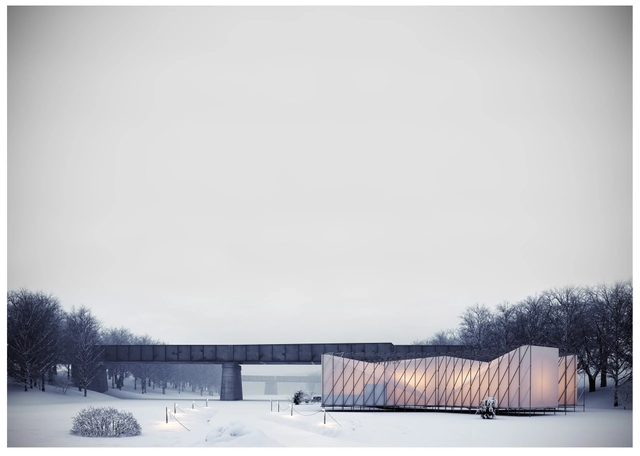
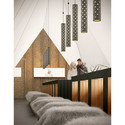
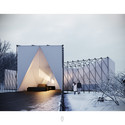
UK architects OS31 have recently won a competition to design RAW:almond, “the first ever outdoor dining restaurant on a frozen body of water.” The temporary restaurant has set up for business in Winnipeg, Manitoba, Canada for the last two years, and for 2015 the organizers held an international open competition for the winning design. This year’s design establishes itself as an expressive frame that appears to float across the ice like a frozen jetty. Learn more about the winning proposal after the break.
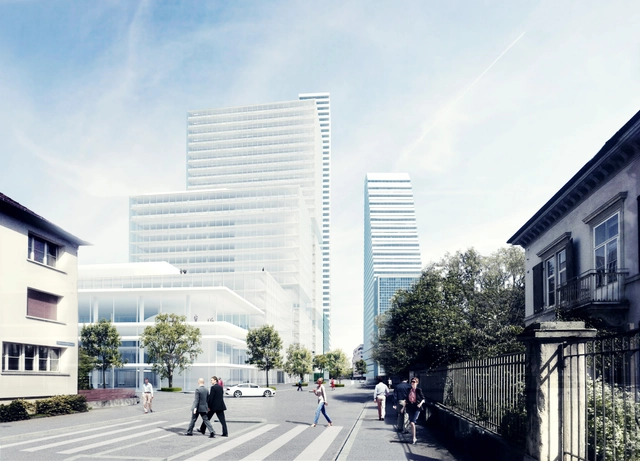
Herzog & de Meuron has unveiled plans for the modernization of the Roche pharmaceutical company’s Basel headquarters. With the first tower already under construction, the overall vision is to consolidate and update all existing facilities, including a historic Otto R. Salvisberg-designed office building, as well as construct a new, four-tower research center and 205-meter tall office tower by 2022.
"The planned consolidation of the existing industrial site will eliminate the need to build over green zones", emphasizes Jürg Erismann, Head of the Basel/Kaiseraugst Site. "Instead, Roche will be making more efficient use of those parts of the site that have already been developed but cannot be expanded.”
Have you ever had the urge to squeeze a lemon on the dome of St. Peters Basilica? Or perhaps, crack a beer with Kohn Pedersen Fox’s “bottle opener”? New York-based designer Nicholas Blechman has put into illustration what we’ve all been thinking, landmark architecture as the food-related items they resemble. Check out Blechman’s “Gastro-Architecture” series here on the New York Times and preview a couple of our favorites, after the break.
Studio Gang Architects has released designs for a 14-story residential tower in the Miami Design District. Anchored by ground floor retail and topped with a resident lounge and swimming pool, the tower will, as the architects describe, “demonstrate Studio Gang’s principle of exo-spatial high-rise design in which the inside extends to the outside in a dynamic spatial arrangement.”
Each of the building’s 76 residential units will frame panoramic views of Biscayne Bay and surrounding Buena Vista neighborhood with Studio Gang’s contemporary reinterpretation of a “Florida Room.”
Update 23/10/2015: In the 12 months since Gehry's outburst, the event has been used as the jumping off point for countless articles both criticizing and defending current architecture. But has Gehry's finger inspired any change in architecture or its discourse? We would love to know what our readers think - let us know in the comments.
Studio Gang has broke ground on the new home for Chicago’s beloved Writers’ Theatre. Situated on the sloped Tudor Court site of the Glencoe Woman’s Library Club, the glass encased timber structure will be a theatrical spectacle, as the main performance space's second story catwalk is designed to peer through the transparent facade.
“Our process has been built around the creative team dialogue with Writers Theatre, its audiences, and the community, and we could not be more excited to celebrate this milestone today while looking forward to the ideas that will soon become a built reality in 2016,” said Jeanne Gang. “The design of Writers Theatre’s first purpose-built theatre reinforces their important mission and vision to maximize the feeling of intimacy between actors and audience within the park-like setting of downtown Glencoe.”
New renderings and more information from the architect, after the break.
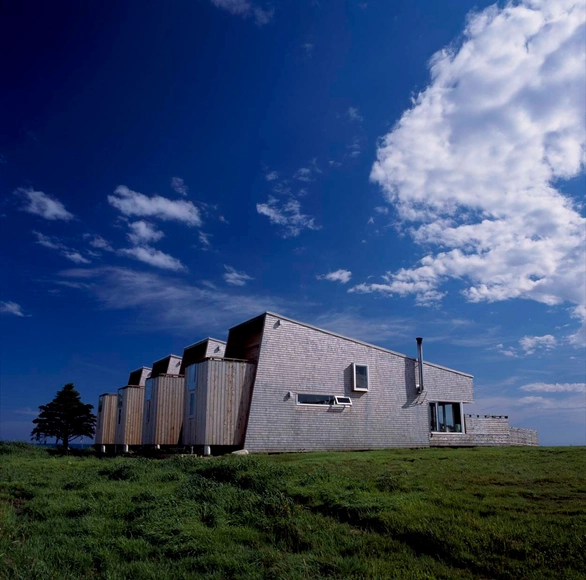
Brian MacKay-Lyons is the founding partner of MacKay-Lyons Sweetapple Architects, a professor at Dalhousie University and the founder of Ghost Lab - the now legendary 2-week summer design/build program that took place on his family farm in Nova Scotia from 1994 to 2011. While relentlessly local, Brian's work has been recognized internationally with more than 100 awards, 300 publications and 100 exhibitions. In 2012, the American Institute of Architects recognized the collective work and influence of Ghost with an Institute Honor Award for Architecture.
On August 22nd, 2014 Brian hopped off his tractor and wiped the diesel fuel off his hands to discuss architectural education with Keith and Marie Zawistowski, co-founders of the design/buildLAB at Virginia Tech and partners of OnSite Architecture. Here is an excerpt from their conversation, which was originally published on Inform:
Keith Zawistowski: Your contributions to the discipline of architecture have been both in practice and in education. In 1994, you founded Ghost, an international laboratory that influenced all generations of architects with its simplicity and this affirmation of timeless architectural values of place and craft. It was a pretty bold move and it seems for us like it was a direct reaction to your discontentment with academia and the way architects were being educated. Do you still feel that strongly about the state of architecture education and the profession?
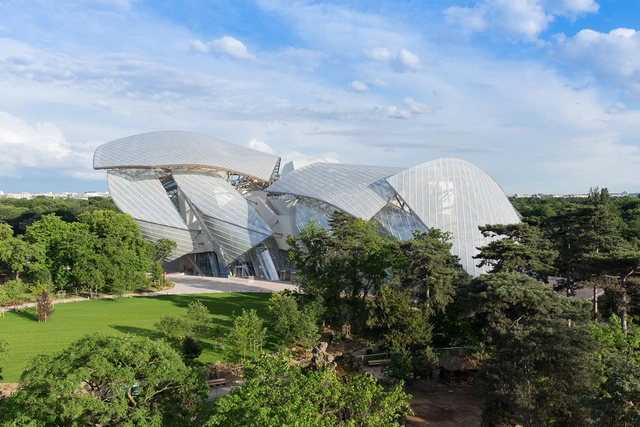
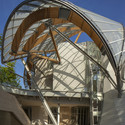
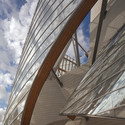
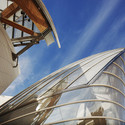
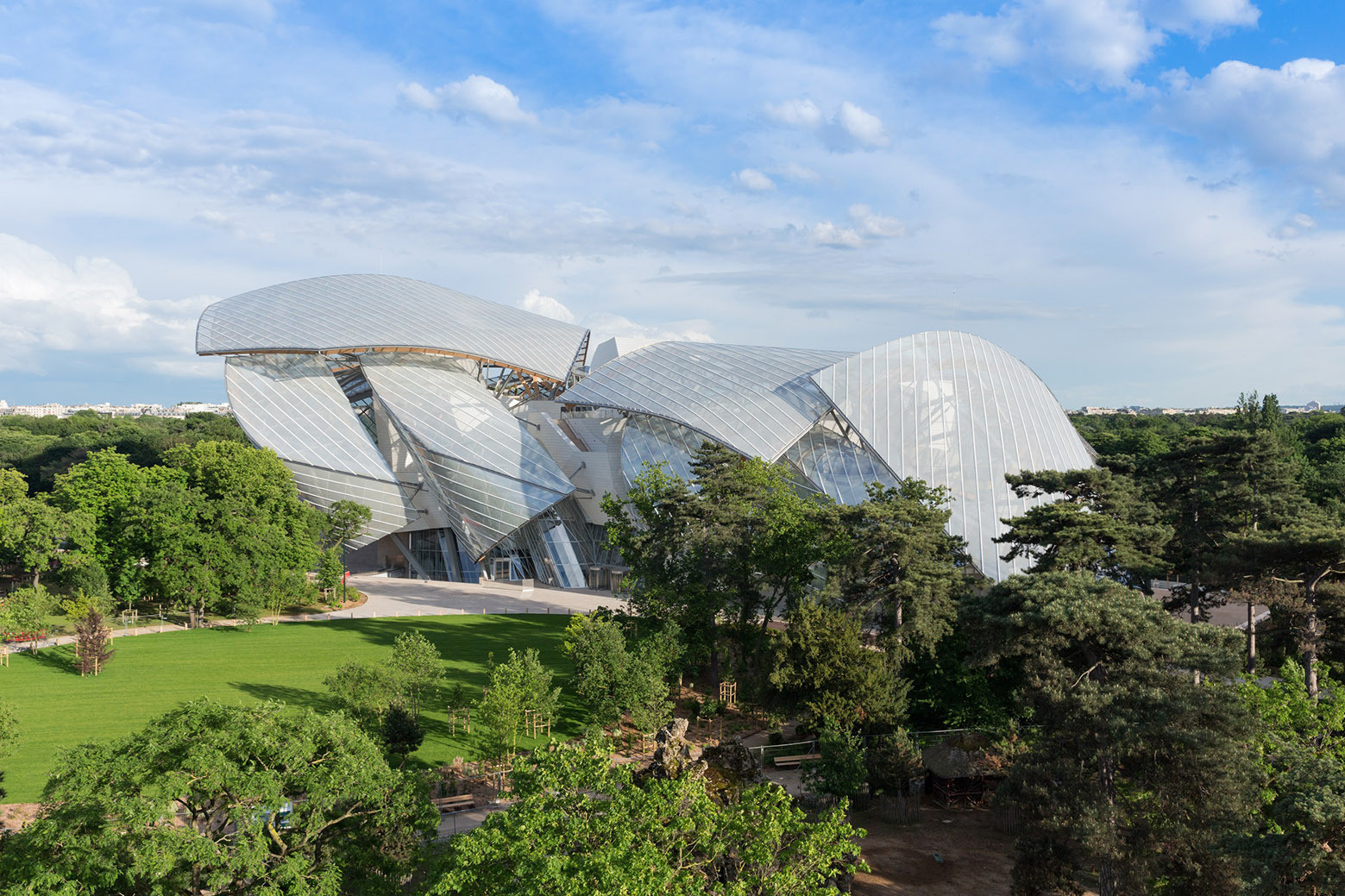
The people behind Frank Gehry'sFondation Louis Vuitton (FLV) in Paris, which is set to officially open on the 27th October 2014, recently invited a band of architecture critics to take a look around and pen their thoughts. Gehry's bold approach to architectural form, most evident in buildings like the Guggenheim Museum in Bilbao and the Walt Disney Concert Hall in LA, matches the foundation's aim to "promote and support contemporary and artistic creation" in France. According to their website, they in particular embody "a passion for artistic freedom." How, then, has the enormous sailed structure, challenged by local opposition from the outset, settled into its Parisian parkland surroundings?
MCHAP was established by the Illinois Institute of Technology (IIT) in Chicago to recognize the best built works in the Americas. As Kenneth Frampton noted when the finalists were announced in Santiago, Chile, the MCHAP Awards are the first time that an architectural prize has been approached, not in a trans-atlantic, horizontal manner, but rather vertically across the Americas.
Although initially the jury intended to select one work to be honored for the 2000-2013 period, they felt that both projects represented “an uncommon expressive display of structure,” and divided the 13-year period into two parts. Siza’s Iberê Camargo Foundation was selected as the 2000-2008 winner, while Herzog & de Meuron's mixed-use parking garage was selected for the 2009-2013 period. The two winning projects were selected from a total of seven finalists by jury members Jorge Francisco Liernur, Sarah Whiting, Wiel Arets, Dominique Perrault, and Kenneth Frampton.
Learn more about the winning projects after the break.
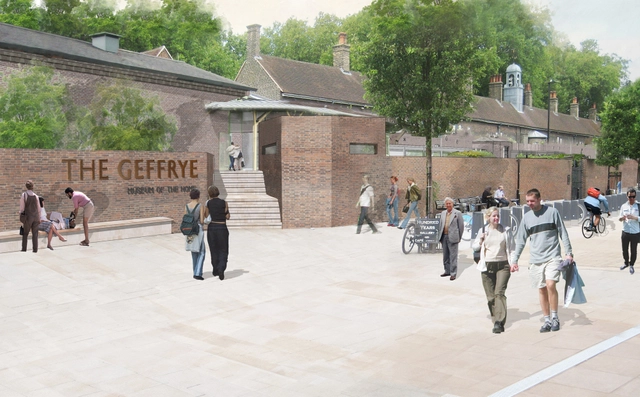
Wright & Wright Architects has revealed their designs for the Geffrye Museum in East London, a £15 million redesign that will increase the museum's total space by almost 40% through "unlocking" previously unused areas of the museum's 18th century almshouses. The design replaces a scheme by David Chipperfield Architects, which last year failed to secure planning permission in part because of the hugely controversial proposal to demolish the former Marquis of Lansdown Pub that occupies the corner of the site.


























Hufton___Crow.jpg?1413917075 "1111 Lincoln Road. Miami Beach, Florida, USA.. Image © Hufton + Crow / Courtesy of MCHAP")
_Erica_Overmeer.jpg?1413917133 "1111 Lincoln Road. Miami Beach, Florida, USA.. Image © Erica Overmeer / Courtesy of MCHAP")
Erica_Overmeer.jpg?1413916984 "1111 Lincoln Road. Miami Beach, Florida, USA.. Image © Erica Overmeer / Courtesy of MCHAP")