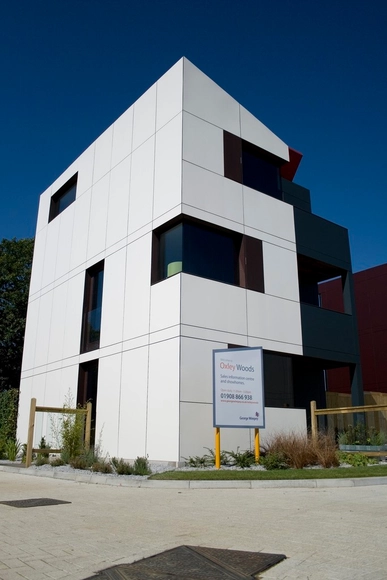
A report uncovered by the Architects' Journal has revealed that an experimental housing project by Rogers Stirk Harbour + Partners has developed major problems just seven years after construction. The low cost factory-built Oxley Woods scheme won the RIBA Manser Medal for housing in 2008 but a report commissioned by the scheme's developer has shown faults in the detailing are causing some parts of the construction to rot. Rogers Stirk Harbour + Partners have distanced themselves from the defects insisting that it was "Taylor Wimpey and Wood Newton responsible for the final detailed design". You can find out more about the controversy at the Architects' Journal and the Financial Times.
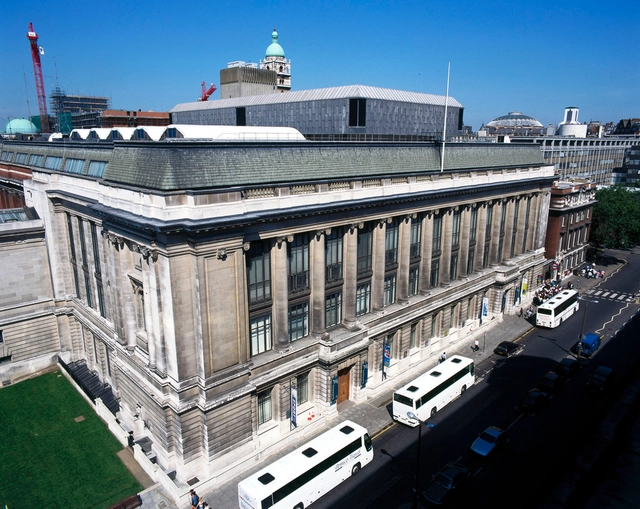
The Science Museum in London has announced plans to expand with three new galleries, launching three competitions to find designers. Two of the new galleries will house new permanent exhibitions about medicine and mathematics, while the third will host an interactive gallery. The three extensions combined will more than double the museum's current size.
The museum hopes to complete the mathematics and interactive galleries in 2016, with the larger medicine wing scheduled for a 2018 completion date.
Read on after the break for more on the competitions
AA Greece Visiting School is a mobile workshop series which travels and reaches cities outside the country’s capital. It functions as a ‘satellite’ of education that promotes the Architectural Association’s exclusive, intensive form of teaching and learning around the country. AA Greece VS aims on visiting a different city each year and construct a single large-scale model which will act as an active nod of communication among the various locations. In 2014, the School will initiate its design agenda with an architectural approach that is focused on the aspect of connection. The city of Patras which is the starting node of AA Greece VS was chosen by the European Commission to be the European Capital of Culture for the year 2006. The concept of the event revolved around the main theme of "Bridges" and "Dialogues", drawing benefit from the city's rich history and its position as a "Gate to the West", to underline the essence of the productive interaction of culture and civilizations in Europe. The AA Greece Visiting School will investigate how well existing buildings with various sightlines and variant spatial grammars perform according to human perception. In sync with the flexible and adaptive concept of parasitical structures, the research focuses on the making of transformable large-scale creations that accentuate prominent architectural features of existing buildings. The research looks at how cultural factors, personal preferences, experiences, and expectations can lead to the transformation of architectural parasitical structures.
Taiwan-born architect Jimenez Lai’s proposal Township of Domestic Parts: Made in Taiwan has been selected to represent Taiwan in the 2014 Venice Architecture Biennale. Scattered throughout the Palazzo delle Prigioni, the installation will be comprised of nine small house, each with a single program, that will make up an “interior township of misfit parts.”
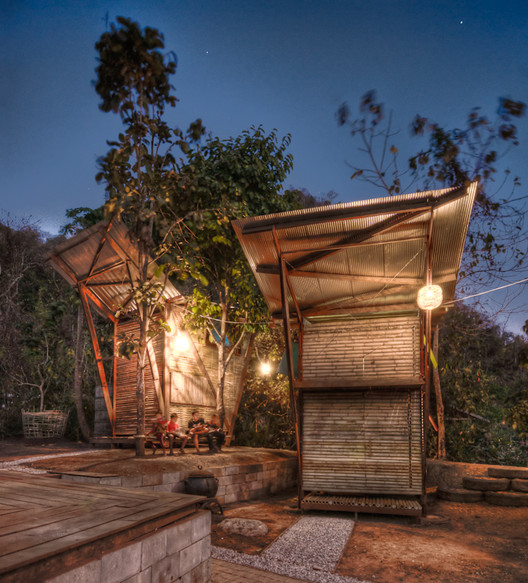
TYIN tegnestue architects are known for their small-scale built projects in underprivileged areas around the world, but you might not know just how open this firm is about sharing their work. If you head to their website, many of their past projects are available for download in the form of photographs, sketches, drawings, models, and more. They believe that by sharing their knowledge, they are encouraging students and young architects to learn by building. The architecture co-operative has even created the "TYIN Architect's Toolbox," a downloadable guide to working on design-builds in places of need. For more information on the guide, keep reading after the break.
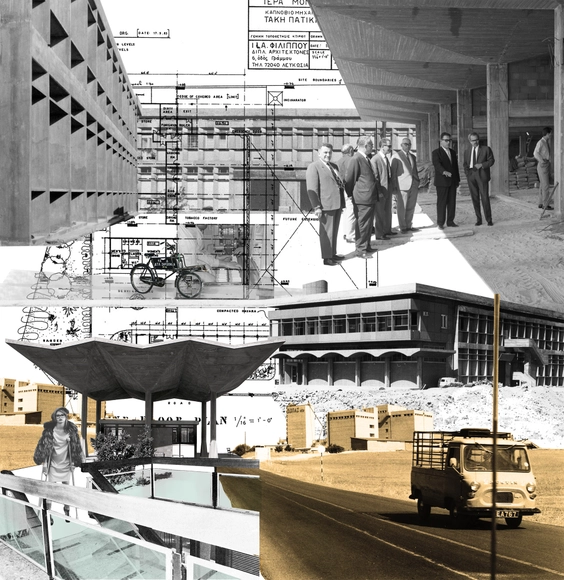
Cyprus has been shaped by a tumultuous history. Power struggles between invaders, conquerors and colonial powers have all left indelible marks on the landscape, much of which can be witnessed in the island’s capital of Nicosia.
Uncovering this history, the curators of Cyprus’ fifth participation at the 2014 Venice Architecture Biennale will expose the island’s layered past and the story of Nicosia in allegory form with the exhibition Anatomy of the Wallpaper.
Learn more and read Cyprus’ full curatorial statement, after the break...
Frederiksberg Urban Spaces, photo by Ulrika Wahlmark (2009), Courtesy of SLA
What does butterflies, quantum mechanics, poetry and dirt have to do with architecture? In the Danish pavilion at the 2014 Venice Architecture Biennale, you are invited to sense, wonder, be curious and reflect when you meet the smell of dirt, read Niels Bohr’s letter to Einstein, hear the sound of poetry and burry your toes in pine needles. The pavilion reintroduces the forgotten power of aesthetics as the complementary to the rational. It argues that the two together form the foundation for our future decision making.
Set to open to the public on Wednesday after a highly controversial and contested journey from idea to reality, the September 11 Memorial Museum has inevitably been a talking point among critics this week. The museum by Davis Brody Bond occupies the space between the Memorial Plaza at ground level and the bedrock below, with an angular glass pavilion by Snøhetta providing an entrance from above. A long ramp, designed to recall the access ramp with which tons of twisted metal was excavated from the site, descends to the exhibits which sit within the perimeter boundaries of the twin towers' foundations, underneath the suspended volumes of Michael Arad's memorial fountains.
The content of the museum is obviously fraught with painful memories, and the entrance pavilion occupies a privileged position as the only surface level structure ground zero, in opposition to the great voids of the memorial itself. The discussion at the opening of the museum was therefore always going to center on whether the design of the museum - both its built form and the exhibitions contained - were sensitive and appropriate enough for this challenging brief. Read the critics' takes on the results after the break.
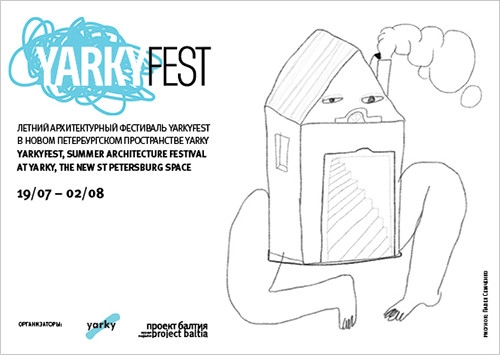
Project Baltia magazine and Yarky Hostel & Space have just announced the Open International Competition for the Design of Summer Residential Unit. Five winning projects will be implemented on the territory of the Hostel by August 2, 2014. The units should enable temporary accommodation for one or two persons. Functions of these units are similar to those of a hotel room.
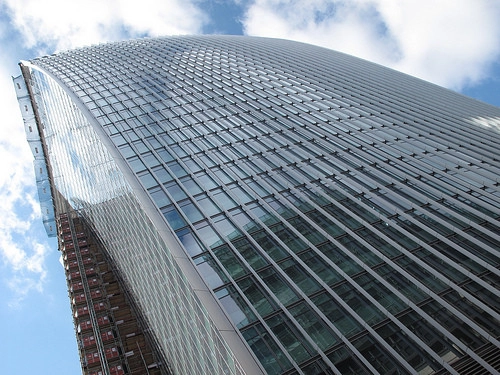
Work to alter Rafael Viñoly Architects' 20 Fenchurch Street - dubbed the Walkie Talkie due to its unusual shape and then the "Walkie Scorchie" after it created a heat-focusing ray strong enough to melt cars last summer - is due to start later this month, after planning permission for the additions was granted in April. The alterations, also designed by Rafael Viñoly Architects, will see horizontal aluminium louvres added to the glass facade between the 3rd and the 34th floor to ensure that the reflective "death ray" effect is not repeated.
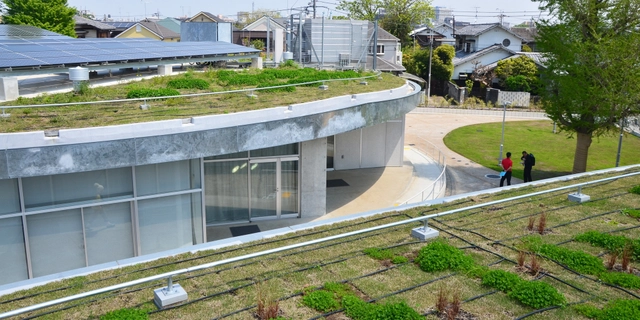
Japanese architect Jun Aoki is famous, above all, for his rather object-like buildings. Although some of his works explore the theme of ephemerality, most are visually quite striking. That said, his new work, just completed in a small town near Tokyo (Suginami district), searches for invisibility. The huge volume of the covered sports hall Omiyamae Gymnasium is hidden. Approaching to the building, one sees only two ellipse-shaped one-floor structures. Lower than the surrounding city, tailored from small private houses, the newcomer does not stand out at all.
First Prize: Junya Ishigami + Associates (Japan). Image Courtesy of Kinmen Harbor Bureau
The culmination of an international competition for Kinmen County has resulted in five winning and honorable mention schemes that promise to use architecture as a means of elevating the county’s national identify as a maritime gateway. Responding to the need for expansion and the desire to establish the port as a tourism and recreation destination, the Kinmen Harbor Bureau challenged architects to a two-stage competition for an energy-smart, low-carbon, and possibly expandable port that could host a variety of passenger services.
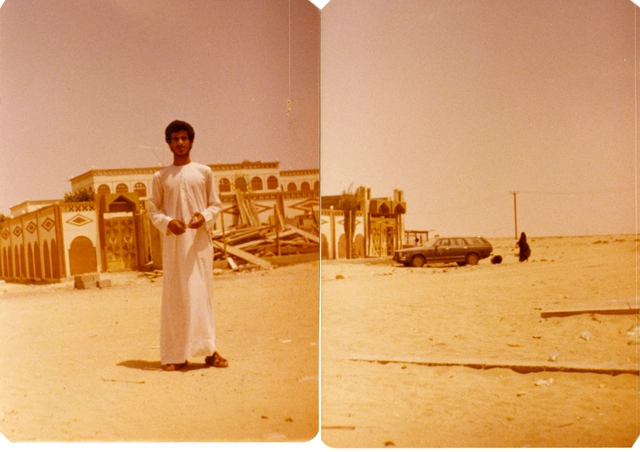
National House - My father’s friend Ahmed Abdulla Al Jassasi, Al Shahama, 1980; Courtesy of Houreya Naser Musabah Khamis Al Kalbani
Within the rapidly changing landscape of the United Arab Emirates, much of the nation’s vernacular and modern architecture is being quickly replaced by “iconic” contemporary structures. Despite this, many of the UAE’s previous landscape remains a vivid memory within the minds and mementos of its people.
Preservation of pre-oil vernacular architecture and a special focus on 1970s and 80s modern architecture will both serve as highlights of the exhibition.
The UAE’s full curatorial statement, after the break...
Over the last decade, the amount of bicycle commuters have increased 60 percent in the U.S. As the U.S. Census Bureau reports, this is the largest percentage increase of all commuting modes tracked by the 2000 Census and the 2008-2012 American Community Survey. Along with the study, the Bureau released a new interactive map that allows you to zoom-in and explore the commuting statistics for every neighborhood in the U.S. Find out how to access this map and read some highlights from the report, after the break...
The AJ100, the annual survey of the UK's 100 largest architecture firms by the Architect's Journal, has shown a noticeable rise in the number of women in the top practices over the past year. The proportion of women in the surveyed practices rose from 25% in 2013 to 28% this year, with an even more marked increase in the top 10 firms: from 22.7% to 27.5%. Though there is still a significant discrepancy in the ratio of men to women, this marked increase is a positive step. Find out more about which practices are leading the way, and what methods they are using to encourage gender diversity at the Architects' Journal.
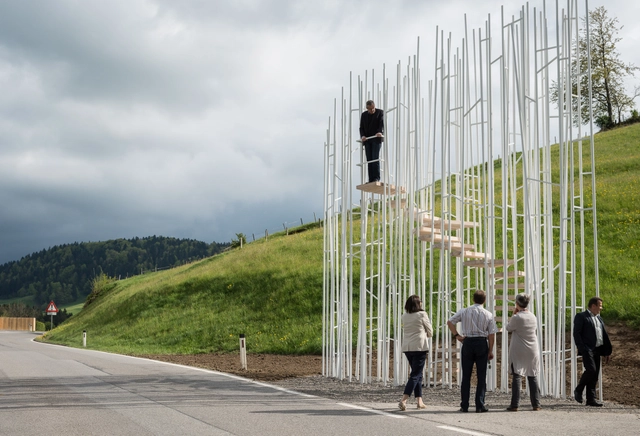
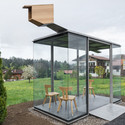
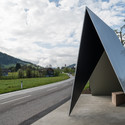
A year in the making, Krumbach in Austria has unveiled seven eye-catching bus shelters which have turned the world's gaze on the tiny village. Designed by internationally renowned architects such as Wang Shu, Sou Fujimoto and Smiljan Radic, who worked in collaboration with local architects and craftsmen, the whimsical structures will put the village of 1000 residents on the map.
Curator Dietmar Steiner praised the commitment of those involved, saying "the entire project succeeded because it was supported in the most generous fashion by more than 200 people." This included the architects, who took up their projects for little more than a free holiday in the area and the chance to engage in an unusual challenge. However, BUS:STOP was not merely a vanity project: Verena Konrad, Director of vai Vorarlberger Architektur Institut, noted that the project was important for "the successful connection of infrastructure and mobility for the rural area."
Restaurant “Sēnīte” (1967); Vidzeme highway 37.km / Linards Skuja, Andris Bite, G. Grīnbergs, R. Ozoliņš - Courtesy of The Museum of Architecture of Latvia
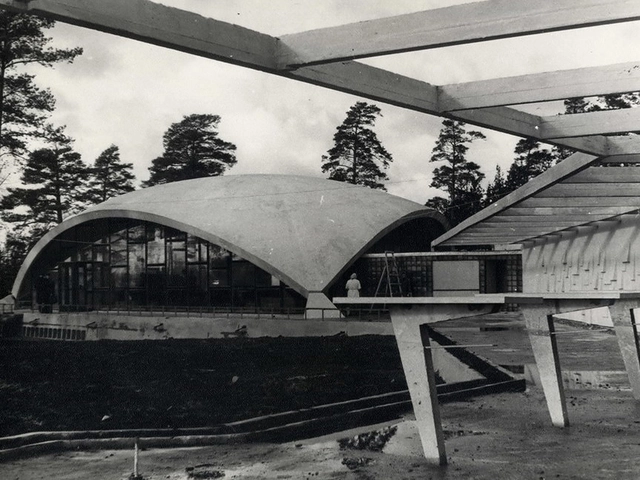
The architects of NRJA have been chosen to curate Latvia’s participation at the 2014 Venice Architecture Biennale. Based on the assertion that “there is (no) modernism in Latvia,” the pavilion’s exhibition Unwritten will confront the lack of research and evaluation of Latvian post-war modernist architecture.
Norman Foster has been selected alongside artist Hiroshi Sugimoto to receive the inaugural Isamu Noguchi Award. Presented by Motohide Yoshikawa, the ambassador of Japan to the United Nations, the award recognizes “individuals that share Japanese-American artist Isamu Noguchi’s commitment to innovation, global consciousness and Japanese/American exchange.” Watch an ArchDaily interview with Foster, after the break...
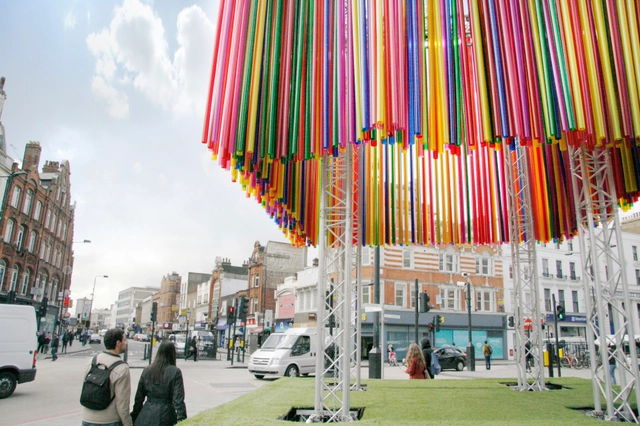
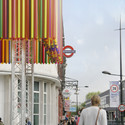
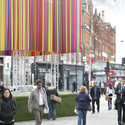
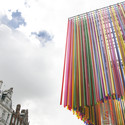
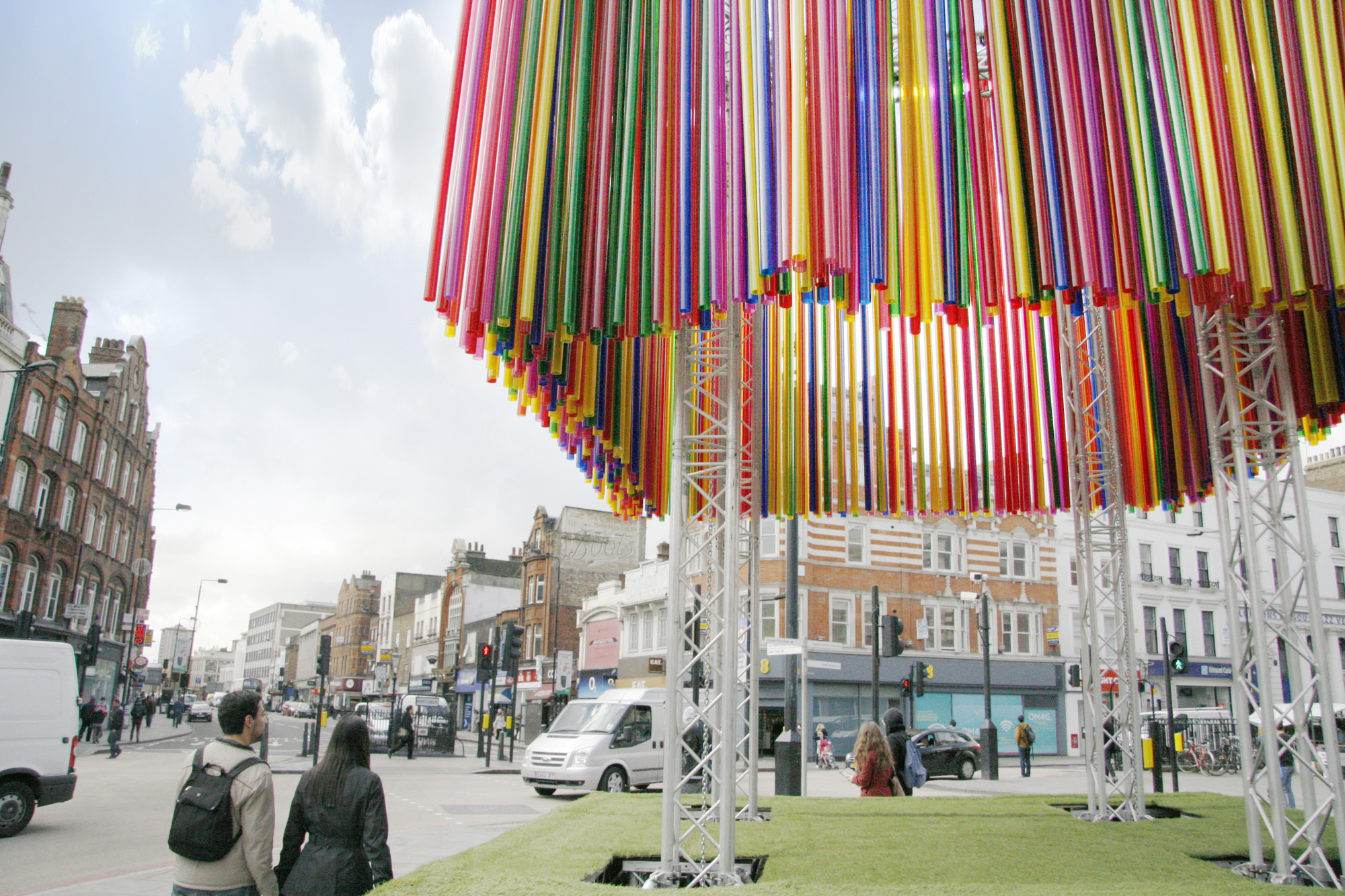
As part of a new three-day festival in the London borough of Camden, KSR Architects have designed a brightly colored pop-up pavilion for the famous Britannia Junction. The festival's centerpiece is made up of 640 fluorescent tubes hanging from a stage truss system to make a colossal wind chime, animating the area with movement, color and sound.
Read more about the pavilion and the festival, and see more images after the break
Though it seemed a compromise was met last October, when Japan’s minister of education, Hakubun Shimomura announced plans to reduce the cost and scale of the Zaha Hadid-designed Tokyo Olympic Stadium, the debate rages on.
Pritzker laureates Toyo Ito and Fumihiko Maki have launched an online petition to “defend the ginko tree-lined landscape of blue sky and Jingu Outer Gardens” from the construction of Hadid’s “oversized” stadium.
The petition (now with more than 13,000 signatures) urges the Japan Sports Council, who hand selected Hadid’s winning design alongside Tadao Ando, to reconsider upgrading the existing Meiji Jingo Gaien Stadium and the gardens surrounding it. This solution, they believe, is a more affordable and sustainable alternative that would prevent the relocation of nearby residents.
Take a tour though Zaha Hadid’s 2020 Olympic Stadium and share your thoughts about the design (and petition), after the break...
Chosen to curate the Brazilian contribution at the 2014 Venice Architecture Biennale, diplomat and architecture critic André Aranha Corrêa do Lago has revealed plans for an exhibition that will chronologically illustrate the evolution of Brazilian architecture.
180 projects will be exhibited, all of which have either played a significant role in the country’s architectural evolution, such as the pre-Colombian (Indian shacks), vernacular constructions and baroque designs, or have displayed a strong international influence, like the Capanema Palace, Pampulha and Brasília. In addition to this, 50 important personalities, including Lucio Costa, Oscar Niemeyer, Lina Bo Bardi, and Paulo Mendes da Rocha, will be highlighted for their assistance in spotlighting the importance of Brazilian architecture.
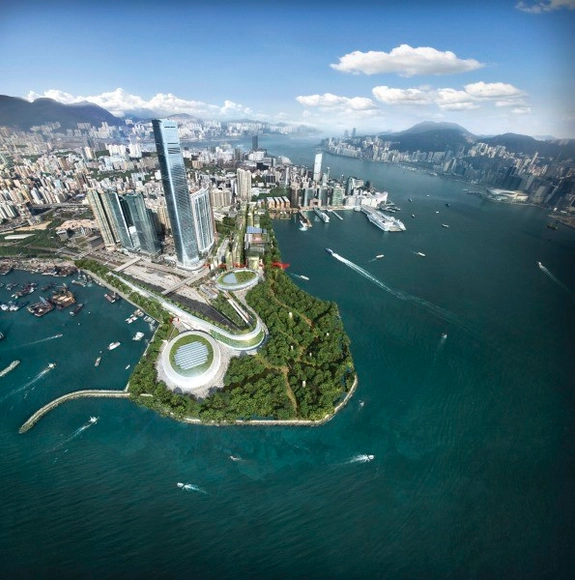
The West Kowloon Cultural District Authority has selected UNStudio, in collaboration with AD+RG, to design its fifth major arts venue, the Lyric Theatre, which will sit alongside Herzog & de Meuron's planned M+ arts venue at the Western end of the Cultural District. The 1,200-seat theatre will be Hong Kong's first world class dance performance venue for ballet, contemporary and Chinese dance. It will also temporarily serve as a venue for drama, opera and musical performances during the construction of the other venues in West Kowloon Cultural District.
Read on after the break for more on the West Kowloon Cultural District and UNStudio's appointment.