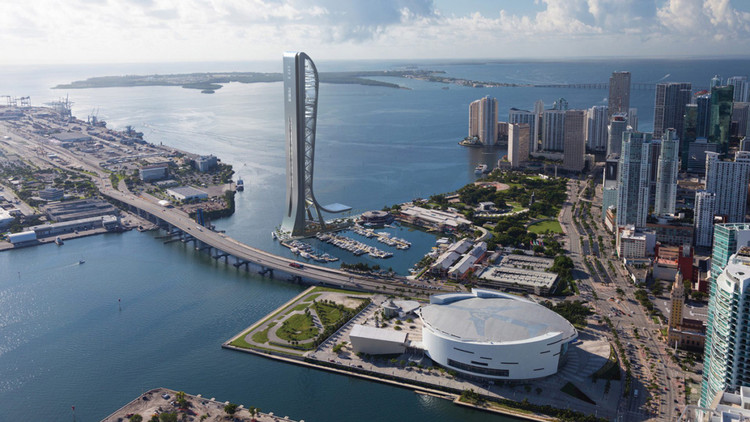
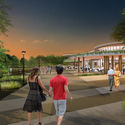
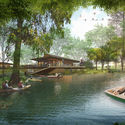
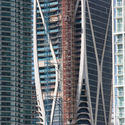
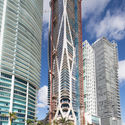
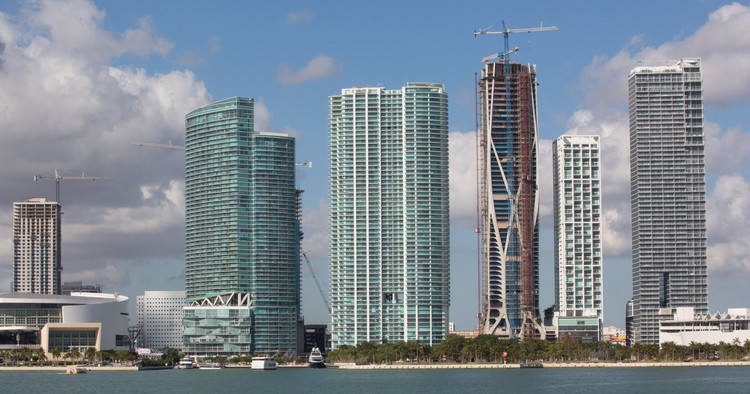
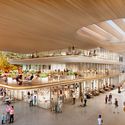
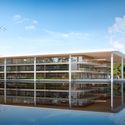
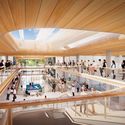
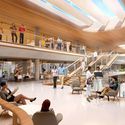
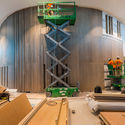
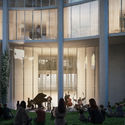
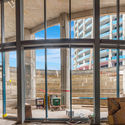
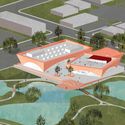
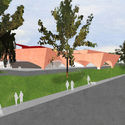
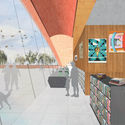
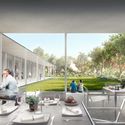
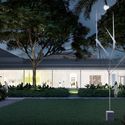
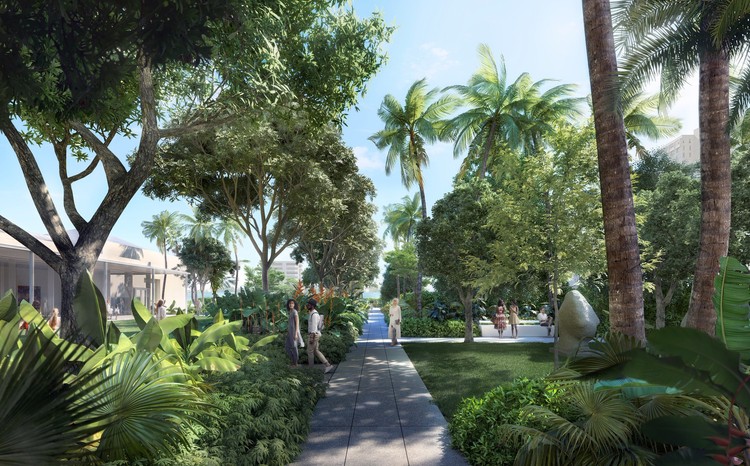
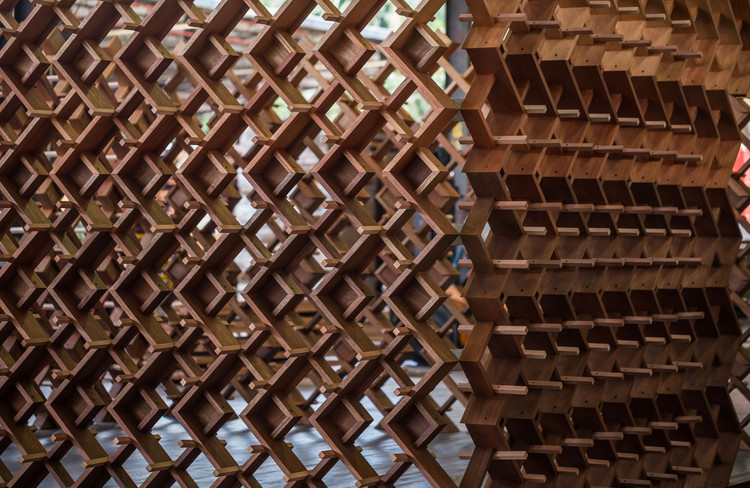
Receiving an honorable mention for their entry for the Dawntown Seaplane competition in Miami, Florida, NC-Office’s proposal, titled ‘Large Roof’, is a solution to when an artificial geographic condition demands an intuitive architectural response. When seen from above – either as one approaches by air or from the large cruise liners – the project is experienced as a large mass. As one enters the structure the project transforms into an ephemeral space. More images and architects’ description after the break. read more »
Florida
The Museum of Contemporary Art in North Miami (MOCA) recently announced that Gwathmey Siegel & Associates Architects will be designing a 27,000 sqf expansion tripling the current museum exhibition space. Unanimously voted by the Council, MOCA’s new gallery space will expand by 16,000 sqf providing the opportunity for multiple exhibitions continuously throughout the year. The project pursue a sustainable design of LEED certifications, and fitting within the city of North Miami’s master plan.
Architects: NC-office
Location: Miami, Florida, USA
Client: Rowland Coffee Roasters / Gansevoort Hotel South
Collaborators: Peter Nedev, Elizabeth Cardona, Cristina Canton, Nikolay Nedev, Mauricio Gonzalez
Consultants: Popov Engineers, Inc. (MEP), Don Shakelford (Structural)
Contractor: RCC Construction
Project year: 2008
Photographs: Michael Stavaridis
The Florida International University Alvah H. Chapman Jr. Graduate School of Business serves as an academic mixed-use facility accommodating faculty and administrative offices, conference rooms, auditorium, as well as two open public courtyards. Architects KPF developed a two phase design creating two distinct communities of students and faculty, the courtyards being the linking element between them.
Photographs and drawings of the academic building following the break.
Architects: Kohn Pedersen Fox Associates
Location: FIU Campus, Miami, Florida, USA
Associate Architect: BEA International
Client: Florida International University
Project Area: 92,000 sqf (phase 1)
Photographs: H.G. Esch and Claudia Uribe
In 2009 West 8’s winning design for Lincoln Park was unanimously chosen by the Miami Beach Commission. The park is part of the New World Symphony Campus of architect Frank Gehry, which includes a concert hall and a conservatory. The Lincoln Park site is a small – slightly larger than 1 hectare in size – urban site located at Washington Avenue and 17th Street in South Florida that strives to establish a new precedent for parks in the City of Miami Beach.
While an urban park this size might often receive a design that has more hard surface than soft, Lincoln Park’s site-specific conditions, context and program elicited a unique response in a green park, not a plaza, that feels intimate, shady, and soft; a park that will support the world-class attraction of the New World Symphony Building. Lincoln Park reflects the spirit and vitality of Miami Beach and will support a multitude of day and night uses, either under the shade of the trees or a starlit sky.
Urban Designers: West 8 urban design & landscape architecture
Location: Miami Beach, Florida, USA
Project Year: 2011
Photographs: Courtesy of West 8 urban design & landscape architecture
Miami Marine Stadium, designed by architect Hilario Candela in 1963, hosted many events – political rallies, boat races, concerts, church services, television shows, movie set for Clambake staring Elvis Presley, and was an important part of the Miami area until 1992 when it fell to disrepair. After much dialogue and arm twisting the Miami Marine Stadium is to be preserved many thanks to the Friends of Marine Stadium. Original architect Hilario Candela, along with Jorge Hernandez, Catherine Lynn and students from the University of Miami’s Architectural Preservation Studio, have created a concept for the revitalization which has been incoprated officially in the to the Virginia Key Masterplan. A hopeful 2012 grand re-opening is planned for this important local neighborhood civic plaza.
More photographs following the break.

Courtesy of Maciej Zawadzki
The Miami Pier Museum of Latin American Immigrants, designed by Maciej Zawadzki is a horizontal monument dedicated to the immigrants who arrived in Miami, Florida on the coast of the Atlantic Ocean. The museum is situated on the coast line, on axis with one of the main streets in the city.
More on this project after the break. read more »
The New World Center, part of the New World Symphony America’s Orchestral Academy, opened its doors this week. Located in the heart of Miami Beach, the music education and performance facility is the first purpose-built home for the New World Symphony founded by artistic director Michael Tilson Thomas.
In terms of design the building’s exterior portrays a quiet, almost tamed Frank Gehry. The rectangle shaped white building expresses Gehry’s well known bends and folds within its interior – glimpses of which are visible through the main entrance east facade 80 foot high glass curtain wall.
The New World Center joins a wave of new architecture and design in Miami. Playing host to the most important art show in the United States, Art Basel | Miami Beach, and the 2010 National AIA Convention, Miami has been focusing its efforts on developing a new vibrant city center. Just down the street from the New World Center resides 1111 Lincoln Road designed by Herzog & de Meuron, completed last year. Currently Herzog & de Meuron are also working on the expansion for the Miami Art Museum.
Miami Beach SoundScape, the public event space designed by the Dutch landscape architecture firm West 8, is located to the east of the New World Center and to the west of the new building is Pennsylvania Avenue Garage, a new 550-car parking structure designed by Gehry Partners, LLP.
Architects: Gehry Partners, LLP
Location: Miami Beach, Florida, USA
Design Partner: Frank Gehry
Project Designer: Craig Webb
Managing Partner: Terry Bell
Project Architect: Brad Winkeljohn
Project Manager: Kristin Ragins
Project Team: Curtis Christensen , Dan Sokolosky, Molly Forr, Lisa Cage , Shikha Doogar, Petar Vrcibradic, Leon Cheng, Vartan Chalikian, Armando Solano, Luciana Vidal, Rolando Mendoza
Acoustician: Nagata Acoustics America, Inc
Acoustical Team: Dr. Yasuhisa Toyota Motoo Komoda Kayo Kallas Daniel Beckmann Robert Mahoney, Robert F Mahoney & Associates
Structural Engineering: Gilsanz, Murray, Steficek, LLP
MEPFP Engineering: Cosentini & Associates
Theater Consultant: Theatre projects Consultants
Lighting Designer: LAM Partners, Inc.
Sound & Projection Consultants: Acoustic Dimensions, Sonitus, LLC
Landscape Architect: Raymond Jungles Associates
Civil Engineer: Kimley Horn and Associates, Inc.
Construction Manager: Hines
Performance Hall Seating: Poltrona Frau
Project Area: 100,641 sqf
Project Year: 2011
Photographs: Rui Dias-Adios, Tomas Loewy
Among many other things, the Neugebauer House, which was completed in 1998, stands as a prime example of an architects ability to creatively design within the city codes and regulations while still maintaining the quality and style found in their other buidings.
As a prominent twentieth century architect who fuses main principles of design from his peers and fellow architects with his own, Richard Meier is known for his endless variations of a rather specific theme of white Neo-Corbusian form, mostly using enameled panels and glass. The emphasis on light, color, place, plain geometry and the interaction between all of the latter help Richard Meier & Partners Architects to design architecture that is clear, comprehensible, and easily admirable.
More on the Neugebauer House and Richard Meier & Partners Architects after the break.
This week marked the grand opening for the Salvador Dali Museum in St. Petersburg, Florida. The new building‘s 68,000 sqf doubles the size of the original one storey warehouse Dali Museum built in 1982.
Utilizing free-form geodesic geometry, the triangulated glass organically flows around and attaches to the rigid unfinished concrete box, a play of hard and soft, protecting Dali’s paintings and simultaneously providing natural daylight and openness to the adjacent bay. This is the first use of this type of free-form geodesic geometry in the United States.
Mesmerizing visitors within the museum is the coiled concrete form that greets them at the reception desk. The poured in place raw concrete spiral staircase is fitted with light cable-stayed stainless steel guardrails. The material choices provide a subtle juxtaposition along with an obvious nod to Dali’s allure with the double helix and other spiral forms in nature.
If you are a frequent ArchDaily reader you may recall our updates on the Salvador Dali Museum. Take a minute to check our previous articles with construction photographs and a video feature.
More photographs and further project description following the break.
Architects: HOK
Location: St. Petersburg, Florida, USA
Programming and Master Planning: HOK
HOK Design Team: Duncan Broyd, Eva Busato, David Chason, Jenny Collins Miers, Susan Dame, Carly Debacker, Gary Erickson, Ralph Evans, Miranda Hensley, Will Hollingsworth, Scott Hughes, Laura Matson, Foard Meriwether, Eddie Pabon, Van Phrasavath, Lynn Puckett, Mary Sabel, Oliver Schwarz, Tommy Sinclair, Nicole Stearley, Izzy Torres, Anna Vasquez, Yann Weymouth, Sean Williams
General Contractor: The Beck Group
Glass Structure Consultant: Novum Structures LLC
Structural Engineer: Walter P. Moore & Associates Inc.
Mechanical/Electrical/Plumbing Engineer: TLC Engineering for Architecture
Program Manager: Peter Arendt
Acoustical Consultant: Siebein Associates Inc.
Civil Engineer: WilsonMiller Stantec Inc.
Landscape Architect: Phil Graham and Company
Lighting Designer: George Sexton Associates
Code Consultant: Rolf Jensen & Associates Inc.
Food Service Consultant: Schwartz Schwartz & Associates
Graphics/Signage Consultant: Dan Meeker Design
Hardware Consultant: S.B.S. Associates, Inc.
Client: Salvador Dalí Museum
Project Area: 68,000 sqf
Project Year: 2011
Photographs: Moris Moreno, Michael Rixon

© Weird Florida
The unusual history of the St. Bernard de Clairvaux Church adds richness to the Floridian landscape as it gives people of all ages a breathtaking escape from the showy yet glamorous side of Miami. Initially built in the town of Sacramenia of Segovia in Spain during the period of 1133-1144, the monastery was named after the famous Cistercian monk Bernard de Clairvaux almost immediately after his canonization. For around 700 years, the stone walls housed hundreds of monks until the mid-1830′s, when the Cloisters were seized, sold, and converted into a granary and stable.
More about the history of St. Bernard de Clairvaux Church after the break.
The Galerie Emmanuel Perrotin located in Miami’s Design District is an extension of a predominant Paris gallery. The renovation and addition by Oppenheim Architecture + DesignThe Miami gallery is an extension of a predominant Paris gallery. The design intention was to maintain the buildings original 1950s character, maximizing exhibition space, while simultaneously integrating the mechanical systems in an inconspicuous manner. The gallery will serve not only as an exhibition space but also as a residence for the gallery owner and as a living space for visiting artists. Photographs, and drawings along wiht a further description about the Galerie following the break.
Architects: Oppenheim Architecture + Design
Location: Design District, Miami, Florida
Project Team: Chad Oppenheim, Juan Calvo, Leslie Abraham, and Carolina Jaimes
Client: G.E.P. LLC
Landscape Architect: Rosenberg Design
Consultants: Vidal and Associates, Cornerstone Engineering
General Contractor: Jack Green
Project Area: 14,000 sqf renovation and 3,000 sqf addition
Project Year: 2006 (renovation)
Renderings: Oppenheim Architecture + Design
Photos: Ken Hayden
The Cube mixed-use condominium complex, designed by Oppenheim Architecture + Design, represents the next frontier in multifamily high-rise housing in urban areas. In response to the individual needs of owners and the need of creating a sense of identity, this design provides the opportunity to not simply pick finishes and add fences. Future condominium owners are propelled to communicate with the architect their needs and day to day functions. Architectural assumption is thrown to the wayside, and Cube is the approach to condominium living in Miami.
Last week on ArchDaily we featured our interview with Chad Oppenheim founding partner of Oppenheim Architecture + Design. Be sure to check out the full interview here.
Follwing the break are words from the architect, along with rendering, and drawings of this future building.
Architects: Oppenheim Architecture + Design
Location: Design District, Miami, Florida
Credits: Chad Oppenheim, Carlos Ramos, Giovana Henao, Kevin McMorris, Juan López, Carla Urreiztieta, Camilo Orozco, Ana Maria Calle, and Rodrigo Londoño
Client: Nexus Development Group
Project Area: 240,000 sqf
Project Year: Estimated Completion 2012
Renderings: Dbox
The mixed-use Campus Center designed by Oppenheim Architecture + Design for Miami Dade Community College will make a statement within the skyline of the tropical city. Popular for its flowing spaces from interior to exterior, the architects capitalized on Miami’s climate creating an open-aired campus design complete with arcades, quads, and plazas. The design incorporates a variety of materials and sustainable practices including a steel frame exo-skeletal system, clad and aluminum with clear glass aluminum window wall system, solar panels in portions of the roof, and vertical shafts wind turbines.
Here you can check out our interview with Chad Oppenheim founding partner of Oppenheim Architecture + Design featured last week on ArchDaily.
More details, drawings, and photographs about the Campus Center by Oppenheim Architecture + Design after the break.
Architects: Oppenheim Architecture + Design
Location: Miami, Florida
Project Team: Chad Oppenheim, Carl Römer, Eduardo Quintero, Carlos Ramos, Germán Brun, Juan López, Sebastian Velez, Robert Moehring, Gianpaolo Pietri, Helen Zhao, Hugo Mijares, Joshua Sacks, Lizmarie Esparza, Francisco Llado, Piero Valtolina, and Santhosh Shanmugam
Developer: Gregg Covin Development
Client: Miami Dade Community College
Project Area: 2,500,000 sqf
Project Year: Estimated Completion 2012
Renderings: Dbox and Olalekan Jeyifous
Miami’s Design District will soon be home to not just another building, but to COR. The ambitious project to design the first sustainable mixed-use condominium in Miami has been getting a lot of buzz and rightfully so. At 400′ tall it represents a dynamic synergy between architecture, structural engineering, and ecology. Extracting power from its environment utilizing the latest advancements in wind turbines, photovoltaics, and solar hot water generation COR upon completion will be seeking a LEED Platinum certification. The polka dotted hyper-efficient exoskeleton shell simultaneously provides building structure, thermal mass for insulation, shading for natural cooling, enclosure for terraces, armatures for turbines, and loggias for congregating on the ground. Comprising commercial, office, fitness, live/work, and pure residential spaces (113 residences from studios to penthouses)—COR provides a uniquely flexible platform for lifestyle enhancement.
Last week on ArchDaily we featured our interview with Chad Oppenheim founding partner of Oppenheim Architecture + Design. Below is a portion of the interview regarding the design of COR, and the full interview can be found here.
Follow the break for drawings and renderings of COR, along with a list of environmental design techniques incorporated into the design.
Architects: Oppenheim Architecture + Design
Location: Miami, Florida, United States
Project Team: Chad Oppenheim, Carlos Ramos, Juan López, Carolina Jaimes, Juan Calvo, Hugo Mijares, Jessica Santaniello Barrera, Rodrigo Londoño and Camilo Orozco
Client: Nexus Development Group
Project Area: 480,000 sqf
Project Year: Estimated 2011
Renderings: Dbox
Architects: Alfonso Architects
Location: Tampa, Florida, USA
Construction Cost: $2,600,000
Project area: 25,000 sq ft
Project year: 2010
Photographs: Al Hurley
Simpson Park Hammock is easily accessible from downtown Miami at the intersection of South Miami Avenue and SW 15th Road. Simpson Park Hammock’s history dates back to 1913 when residents requested that 5.5 acres of native hardwood hammock be preserved as a natural area. Since then there have been many highs and lows and this new pavilion structure, by Miami architect Chad Oppenheim and Swiss landscape designer Enzo Enea, was part of the first phase of a public/private partnership to revitalize this historic park and return it to the community. The pavilion embodies a symbiotic relationship between nature and architecture as the structure embraces and becomes interwoven within the diverse indigenous canopy of the hammock while minimizing ecological site impact.
After the break you will find more photographs of the pavilion and words from Chad Oppenheim.
Architects: Oppenheim Architecture + Design
Location: Miami, Florida, United States
General Contractor: Enea Garden Design / Larqcon Group
Structural Engineer: Ysrael A. Seinuk
Landscape Architect: Enea Garden Design
Electrical Engineer: Gustavo Solano
Lighting Designer: Kreon
Client: City of Miami Department of Parks and Recreation
Project Team: Chad Oppenheim, Carl Römer, Robert Moehring, Kurt Petgrave
Project Area: 300 sqf
Project Year: 2009
Photographs: Ken Hayden
Multiple rooms, both interior and exterior, have been added to a non-descript, one-story 1960′s ranch style home transforming it into a receiver of Miami’s tropical climate. While the effect is striking, minimal alterations were made to the existing structure. The house is entered through a 20′x30′x30′ volume where a reflecting pool and oculus align to activate the space with reflection and luminance. A large room organizes the house into private and public realms. Tremendous spaces with oversized windows overlook the pool and canal. A 60′x20′x20′ volume, at the rear of the home provides enclosure for outdoor living and a large circular column contains an outdoor shower open to the sky. The second floor contains a secluded courtyard garden, off the master bedroom. The project provides a flexible infrastructure for the participation and enjoyment of the pleasures of life.
Follow the break for more photographs and drawings of Villa Allegra.
Architects: Oppenheim Architecture + Design
Location: Miami Beach, Florida, United States
Project Team: Chad Oppenheim, Juan Calvo, Giovana Henao, Leslie Abraham, Rodrigo Londoño, and Roger Placencia
Project Area: 9,000 Ssqf
Project Year: 2002
Photographs: Eric Laignel
One of the fundamental rules of architecture as taught in beginning design courses is the importance of pushing the system. An idea should be so wholly thought out and executed that the design rules and logic are obvious to anyone, even if it is at the most elementary level. Paul Rudolph, 1918-1997, understood without a doubt how to successfully design a building that could be read for what it was conceived to be, as is the case with the Milam Residence of Jacksonville, Florida.
Using concrete to yield a front facade that is readable even from a distance, Rudolph explores the separation of interior and exterior spaces as the framework exhibited is independent of the structure behind it. Although detached from the program of the house, the rectangles and squares of the orthogonal facade occasionally relate interior rooms at various levels by the formation of sun screens, making the design both visually stimulating and functional.
More on the Milam Residence after the break.
In a world where anything in your imagination can become a reality, Walt Disney World in Lake Buena Vista, Florida stayed true to their word and hired architect Michael Graves to design a resort consisting of two hotels that would become part of Disney’s famous collection of “entertainment architecture.” Graves’ postmodern, colorful style was the perfect choice for the playful themepark resort, and his whimsical design decisions and statues of grandeur contribute to the famous Disney kingdom. The theme for the design of the hotels sprung right from its early conceptual stages, where Graves developed an entire story to create characters for both the Swan and the Dolphin in a magical tale that he thought could potentially become Disney characters.
More images and information after the break. read more »