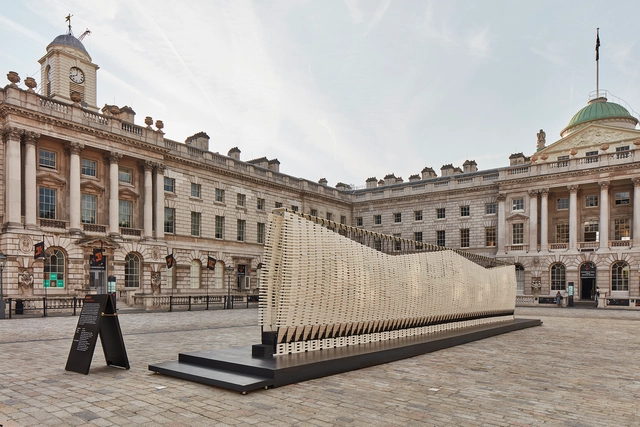
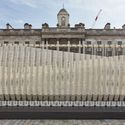
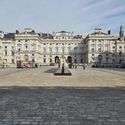
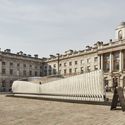
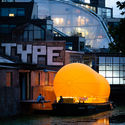
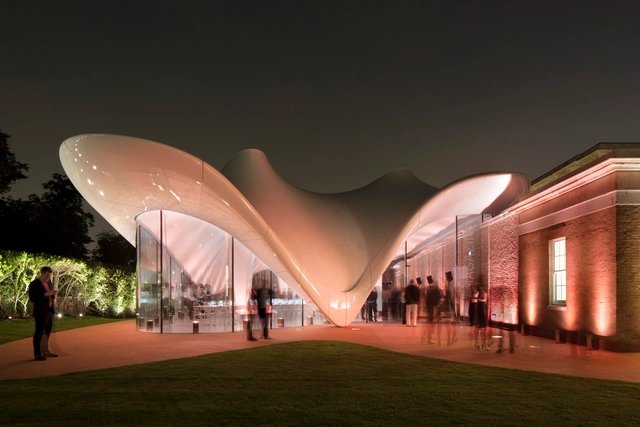
Experimental design practice Studio INI's has designed a kinetic installation to represent this year's Greek Pavilion for the 2018 London Design Biennale. Entitled ΑΝΥΠΑΚΟΗ (Disobedience), the installation responds to the Biennale theme of Emotional States. Selected for the central courtyard exhibit, the design is comprised of a 17 meter-long wall constructed from a steel spring skeleton built up with recycled plastic which flexes, morphs and breathes around the human body.
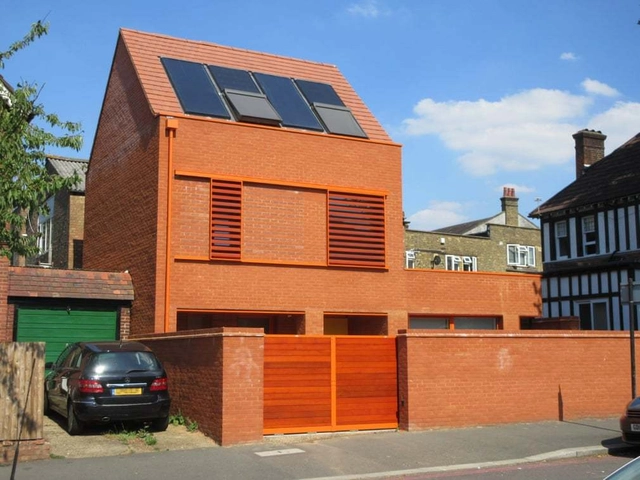
20 Ambleside Avenue, London / Pace Jefford Moore Architects. Image via Building Design
They say that bad publicity is good publicity. Nevertheless, late August is a time for baited breath among UK architects, as the readers of Building Design generate the shortlist for Britain’s "ugliest" building. Beauty is certainly in the eye of the beholder and judgment towards these unpopular designs shouldn't necessarily be generalized. However, this competition opens up important dialogues about architectural aesthetics and public reception of new projects.
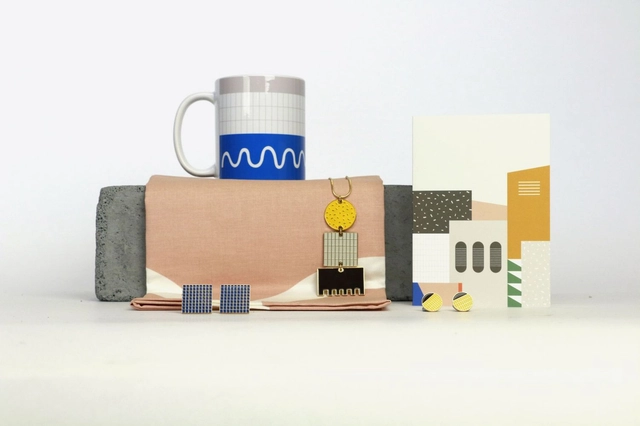
The Barbican, London’s iconic Brutalist estate designed by Chamberlin, Powell and Bon Architects, has launched a range of jewelry and homeware designed by creative studio Tom Pigeon, paying tribute to the vibrant aesthetic which put the scheme on London’s architectural map.
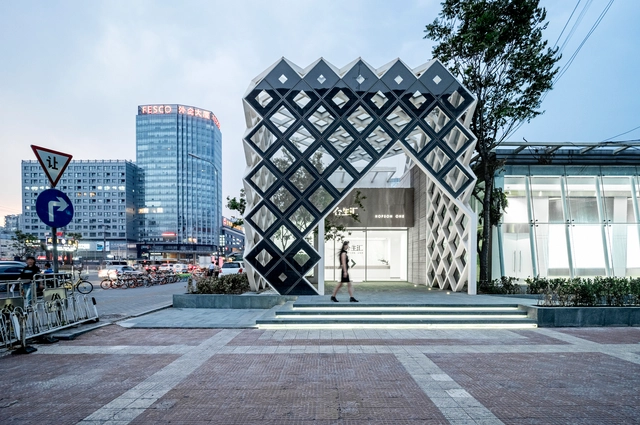
Manuel N. Zornoza grew up in Alicante, Spain and, following studies in Madrid (UAX) and London (the AA), relocated to China in 2010 to avoid the economic crisis stifling architectural work in his home country. Over the last eight years, the young architect’s small but thriving studio has built more than a dozen projects, from shops, to factory space conversions, to a traditional Chinese hutong - all in China. But that’s not to say Zornoza’s left his roots behind. He now also maintains a small practice in Madrid, which handles projects in both China and Spain.
This interview was conducted on a bullet train ride from Beijing to Tianjin, where we ventured in search of the recent architecture that has brought so much media attention to this emerging metropolis.
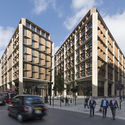
Open House London 2018 has officially released the list of over 800 buildings open to the public this September. Now in its 27th edition, the weekend-long festival offers free guided tours and open doors to buildings and architecture across the city. This year, a range of exciting architecture will be featured, including the new US Embassy by KieranTimberlake, Maggie's Barts by Steven Holl Architects, and Bloomberg European Headquarters by Foster + Partners, the world's most sustainable office building. Find out our list of the top 10 must-see buildings to discover at this year's Open House.
The scheme was chosen from 132 entries to the competition run by Shiva Ltd and the Architecture Foundation, which asked participants to engage with “the heritage of the Regent’s Canal in innovative ways.”
Jones, who is a Past President of the Royal Society of Ulster Architects, and the first RIBA president from Northern Ireland, will take over from current RIBA president Ben Derbyshire for a two-year term beginning on September 1st, 2019.
https://www.archdaily.com/899860/riba-elects-new-president-following-controversial-campaignNiall Patrick Walsh
Grenfell Tower: In Memoriam . Image via Darc Studio
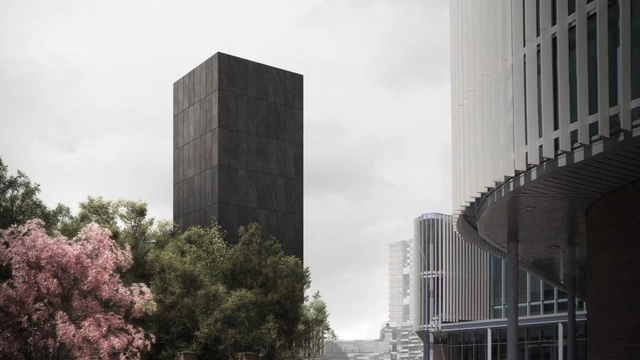
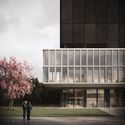
London-based JAA studio has released a new proposal to transform Grenfell Tower into a black concrete memorial to victims of the fire. Encasing the burnt-out shell, a solemn sarcophagus of 224 concrete panels would wrap the facade to anchor the tragedy in collective memory. Titled Grenfell Tower: in Memoriam, the concept does not claim to be an answer but an alternative way of thing about the site and its new-found sanctity after disaster. As JAA states, "the city needs its scars."
When you think of your favorite spot to grab a beer, what architectural features come to mind? Is it the swanky furniture, themed artwork, or the heavily designed cocktail menu? Today, the aesthetics of bars are now as much a draw as the drinks themselves. From movie set inspired spaces to rooftops that offer spectacular city views, we’ve compiled a list of nine bars and beer gardens that every architect needs to cross off their list.
The Center for Globalization and Strategy from Barcelona’s IESE Business School has unveiled its annual list of the world’s smartest cities. In its fifth year, the IESE Cities in Motion Index has calculated the performance scores for 165 cities across 80 countries based on an exhaustive rubric of economic and social indicators. Familiar global power centers have maintained their position at the top of the heap, while expanded categories of assessment have helped a few small cities advance their position drastically.
1. Abstract: Food is one of the most fundamental elements of human existence. Looking back, the way we produce, store and consume food has evolved greatly. Humans have thrived because our ancestors learnt how to gather, produce and consume food, all with their bare hands. And mankind has sustained due to these crucial elements of knowledge passed through generations. With industrialization came mass production, and with mass production came an influx of consumers - who started paying instead. Skills and crafts related to agriculture and food production are now mostly obsolete in the urbane environment. Mass consumerism through supermarkets and even online mediums is slowly changing how we perceive, acquire and consume food. This has raised issues like overconsumption, poor quality, high wastage and an over-dependence on manufacturing agencies. In the long run our perception of fresh foods/fruits will be completely eroded by advertisements and fancy packaging, which can have irreversible impacts on health, and hence, the human evolution cycle. The time to intervene is now. As a designer how can you bring farming to the cities where people can see, participate or celebrate cultivation - and understand what they eat, much better? Where not only awareness related to food is available, but as a community we become more responsible for our actions. How can you change the image of cities as the ones that only consume, to ones that contribute too? Or make farming so easy for people using technologies of today that makes it easy for people to grow it in their homes? Urban meal mine1(n), is a place where people can generate/learn/contribute to grow food for their city. This is usually located in the heart of the city where skilled labour + abundant transport + short distance logistics + faster production technologies can break even revenue over the high cost land it occupies. Learn more on http://unfuse.uni.xyz 2. Site: The site for this intervention is the New Covent Market located in the Nine Elms District, London opposite to historic Battersea power station. The site is close to the river Thames and is a part of Nine Elms regeneration plan. It consists of a 4 decade old market structure which houses a wide variety of wholeseller’s of foods, fruits, vegetables and flowers. The site is surrounded by residential and commercial developments of various scales, and is expected to invite people from around the city. It also has two brand new tube stations proposed in attempt to rejuvenate transport links to the Nine Elms district. 3. Eligibility The competition is open to all students and professionals (Worldwide). Minimum eligible age for participation is 18 years. This competition is open for both students and professionals. Team size is maximum of 4 members per team. All disciplines are eligible. Team: Teams with all student participants (with valid id’s required) will be categorized under student teams. Teams with even one professional participant will be categorized under professional team. 4. Submission A maximum 6 – A3 sheets in digital format (JPEG) (120ppi). Minimum requisites in the sheets (For a complete submission): Site plan (Compulsory), Key conceptual sections x 2 (Minimum), 3D views x 3 (Minimum / Should include 1 aerial view), Elevation x 1 Cover image of size 1500 x 600 px or larger in aspect ratio 1 : 2.5. Floor plans, images, sketches (if any) can be added to support the entry in the form of additional images. 5. Prizes A total of 4000$ worth rewards to be won. Winner: 1500$ in cash + Trophy + Certificate + Publication Runner up: 550$ in cash + Trophy + Certificate + Publication People's Choice (Students): 500$ - Trophy + Certificate + Publication People's Choice (Professionals): 500$ - Trophy + Certificate + Publication Honorable Mention (Students x 4): Medal + E - certificate + Bi-Annual Digest of Unfuse + Publication Online presentation: 30 Shortlisted Entries - E- certificate - Entries promoted through partner websites.
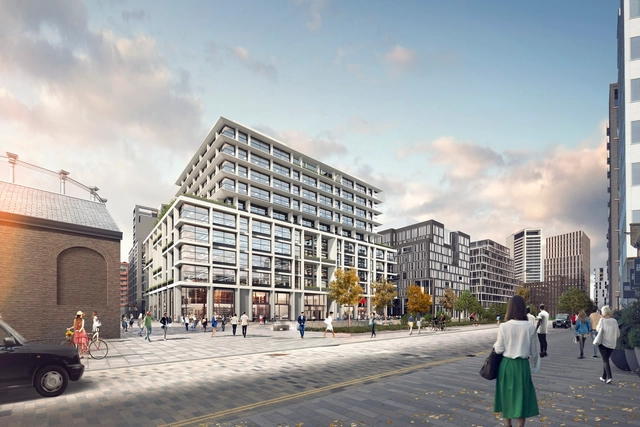
Facebook is moving into new offices in London’s King’s Cross. The announcement from King’s Cross details the social media giant’s commitment to take over 600,000 square feet (55,000 square meters) of office space across three buildings, namely 11 and 21 Canal Reach by Bennetts Associates, and P2 by Allford Hall Monaghan Morris.
The July 23rd deal between Facebook and King’s Cross Central Limited Partnership (KCCLP) represents one of the most significant such commitments in London in the last decade, encompassing around 15% of King’s Cross’ 4-million-square-foot (370,000 square meters) commercial portfolio.
https://www.archdaily.com/898752/facebook-set-to-occupy-london-offices-in-kings-cross-by-ahmm-and-bennetts-associatesNiall Patrick Walsh
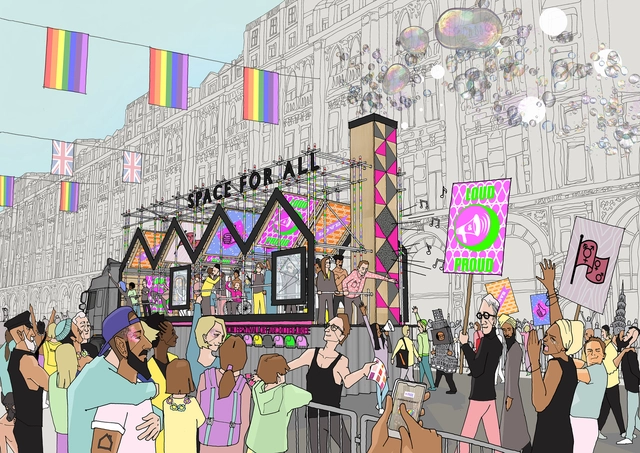
‘A Space For All’ by Hawkins\Brown has been announced as the winner of London Festival of Architecture (LFA) and Architects LGBT+’s Pride Float Competition, the design representing architecture in Pride London 2018. Forming a crucial part of the LFA’s 2018 program, the competition was open to students, graduates, emerging practices and established offices alike, with 'exploring identity' being the brief's core theme. The winning float advocates for increased LGBT+ acceptance and presence within the construction industry, combining “the dual identities of LGBT+ and being an architect.”
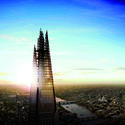
This morning, planning permission was awarded for the construction of 100 Leadenhall Street, an SOM-designed skyscraper in the eastern cluster of skyscrapers in the City of London. At 263.4 meters tall, the building will be the third tallest in the cluster, trailing only 1 Undershaft (305 meters), which is approved but yet to begin construction, and 22 Bishopsgate (278 meters), which is currently under construction. The Shard, at 310 meters, is also nearby on the south of the river.